Friday, 26 February 2021

How Crust Survived the Millennium Bug (part 7): Guided Cradle / Instinct of Survival "S/t" split Ep, 2006

When it comes to Terminal Sound Nuisance, I always look for inspiration, wisdom and enlightenment in order to offer the deepest insight to the millions of readers spread over the world (according to the estimates of my rather competent Public Relations manager). While the mundanity of everyday life can be efficiently dealt with without involving too much of the - by nature limited - attention span and brain availability, writing for the blog requires the greatest intellectual commitment and the non-negotiable and total involvement of my resourceful knowledge. To achieve such a secondary state of utmost intellectual presence, Revelation must be attained through intense sessions of fasting and meditation (I recommend waterfall as meditation spots as they look great on Instagram and can highlight your abs) and then, and only then, is my mind ready to focus on punk music and the forced conversion of the unsuspecting masses. If you want to know more about my refined and beauty-enhancing meditation techniques, look out for my new book Essential Chakra Meditation: Awaking your Crust Power with Meditation, Visualization and Cider

One of the numerous visions that I experienced after two days straight of standing motionless under that waterfall and freezing my arse off in the process is that, once upon a time, I often waited ardently for records to come out and my expectant chatter could be heard at punk venues and even, according to flatmates, in my sleep. Excitement barely contained, eyes sparkling with anticipation, watching our for the record's release with bated breath. If this incomparable feeling of suspension has not completely disappeared when it comes to my record buying habits, the years combined with our new gargantuan and yet blasé consumption of cultural goods online, their seemingly unstoppable commodification as well as the constant flow of new bands and new trends somehow tempered my once insatiable enthusiasm and eagerness for new punk records. Perhaps it has to do with growing older and with the steady accumulation of records that the loyal support for the bands, for the labels and for materialism necessarily entails. With the improvement of one's knowledge, the probability to be genuinely, not to mention pleasantly, surprised decreases. I sharply remember with a tinge of nostalgia the seemingly endless wait for the split between Hellshock and Effigy to come out, or the one between Stormcrow and Sanctum, or the After the Bombs Lp, and that's just sticking to the old-school crust sandpit (admittedly my genre of affinity). That's not to say that my proverbial ebullience dried up after the mid-00's as my expectations for more recent records like the split between Fatum and Cancer Spreading, the one between Extinction of Mankind and Apocalypse or the one between Zygome and Kaltbruching Acideath were quite high indeed. However, the stenchcore revival of the noughties undoubtedly marked the peak of my anticipative years and the split Ep between Guided Cradle and Instinct of Survival was one record that I waited for feverishly.


I already wrote about my intense relationship with Instinct of Survival - one of the few current crust bands that has proved to be able, time and time again, to surprise me - so for the sake of literary brevity I shall not tell the story of my first encounter with the band again but if you are interested in this classic moving tale of initiatory journey, I encourage you to read the review of Lapsed into Absurdity, their one-sided flexi from 2013. I obtained this very fine split Ep at a Guided Cradle gig in Paris in 2006 during their European tour. I first heard about GD, that band from Czech with two American punks in it, from a mate of mine who had already seen them live and, although he was not especially a sucker for this style of hardcore punk, was very complimentary about the band's performance which he described as "stadium crust". Now, that is a tag that makes one wonder, doesn't it? While a quick survey revealed that GD did not actually play crust music, I could understand where the "stadium" qualifier came from after ordering the first 2005 Lp and why it sorta made sense. GC were epic. And I don't mean epic like a neocrust band, far from it, they were epic like an over-the-top metal-punk band, one potentially able to entrance the audience and have them collectively fist-pump and cheer as one to their brand of bulldozing Swedish-inspired metallic hardcore punk. I witnessed GC for a second time at the Play Fast or Don't festival (in 2009 I think) playing to a large crowd and, if it could not be realistically called a stadium-sized audience (unless we're talking about of a mid-table November game at the Salford City stadium), the band definitely packed a severe punch and worked particularly well on a big stage supported by a massive sound which brought their crushing power to the fore. A live hardcore tornado that unfortunately had not materialized at their Paris gig.

It was bad luck really. GC were playing a squat on the outskirts of Paris (in fact it was a squatted inn), an infamous venue that hosted many gigs for a couple of years (Leadershit, Makiladoras or I Object played there) and was renowned for being inhabited by more dogs than people which could make for strange atmospheres when bewildered touring bands sometimes literally played at 2am to ten scruffy dogs barking and chasing one another and three dog owners too pissed to stand properly. On occasions though, when the place was packed, the atmosphere was crazy and electric and anything could happen. Great memories. Sadly, a massive party at a nearby squat was taking place on the very same days as GD's gig so that it was poorly attended and, well, a bit depressing. I was of course among the few excited people present in the room and the band played well enough, with the intensity you were entitled to expect after regularly blasting their debut album, until some annoying lad who was as high as a kite started to jump on one of the guitar player's pedal board (not once but twice) which brought the gig to a quick stop. Understandably, GC looked miserable enough after what must have been a major low on their tour. This sorry state of affair did not keep me from asking the band if they had the split with Instinct of Survival to sell, which they had, and I left the venue in a merry, light-hearted mood with a precious crust artifact whose coming I had anxiously awaited for what seemed like centuries but must have been less than a year.

Let's start with GC's side. The band started in 2003 in Czech as a cover band called Anti-Climax that is more than likely to have performed a couple of Anti-Cimex covers. Before GD, guitar player and intense frontman Ethan played in the crustcore band Dread 101 (that had ex-Lies & Distrust members if you wanna know) and one may presume that Anti-Climax must have been a tight hardcore unit that enjoyed some local success since they proceeded to write their own songs and become a proper band with a proper name, one that doesn't just cover Anti-Cimex but tries to creatively imitate them as well. As alluded to above, I first came across GD through their first Lp which left me in awe. The brute force released by this album was an assault to the senses and my appreciation for it has never faded as I still mentally rock hard whenever I play the geezer (for some reason, experience revealed that I really enjoy indulging in early GD on sunday mornings). With its masterful cover of "Wheel of life", the eponymous album also urged me to get hold of a copy of Anti-Cimex' Absolute Country of Sweden which frustratingly only materialized a few years later as I had to content myself with mp3's until the acquisition. The perspective of a collaboration between GD/IOS not only sounded promising but also made sense since both bands certainly packed a hefty punch in the metal punk department but nevertheless sounded very different in terms if intent and influences. 
 
The two GD songs on this split Ep were recorded in October, 2005, and, in spite of a thinner production than on the album, the general gist hasn't changed in the least. The listener therefore has to prepare for a heavy metallic käng attack with extremely aggressive and direct vocals and overblown guitar leads. Because of the rawer production, their side of the Ep is not as much of a bollocking as their previous work, but these two songs (one of them in Czech) still make for serious contenders in the Cimex-hardcore game. 90's era Anti-Cimex, Driller Killer and Wolfpack are obvious points of comparison and GD could definitely hold the fort with its harsh and pissed vocals, the triumphant metallic leads and the very upfront and hard-hitting drums that never fail to convey a sense of being pounded by an orc (which, in the case of GD, was completely intentional but we'll get back to the issue later). GD released a second Lp in 2007, You will not Survive, that I did not like as much in terms of songwriting as it used probably too much metal cheesiness for my liking though it sounded absolutely massive. After the split of the band, Ethan joined Mörkhimmel and then Dog Soldiers and finally Hellshock upon his return to the U$A while Austin moved to Bloomington and now plays country music (?).   

On the other side the resplendent IOS offered their first two stenchcore songs on vinyl which, in retrospect and keeping in mind what they have achieved since 2006, is a bit of a historical event in the grand narrative of crust. As my wikipedia page and my previous post about the Hamburg crust elite indicate, the first contact with IOS was akin to an epiphany. Some people get to see the face of Jesus on a dog's arsehole, I get to be possessed by the new wave of crust at a festival somewhere in Germany. To each their own. I still have vivid memories of that IOS gig at the 2005 Yellow Dog festival but I am not sure how real they actually are and how much of an idealization of an initiatory arc of my quest for crust they might possibly stand for. Somewhere in the middle I suppose. In any case, my first live experience of IOS corresponds to a large extent to the two songs they committed to vinyl for this split Ep. You do not really need me to recount the tale of the band but since we are all gathered around the bonfire tonight I might as well have a go. 

The band started out as Sperrzone in 1995 and played primitive and fast deutschpunk with studs, spikes and quite certainly acne. They then morphed into Instinct of Survival in 1998, the nod to Napalm Death a sufficient clue to know in what direction they were now heading: raw old-school grindcore. Most of the band's newer audience seem to ignore - intentionally or not - the pre-stenchcore period of the band which is, I believe, an error of judgement. Although personally partial to Warsore or Rot, I cannot be said to be much of a grindcore fan, however even a casual listening to their split Lp with Wojczech, recorded in late 01 and early 02, reveals that IOS had been toying with heavy old-school metallic music with gruff vocals before the mid-00's. The heavy and crunchy guitar sound enhanced with those typical slimy bends, the texture of the nasty hoarse-versus-screeching dual vocals and the overall filthy vibe are not dissimilar to the band's take on vintage Peaceville-styled crust that emerged in the mid-00's. And if you are so inclined as to look at the band's evolution from a meta crust prism, you could very well argue that, if the version of "Instinct of survival" on Scum belongs to the glorious early years of grindcore, the first version of the song on Hatred Surge had all the characteristics of the early UK crust sound of Deviated Instinct, Hellbastard and the likes. So even if IOS took it the other way around, it still makes sense. The band took the first step toward orthodox crustness around 2004 as a tape bucolically titled In Conspiracy with Crust, the Stenchcore Sessions seems to indicate. It might have been originally a rehearsal tape meant to capture the new unequivocal direction of stenchcore revivalism and it includes early versions of songs that would eventually end up on IOS records later on. 

But back to this Ep. The production is, again, a bit thin and raw but, given IOS' style, I would say that it doesn't affect their songs as much as GD's and you could even claim that it gives them an even more organic old-school vibe (if you ask me, I wouldn't change a thing). I have listened to those songs so much that it is a little difficult to provide a critical perspective on them, but then if you are clueless about the band's music then your blithe inattention is really your fault and yours only. "Axis of stupidity" is a classic mid-paced number that starts with a dark and heavy Deviated-Instinct-in-'87 introduction and then bursts into a brilliant Napalm-Deathed riff that is guaranteed to have you headbang sensually and you also get a slower early-Axegrinding moment as a break and treat. "Human" is a faster one, it opens with a kind of primitive early-Bolt-Thrower-on-speed beat before unleashing ace Sacrilege-worshiping metal riffs highlighted by a groovy mid-tempo. The vocals are top notch, Kalle goes for the bear-like disgruntled low-pitched shouts while Padde opts for high-pitched and insane-sounding screeches and I love how the two work together. Absolute classic record of 00's stenchcore that made the listener - by which I mean me 15 years ago - crave for more. And, thanks fuck, more quality old-school crust records would come out of the IOS bag in the 00's, two Ep's with the wonderful Winter in my Mind at the end of the same year and Screams of Suffering in 2009 and an outstanding Lp in 2008, North of Nowhere, probably their most famous records. Without a doubt, IOS were at that time the strongest and most consistent European answer to US bands like Hellshock and Stormcrow, they influenced many bands to take up arms and do the crust and they are still a reliable and relevant crust force at the time of writing so that they more than deserve the "classic band" tag.

The cover alone could be the object of a whole essay. It was drawn by Steve from Visions of War who can be described as both a talented artist in his own right and a talented crust artist. Not unlike Mid's art before, Steve's progressively went on to define new visual aesthetics for crust so that his drawings - or fartworks as he calls them - became closely associated with the crust/stenchcore genre in the 00's and 10's. If you are even only remotely interested in crust punk, you must have seen one of his pieces. In the case of this split Ep, Steve used a theme for the cover that was quite common in the 00's, namely orcs and skeletons in armours. I suppose the success of the Lord of the Rings movies is no stranger to recurring representations of savage axe-wielding warring orcs and heads on pikes in the crust universe (GD's first song even starts with a sample from a Lord of the Rings movie) and we have here a fine example of this trend that has not quite died out. As I said, it has also become a legitimate part of the genre's visual canon. The Ep was released on Yellow Dog Records, a now defunct Berlin-based label with a long discography that discogs will lead you through.                               


Cradle of Survival

Friday, 19 February 2021

How Crust Survived the Millennium Bug (part 6): Stormcrow "Enslaved into Darkness" Lp, 2005

We are now deep into the middle of How Crust Survived the Millennium Bug, an as per usual tortuous retrospective series aimed at showing how crust music survived in the noughties after it gloriously peaked during the previous decade. The first five entries dealt with bands whose conception predated the so-called "stenchcore revival" - although Effigy often get associated with the trend, out of their split with Hellshock and of their open intertextuality - arguably the most spectacular crust-centered boom of the 00's and what that decade would be significantly remembered for afterwards. In truth, some would claim that the much more massive, not mention popular, "neocrust" wave is what really characterized the noughties crust sound and, as far as sheer proportions go, this claim cannot be said to be wrong. Still, do we really need terms like "epicrust" or "tragicrust" to be emblazoned forever on the forehead of 00's crust? Do we even want such terms to go down in punk History and be remembered at all? Exactly, we don't. And if someone must volunteer to undertake a radical revisionism of 00's punk and attempt to erase neocrust from History books and the comrades' collective memories and deny that cheap-looking xeroxed fanzines promoting brooding epic crust bands with melodies and, at least, four words in their name ever existed, then, for the sake of future generations, I'll be willing to take on that ungrateful role, even though the truth might resurface one day and, in a Planet of the Apes moment, a young hardcore kid will find an Ekkaia Lp half buried in the sand and thus uncover the conspiracy. It was all for your own good, Comrade.

So the 00's stenchcore revival it is then. Undeniably, the most iconic representatives and initiators of this trend were Portland's Hellshock, a well-known and respected band that I have already laurelled in the past and whose magnum opus Only the Dead Know the End of the War could be rightfully considered as one of the true great old-school crust classics of all time and all places, quite a feat when one keeps in mind that Hellshock was originally pretty much a humble side-project between mates who were keen on nicking Sacrilege and Bolt Thrower riffs, but the music ended being too good to be just that (which must feel lovely as it is generally the other way round). Accurately, if unwillingly, Hellshock also set up a new protocol for knowledgeably building on the original crusty stenchcore bands' sound and aesthetics while still rocking like a much more focused and self-conscious band of the early 00's (a different context of creation and a will to "play crust" that sometimes hindered creativity). Beside the evident sonic reliance on the canonical crust gospels, Hellshock deftly invited Mid from Deviated Instinct to draw the cover art for their first two Lp's and exert his not inconsiderable skills in (re)creating a typical crust visual, one utilizing saturated crust signifiers. The presence of an artist who originally defined the aesthetics of crust and the request from him to "draw crust" of course points to a referential stance and a message clearly delivered, that it's '87 in '03 - although it has to be said that Hellshock's experienced musicianship was undeniably superior to that of the original crust bands (without mentioning that Mid's craftsman ship and techniques vastly improved during this lapse of 15 years). Interestingly, the second bigger name of the stenchcore revival - which was at first distinctly located in North America - also asked talented stenchcore-architect Mid to "draw crust" for the cover art of their debut album, Enslaved into Darkness, and with the band's being name directly taken from a Deviated Instinct anthem - probably my favourite DI number at the time - I guess it would have been impossible to answer in the negative to Stormcrow.

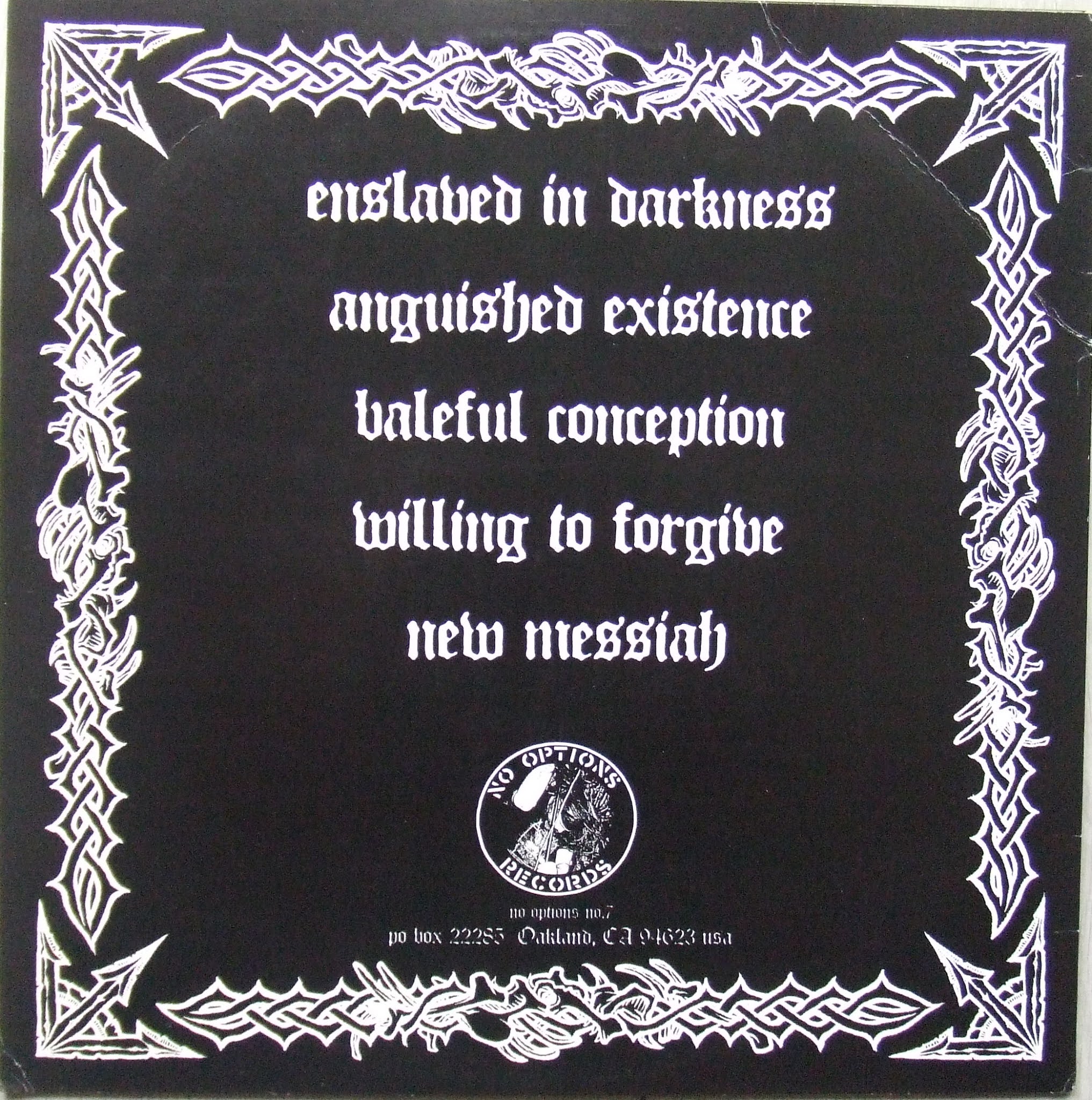
I discovered Stormcrow through their connection with No Options Records, a label run by Will from Born/Dead that had released two records I owned and enjoyed (Endrophobia and Phalanx, the latter of which I still actually play) and whose moves I was monitoring closely. I must have hyperventilated upon reading the Deviated Instinct-inspired name Stormcrow on some message board, as any sane person normally would in the mid-00's, and then proceed the hunt the fucker which I eventually did... on Interpunk. Now be merciful with me and know that my using this provider is the source of no little embarrassment today but, to be fair, at that time, it distributed Prank, Hardcore Holocaust, Havoc, Tribal War and many other DIY hardcore labels. I bought my first Nausea and Antischism records from that website. Out of curiosity, I peeked at Interpunk a few hours ago - I was not even sure it was still standing - and even the most furtive look could not protect my innocence against the abominations proudly displayed on the website's front page, hellish visions capable of leaving your average crusty scarred for life. I'm sure they sell shoegaze over there. But anyway, shortly after its release in late 2005, I ordered the cd version of Enslaved into Darkness (I only upgraded to the vinyl version when I finally transitioned into adulthood in my early 30's), played it, was left astounded and in awe at the ferocity of their filthy metallic crust power, played it again, cavorted and headbang hard about my room for a bit, played it for the third time, swiftly ordered the shirt and prepared to boast about it to my mates the next weekend.

Stormcrow formed in Oakland in 2003 and was made up of members of local hardcore acts In the Wake of the Plague (that also had Will No Option) and Exit-Wound, PDX grindcore band Bent Over Backwards and sludgecore monsters Brainoil, beside which guitar player Nathan had also played in Destroy! and Code 13 while in Minneapolis.  Of course, I was completely unaware of such resumes at the time but remember reading that Stormcrow was made up of people who had been playing in bands for a long time, known faces so to speak, though not by me. The band's association and ties with older Oakland crust outfits should not be left unexamined. Enslaved into Darkness was recorded and produced by Salvador Raya, who played in doom-metal band Asunder alongside former members of the mighty Skaven (with whom Stormcrow would eventually share an outstanding split Ep). Alongside Greg from Brainoil, aforementioned Raya is a sound engineer at Earhammer studios, where Stormcrow's debut, and many other Oakland punk records since, was recorded. Stormcrow were also mates with the people from Dystopia and, if it would be far-fetched and questionable to claim that both bands sound alike (who can even claim to sound like Dystopia anyway?), I like to think that their sound and creative intent arose from older metallic crust acts like Dystopia, Confrontation, Carcinogen and of course the oft overlooked Skaven as well as the heavier sludgy doom-influenced bands that followed. All bands must bloom out of some preexisting context, there is always an initial spark lit by predecessors and, from such perspective, Stormcrow can be seen as both a prominent band of the 00's metal crust revival and heirs to the Oakland crust tradition of the 90's. 

Enslaved into Darkness is a devastatingly heavy and crushing crust behemoth whose raw and filthy metallic production never impairs its impact. In fact, few crust records are able to conjure up both power and rawness as potently as Stormcrow's first born. The two guitar attack confers to the recording a rare heaviness that is almost overwhelming at times in the thrashing department. This Lp is the sonic representation of the four Horsemen galloping through a barren wasteland with a nuclear sunrise in the background while being chased after by a malign horde of punk zombies. But let's not get lost in verboseness and useless convolutions, Enslaved into Darkness contains five long songs of colossal old-school metallic crust with a mean and dirty doom-metal vibe running through it. If Stormcrow do not hesitate to speed up the pace and inflict a deliciously thrashing guitar-driven punishment, this Lp is mostly slow-to-mid-paced and still proved to be their fastest work. I remember thinking that the album felt a bit short with a running time of 27 minutes but, by today's standards, it is actually the perfect length for this genre of crust. The organic, almost rotten, if not putrid, metallic sound of the down-tuned guitars are to die for, like the metaphorical shovels that will bury your skinny but still muscular body, and the relative lack of tightness in places even adds to the savage funeral mood of the whole. The vocals were also a massive selling point for me when it came out. I was never a metalhead and only became familiar with the extreme metal world through crust and therefore was quite inexperienced in the dark arcane arts of living dead growls, cries of excruciating pain and the whole assortment of gratuitous bellows meant to replicate the screams of possessed tortured souls. So when I heard the level of threatening gruffness of Stormcrow, it really sounded like I had availed myself with a direct line to the underworld. As mentioned, Stormcrow did have a sludgy Asunder-like doom-laden side, but at that time the band navigated clearly in old-school crust territories. Bolt Thrower teaming up with early Paradise Lost to cover Antisect and Deviated Instinct after smoking too much weed would be a relevant description, or, to stay local to California, perhaps Mindrot and Carcinogen aggressively jamming in Skaven's back garden. I'm sure you get the idea. 

The length of the songs - more than seven minutes for two of them - really helps the band install a specific atmosphere, one that reeks of pain and despair, rather than the sadness one associates with doom metal, but also of threat as Stormcrow sound like they are ready to bite back and spread rabies if need be, as punks playing metal healthily should, and the lyrics typically deal in allegories about destructive capitalism, alienation and state terror. The joys of our modern age. Like captain Obvious indicated at the beginning of this wordy sojourn, the cover art was drawn by Mid and represents - in his lovingly recognizable apocalyptic, morbid, organic style that came to define the classic crust aesthetics (though I would like to point out that the man is certainly not a one-trick crust poney) - mother Earth emerging angrily from a plague-ridden soil because of humankind's selfishness and greed. As much as I love Mid's art, I still have to admit that the focal point of this artwork, and as a result of my Stormcrow shirt, is the rather large pair of tits of Mother Nature. And I guess it makes sense that she would be big-breasted, what with her feeding the world and everything and, although seldom represented in crust art, there is nothing intrinsically ludicrous in having breasts on the cover of a crust record, it all depends on the artistic intent. Nonetheless, I still struggle to perambulate up and down the streets basically boasting monstrous tits right in the middle of my chest which certainly attracted more than a few frowns of puzzled consternation throughout the years. It's not as bad as my Genital Deformities artifact but still not a piece of garment I chose to wear at my great-aunt's birthday bash. However as a crust record cover, it works much better and I cannot really blame my lack of vestimentary insight on anyone but and I should probably have picked the other design. Oh well.

Hours spent overplaying Enslaved into Darkness converted me into a staunchly devout Stormcrow fanboy so that when I learnt that a split Lp with Sanctum - another stenchcore revival band I was really into - was planned, I exhilaratingly started to hassle everyone I knew about it - including the Sanctum lads when they played in France - and scouted the internet for any piece of intelligence about the Lp. This search came to an end in late 2006 thanks to No Options Records again and it proved to be an excellent effort and certainly one of the best crust split records of the decade with a cracking artwork, done by Dino from Dystopia, that is something to see if you are into Warhammer or Lord of the Rings-inspired fantasy battles (a recurring visual trope of the often very orc-oriented 00's crust scene). Stormcrow loved split records - and so do I to be honest - and 2008 saw the release of an absolutely classic split Ep with Skaven and a split Lp with Canada's prime grinding cavecrust unit on the always solid Agipunk from Italy with Stormcrow starting to display an even sludgier and doomier sound. The band's last two split Lp's (again!) with Laudanum in 2009 and Coffins in 2010 confirmed the band's development, which unfortunately was not my predilect cuppa tea, and my progressive loss of interest.

After the demise of the band in 2010, Brian and Tony formed Femacoffin, an excellent metallic crust act in the vein of Stormcrow's early years the review of which you can read here. I have to admit I quite miss the apocalyptic doomy stenchcore power of Stormcrow, which I actually got to see live in Tucson in 2009 (don't ask) and the guitars were so loud that they almost buried the drums and vocals. Well class.


Enslaved into Crustness 

Sunday, 14 February 2021

How Crust Survived the Millennium Bug (part 5): Flyblown "The Fear and the Fury" Lp, 2005

Sam McPheeters' book, Mutations: the Many Strange Faces of Hardcore Punk, got me to think. In case you don't know, the man used to sing for Born Against, a hardcore band from New York (but not a "New York hardcore band" as Born Against's members were nowhere near hard enough to earn this title) and his insight into the evolution and meaningfulness of (mostly) American hardcore and punk music and scene is clever. Although I was not really familiar with a lot of the bands he wrote about (since I have never felt close to the aesthetics of US hardcore punk), I enjoyed perusing his reflections. Beside, McPheeters devoted a chapter to Discharge, the most influential band in punk history (just a factual remark and therefore not open to debate), and being a massive fan, articles about Discharge usually have my undivided attention and I was curious to see what perspective someone who grew up revering American hardcore might have about Discharge. One thing that struck me is that he did not call Discharge a hardcore band but rather always characterised them as a punk band. From my point of view, if the band's punk-as-fuck background and attitude made the latter utterly obvious, the hardcore tag is also relevant to Discharge. In fact, you could argue (like I do) that Discharge were one of the first real hardcore punk bands. I am well aware that many would disagree with this claim, that it might be met with incredulity, shock, well meaning worries for my mental health, or on the contrary open threats of tarring and fathering if I ever get the silly ideas to visit the US of A.
 
Considering Discharge as an original hardcore band is not preposterous however. It's true that the hardcore tag often conjures up images of boyish athleticism, tattoos, cropped hair and trainers rather than charged hair, studs, cider and factory chimneys. But, the petty and hollow obsession with fashion notwithstanding, if you postulate that hardcore punk is in essence the bare and primal expression of anger, a representation in context of a particular aesthetic of anger, then Discharge really much fit the bill. Perhaps it is all a matter of terminology and what you intend the hardcore qualifier to signify. It can be performative. You are a hardcore band because you claim to play hardcore music. It can also merely be a metonymy for a scene or parts of a larger scene, to a group of like-minded who are or were involved in hardcore to some degree. Or it can be used as a term summarizing an artistic project, like in Discharge's case, intent on turning social, political or personal anger into "noise-not-music" music without much consideration for musicality or tunes (which does not imply a lack of catchiness).
 
While thinking hard about the metaphysical consequences on the broad punk universe that such an auspicious intellectual position must have, my mind drifted to shores closer to the ambitious and meritorious work recently started on Terminal Sound Nuisance. The aesthetics of anger... What is the angriest-sounding crust record of the 00's? Not the heaviest or the fastest, but the most furious, the record that sounded like a vicious assault to the senses, one that, however much you warranted the attack, left you dizzy, haggard, disoriented, battered, teetering on the edge of abyss or of harsh noise music. After some meditation, I came to the conclusion that Flyblown's The Fear and the Fury Lp may very well be the most intense crust bollocking that the noughties have produced - but I suppose this is highly subjective and it depends on the material conditions of the first listen and how well you relate to the style of aural butchery that Flyblown generously inflicted upon the punk community. 
 A prime example of the "Can you decipher the evil font?" challenge
 
Flyblown were not a band prone to mess around. Or fool around. Or arse around. Or fuck around. They would go directly for the throat and, to borrow from the great wrestling tradition, would chokeslam the listener into oblivion. Flyblown started in 2004 and, while I am not completely sure about the exact lineup (and of possible changes thereof), the band was made up of members from Morose and the mighty Scalplock, one of Britain's most furious and fastest Infest/Dropdead-type hardcore band, and I think they were located in the English South-East. From what I can gather Pete Giles, from Scalplock (and, in the late 80's, in an early death-metal band Azagthoth alongside Shane Embury), was the mastermind behind Flyblown, a band that started out as a punishingly fast hardcore thrash band, not unlike their aforementioned predecessor, as their first Lp, Genocide, released in 2004 through On the Verge records (the band's label I presume since it only released Flyblown and Scalplock material) and their split Ep with Disclose, can attest. Flyblown's last venture into the brutal realms of nasty blasting hardcore was a ten-song session recorded in April, 2005 (coincidentally this unreleased recording was just uploaded last month onto youtube as were Flyblown's two albums only last week on Tadpole Records's channel). However, it appears that Flyblown were a fast-moving unit and, sometime in 2005, they switched to a (very) heavy pummeling d-beat approach and accordingly wrote a new set of songs (only the referentially-coined number "The doves do not fly here anymore" was kept ans reworked) that would constitute their second Lp The Fear and the Fury recorded and released in 2005, that powerfully demonstrated that, indeed, this lot was definitely not arsing around and had an urgent message to deliver forcefully.
When trying to recall when I first heard or read about Flyblown, my memory becomes a little hazy but I do remember a local old-timer recommending this Lp to me with the argument "They are a British d-beat noize band from the UK, you're bound to like it", which was a valid enough incentive. Being a man of simple - not to mention self-evident - tastes, this short presentation from a venerable punk did not fail to grab my precious attention and I proceeded to track the record, a fast endeavour since I seem to remember that this benevolent friend (may the Gods of Dis bless you) sold it to me. A smooth, possibly planned beforehand, transaction. At first, I was a little bemused and even a tad suspicious that someone as capable would be willing to sell what was, in his own terms, a solid record. I was right to be undeterred by such oddity though and pretty much expected a slab of Disclose-influenced d-beat crust punk, but even such a sound prognosis left one unprepared for Flyblown's The Fear and the Fury as it instantly sounded like a massive kick up the arse when I first played it. The Lp almost sounded too relentless at times, not necessarily because of the songs taken individually, but because Flyblown never let the pressure and the music's intensity does not decrease. Pauses between songs are rare (that's the reason why I ripped the album into eight tracks only although there are actually seventeen songs on the album) and tracks, in a narrative effort, are often tied together with loud feedback and spoken parts. The Fear and the Fury sounds like a full immersion into a pool of political anger, a tornado of d-beat crust violence, it enraptures the listener and only let go when the bollocking is deemed solid enough (after about 25 minutes actually). As much as I love this album and would tend to hail it as a minor classic of the genre, as much as I can extol its virtues of sonic punishment combined with relevant political comments, this is not an album I would encourage listening to on a daily basis (even a confirmed d-beat amateur like myself would not risk it, or else I might turn into some sort of depressed-yet-rabid Hulk-like abomination liable to rip a perfectly decent and potentially irreplaceable punk shirt). 
                                                                            So 2005
 
On this album, Flyblown opt almost exclusively for a d-beat drumming but the speed can vary from the traditionally-paced "just like" d-beat to the faster savage crust version. However all shades are played with the same level of fury and the drummer hit as hard as he can (especially on the poor cymbals), as if his life depended on it (and who knows, he might have been blackmailed to play in the band for all I know). The guitar's sound is indeed well distorted and very aggressive but not so much as to be undiscernible, dirty but powerful like a world-ending tsunami. The vocals can be something of a deal-breaker depending on where you stand on the subject of aural torment and how much angry growling you can take in one sitting. Pete's vocals are quite monotonous and atonal, they don't really follow the groove of the music, however they sound very extreme, harsh and anguished like a litany of pain and outrage (they have been described in a review from the Collective Zine website as emanating from "a nutter with an axe" which is fair enough). They remind me quite a bit of Masskontroll's actually. As mentioned the music revolves around the crusty d-beat school of noize and this reliance shows a strong Swedish influence (Warcollapse or Skitsystem come to mind) but with more distortion, not unlike what Electric Funeral or Giftgasattack would be doing a couple of years later, and, while I'm at it, I would also throw in the crasher crust stimulation of Atrocious Madness and even the sweeping crust power of SDS. Overall there is a dark and violently desperate vibe blowing throughout the work and the intensity of the delivery and of the riffing is not unlike Framtid's who are, after all, also a fierce non-Swedish käng hardcore band (though Flyblown are somehow more linear). Another important source of inspiration can be located in the harder tradition of UK anarchopunk band, especially Antisect, and the crucial and passionate political speeches, with that typical anarcho delivery, interspersed throughout set Flyblown apart and confers a more narrative dimension to The Fear and the Fury, though the impression of fluidity and relentlessness given by the feedbacks and interludes connecting the songs already pointed in that direction. 

                                                                            Antiwar

With an album opening on a slow and heavy sludge-like song and a political speech, the fact that Flyblown carried an urgent political message and were keen on spreading it with much force - like Scalplock did really - is little surprising. No insipid metaphors here. The Fear and the Fury can be likened to a scream of despair in the dark night of ignorance, a scream at our disillusions, our self-inflicted political powerlessness, at the manipulations of people's fears and at our war-mongering politicians and the Antisect comparison also applies to a lot of the lyrics. "Innocence is the first casualty of war". Recorded in 2005, this album has to be put in the context of the (second) Iraqi war started by Bush Jr. I remember the US president being absolutely hated by punks and progressives and his wars were extremely unpopular, notably in England who took part in the latest American crusade without thinking twice about it. Vehement anti-Bush songs bloomed in every punk band's set lists. That thick president was easy to hate and I would argue he probably prompted the formation of more than a few punk bands at the time (I doubt Behind Enemy Lines would have sounded quite as good without Bush). He was the new Reagan to some extent and Flyblown's poster representing a scarecrow-like Bush being crucified is a typical artifact of the period (and probably what I like the least about the album). Unfortunately, the insert of the album is very simplistic and with such a powerful collection of songs and lyrics, one could have rightfully expected something more elaborate as it looks a little rushed and there are not even any credits.

The Fear and the Fury (a reference to The Filth and the Fury movie about the Pistols?) was released on On the Verge, like the previous album, and Flyblown would appear on a last and posthumous record, a split Lp with Sweden's käng fanatics Warvictims in 2008 on D-Takt & Råpunk Records, a cleaner effort on the Brits' part but not as intense and grim for it to be on par with today's album. Pete would go on to play in Pombagira while Aaron got to be part of Cease to Exist, Cthulhu Youth, Unloved and the Deathskulls (not sure about drummer Piers) and both of them would record an Ep with the Discharge-loving Realities of War in 2006 alongside members of Burning the Prospect and Steve/Means to an End.

This album can also be used to punish unruly no(i)sy neighbours. Satisfied or refunded.                    

 The Fear and the Fury       

Friday, 5 February 2021

How Crust Survived the Millennium Bug (part 4): Effigy "From Hell" Ep, 2003

I know, I know, how predictable. Bloody Effigy. Again!

For those who have been unblessed enough to avoid reading my delusional ramblings, I have already written, loquaciously, about Effigy, on the Christmas Eve of 2015.  Sometimes I fell like I am the internet equivalent of the bus station loonie - every bus station has one, it is common knowledge - who constantly harasses innocent and unwilling travelers about politics, the economy or the state of public services, except I would rave about Antisect worship instead of dodgy conspiracies. Be warned though that, if you ever witness someone standing on a box on your street corner and yelling feverishly about the apocalypse, it might just be me offering my expert insights into the band Apocalypse as part of a world tour of Terminal Sound Nuisance IRL. 

Rereading the piece I did on Effigy's 1999 Evil Fragments 12'' Ep, I spotted unusual imprecision and a couple of blatant inaccuracies that could have me revoked from the crust society so I encourage the more discerning readers to gently disregard some parts of it. My core theory then was that Effigy, as a band and unit, bridged the gap between the second generation of Japanese crust and the third one. In an uncharacteristically pedagogical attempt, I will summarily resign myself to some defining. 


The overarching hypothesis was that Effigy's works between 1999 and 2002 acted as a metaphorical tie between the second and the third crust wave. To put it succinctly, the second wave took place in the first part of the 90's with Osaka's Final Noise Attack scene, better embodied and violently kindled by the illustrious Gloom, generating bands like Defiance, War Cry or Condemned and the Tokyo crusties' club that included Battle of Disarm, Collapse Society, Abraham Cross or Crocodileskink; the third wave of crust took the early 00's by storm through the impetus of Acrostix, Zoe (two of the Darkest 4), Contrast Attitude, Deceiving Society or Defector (though some of these bands may have been as old as Effigy is not the point). Of course, Japanese crust is very much a fluid continuum and an analytical frame focusing only on discrete time periods or decades may not always be relevant or enlightening, although it can prove helpful to some extent. From such a perspective it makes sense to see Effigy in the same light as AGE, as a band carrying the sonic torch and perpetuating the metal crust tradition in the late 90's and early 00's. What I did not realize however was that Effigy's roots - not unlike AGE's with Hakuchi - were actually older as singer and bass player Masuda played in the metallic thrash-punk band COSA (cryptically standing for Cache Of Strategic Arms) between 1989 and 1995. It has to be pointed out that COSA had very different sonic intents to Effigy's (COSA sounded more like traditional 90's metallic Japanese hardcore) so that the conflation of the two bands is only partly pertinent in so far as it indicates that Effigy's songwriter - Masuda, I presume - was already experienced although not in the crust department.

Does all of this matter? 

From a diachronic perspective, the coming and going of crust waves is always revealing, in spite of the inevitable instability of their stylistic and chronological boundaries and the inherent uncertainty of the notion of "wave" itself. I like to think that, because of their transitional place, Effigy can be seen as a - at least symbolical - link between the 90's and 00's, bringing not only bagfuls of the old-school metallic crust sound into the new decade, but also the high degree of sonic referentiality and visual intertextuality of SDS with them (without mentioning some new crust fanatics). From a synchronic position, you could very well make the sensible argument that From Hell is the best crust Ep of the first half of the noughties. Records like Hellshock's 2003 S/t Ep, Defector's Punk System Destroy or After the Bombs' Terminal Filth Stench Bastard would be definite contenders but From Hell remains the safest horse to bet on (but you know, what with taste being subjective and everything). But then, even trying hard not to fall into the trap of retroactive imposition here, the notion that Effigy's earlier records may have had an influence in kick-starting the 00's stenchcore revival is not completely preposterous. 


Their split Ep's with Äpärät in 2001 and Häväistys in 2002 (I am not going to revisit Evil Fragments) openly and reverently built on the classic crust sound and visuals and nods to the crust canons were distributed prodigally. The former was a brilliantly crunchy and filthy, not to mention heavy as fuck, example of late-Antisect/vintage-Sacrilege infuenced metallic crust with a touch of cavemen doom/death-metal, while the latter, unfortunately a bit thinly produced, relied significantly on the rocking Japanese crust savagery of SDS, Carnage and Anti-Authorize (the locally-sourced original reworking of the Antisect sound if you will), with a spoonful of Hellbastard for added tastefulness. Could such potent records have prompted some PDX punks to also play referential old-school metallic crust, or stenchcore? After all, the split with Häväistys was released on Portland's Whisper in Darkness and there is little doubt that the members of Hellshock were suckers for the old-school crusty Peaceville sound to start with so would it be that far-fetched to venture that the early Effigy records and their creative intents, namely the unabated open tribute to the visual and sonic aesthetics of the crust canon, could have encouraged and facilitated the sonic formation of Hellshock? Or was a stenchcore revival just floating in the air at the time? After all, the idea behind Atrocious Madness was largely to emulate Gloom's revolutionary stance and Tragedy have always been notably influenced by the triumphant sound of 90's Burning Spirits hardcore, so that the artistic connections between Japan and Portland was certainly nothing new by the early 00's. It is also worth wondering whether the early Effigy records portended the band's tour de force, From Hell. In retrospect, it is far too easy to reply smugly in the affirmative. The first three records signaled potential but I have no idea how well-received they were upon their release and how high were the subsequent expectations. 

From Hell was my first encounter with Effigy. I got the Ep when it came out in late 2003, at a time when I was obsessively and deeply immersed in the industrious exploration of crust music. Effigy's From Hell might have been the first Japanese crust record I really connected and closely listened to and I can distinctly remember the excitement and anticipation when I first looked at the cover which, it seemed to me, looked like a grandiose masterpiece, and, although in 2021 it may not look as impressive, the cover remains the iconic visual that Effigy would be known for until the end of time. I played this Ep a lot, with an almost religious fervour that comforted the prospective crusty in my heart, and along with Hellshock's Only the Dead Know the End of the War cd (which sounds exactly how it looks like), those immensely gratifying records gave me the belief that something was up, that a storm was coming. Out of sheer luck, the prediction proved to be true and "stenchcore" would be revived indeed but it proved to be the last time I was right about a punk trend ever (I remember betting in the early 10's that "postpunk" would be gone in a matter of months and look where we are now). 

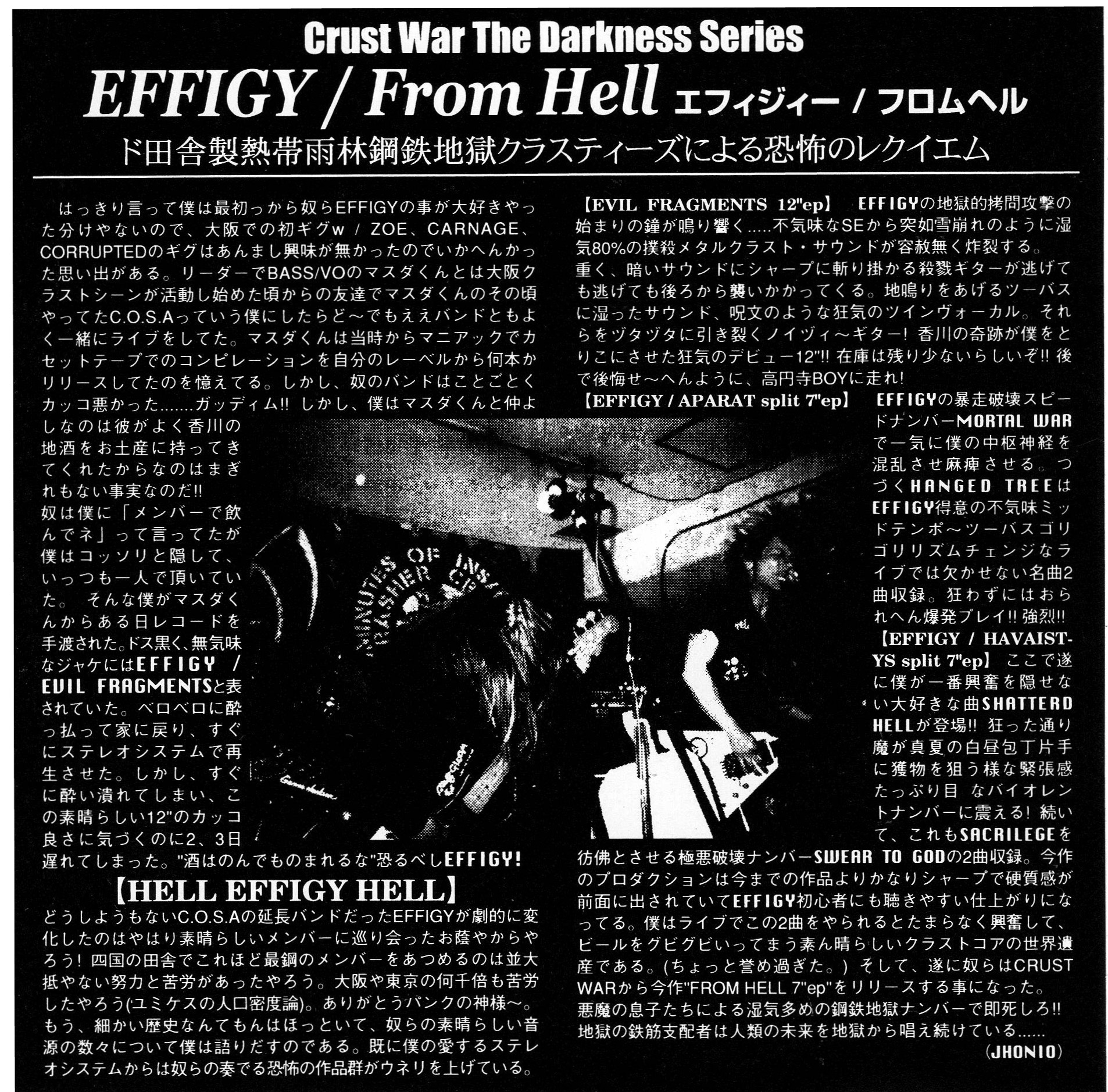
So what about the Ep then? It was released on Osaka's Crust War Records, run by Jackie Framtid, in 2003 and it was the label's twenty-first record, right between Defector's パンクシステムデストロイ and Gloom's 撲殺精神破綻者, which was not a bad spot. From Hell was made up of two long songs - "Stark moon" was 4:40 long and "From Hell (summer devil)" 5:11 - which already pointed to the template of epic old-school metallic crust territory. "Stark moon" opens on an eerie and dark guitar introduction that unsurprisingly bursts into an epic slow-paced metallic moment, all strongly reminiscent of Axegrinder, before going for a tortured and fast-paced Antisect/Carnage-like beat with rough possessed-sounding dual vocals, then a crusty thrashing Out From the Void-break, and back to the speedy darkness for the conclusion. "From Hell" starts with a bass line that is yet another nod to the axegrinding philosophy before unleashing a savage, primitive SDS-fueled metallic crust riff morphing into mid-paced thrashing crust inferno in the manner of late Antisect. For some reason, it was this very song, "From Hell (summer devil)", and particularly the riff, that made me realize - I was always the unperceptive one - that I was definitely not insensitive to the metallic variety of the crust genre.   

The songwriting is certainly meticulous and the two numbers are perfect in their classical conception and purposefully stripped-down, approach. The production has a dark and raw, almost atavistic, quality that makes From Hell stand out, even for an Effigy record. Although the guitar sounds carefully primitive, gloomy and threatening, it is never lacking in the heaviness department, and I also especially enjoy the texture of the vocals, really hoarse and sepulchral but crushing nonetheless. There is an almost evil, lugubrious, tranced atmosphere running through the record, not unlike early black metal stuff, and I can easily imagine it being quite compatible with pagan bonfires (which I tend to avoid because of mosquitoes and bugs in general). Effigy sound like an evil thrashing crust band from the Palaeolithic and I suppose the mastering from Jhonio and Habi contributed to the uchronic impression. The artwork is aptly dismal and highly referential as Effigy respectfully borrowed Axegrinder's font and parts of one of their logos (and fair enough, they have some of the best of both) and Antisect-ish interlace - an intertextual artistic take that they most certainly inherited from the earlier Japanese crust school. Actually, and here comes another of my wild guesses, I would argue that the record's subtitle, namely Grinding Metal Massacre, is itself a reference. Of course, Effigy not being a grindcore band at all, the choice of the "grinding" qualifyer might seem odd at first, however I posit that it would be a mistake to connect it with the grindcore genre. Rather, I hypothesize that "grinding" refers to the descriptive vocabulary and terminology used, in late-80's and early-90's fanzines for instance, to define the sound of early crust bands. In those cases, before the sedimentation of subgenres and their attached lexicon, the term "grinding", in its literal sense, was not unusual.    

From Hell proved to be, rather sadly, Effigy's climax and defining moment. A little after the release of the Ep, I read that a split record with Hellshock was in the works, an annoucement that had me compulsively check distros and labels' websites and send anxious emails all around. On paper, a collaboration between Hellshock and Effigy should have produced the ultimate crust record of the decade but, if Hellshock rather did the job, Effigy's side was disappointing, a little uninspired, and paled in comparison to From Hell. Still, the band managed to create a genuine crust classic so there is little point in inconsiderate judgements now. After the split of Effigy, Kakuda and Masuda formed Axewield in the late 00's along with Ujita and then Masuda and Ujita started Ulcer in the mid-10's, both bands sharing significant artistic similarities with Effigy although I don't think any of those bands could ever touch the crust magic of From Hell.        


 From Heeeeell

Saturday, 30 January 2021

How Crust Survived the Millennium Bug (part 3): Lost "Fear-Strach" Lp, 2003

"Do you like Lost?
 
If you are ever being asked the above question during a dinner party held at normies' (collective gasp of horror), the possibility that they are referring to the once-famous-but-now-antiquated American series is strong indeed. In this particular case, it is highly advisable that you come up with something that will make you look both profound and witty in front of the guests - but not so much as to make them feel intellectually threatened - so that you get reinvited next time around (free food is free food after all). The very least you can do is bleat "They were all dead from the very start, innit?", a weak attempt perhaps but one that should insure that you are allowed to stay at least until dessert. If the very same question is formulated at an open air punk festival by a towering middle-aged crusty, still standing despite it being well past 4am, then it is a safe bet that the inquiry has to do with the early noughties Łódź-based band. If, under such circumstances, it is not, then you should probably avoid this interlocutor as you are about to embark on a lengthy conversation about metaphysical angst and the perpetual feeling of "lostness" or, as is more accurately in sententious academic circles, "Verlorenheit". That or a lunatic speech about survival in inhospitable and unfamiliar arctic forest and how to eat leaves, roots and shit (in that order). Either way, you 'd better head straight to the bar.
 
A couple of crows apparently no longer talking to one another
 
Discogs tells me that Lost has been a rather popular band name throughout the years, ranging from UK house techno breakbeat, Portuguese depressive black-metal, Italian eurodance or German gothic metal. Pick your kings. Going for Lost as a name is sound enough of course. Because it evokes powerful images of desolation and conveys an atmosphere of nothingness, it is an ideal moniker if you aim to create dark and oppressive music, a criterion that certainly applies to Polish crust and even more so to Lost, who were probably the heaviest and darkest band around at that time. 
 
I have already written at length about the Polish school of crust in the past, most notably through the Pulitzer-winning series Polish Tapes Not Police States (with Disgusting Lies, Monoteizm-Co-Existence, Stupor, Earth Movement, Undecided and Bisect) I did in 2018 but other 90's bands like the typical Money Drug, the classic Homomilitia and the mighty Filth of Mankind were also offered the Terminal Sound Nuisance treatment so that the TSN staff is far from unconversant with the Polish crust sound (it is even a job requirement). However, Fear-Strach cannot be sanely described as your typical crust band and, while Lost retained significant classic elements of crust, they were a distinctly different animal, one that did emerge from the same crust habitat but thrived on a different diet. Lost have often been referred to as a post-Homomilitia band, which is both true since Agnes used to sing in Homomilitia before and also something of an understandable distortion since, even though the other members were not part of it, Homomilitia were undeniably Poland's most iconic crust exports in the 90's. 
 
One meditative Deviated Instinct-ish crow
 
Lost formed in Łódź in 2000 with a lineup of Agnes on vocals, Jaro on the bass guitar and Marcin on the drums. Apparently Tomek from Filth of Mankind was the first guitar player but was quickly replaced with Simek and then a second guitar player, Jarek, joined in. It was this lineup that recorded the Thoughtless-Bez Zastanowienia Ep in 2001. Frytek then took over the drums and second guitar player Jarek left, thus giving birth to the team that would record one of the strongest crust Lp's of the decade, Fear-Strach. Beside Agnes' connection with Homomilitia, the Lost members were equally busy bees. Guitar player Jarek and drummer Frytek - along with Strzała from Red Corps and Homomilitia - also played between 2000 and 2004 in a band called Disable who, according to sources close to the matter, were quite popular and active at the time and actually toured with Lost. In fact, there was even a first incarnation of Disable in the mid-90's that did not last long and only played the one gig. If you are interested in hearing a sonic rendition of a meeting between Sanctus Iuda and Hellkrusher at a Hiatus gig in 1995 then the Disable cdr from 2003 comes highly recommended and it also gets additional old-school punk points for the use of the Disaster font before the Disaster reissues. Aforementioned Jarek and Frytek also teamed up with guitar player Simek in a rather obscure hardcore band called Hard Life in the early 00's, that never released anything but some videos of live performances can be found if you look hard enough, while Jarek also played in the much mysterious Compos Mentis. Have you been following?
 
A flying crow
 
The city of Łódź is often considered to be one of the birthplaces of the black-clad crust genre in Poland, for good reason, (the ace Nausea live Lp in Łódź only adding more to the mystique) and it has been delivering quality crust acts for the past three decades. Still, Lost's Fear-Strach went beyond what one could rightfully expect from a solid Polish crust punk work and proved to be a unique hybrid pervaded with a vibe that had no real equivalent in the crust universe, although it cannot be said to be really breaking new grounds either. I remember getting this record upon its release after reading a review of it in an issue of the Leeds-based Attitude Problem fanzine. I remember the iteration of the word "dark" throughout the short review which only meant that Lost were bound to sound, well, really dark. While I expected and presumed to embrace the music's darkness, I was not quite prepared to such a level of suffocating heaviness. I was aware of, but merely vaguely familiar with, the doom/sludge metal genre and therefore the punishingly massive slowness that make up large portions of Fear-Strach, interpersed with galloping vintage crust punk or mid-paced stenchcore moments, were almost too much to bear at times and would leave me drained and, well, in a really dark mood. I could withstand some slow and heavy music without hyperventilating though and enjoyed bands like Cult of Luna, Facedowninshit or indeed His Hero Is Gone. But Lost were different, nastier, more menacing, more organic, dirtier too, their hopeless anger barely contained, they sounded like I was being grabbed by the collar by a reincarnation of anger and given a right bollocking for no other reason than the world is a depressive and lonely place where illusions of happiness are left to rot and feed the crows. And while I am on the subject of morbid birds, crows, either literally or figuratively as symbols of decay, inform the whole of Fear-Strach. They are on the cover, on the backcover, on both labels, on both sides of the insert and on the introduction to the first song (while the terrifying last song "Słowa" starts with the barks of fighting dogs). I sense that, had it been available, Lost would have been called Crow but then they just had to give up all hope.
 
The band photoshopped inside a giant crow
 
As expressed subjectively above, Lost blended metallic old-school crust with sludge and doom metal, resulting patently in a heavy, downtuned and joyless mixture that one could locate on the fringes of the crust sandbox. The most obvious influence is the New York City doom-crust band 13 which Lost cover and even thank on this album, but I guess Grief, for their antipathic aggression, and Eyehategod, for their mean rocking aspect, are worth mentioning too. As far as the sheer display of crust power is concerned, late Nausea also come as an evident inspiration, especially when Lost rock their devastating mid-paced moments, as well as the late 80's heavy versatile and pissed sound of Contropotere and I cannot help but hear some modern version Guttural Breath-era Deviated Instinct at times, but probably out of a similar creative intent rather than design. Counterblast's Balance of Pain is also a work that meaningfully sprang to mind, not because Fear-Strach sounds like it, but because both albums presented something different and hybrid, full of personality, but still completely congruent with the crust orthodoxy with its crunchy and filthy - but precise like the rest of the instruments - guitar sound. The incredible vocals of Agnes emphatically propel the music forward into furious oppressiveness. Never has her voice sounded as harsh and almost possessed with uncontrollable pain, although it has to be said that by the time Homomilitia recorded their second album, she was already experimenting with a throatier and raspier vocal style (akin to Alicia 13 and Mags Excrement of War). She prominently affected the overall vibe and atmosphere of Lost, enhancing the overwhelming intensity and black vibe of the music. Polish crust has had a long tradition of powerful female-fronted bands, from pioneers Homomilitia, Silna Wola, Stradoom Terror, Monoteizm-Co-Existence, Stupor, Insuiciety or current bands like Social Crisis (to name only the crusty bands, there are far more examples in other subgenres) and Lost were potent representatives of that tradition.
 
A surprisingly crow-free poster
 
The lyrics of Lost are, well, really dark. Depression, loneliness, inner pain, isolation and of course the obligatory anti-system song, everything that inevitably bury your joy of living deep into the cold ground. The band's Ep, Thougthless-Bez Zastanowienia, from 2001, is also thoroughly enjoyable, though not as heavy and sensibly faster. I would argue that the full album format fits Lost's songwriting, meaningfulness and aesthetic ambitions far better and, with Fear-Strach lasting over 40 minutes, they did cleverly take their time to build the atmosphere they craved for. An atmosphere that is, well, really dark. The Lp was released on Malarie Records, well-known and proficient label from Czech, and Berlin-based Schandmaul Records. 
 
Really dark indeed. 


More crows
            

Friday, 22 January 2021

How Crust Survived the Millennium Bug (Part 2): Consume "Forked Tongue" Ep, 2003

Serious talk. Modern society has grown to be ruled by an endless cycle of frustrations temporarily relieved with virtual gratifications quickly spoiled and cut short witg new frustrations and so on. Our culture of instantaneity hasn't just significantly reduced our attention span - as it was being jeopardized for a long time and its eventual sacrifice to the ogreish youtube should surprise only the most inanely deluded - it has also, in the same movement, greatly shortened the lifespan of every cultural items and artifacts produced in this new age, be it movies, fashion, music or even food. Punk music, by which I mean all genres, subgenres and subgenres' subgenres, has too fallen prey to such a mode of relating and engaging to the art produced by our collective culture. This could hardly be called groundbreaking news and our social behaviours have been made much more conspicuous online than they ever were but, unless we pause to look at ourselves carefully, we sometimes do not realize it, or rather, we are aware of it but choose to store it in the denial facility of our brain and only comment upon it in an ironic and detached postmodern fashion. Cheap marketing techniques applied to the DIY punk economy make us endlessly and feverishly jump from band to band, so eager not to miss on the latest hype of a hot label that will be replaced with yet another hyped band in three months. Perhaps it was always like this and the new technological tools only made the vanity fair more visible and although I am no cunning university scholar with a PhD in sociology and an inflated air of self-importance (I am just innately pompous), I still know the punk basics and it pains to see how wrong Infa-Riot were. Five minute fashions are very much here to stay.
 
Those solemn thoughts crossed my mind upon watching some early 90's wrestling match involving the legendary André "the Giant". It was not a great one as he was already barely able to wrestle properly but it reminded me of that hipsterish brand shamelessly using André's face that many a trendy wanker craved for some years ago: Obey. At some point, their bloody logo could be seen in every fashionable and supposedly "edgy" gentrified neighbourhoods of the capital and I remember feeling the burning desire to inflict surgical German suplexes to all the knobheads who defiled the great André. The name of the brand also illustrated the eloquent paradox of modernity since all those people ironically wearing the injunction to obey in order to assert their dislike of "the mainstream" were in fact displaying their obedience to the herd mentality inherent in fashion and a desperate will to fit in with the cool crowd. The unique taste of millions indeed. At least the Obey brand could be used as a highly efficient hipster detector and that's still something, right? Of course the name "obey" referred to John Carpenter's cult subversive movie They Live, starred by the magnificent Rowdy Roddy Piper so that the brand managed to be insulting to two iconic wrestlers (you could definitely add a figure-four leg lock to the aforementioned suplex). And then by a strange association of ideas, I started to think about the band Consume, another reference to They Live, but one that, stemming from a DIY political crust punk band, made far more sense and was absolutely deprived of cheap and smug irony. So I played their records, some had not seen my turntable for quite some time, really enjoyed them and started to think about a new series with only 00's crust bands that deserve to be held in the highest regard and be said to be, with firmness, the dog's bollocks.


Although Consume did not play for that long, they left a significant mark on the crust-oriented punks in the early and mid-00's and whenever you mention their name, the general consensus appears to be, by and large, that Consume were great on records and savage on stage. Regrettably, I missed them on their European tour with Hellshock in 2003 because I was living in Manchester at the time and, like an unperceptive nincompoop, I imagined that I would just catch them the next time and did not bother coming home for the occasion. But you can't cheat karma and Hellshock never played in Paris again and, to this day, I feel a gnawing jealousy toward my undeserving friends who were actually at the gig. Following this tour, it seemed that every crusty and their dogs had Consume patches or shirts which only made it more damaging for the morale. Reflecting on this, it is both quite amusing and revealing to notice how the display of a given patch indicated one's presence at a particular gig, acting as a dependable crust radiocarbon dating. Perhaps that, in the future, head-scratching archaeologists will struggle to date with accuracy the mummified crusties they found under derelict distro tables but, future Professor Grants, if they do have Consume patches on their bumbags, their involvement in the scene in the early 00's is a safe estimate (that academic researchers have any access to Terminal Sound Nuisance after the apocalypse is another question entirely). A couple of years later the same phenomenon could be observed with another band whose name bloomed on many a pair of crust pants and sleeveless jacket as well, Pisschrïst, and like Consume, the band was a powerhouses live (one I never had the chance to witness...), a description that even punks generally unconcerned about d-beat hardcore agreed to. 
 

Based in Seattle, Consume's relative popularity also originated from the reliable pedigree of its members: Jay had played in the mighty State of Fear back in Minneapolis and, of course, the legendary Disrupt, Jim had been a member of Shitlist, of the rather underrated Decrepit (alongside drummer Jon) and of Whorehouse of Representatives, while Ryan had done time in the grinding Cephlatripe. This lineage certainly informed not only Consume's sound but also their reputation, and, to an extent, people's esteem for them. This said, they were probably too good to even need to rely on their 90's punk adventures anyway. Although I missed them, my mates had not therefore would occasionally burst into dithyrambs on Consume's merits. The band's records were on heavy rotation and, because they provided a brilliant template for feral-yet-rocking crust hardcore with pissed lyrics, they were a major influence on us. We also relished the faster more Mob 47-inspired take of State of Fear and Disrupt's mid-90's uncontainable fury, of course, and Consume appeared to blend both with dramatic ease. Despite their relatively brief run, Consume released many records, although they only did two recording sessions, one in February, 2003, at Seattle's Mount Analogue, when they recorded 17 songs that would appear on split Ep's with rising stenchcore heavyweights Hellshock and Resolve (a Minneapolis team with former members of Detestation, State of Fear and Scorned among others), this Forked Tongue Ep, the Who's the Real Monster Ep (with an angry white shark on the cover like External Menace on their split with Recharge) and a mysterious compilation Ep on Spiral Records that was never released. Insane Society then issued a self-titled cd in 2004 including all the songs from that first session. In August, 2003, Consume came back to the same studio to put nine new songs to tape for a split Lp with Born/Dead on Yellow Dog Records. That makes 26 songs in a single year, which might suggest that the band had devised some kind of käng riff machine that no one knows about. 


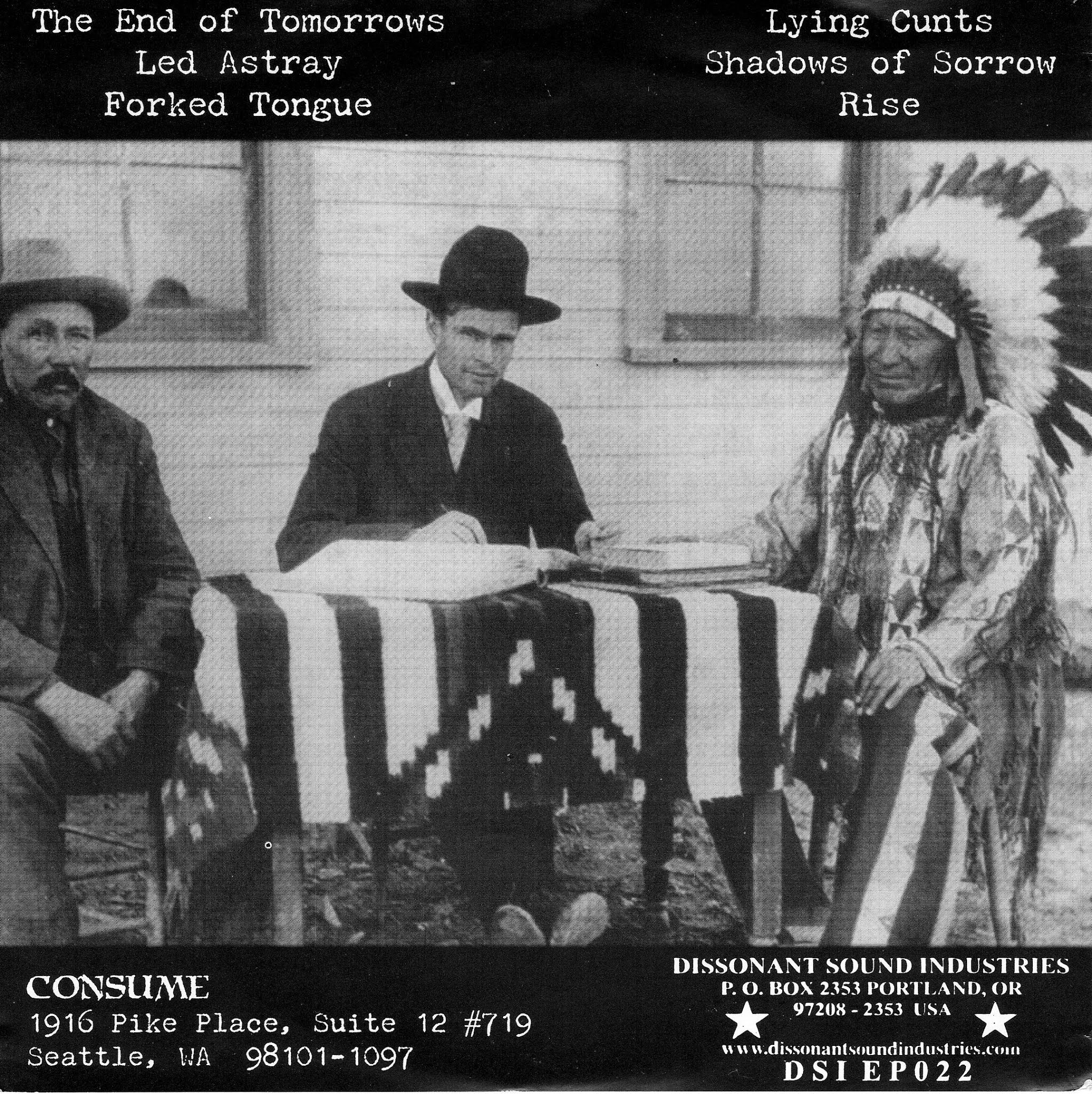
In terms of style, Consume could be found at the intersection between the familiar riff-driven 90's käng path and the well-trodden 90's crustcore one. An explosive recipe indeed. Totally free from the pomposity of neocrust (or epicrust), Consume proved to be able to pull out all the variations and paces of d-beat with apparent ease. From the slower hard-hitting one (aka dad's d-beat), to the more traditionally framed (trad d-beat) or the frantic mangel (c-beat), the six songs that make up Forked Tongue encompass the whole range of d-beat. Variety in D major, so to speak. Another strength of Consume lied in the actual songwriting. The riffs are always accurate, impactful and groovy and thanks to a great rough dual vocal work, all the songs become quite memorable. Although I had not played the Ep for a long time, I still remembered every hooks and arrangements and it has held up very well in my opinion. Consume's rocking vibe never impaired their ability to sound seriously aggressive and incisive like a friendly but intense melee between Disrupt, Tolshock, React, State of Fear and Uncurbed. Happiness and glee do not exactly emanate from Consume's lyrics which tackle in an in-your-face fashion our disconnect with nature, pollution, The United States' outrageous treatment of Native Americans throughout the ages (hence the visuals on the covers and the Ep's title) or the dark recesses depression with the song "Rise", their better and most poignant words on the record. 
 
 
Forked Tongue was released on Portland's Dissonant Sound Industries, a short-lived early 00's label that also put out records from Protest Stagnation (the label owner played in the band) and Poland's Antichrist. I think that drummer Jon stayed in Europe (Barcelona, I think) after the end of the tour and formed the excellent crust punk tornado Cop On Fire with members of Ekkaia. The remaining members of Consume would form Deathraid in 2007, a band that is still gloriously running and that I see as the logical continuation of the sound and mentality that Consume embraced at the beginning of the noughties. A very fine band with members that have been flying the filthy flag of hardcore crust with dedication and heart for a long time.    
 
Consume!