Showing posts with label 1996. Show all posts

Sunday, 12 November 2023

An adventure in split Ep's! I have no gun but I can split: UNCURBED / SOCIETY GANG RAPE "S/t" split Ep, 1996

I recently went on vacation with my mum, something I had not done since 2012, for good reason as it transpired during this trip. Not that we argue much or anything, it is just that she is into the silent contemplation and connection with nature while I cannot help but doing a d-beat with my fingers whenever and wherever I happen to be. Beside I am highly distrustful, as a rule, of flora and fauna since the day  I got shat upon by an evil pigeon twice (!) in a single week. I bet it was the same fucker. Beside what are leaves for if not to hide dog turds for you to trod upon when you are taking in innocent Sunday morning walk after a barely remembered night out? Exactly. We don't get along much Mother Nature and I although judging from the lyrics of 99% crust bands trees are, apparently, crucial to the Earth's survival and, by extension, mine. So please don't die trees. Thanks.

Still we had a pretty good time and no bird fucked around with me. There is absolutely no connection between this quiet mother-and-son adventure and the present split Ep. In fact, had I told my mum that the prospect to write a review about a band called Society Gang Rape upon our return was very exciting, she would have looked at me with her usual look, a blend of worried disbelief and genuine maternal bewilderment that means "what the fuck did I do wrong?". And well, to be fair, I certainly would not wear a Society Gang Rape shirt. What with reaching 40 and being a bloke, I would definitely pass for a disgusting, revolting pervert, understandably so, and I would no doubt get my ass kicked before I can explain that the band was a feminist crust band from Sweden with three female members. That would definitely end up on some social media, I would be canceled for life and you would have to hide in the loo in order to read Terminal Sound Nuisance in secret, like a vulgar porn mag (note for zoomers, a "porn magazine" was a glossy newspaper with dirty pictures in it before you could not stream videos with your phone before). So yeah, I will stick to my Antisect and Deviated Instinct shirts. 


Both bands on the split were actually from the same - rather small - town of Avesta and both bands had the same contact address under the name of "Gunnarsson", a last name shared both by Marie-Louise (SGP) and Michael (Uncurbed) so that one could venture they might have been from the same family. Would the Uncurbed family be for real? I have never been there but wikipedia states in the "Sightseeing" section in order to attract tourists to this quaint little town that Avesta has the world's biggest Dalecarlian horse. Since you are clueless about what a Dalecarlian horse is, let me educate you. Dalecarlian horses are painted wooden statues of horses that have been around since the 17th century, at least. So I am guessing they are big on horses over there. Which I am not. They are mean creatures that stink of shit. For some reason, wikipedia does not mention any Uncurbed museum so there might not be one in Avesta which does come as a surprise. I have already written about the mighty Uncurbed and their really fun ...Keeps the Banner High album here, a work that illustrates rightly what heavy rocking käng crust sounds like. But the four songs on this Ep, recorded in August, 1996, a couple of months after Punk and Anger and almost a year before Peacelovepunklife, is different. Uncurbed loved the album format and they only released two (split) Ep's in the 90's, one with Disfear and the other with SGR. Possibly one of those bands that go into a songwriting frenzy before recordings and always end up doing an Lp. Not always for the best but sadly untreatable. 


If the four songs included on the Ep were instrumental and your eyes were closed, you would not necessarily guess that they are Uncurbed's. Not that they strayed far from their Swedish hardcore roots mind you, but still. Even for a genuine world-renowned expert like myself, with eyes closed and without the vocals, I would have said that we are dealing with a rare recording of some sort of Meanwhile or Disfear. The first two songs out of the four included on the Ep are impeccable raw pummeling "just-like-Discharge" d-takt scorchers done with taste. Of course the classic Uncurbed dual vocals immediately give away that the bunch of friendly Avesta punks are behind it. "The rope song" is a classic faster käng number typical of the band's catalogue while "Pissaa ja paskaa" is a short enjoyable Tervet Kädet cover. The production fits the songs perfectly, rawer and meaner than what Uncurbed usually go for. These are great six minutes. 


On the flip side are Society Gang Rape, one the few Swedish hardcore bands in the 90's that had female members. In fact SGR was an almost all-girl group as only the drummer was a man. This was pretty uncommon at the time and, if things have changed for the better, it still, sadly, is to a significant extent. The band started as a Swedish death-metal band in the early 90's and, just like hardcore bands, there were shit tons of those over there too. What a decade, though not a good one for hairdressers. I  cannot claim to be a connoisseur of death-metal although I don't dislike it and the Scandinavian brand has always stricken me as being particularly good (like their take on extreme music in general). The early version of SGR sounds very convincing with traces of crust already popping up here and there. They were initially called Sadistic Gang Rape which they wisely changed to the slightly less shocking Society Gang Rape. I have no idea if they ever made patches or shorts with the first moniker as the one google search I dared to do was extremely depressing. Obviously the fact that the band was predominantly female does cast a different light on the meaning of the name and highlights a proud feminist stance that is not taking any shit. Would it be possible for a band to have such a name in 2023? I can only imagine the online shitstorm and it is not pretty.


By the time they switched from the sadistic abuse to the social one, the band was slowly morphing into a decidedly crustier unit. Their second self-titled effort released in 1994 was a pretty typical 90's crust affair with brutal dual vocals but the production was arguably too clean and overall it lacked the aggression that the death-metal version of themselves, and indeed their later one, displayed. For some reason this recording was first released on cd in 1994 with eight songs and on an Ep under the titled More Dead Than Alive in 1997 with only four, both on Sound Pollution. Uncurbed and SGR were clearly closed tied with the American label that released four records of the former and two of the latter. 

The four songs on this Ep were recorded in August, 1996, at the same studio as Uncurbed and it is not unlikely that both bands recorded on the same day or week. The session proved that SGR sounded better, raspier and angrier when in all out raw käng mode. The songs are simpler, more urgent albeit a bit sloppier but then that's how the genre is supposed to be played. The metal influence is all but absent with only a delicious filth-crust break on the first song and a short introduction to the last one, itself a masterclass in direct chaotic pissed mangel hardcore with the cymbals really at the front  - I am sucker for that when it comes to this style when on the Ep format; it just works insanely well - that is almost Frigöra-like. Musically SGR here sound close to Uppsala bands like Cumbrage or Diskonto but the typically 90's crust dual female vocals bring something different in terms of flow, structure and scansion and made those four songs rather special in the context of the käng/crust/d-beat wave that swept over Sweden in that decade. I am reminded of the Swedish-inspired but crusty dual-vocal band Excrement of War, especially with Mags' voice, and in terms of gruff angry growls and shouts, female-fronted Polish crust acts like Stradoom Terror or Homomilitia are not far. Four songs in five minutes, no fucking around. 

However I would like to point out that the song "Fuck Chirac" is deeply insulting for French people and would make my dad really sad because he was a massive fan of the president (Chirac was a bit like his own Taylor Swift if you like) and he even shook his hand once (granted Chirac shook the hand of all the employees of the company but still, my father felt a bond).


Following this Ep SGR would release the No Fate Lp in 1997 (on Sound Pollution again) that globally built on the same basis but with a cleaner production (courtesy of one Peter Tägtren a death-metal specialist) that did not convey as well the similar vibe of a brutal käng attack and anger. Still a decent album, though a tad long, and one that you should definitely know if you are into what Swedish punks were up to in the 90's and into feminist or all-female hardcore punk, especially since the band seems to be half-forgotten these days. 

This Ep was released in 1996 on Yellow Dog Records, a once very active Berlin-based band and record store run by a member of Autoritär. A nice little record of crusty Swedish hardcore.  

Society Uncurbed Gang   

Saturday, 28 October 2023

An adventure in split Ep's! I have no gun but I can split: TOTUUS / HIASTUS "Sankari / S/t" split Ep, 1996

If you are looking for something clean, thought-provoking, challenging hardcore-punk that goes against the rules and regulations, codes and conventions, against "the norm" done by good-looking Instagram-friendly Americans who thrive on being "followed" by others and taking selfies, then this record is not for you. Or maybe it could be if you bother for a change, checking ugly bands playing ugly music to ugly people for a good price as I was able to find a copy of this split Ep for a mere 2€ which is about 15 times cheaper than a Turnstile record (checking this Zoomer band's website I realized that they sell grossly overpriced hats and fucking teddy bears but no physical records... what an odd choice for an ex punk band). Alright, let's stop with the boomer-flavoured rant, as we can hold hands, kiss and definitely enjoy Turntile and Hiastus, even though the latter were fortunately never nominated for any kind of awards, except a local beer drinking contest and a grizzli bear imitation one. 

Let's just get to the actual record in a swift fashion. This is not an excellent record to be perfectly honest. I like it a lot but that doesn't mean it is objectively that good and, in fact, even fans of the genres adopted by the bands could do without the Ep and live a perfectly normal, unhappy life. I am not, have never been and never will be, as you know full well, one deterred by average generic punk music. It is all a matter of love that is as blind as it is, in this case, deaf. This Totuus/Hiastus split Ep reminds me of the original noble goal that led me to create Terminal Sound Nuisance: "a blog promoting good (and not so good) genuine punk music". This record does fall into the "not so good" category but it doesn't mean it cannot be loved and rediscovered. There was something heart-breaking in seeing this battered copy in the 2€ record bin (my acute crust detector told it was only a matter of time before it got relegated to the 1€ one) and, being a soft bastard, I could not help but rescue this little angel from the dumpster, like a gran welcoming her seventh kitten because the little shit was hungry and homeless or something. 


I knew of Totuus before because I already owned the 1999 self-titled Ep released on Fight Records and I closely associate the band with this well-known and still active Finnish label based in Tampere that released or rereleased works from Kaaos, Tampere SS, Unkind, Positive Negative or Riistetyt. With such a list of culprits, one already logically imagines what Totuus - which translates as "truth" - will sound like: classic raw and direct Finnish hardcore. Clever but not completely true. The backbone of the band remains firmly rooted in 80's Finncore (think Terveet Kädet or Kantan Uutiset, even Riistetyt) and the production, or lack thereof, effortlessly reproduces the sound of that decade, but you can still tell Totuus was a 90's band. It would not be mistaken to compare them with bands like Rajoitus or Uutuus because, beside them all ending with the phoneme "-tus", they cook with the same old-school ingredients, but where the aforementioned bands almost exclusively rely on 80's Finnish hardcore (although Rajoitus were Swedes) Totuus also had a European hardcore influence and bands like BGK or Ripcord do come to mind. It would appear far-fetched to state that they were as good as all those canonized acts but their side of the split is still pretty solid and has that wild, furious, biting energy. 9 short songs in less than 7 minutes. The split Ep format fits the songwriting perfectly and makes Totuus and solid example of proper raw old-school hardcore done in the 90's and looking lovingly toward the previous decade. 

Do you remember that kid at school who was desperate to look like the coolest, most stylish, most popular cat and tried so hard to walk like him, dress like him, talk like him? That's pretty much the relationship between Hiastus and Hiatus. The former went as far as calling themselves Hiastus, which means - wait for it, wait for it - "hiatus" in Finnish. On the surface, this sounds adorable. A band trying to sound like their heroes, a band that openly wears its heart on the sleeve, a band that does not give a single shit about even trying to pretend to be original in any way. And really deep down, it is what most teenage bands are all about when they start. They just want to be The Clash or Black Flag or your older cousin's nu-metal band that for some reason seems to attract a lot of girls. 


D-beat, as a genre, works exactly like this, on worshipping and emulating the source material, referring to the signs and symboles. If one were to see it as a subgenre, 90's crust would be one that is defined strictly with a rather short time period - let's say from 1991 to 2005 and the rise of neocrust. D-beat also started as a 90's epiphenomenon but, contrary to the classic eurocrust sound, survived in one piece in spite of a certain drop in popularity in the late 00's, and then got even stronger and spread everywhere with time. Therefore "eurocrust" or more globally "90's crust" was not so much a subgenre as it was a wave, with a distinct sound that was used to build and lead the new generations of crust, as opposed to d-beat which by essence had to stay the same with some tone variations. Siblings of 90's crust, "cavemen crust" or "cavecrust" (as I like to call it) managed to stay alive, afloat and deliver proud examples of the Doom-loving crust traditions from times to times, especially in Japan - Doom-love was an essential trait of European crust in the 90's - and instances of classic ENT/Disrupt dual-vocal crustcore bands still occur but on too small a scale to state to states that there is a such a thing as genre-emulating or genre-referring 90's crust trend. Sob fucking sob.


But in any case, Hiastus were 90's eurocrust to the bone. It was in their blood, they breathed eurocrust, they ate eurocrust, they drank eurocrust, their wildest dreams were made of fantasies of splits between Hiatus and Warcollapse, Silna Wola and Subcaos, Enola Gay and Social Genocide. For all I know the drummer named his first-born Way of Doom. It is actually not the first time that I write about Hiastus as they appeared on the Never Again compilation Ep that I reviewed 10 fucking years ago. That stings. Beside the mighty Hiatus, the Oulu-based band was without a doubt very influenced by the national crust heroes Amen who, with a first deliciously sloppy Ep in 1990, belonged to the first generation of eurocrust. They clearly must have played Feikki and Paranemia quite a bit. With the band relying on the traditional dual vocal crust attack, like Amen, to spread the message - recent discoveries revealed that the first instances of such an aural technique may date back to the neolithic era, when humans could not actually speak and grunted like apes - early Disrupt and Extreme Noise Terror must have been blasted to death as well. The sound is obviously pretty raw (the surface noise only providing extra crust points) but the music is more energetic than I remember with a good pummeling drumming. The vocals are too loud in the mix and a little overwhelming at times, especially because of the very dedicated fellow responsible for the low growling parts. Ironically the spoken parts are too low in the mix, as if the singers, after three songs of shouting like demented sea elephants, were too shy to speak normally all of a sudden. The flaw makes the music sound a bit ridiculous but even more enjoyable as well. This is 90's DIY crustcore, not technical metal. 


Hiastus remind me of the Polish band Money Drug who were equally raw and a bit sloppy with their dual vocal eurocrust recipe, and of their countrymen Rotten Sound who started as very similar Disrupt-ish act with their Ep Sick Bastards in 1995. I like the Hiastus side a lot but, let's get real, this is one is for the crust completists, for the archivists, for the obsessed, for those who consider prehistoric 90's crust as the sweetest serenade and mid-table Hiatus-like bands as adorable underdogs in a decade plagued by shoegaze. 

You already know if you need this split Ep, I know I do.   


TOTUUS + HIASTUS = argh          

Wednesday, 5 July 2023

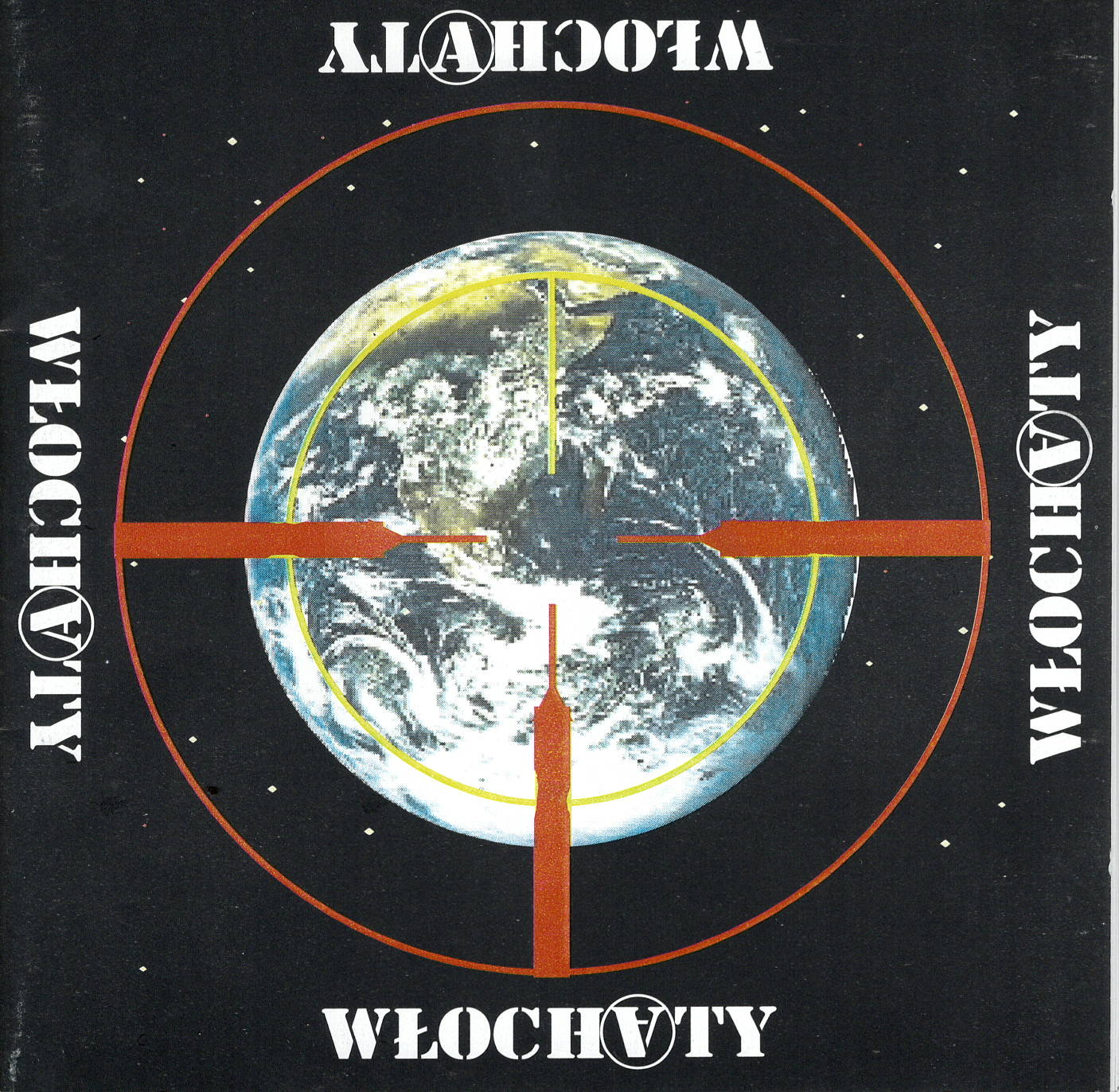
Still Believing in ANOK: Włochaty "Wojna Przeciwko Ziemi" cd, 1996

If the name FUAL, the Irish band we covered last time, was a little tricky and rather confusing, to pronounce the name Włochaty properly on a first attempt would be akin to a miracle, an event that neither science nor reason could explain. A bit like that bloke who woke up from a coma speaking a highly difficult random foreign language perfectly while he had never even left his hometown in the arse-end-of-nowhere and could barely spell in his mother language to start with. Unless you're Polish or have some knowledge of it. Sometimes I wonder whether Polish punk bands pick names that are hard to pronounce just to take the piss (I know I would). 


Włochaty is actually one of the first Polish punk bands I became familiar with in the early 00's, an innocent time when hair loss was still a prospect so distant it was practically unreal and when you could look like a fool without fearing to be the object of a demeaning viral video online. The drummer (who was Polish) and the guitar player of my very first band, a pretty basic French-style punk-rock band with more motivation than talent, were really into Polish punk-rock, a concept that, at a time when I mostly knew English and American bands, sounded about as strange and exotic as polar bear racing ("so they also have punk in Poland! Fuck me!"). I realize now it sounds a little stupid and adorable (alright, mostly stupid I suppose) but I remember vividly the Polish punk tapes my friends played in the guitar player's derelict car. The sound was ghastly as the tapes had been played to death and the tape player was not exactly top-of-the-range (cd players in car were a thing of the upper-class and we loathed them with a passion). On those tapes were Dezerter (obviously) but also Tzn Xenna, Moskwa and many others I cannot remember (those would have almost certainly been classic 80's bands in retrospect). And Włochaty, certainly the band that impressed me the most as they didn't really sound like anything I knew.


As fate would have it, Włochaty toured Europe after this musical encounter (in 2002 or early 2003 I think). A mate of ours was doing a fanzine at the time and he asked us if we could interview the band. So we wrote down some questions (pretty much the usual police interrogation about their influences, politics in Poland, nazis, the local scene and so on) which the drummer translated and we interviewed the band. I have to admit I was pretty proud of myself although I cannot say I did that much. I do remember including a question about how much they loved Conflict and lecturing a helpless friend in the audience about the correct pronunciation of the band's name. I barely knew better than him (after all I had only just talked with the band as some of them spoke English) but I was in a position to pretend I did. Włochaty played a solid gig and that was that. My band split up and I did not really listen to much Włochaty afterwards. They became that kind of good bands that you know you like but don't listen to anymore. A bit like that high school friend who got pissed with you instead of going to P.E. class. A solid dude you would love to see more often but whom you just never call.


When I started thinking about Still Believing in ANOK there were bands that spontaneously came to mind, because they epitomised the survivance of the traditional 80's anarchopunk sound into the 90's and also because some of those bands had been unfairly forgotten (like Capite Damnare or Firing Squad) despite penning some great anarcho songs with their own twist. I instantly thought of Stracony - the Polish Alternative - because they are brilliant and underrated and quite naturally my thoughts drifted towards Włochaty (it actually means "hairy" in Polish) and their magnum opus Wojna Przeciwko Ziemi. I played the album carefully because I only remembered it through younger ears that had not yet been polished and elevated by two additional decades of listening intently, intensely and relentlessly to punk music. And well, you could make the argument that Wojna Przeciwko Ziemi is easily one of the best anarchopunk albums of the 90's. 


Such a claim is a matter of perspective too of course because Włochaty were huge in Poland: the tape version of their first album from 1994 sold about 20.000 copies and the band grew into something that no longer belonged to the realms of DIY punk. And let's face it, some of their 00's albums were dreadful and the band did not necessarily take the right turns. So that if you are from Poland, because of this history with which you're obviously familiar because Włochaty is that big famous band, your view of the band is different to that of a punk with a relative knowledge of Polish punk music but oblivious to the status of the band. Because I, the coolest kid in town, am a refined connoisseur of Punk and not just a vowel-challenged nincompoop, I am of course aware of such a discrepancy and therefore I have to do my best to be as objective as possible about Wojna Przeciwko Ziemi. And objectivity dictates that this album must be seen as one of the great anarchopunk works of the 90's along with FUAL, Aus-Rotten's The System Works... for Them, Cress' Monuments or Resist and Exist's Ep's. 


Wojna Przeciwko Ziemi's main quality is how monumental, original and epic it sounds, and I mean genuinely formidable, armed with a powerful scope, a coherent meaningful discourse and a sense of narration that is rarely seen in punk-rock. Włochaty were not the heaviest or the most aggressive but the intensity and creativity displayed on their second album is nothing short of awe-inspiring and few anarcho bands can claim to have crafted a work as impressive and convincing as Szczecin's most famous punk export (yeah try to pronounce this while you're at it). There are a lot of great things going on on this Lp so that it would be impossible to list them all. Like any good punk albums (or just albums really) Włochaty's is built like a real story fueled by narrative tools and recurring themes. The use of radio samples reflecting the post-communist Polish society of the 90's, with all it entails in terms of cultural and political changes, throughout the work indicates a cohesive thematic continuity. Likewise the brilliantly epic sax (it pains me to say that I actually enjoy it a lot here) is not overbearing and only operates tastefully at some specific moments to emphasize a mood, increase the pressure or introduce transitions and interludes between songs, keeping in mind that most of the songs are tied with one another through feedback (a trick that Conflict, of course, also used 10 years prior) forming a whole. 


The very fast-paced vocal delivery, the maniacal rants and the crazy length of the lyrics are breath-taking at times and can clearly be said to be one of the band's trademarks, it has that intense, almost insane feel that some angry punks are endlessly shouting pamphlets at you (not unlike Dave Trenga from Aus-Rotten and Behind Enemy Lines but with even more words) and the listening experience can be a little exhausting, although I personally love it as it reminds me of a lot of the UK anarcho greats. On a strictly musical level, Włochaty were certainly not a one-trick poney (or rather a one-beat poney) as they experimented with a lot of changes of paces, song structures (there is a proper punk epics on Wojna Przeciwko Ziemi), wrote real transitions and melodies while hitting hard and on the whole displayed a versatile and inspired songwriting ability (yes there is some reggae, get prepared, but also spoken parts and instrumental songs). Conflict's Ungovernable Force - and even Conclusion actually - are by far the band's prevalent influences here, not just in terms of sound but also in terms of structure, form and how it helps shape the music and the message. It has to be noted Włochaty's sometimes complex songs also illustrated a context that was confusing, contradictory and polymorphous. And well, there are also direct loving nods to Conflict as well as Crass (not an easy feat) just to be on the safe side, and Icons of Filth are definitely not far away. The top-drawer riffing, with that inventiveness characteristic of Polish bands, can bring classics like Abaddon or Armia to mind. The band was definitely a 90's band though. I am reminded of what Kochise or Sin Dios were trying to do, not because these bands sounded alike (they did not) but because they built something that was relevant and original at a time when it mattered.


This is a wonderful punk album with a clear production highlighting the musicianship and I keep noticing new details each time I play it, whether it is a bass line, a transition I had not really given much thought to or just a jazzy guitar tune, Wojna Przeciwko Ziemi is a rich work (and it has a song called "Hiroschirac" which always cracks me up). The album has one major flaw: it does not look good. The cover is pretty bland and, if the thick booklet is packed with lyrics (they had a lot to say and those are very long, dense lyrics), it does not really look like anything and is mostly informative. English translations are provided in case you want to know what this is all about (you should). This is the cd version released on Nikt Nic Nie Wie (aka NNNW) the classic Polish label and distros that has been running since 1989. The vinyl version may look better but the cd also includes eight (!) bonus songs that were not included on the tape or vinyl versions. I am not sure where the songs come from, they were not meant to be part of the album-as-story and some are new takes on older songs with a better production but they were probably recorded around the same time, between December, 1995 and January, 1996. For once, I therefore actually recommend you pick the cd version. 


Proper anarchopunk epics here.


Wojna Przeciwko Ziemi

Wednesday, 27 October 2021

Booze, Life and MISERY: a Look at Three Ep's from One of Crust's Greatest

You all know Misery (and if you've ever been dumped during your secondary school years you've experienced misery too). If Prince was the prince of pop music then Misery are the princes of US crust music. Not that Minneapolis is an aristocratic hotspot but you get the idea. Although I am under the impression that they are semi-retired at the time of rambling - oh rage! oh despair! oh age, my enemy! - the band has been the real deal and delivered the crust for 25 years. By the early noughties, the majority of the 90's crust icons had but fallen with varying degrees of heroism on the battlefield of punk. Some, like Hiatus, died standing up still holding a half empty bottle of tripel (though they finally did come back from the grave recently), others like Warcollapse managed to soldier on but had to go on hiatuses on several occasions to survive. Disrupt and Destroy! did not get to live long enough to see 1995 and legendary Japanese pioneers SDS and Gloom barely made it to the next decade. The new millennia had arrived. Once healthy, flourishing sectors of the crust scene were engulfed in flames and overrun with epic emotional guitar leads, baseball hats and bands owning more pedals than own songs. The classic eurocrust style never really got up from this heavy blow, with still some exceptions, and the death certificate was on the table when it transpired that the new wave of 00's crust bands enjoyed wearing Vans and maintaining an acceptable level of cleanliness. Fucking posers. 


The metallic brand of apocalyptic crust did survive thanks, notably, to a major revival in the mid-00's and although there is no denying that the popularity of crust music has been declining steadily, dauntless groups of valiant crust survivors managed to carry the original old-school sound and spirit on their shoulders through more than two decades and no one has stood for this admirable resilience better than Minneapolis' finest, Misery. Misery is what can be called a "name band". If you have been into hardcore punk for a decent number of years, you've either at least heard of them at some point or used to have a dodgy roommate who wore a patch of them, often the same fellow who favoured records over rents. There is no exception. Misery is a prerequisite for any entry-level crusty (you can get extra crust points if you identify the reference in the article's title by the way). What is even more remarkable in their case is that they formed as early as 1987 which makes them a first generation US crust band, like Disrupt or their Minneapolis comrades Destroy!, and on the other side of the country Apocalypse, A//Solution and Glycine Max. New York City's Nausea are also often considered as one of the very first crust bands nationally because they were around since 1985 but they only really started to sound like crust - as commonly defined by the British Mermaid crust wave of Hellbastard, Deviated Instinct et al. - when Al, actually Misery's first singer, joined sometime in 1988. Interestingly, Misery would release two full Ep's in 1989 before Nausea got to release their own crust masterpiece Extinction in 1990. But let's stop arsing about, it's all good shit. Misery were among the first on the starting line, even though in 1987 they were probably just scruffy kids messing about in a studio getting pissed and making a lot of noise (in that order). Like any other tribe, the North-American Crusties, in order to thrive and eventually reproduce, need strong origin stories. These allow them to find their place and some balance in the sometimes ruthless wider punk world, one that have seen rival tribes prosper in later years. Tales of glorious late 80's crust bands reinforce a sense of belonging to a strong American tradition of soap-dodging Amebix-worshipping individuals and validate a tradition spawning over three decades so that it matters to underline Misery's place in the early crust pantheon. 

We are, as a social species, a bit odd and inhabited with rather morbid fascinations. People never like you more than when you are dead. Absence makes one great or, at least, greater, as if death somehow casts a glow of grandeur and produces a feeling of admiration and instant nostalgia. A statement that is as true for bands as it is for people. It sometimes looks like in order to become a "punk legend", you first have to die. Just think about the deificiation and hero worship of short-lived 80's bands while long-running bands are taken for granted and don't get the credit they deserve. I am personally always favourably impressed with bands who keep flying the flag undeterred, which does not mean I like all of them - some should objectively have been stopped a long time ago - but I like the quixotic romanticism and determination of playing in a punk band for decades. As a wise man might have said once - probably my role model Fat Bob but I could totally be making that up - "we're still bollocks but we're still here". Misery kept going through many trends, seemingly undisturbed, just being Misery. Of course, their sound changed a lot and the opposite would be almost worrying. Born, Fed... Slaughtered sounds very different to From the Seeds that we have Sown, but, in spite of the significant changes, the band's music has remained meaningfully recognizable because of the strong identity they managed to build throughout the years. You cannot really mistake Misery for any other crust band, an impressive feat considering the influence they have had on the global crust universe. One thing that characterizes the Misery sound is how punky it actually sounds and feels like. They have always been, first and foremost, a punk-rock band with several proper punk-rock-tinged songs in their repertoire (granted, these are much heavier than your ordinary punk-rock numbers) which, given the emphatic Bolt-Throwerization of the metallic crust sound from the 00's on, is quite remarkable and something that I, coming from a UK punk background and not a metal one, enjoy thoroughly. And of course, Misery's artwork and lyrics are punk-as-fuck, just taking a look at the drawings on Blindead - which includes drunk zombie punx with spiky hair, barely readable handwriting, a method for a beer bong game and a massive gratuitous "FUCK OFF" - has even the most unperceptive punk notice that the lads were listening to Disorder and charged punk just as much as Axegrinder, all in a boozy fashion.


But enough arse-licking, let's get to the core of the write-up. I chose to address three Misery records, all recorded in the crusty decade of the 1990's: Children of War because it unarguably stands as one of Misery's strongest records, Your Leaders were Lying because it showcases a live performance from a band that, according to reliable and sober enough witnesses, was brilliant on stage and the split with Assrash because it highlights the band's punkier worldview (a bit of an understatement in this case as we will see in due time). Let's start with the Children of War Ep, released in 1991 on Grind 'Til Total Perfection Records, an albatross of a name for what was a one-off sublabel of the then young Relapse Records (the record was also distributed as indicated by MCR Records from Kyoto). This was Misery's third Ep, after their deliciously raw debut Born Fed Slaughtered released in April, 1989 (a second version with a new mix and an additional song saw the light of the day the year after) and Blindead released in July, 1989 but recorded during the same session as the first Ep. Busy bees indeed since they also found the time to record a full Lp during the summer of 1990, Production Thru Destruction, released the following year on the French label (yes!) Intellectual Convulsion. They kept this rather incredible productivity (born out of destruction?) with their third Ep Children of War, recorded only five months after the Lp and eight months before their side of the split Lp with SDS a legendary 90's record and one of the most potent collisions in the memory of crustkind, possibly the best crust split record ever that can also be used as a spell to get your ex back and find the perfect job or as a talisman that can repel malevolent beings (like your neighbours, but play it really loud). 


But let's get back to Children of War. If you happen to have a friend who is unfamiliar with the work of Misery or if you just happen to have a friend at all, this Ep is an ideal introduction. The first two might be a little too raw and grinding for the uninitiated and a full Lp could be hard to stomach on a first date. My own initial introduction to Misery was through the Who's the Fool Lp, a recording which saw the band at its apex so that diving into it proved to be easy enough, although grasping properly what they were intending to create sonically can be said to be a more arduous task. Forget all the slandering and libeling about 90's crust punk and how all of it is supposedly generic, bland and redundant, Misery have always been the real deal, an innovative and creative band. Uneducated judgements such as these are always uttered by people wearing non-black shirts from trendy and "edgy" or "freaky" hardcore bands and secretly dreaming of drinking IPA on a Brooklyn rooftop instead of special brew in a rat-infested Leipzig Wagenplatz on a rainy October night. Beside, at least 10% of the 90's crust production was a bit original. At least. On Children of War, Misery's music was really falling into place and you could hear the different elements blending seamlessly together to shape the sound the band was known for in that decade. The Ep kicks off with the eponymous anthem "Children of war", one of their most famous and strongest early number. Mid- paced, anthemic and organically heavy Amebixian song with a strong '88-Axegrinder-meets-'87-Deviated-Instinct vibe. What made this song a proper "Misery song" was, first, the interaction between the two guitars, and, second, the bulldozing sound of the bass guitar. Not many, old-school metallic crust band played with two guitars as having two geezers rocking the same heavy apocalyptic riff all the time is a bit pointless. One of the guitars in Misery's music often concentrates on leads, eerie or epic tunes that help create a foreboding soundscape and draw the song to a particular mood that will define or herald what follows. The introduction of "Children of war" perfectly exemplifies this: miserable and atmospheric at first and then apocalyptic and seemingly unstoppable but interdependent. The bass sound also plays a crucial part in this shift. Misery were always very bass-driven, probably more so than any crust band of that era. During the introduction of the song, the bass is rather clear, very Monolith-like and then, when the guitars kick in, it turns into a lava-like, distorted monster with a terrific steamrolling groove. Undisputedly this bass sound is one of the band's clear trademarks which is unusual for a crust band.


The second song, "Thanksgiving day", illustrated another, punkier side of Misery. Typical old-school UK anarchopunk riffs played with the doomsday Misery vibe. Like a crustier version of '84 Antisect and Icons of Filth. On that level, the band has often reminded me of their London contemporaries Coitus who also added a dirty and groovy punky vibe to the classic heavy Antisect sound and one could advance that Misery did the same with the Amebix/Axegrinder sound. Does that make sense? The Minneapolis bunch love classic punk music and it shows, the last song of the Ep, the faster "Dragged off to war" is reminiscent of GBH and Broken Bones drinking malt liquor around a bonfire in a scrapyard. I always tend to associate Misery's vibe with an urban and desolate industrial atmosphere, atavistic anger or derelict factories while a band like Amebix evokes in me a bleak moor, a strong land connection and the potentiality of praying to pagan gods in the nude, probably not something you can do in Minneapolis, although I could be wrong. The third song of Children of War, "Morbid reality", is not dissimilar to "Children of war" in terms of songwriting, classic old-school metallic crust with death-metal-ish vocals, a shitload of mosh power and something of a Prophecy of Doom touch. The lads in Misery liberally shared vocal duties which brought some variety to their already diverse bag of crust tricks and offered different possibilities in terms of vocal textures. The singers complement each other perfectly and have recognizable voices and prosody - gruff, hoarse and pissed lower-pitched shouts answering to snottier, punker in-your-face vocals, not unlike GBH and Concrete Sox at times. This element, I think, has significantly contributed to the identity of the band throughout time and along with the distinctive guitar plays and massive bass sound. As for the cover, it is an iconic piece of crust history, a little confusing at first but I like the many details and the profusion. 


Misery is possibly the one crust band I wish I saw live but never did. Don't get me wrong, I wish I had been at the Mermaid in the mid/late 80's obviously, but Misery were still very much active when I first fell for them in the early 00's so the prospect of seeing them one day was not completely unreasonable and even plausible (I was blissfully unaware of the logistics of touring at the time so that, in my youthful mind, any active band was likely to play in Paris at some point. Little did I know that most bands actually avoided playing in my hometown but that is a whining session I shall develop another time). Of course, Misery never toured Europe in my punktime and  never will, something I have done my best to be as placid as possible about for a decade. So posting a live Ep sounded like the thing to do to exorcize some of the pain, especially since Misery, I have been told, were a live powerhouse. Not exactly surprising given the unique sound they managed to create in the studio but it is still comforting, and in this case also painful, to know that a favourite band of yours which you never got to sing along to while properly wankered in a live environment was a great live band. Your Leaders were Lying was recorded during a gig in New York City in 1993 and released the same year on Squat or Rot, a label close to the local squatters' movement run by Ralphie Boy from Jesus Chrust and Disassociate. 

There are three songs on this wonderful Ep, two classic Misery numbers on the first side, "Filth of mankind" and "Fear to change", that appear respectively on the 1992 split Lp with SDS and the 1994 Who's the Fool Lp. Brilliant songs epitomizing the sheer power of Misery. The band is tight, the sound is surprisingly good and balanced for a live recording. Heavy, rocking, dark polyphonic metallic crust and the perfect soundtrack to the apocalypse. At the time of this recording Misery were possibly the best band around doing this type of crust so that there is little point using points of comparison. Misery just sounded like Misery and sounding like oneself is quite an achievement (metaphysical shit for you). These two songs are energetic and rather fast ones with "Fear to change" showing that the band could pull the fast and furious brand of crust, with ease. The other side includes an Amebix cover, "Nobody's driving", which they pull brilliantly, with the skillful drummer even bringing some variations of his own. Needless to say that, Amebix being the band's primary influence, covering an anthem from Monolith must have been an easy enough decision to make. Misery seemed to have been a band that loved playing covers as, beside "Nobody's driving", they did Sacrilege's "Life line", Icons of Filth's "Fucked up state" (the best one of the lot according to me), New Model Army's "The hunt" and Amebix again with "ICBM". The band was apparently made up of cheeky bastards prone to terrorize innocent law-abiding citizens. There is a copy of a letter from angry neighbours living close to what I assume is "the Misery house" complaining about the noise, the raucous partying, the obscene behaviours and language although they claimed to have nothing against people "generally maintaining an appearance and lifestyle different from others". Punx will be punx. Misery was not insensitive to childish, puerile, scatological jokes either as the cover is basically a picture from the loos' venue while the backcover of the Ep shows a bare arse with the caption "Nobody's wiping". I did find it funny which says a lot I suppose.


The third Ep we are going to talk about today is the split with Assrash, another Minneapolis band with a common fondness for arse-related topics. This Ep was a picture disc, a format I have never cared for and I don't think I own more than ten records of this kind (I am similarly completely indifferent to coloured vinyl, my Discharge vision only seeing things in black and white). However, this one is pretty funny. This Ep might be one of the punkest-looking records I own - and I still have my old Casualties collection so that's saying something. A picture of the lads getting heavily pissed on one side, and one with them standing in line back to the camera with their hands against a brickwall as if about to being searched by the police. Typical punk posing I have to say but the so-called US streetpunk wave was emerging back then so perhaps the "pissed, punk and proud on the street" was in the air. In any case, while I would not listen to a band whose sole quality is their fashion statement, Misery waving the punker-than-you flag is fine with me. And well, in the light of the current alienating fashion worship and popularity contest on Instagram, the pictures on the split look almost tame in 2021. I am not sure when the songs were recorded exactly but the split was released in 1996 so I am guessing in 1995, perhaps during the same recording session as the Next Time Ep. "Bitter end" and "12 years of hell" see the band still in their unabated old-school crust mode, with maybe a less prevalent Amebix/Axegrinder influence. "Bitter end" has that classic guitar play and bass groove as usual and the songwriting reminds me of a crustier Celtic Frost, not unlike Coitus again (now that I think of it a Misery/Coitus split would have been magnificent and an endless source of top puns, just think about it) while "12 years of hell" is a quality fast and thrashing crust punk numbers. Both songs have that "90's Misery sound" but it was to be the last record to really display Misery at their crustiest. The following record, the split Lp with Extinction of Mankind from 2001, saw the band incorporating other, new influences into their crust recipe to great effect (their songs on this Lp are among the very best they ever wrote). On the other side of this 1996 split, Assrash delivered their typical brand of raucous, obnoxious, two fingers in the air punk-rock with singalongs, not unlike late 80's Chaos UK, The Restarts or Suicidal Supermarket Trolleys. Energetic and snotty, the three songs work pretty well on the Ep and should get you properly prepared for a pogo session or a night out on the piss. The Ep was released on Clean Plate Records, the label run by Will from Orchid, and it is without a doubt the punkest record he ever put out. 


That's enough Misery for today. This band deserve all the praises in the world for keeping the old-school crust sound alive and making it evolve for such a long time. Our shorter attention span, the availability of everything everywhere and our modern consumption of punk music makes us addicted to a constant flow of new bands and records often using marketing techniques and vocabulary to sell their product and turn a six-month old band into hardcore pioneers so that bands like Misery are less likely to keep running and flourish in our current context. Love and support your older crust bands.


 Booze Life and MISERY


Friday, 4 December 2020

Wesh to Sweden, the Formative Years (part 5): Diskonto "Silenced by Oppression" Ep, 1996

As I mentioned in the first part of Wesh to Sweden - a series that is also the cheapest way to visit Sweden in our plague-ridden postmodernity - the realization that there was such a thing as "Swedish hardcore", that it was a valid concept, one that did not point at bandana-wearing Swedish nationals trying to be Agnostic Front or Minor Threat but referred to a hardcore punk subgenre that was recognizable, definable and specific to Sweden, came through a local radio show. The show was called Ça Rend Sourd (which translates as "it is deafening") and was broadcast every other sunday on the French Anarchist Federation's radio station, Radio Libertaire. Even as an innocent, not to mention rather thick, "streetpunk-oriented" teenager, I had heard many praises about the radio show which had genuine activist punk voices behind the microphones and played all kind of DIY punk music. It was only a matter of time before I started to listen religiously to Ça Rend Sourd, first out of sheer curiosity and then as a positive way to expand my punk horizons. I must admit that a lot of what they played was lost on young me and while I would love to tell you that, thanks to my incredible open-mindedness and my outstanding genetic background, I was hooked instantly to the sound of crust punk, the truth was much less flattering and I would often scoff at faster bands for their ridiculous vocals and the shortness of their songs while wondering why on Earth they only played bands I had never heard about. Still, I remember fondly chain smoking in my tiny bedroom and taping the shows so that I could play them again and write down the names of the songs and bands that I did like (in my pre-internet world, it was never an easy task, especially with the much dreaded combination of international band names and heavy French accents on a cheap boom box). 


As time passed, my highly perceptive self started to notice that the playlist always included bands described by the presenters as "d-beat" or "Swedish hardcore" and I became familiar with those terms and was able to roughly identify those genres. I distinctly remember a show of theirs when they played Mob 47 several times (could it have been some sort of Mob 47 special?) and other similar raw scandicore bands among which were Diskonto. For some reason, I recall being particularly impressed with that Diskonto song, with how raw, and yet energetic, it sounded like and thankfully the name "diskonto" was quite easy to catch and spell. The song was a short sharp shock of hardcore punk and I was in awe. From that point on, my tiny mind closely associated Diskonto with classy traditional Swedish hardcore, they became synonymous with the concept, genuine paragons of this furious hardcore subgenre that I was starting to discern with more and more ease, and I became healthily obsessed with them. This snotty raw hardcore edge coming from a modern band who tried to sound like an 80's one conferred an aura of mystery to them and symbolized a new underground world to me. I managed to tape their 1994 Ep, A Shattered Society, from a mate of mine who had acquired it on my ever persuasive recommendation. The fact that it was released on Profane Existence - a label I would have trusted with my own life at the time - taught me that the band was strongly politically-motivated and only confirmed what I already knew: Diskonto were for fucking real.


I remember getting the Silence by Oppression Ep and There is no Tomorrow album (on cd as usual) at about the same time and, while the former delighted me and delivered exactly what I was craving for, the latter had a much cleaner production that - I decided after as much deliberation I could muster - did not fit the songwriting and was missing that raw punk edge that, to me, represented what made Diskonto stand out from the rest. After this deep trauma, I never could listen to any 00's Diskonto (I am not familiar with most of their post-Their is no Tomorrow materials actually) and I have staunchly, if not defiantly, remained loyal to 90's Diskonto, as if a side had to be chosen. And I would not reasonably call myself a raw hardcore bigot incapable of enjoying any recording that doesn't sound like it was done on a rusty four-track, with out of tune instruments and paint tins for drums, as I have been known for a long time - and the most respectable witnesses can testify to that - to be a rather balanced individual quite capable to listen to overproduced hardcore when the situation justifies it. The thing with Diskonto, in my personal soundscape, is that they stood for that raw, cheap and direct punk sound that characterized what I loved in 80's punk music, and I didn't know that many contemporary Swedish bands at the time that went for a similar raw sound, on the contrary, by the late 90's/early 00's, most bands were looking for heavier, tighter and cleaner production (some would says more metal actually) so that Diskonto felt a bit unique. Of course Totalitär were raw but they sounded like they knew what they were doing and, unlike Diskonto, were tight as fuck, while Rajoitus - whose discography cd on Hardcore Holocaust was on heavy rotation - were very punk and very raw indeed but were much more Finnish hardcore-oriented and I was sadly unaware of Frigöra at the time (who were to Mob 47 what Disclose were to Discharge). If I wanted raw käng music played by an active band, Diskonto were the logical option and Silenced by Oppression certainly lived up to my raw punk expectations. The Silenced by Oppression Ep is a deeply gratifying experience if you know what you are in for: 10 songs and about as many minutes of raw käng.


Diskonto formed in 1992 in Uppsala, a town near Stockholm that had a vibrant, if rather incestuous hardcore crust scene in the 90's. In fact, Diskonto's singer Steffe and guitar hero Martin also played in Time Square Preachers and the same Steffe was also behind the mike in Zionide alongside Diskonto's drummer Malmen. A dozen of musicians for as many bands but then hasn't it always been the case since the 90's? If your innate sense of curiosity leads you to take a legitimate interest in the Uppsala käng scene of the early/mid 90's, I strongly suggest the Uppsala Crust compilation Ep from 1996 which will get you acquainted with wonderfully furious and raw scandicore bands like Dismachine, Abuse (who did a split 10'' with Diskonto in 1997) and Aparat. Diskonto appeared to have been very active in the mid-90's as they did no less than four different recording sessions with the same lineup between December, 1994 and late 1995, all in the ADM Studio in Uppsala. These logically resulted in quite a few releases with 1995's A Shattered Society Ep on Profane Existence, 1996's Silenced by Oppression on Clean Plate, the 1996 split Ep with mangel mongers Frigöra from Japan on Blurred Records (arguably the early lineup's most potent recording), 1996's More Power to the Cops... is Less Power for the People Ep on Malarie Records and a split Ep with Distjej for Crust Records in 1997. The band kept recording at a steady pace afterwards with a new lineup - Daniel (from Dellamorte) and Jonas (from Dismachine) replacing Kaj and Malmen - and the 90's saw Diskonto further release a full album, the Destroy! Rebuild! Lp in 1996 for Reiterate Records, a split 10'' with their fellow Uppsala-based Abuse on Consume, Be Silent, Die (a jovial label if there ever was one) in 1997, the Diyanarchohardcorepunk Ep in 1998 for Retard Records and finally a second Lp, Freedom is Out of Sight on Crust as Fuck Records in 1998, followed two years later by There is No Tomorrow which I mentioned earlier. And of course, that's without mentioning eight appearances on various compilations. Diskonto were undeniably strongly motivated and prolific, busy bees with a passion for stripped down classic Swedish hardcore and radical anarcho politics. If quantity sometimes prevailed over quality during their first decade (I would argue that the Lp format did not really suit their basic raw style and were bound to include some fillers), I still believe that on Ep they were a formidable unit if you have more than a passing liking to käng. By which I mean, basically, if you are not a poser. 
 

When working on this review in my office (meaning in my Disclose pajamas), I have been thinking about the perception of Diskonto in the 90's by older punks who were already into Swedish hardcore. The 90's were saturated by Discharge-influenced hardcore bands. Whether they came from the d-beat/d-takt, käng, crust or mangel persuasion did not matter, they all believed in the same god. In the midst of all the Swedish heavyweights building on the Discharge mythology and its 80's Swedish children, Diskonto were completely of their time, their dis prefix acting as a relevant tribal sign ("diskonto" actually means "discount" in Swedish, a moniker that gets the band a mere C+ on the Swedish government's official Disnames Rating Scale - a barely passing grade) and there were many references to Anti-Cimex or Mob 47 (not only did they cover "War machine" but the sound engineers were nicknamed Anders Cimex and Nicke 47). Yet, Diskonto, at the apex of the Swedish 90's wave, were also quite different in the sense that they never attempted to rely on a heavy production like Driller Killer or Wolfpack, never incorporated metal or crust influences like Skitsystem or Warcollapse, never strove to be perfect dischargists like Dischange or Disfear. Indeed, the band's original drive was simply to play primitively raw, fast and aggressive, traditional 80's käng and I think that they succeeded in doing so. 
 

Silenced by Oppression could be likened to a stripped-down version of Anti-Cimex' Raped Ass-era (the solos especially point in that direction), but I am also hearing some Moderat Likvidation in the fast-paced shouted snotty vocals (undoubtedly one of the band's most easily recognizable feature) and raw punk-as-fuck käng acts like Kvoteringen or Rövsvett but driven with more Discharge-inspired riffs. The ten songs are unsurprisingly fast, juvenile and energetic, so to speak, käng-paced (a notch faster than the traditional d-beat), and they are all pretty much the same musically with similar song structures as the band enthusiastically goes directly to the point, the sloppy bits being the collateral damages of the angry hardcore attack. If you like your scandicore with a crushing production and scorching guitars, this won't probably be your thing, however if you in the mood for ten minutes summarising the quintessential raw energy of hardcore punk, this Ep will do perfectly. Just pure and unadulterated Swedish hardcore that is both strictly tied to a specific creative sphere of the 90's - one of replication and referentiality - and yet quite timeless because of its classicism. It is, in a very noble sense, typical raw käng. As such, it was a wonderful introduction to the 80's greats for me, one that prompted me to dig deeper into the world of obscure Swedish hardcore, and for that I will be forever grateful to Diskonto and to this Ep in particular. Silenced by Oppression was recorded in December, 1994, during the same session as A Shattered Society (although I like the song selection on Silenced by Oppression better) except for the Anti-Cimex cover, recorded in March, 1995, during the session that will give birth to the split with Frigöra and More Power to the Cops. 
 

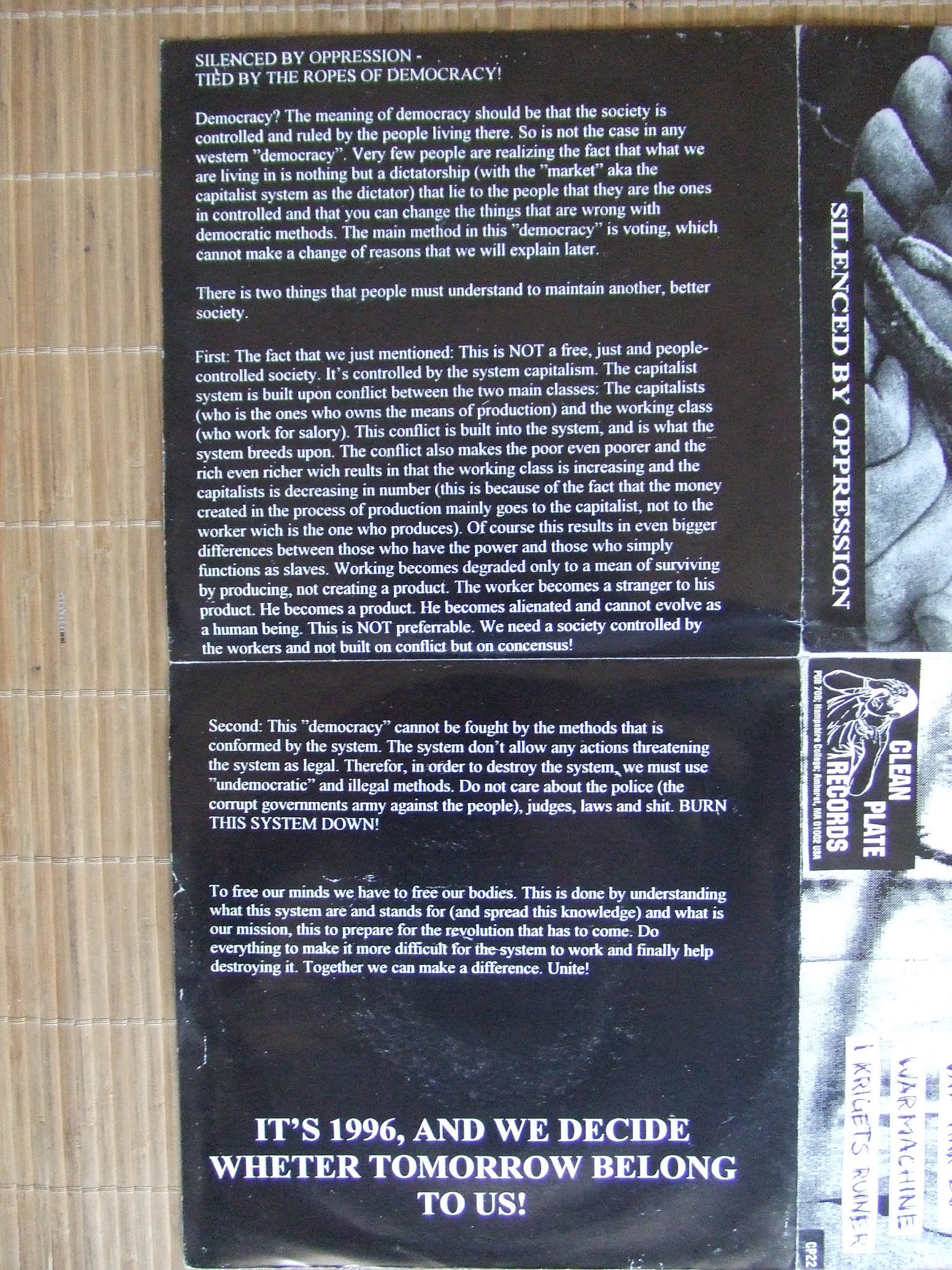
The angry and direct confrontational lyrical content ranges from anti-capitalism, the glory of Finnish hardcore, the conformity of PC punk, alienation through fashion, war profiteers and a person whose name was pronounced "Käng" in Swedish which, indeed, is pretty funny. A note on the foldout reveals that the Ep was supposed to be released on the French-based Minstrel Records (that released a Zionide cd) and then on Eugene Records but it did not happen so Clean Plate (label of Will Killingsworth from Orchid that put out materials from From Ashes Rise, Detestation or Misery) stepped up and agreed to release it with that extra cover song. There is also a political anti-capitalist statement entitled Silenced by Oppression - Tied by the Ropes of Democracy that sums up the band's position about modern democracies and their inherent support of the Capital. Relevant sentiments, to be sure. Ironically, Diskonto were not that cheap in the end. 
 
This humble review is dedicated to the memory of Steffe, singer of Diskonto, Time Square Preachers, Zionide among other projects, who sadly passed away in 2018. I have never met the guy and this is really not much, but here is my tribute to a man who has, since 1992, sung several hundreds traditional Swedish hardcore songs in his life and, in a world based on shallowness, fashionability and instantaneity, such dedication and passion are admirable. May he rest in punk. 
 

It's the red version (obviously)
                                               
 
Silenced by Diskonto          

 *about the title of the series "Wesh to Sweden": "wesh" is a slang word commonly used in France by the urban youth. It is derived from the Arabic language and can mean a variety of things like "hello", "what's up", "how are you?", "what!", "fuck" and the list goes on and on. Sorry if the meaning gets a bit lost in translation.