Showing posts with label folk music. Show all posts

Tuesday, 7 April 2020

Give Us This Day Our Daily Death, Uplifting yet Melancholy British Anarchopunk Songs '79/'95: a Compilation

This is the third anarchopunk compilation I did and it has not been banned from youtube (yet?) but I thought that it would be safer to post it on the blog proper. So here we go again.


Third compilation of dark and tuneful British anarchopunk with songs from 29 bands recorded between 1979 and 1995. As with the first two, the purpose of this selection was to emphasize the moodiness and the diverse ways to express anger and outrage that characterize the anarcho wave.  

1. Disrupters « Rot in hell », Alive in the electric chair 12'' Ep, 1985 (Norwich)

2. Faction « Turn away », You've got the fire Ep, 1984 (London)

3. Internal Dimenzions « Wargames », S/t demo tape, 198?'s (?)

4. Youth In Asia « When the wind blows », S/t demo tape, 1983 (London)

5. Potential Threat « A cry for help », Brainwashed Ep, 1984 (Blackburn)

6. Icon AD « Fight for peace », Don't feed us shit Ep, 1982 (Leeds)

7. 7th Plague « Painful death », Aristocrap compilation Ep, 1984 (Wolverhampton)

8. Toxic Waste « Traditionally yours », The truth will be heard split 12'' with Stalag 17, 1985 (Belfast)

9. Slaughter Tradition « Nightmare », Passion revolt demo tape, 1983 (Wales)

10. TVOD « War is for rich men », TVODemo demo tape, 1985 (Bolton)

11. The System « Their corrupting ways », Thought control Lp, 1983 (Wigan)

12. A Touch of Hysteria « Death cart », S/t demo tape, 1983 (Ambleside)

13. Anathema « Fighting to win », Smash the illusion/Acceptance split tape with Systematic Annex, 1986 (New Malden)

14. Wartoys « Ignorance », Indoctrination is the system, indoctrination is death demo tape, 1983 (Wigan)

15. Riot/Clone « A letter to no one », Still no government like no government 2xLp, 1995 (Ashford)

16. Schwartzeneggar « Child of the times », Art XX craft cd Ep, 1993 (London)

17. Honey Bane « Porno grows », You can be you Ep, 1979 (London)

18. Anthrax « It will be alright on the night », Who? What? Why? When? Where? compilation Lp, 1984 (Gravesend)

19. Alternative « Love and life », If they treat you like shit, act like manure Lp, 1984 (Dunfermline, Scotland)

20. FUAL « Repetition », S/t Lp, 1990 (Belfast)

21. The Apostles « Worker's autonomy », Punk obituary Lp, 1985 (London)

22. Chumbawamba « Common ground », Common ground demo tape, 1984 (Leeds)

23. The Assassins « Ronnie's bomb »,  S/t demo tape, 1983 (London)

24. The Mad Are Sane « Collision », Look further than vengeance demo tape, 1985 (Bournemouth)

25. Reality Control « Another sunrise », The reproduction of hate Ep, 1983 (Newcastle)

26. Two-Fingered Approach « World War album », My World War album Ep, 1982 (Cheshire)

27. Omega Tribe « When I'm with you », S/t demo tape, 1984 (Barnet)

28. Morbid Humour « Give us this day », Daffodils to the daffodils here's the daffodils compilation Lp, 1984 (Bradford)

29. Blood And Roses « Necromantra », Love under will 12'' Ep, 1983 (London)


The Terror of Loaded Guns, Diverse Textures of Moody British Anarchopunk '82/'93: a Compilation

This was the second anarchopunk compilation I did for youtube and, just like the first one, because of monetisation issues, it also got banned from the platform and cannot be uploaded again and I don't really care that much to be honest (do you?). Anyway, here it is with the original introduction.


This is my second anarchopunk compilation after "All the lonely faces" with a selection of 28 songs from as many bands that existed at some point between 1982 and 1993. 

This time I tried to go for a more narrative feel and convey a sense of storytelling informed by the arrangement of the songs. On the whole, the atmosphere is rather moody, sometimes melancholy or bitter, sometimes poignant and hopeful. I also intended to select songs that are different from each other (there are some acoustic and strange-sounding tracks here) but hopefully echo with each other significantly. There are some well-known faces here as well as more obscure bands but all were connected with the anarchopunk world.

1.Blood Robots « Loaded guns », S/t demo tape, 1984 (Newcastle)

2. DIRT « Mother », unreleased Ep, 1985? (London) 

3. Thatcher On Acid « Put it in », Frank Lp, 1990 (Somerset)

4. The Waste « Stop the hate », Not just something to be sung Ep, 1986 (Exeter)

5. Decadent Few « They shoot children », They shoot children Ep, 1993 (London)

6. Man's Hate « Porton Down », Forward into the abyss demo tape, 1988 (Peterborough)

7. The Amebix « Moscow madness (no gods part 2) », No sanctuary 12'' Ep, 1984 (Bristol)

8. Internal Autonomy « Trapped », Inquiry Lp, 1990 (Surrey) 

9. Flowers in the Dustbin « The journey's end », Freaks run wild in the disco 12'' Ep, 1984 (London) 

10. Terminus « Terror is the best of guards », Going nowhere fast Lp, 1990 (Scunthorpe) 

11. Joyce McKinney Experience « Ghost in the mirror », Braemar demo, 1992 (Leamington Spa) 

12. Decadence Within « A breath of fresh air », unreleased Ep, 1987 (Ledbury)

13. The Astronauts « Typically English day », It's all done by mirrors Lp, 1983 (Welwyn Garden City)

14. Dominant Patri « Experiment », Heroes'  glory demo tape, 1983 (Luton)

15. Passion Killers « Why? », Motion... yet motionless demo tape, 1984 (Leeds)

16. A-Heads « Forgotten hero », Forgotten hero Ep, 1983 (Warminster)

17. Conflict « To be continued », The ungovernable force Lp, 1986 (London)

18. Toxik Ephex « Final epitaph », The adventures of Nobby Porthole the cock of the North Lp, 1991 (Aberdeen)

19. The Pagans « Quality of life », The cuckoo has flown demo tape, 1982 (Warminster)

20. Hex « Initiative », Nothing ventured nothing gained split Ep with Feed Your Head, 1987 (Sunderland)

21. Earths Epitaph « Reality song », Child's play demo tape, 1985 (Cwnbran, Wales)

22. Flux of Pink Indians « Is there anybody there? », Strive demo, 1982 (Bishops Stortford) 

23. Virus « 3rd world wonders », You can't ignore it forever demo, 1985 (Dorset)

24. Dan « I think I should », Where have all the children gone? Lp, 1987 (Darlington)

25. Louise « Ribbons and roses », Chiswick demo tape, 1989 (London)

26. Kronstadt Uprising « The horsemen », Part of the game Ep, 1985 (Southend-on-Sea)

27. Blyth Power « Bind their kings in chains », The barman and other stories Lp, 1988 (Somerset) 

28. Paranoid Visions « Strange girl », The robot is running amok Ep, 1986 (Dublin)


Saturday, 28 March 2020

Last Week's Trend is Now Passé (part 8): Karma Sutra "The Daydreams of a Production Line Worker" Lp, 1987

This is the twelfth day of national confinement and I am deeply saddened to announce that tragedy has eventually hit the Terminal Sound Nuisance empire. Indeed, although the unspeakable truth was clearly looming near, I had done my best, until then, to ignore it, pretend it did not even exist, deny in fact the very possibility of its existence. But now it no longer seems possible to hide from the facts: the confinement has made my beach body history. Whereas only two weeks ago, I could easily display incredible steel abs, a small but flabby belly is now growing in their place, like a shabby 80's bumbag. Needless to say that my self-esteem has been shattered by this unheralded and unfathomable event, but, as disconsolate as I understandably am, I shall, against the odds of getting a bit fat, like a modern day hero, keep doing the blog when I should probably exercise more. That is the French panache in a nutshell.

Looking at some of the bands I picked for Last Week's Trend is Now Passé made me realize that, alternatively, I could as well have called the series Great Bands with Questionable Monikers. Today's band may actually take the biscuit in terms of unwise choice of substantive since their name is a pun. Coming from a country with a strong (and, as far as I am concerned, unfortunate) tradition of punk bands going for supposedly hilarious pun-related names (common decency and fear for my personal safety command me not to give examples), a band called Karma Sutra immediately sounds well dodgy (not as much as Skama Sutra, but still close). I first heard KS through the Profane Existence 15 Year Anniversary compilation cd that was included with the issue #45 of the magazine in 2004. There were a lot of top bands on that cd and, young and idealist, my friends and I often played it because it was a good introduction to different styles of political hardcore punk and, since it covered a period of fifteen years, it gave us an introductory glance at the diachroneity of punk music. Besides there were State of Fear, Hiatus and Detestation on it and they were the real fucking deal. I remember that the KS song included on the cd, "Poll tax", really stood out from the rest, with its 80's vibe, those heavy and hypnotic tribal beats and Crass-like female vocals. And then there was also the flute. Yes, an actual flute. We did not really know what to make of it to be honest, especially since we were primarily looking for hard-hitting crust music at that time and the flute clearly belonged to the "prohibited instruments" category that only barefaced hippie rockers dared use. There was a general agreement that, until the flute kicked in, the song was, yes different, but in a good way, so why would anyone spoil an otherwise perfectly decent composition with an instrument reeking of artisanal goat cheese? I had not played "Poll tax" for ages before working on this blog entry and it brought back many memories of more innocent, less cynical times. I had not realized at the time that it was an unreleased KS song that was originally meant for a benefit compilation that never happened (possibly for the poll tax prisoners I presume). Also, I did not remember the song to be that brilliant, in spite of, or rather thanks to the flute (still prohibited in punk in 99% of cases though).


There is not much information about KS floating around on the web so that I had to sharpen my inquisitiveness in order to gather some facts. They were from Luton, like UK Decay, and must have formed around 1982 or 1983, although the singer Dave Commodity used to sing in the Phallic Symbols before (all things considered, the name could have been worse than KS). While singer Dave provides some interesting liner notes for the Anti-Society compilation cd, they are only briefly mentioned in The Day the Country Died since, unfortunately, none of the band met with Glasper and there is just one tiny paragraph about them. However, the Dominant Patri singer, another anarchopunk band from Luton that may (this is a wild guess) have had a member in common (Bugsy) with them, states that KS played a crucial role in the making of local scene at the time, like many bands, their lack of global exposure not reflecting at all their importance on a local level. After playing with Conflict, they got offered to record a song for a Mortarhate compilation which would materialise with the inclusion of the highly catchy "It's our world too" on the Who? What? Why? Where? When? Lp in 1984 (already reviewed here). One year later, they once again contributed a song to Mortarhate's We don't Want Your fucking War Lp, this time "How the other half die", this time with a better sound and tighter musicianship, and backed with those prominent tribal beats that would come to typify the KS sound. The band went on to appear on other compilation Lp's, 1987's God Save Us from the USA, a benefit Lp for the Nicaragua Solidarity Campaign that also included bands like Heresy and Dan, Mystic Records' Airstrip One in 1988 (the atrocious cd reissue of which was reviewed here) and Life is Change in 1989, released on a German label (KS toured Germany in 1988), Beri Beri, responsible for records from bands like Life But How to Live it?, Stengte Dører or Samiam. The chronology of KS's demo tapes and recording sessions is at best foggy. There is a rather raw four-song demo entitled Anarchy and Peace supposedly released in 1985 that saw the band exercise their punky moodiness, while the very strong song "Fantasy ball" that appeared on Anti-Society was part of another demo session (probably 1986?) and I have no idea when "Poll tax" - and the oethr '87/'89 compilation songs - was actually recorded though I would venture that it was after the album. I bet there are still unreleased KS songs from such sessions gathering dust in a Luton basement, just waiting for an alacritous adventurer to bring them back to life. Anyone brave enough?


One thing is certain though, KS's overlooked masterpiece, The Daydreams of a Production Line Worker, was recorded in Sheffield at Vibrasound Studio (The Abused and Switzerland's sloppiest The Decay also recorded there) in 1987 and released on Paradoxical Records the same year. Daydreams can be described as a concept album revolving around several revolutionary ideas that the band develops in the songs, as each of them reads as a chapter from an anarchist pamphlet and is followed by a long explanation further detailing the political implications of the topics. Like Chumbawamba, with whom they were close and often gigged, or even The Apostles, KS were very articulate politically and genuinely anarchists. The thick booklet provided with The Daydreams reads like a pamphlet and focuses on radical politics that went far beyond the usual antiwar rants from your average anarchopunk bands. The texts refer to the situationist notion of the spectacle, to Malatesta, to prison struggles, to a radical criticism of the notion of gender, of private property, of class oppression, of cultural brainwashing, of ineffective revolutionary tactics, of left-wing mythologies, of the notion of artists, of the feudal wage system... It is basically a rather dense anarchist magazine with the open purpose of making you question what you take as normal in your daily life. In a word, propaganda. If the writers are clearly passionate and somewhat idealists, they never sound preachy or judgmental and the cartoons provided to illustrate the statements are humorous and probably borrowed from 1970's situationism (which I quite like). The music and the words stand for the daydreams of this symbolical production line worker, for what he or she is thinking about in the utopian realms of the dream, and as a result, the album itself becomes the daydreams, the metaphorical happy place where oppression is debated and fought. It is an intelligent album with a strong message and a coherent structure, pregnant with meaning, and it can certainly be considered as a major achievement, like Chumba's Pictures of Starving Children or Conflict's Ungovernable Force, although it came out at a time when the original anarcho waves had already died out and thus did not get all the praises it deserved.

The Daydreams is a remarkably narrative Lp. Instead of a mere collection of songs, the listener is offered a political pamphlet put into punk music (or is it the opposite?). It is a moody, varied work where different genres echo and complement each other, where different paces reflect the impetuosity of human emotions, where spoken parts and instrumentals serve to give a meaningful frame to the whole. Approached through the prism of the daydream metaphor, precisely because of their dreamlike quality, I have to reluctantly admit that even the hypnotic flute parts come to make sense by creating a fragile, misty atmosphere. The Daydreams is a vibrant, polyphonous and above all ambitious album with at its core a bittersweet hopefulness that is undeniably unique in the anarchopunk world. It is not a flawless work and I suspect the songwriting and conceptual dimensions at times proved a little too challenging for the band, but the end result is impressive nonetheless. KS were a very moody band, able to express genuine outrage, heartfelt optimism, or despair from to song and as a result the band's music, aided by the album format that allowed them to build the right vibe, experiment and give the songs enough time to be truly eloquent. The different genres present on the Lp reflect this versatility, from folk music, to heavy and pounding tribal rock, to soft pop with harmonics, flute and even cello, to epic polyphonous anarchopunk with male and female vocals or dark goth-tinged postpunk (every shade of anarcho music but hardcore punk really), KS used many tools to create a cohesive and memorable whole, a quality further emphasised by the fact that a lot of the songs seamlessly blend into each other, as if it were a sort of punk epics. Comparisons with other bands become not only difficult but perhaps a little pointless as well. I guess that if Chumbawamba and Killing Joke had written an album together, it would have been quite close, the cold and tribal drumming section of KS being remarkably heavy. Bands like Smartpils, Omega Tribe, Civilised Society?, even Vex, Flowers in the Dustbin, No Defences or The Mad Are Sane could be mentioned too, but in the end it would be much more meaningful to just listen to the Lp.

Of course, as shown on the backcover of the album, KS took their political considerations to their logical ends and even questioned the validity of popular music and how, as a capitalist industry, it can be used as a pacification agent even when it promotes supposedly revolutionary bands: "The covers may have looked revolutionary but it was all a con, the biggest con ever". They also criticize the commodification of punk music and how we all got caught in consumerist behaviours stemming from capitalist culture, replacing "revolutionary activity" with "sub-cultural rebellion" - a critique that Bookchin formulated. This very issue may have prompted the demise of KS themselves since, while some members wanted to get out of the punk scene and try to reach wider audience (a condition known as the "Chumba syndrome"), others were involved in the free music, travelers' scene that was more about the anarchist lifestyle and less about revolutionary propaganda. In any case, the band split up in the late 80's (1989 is my best guess). The Daydreams of a Production Line Worker is very hard to find today and it was never reissued properly although an early 00's cd reissue is rumoured to exist. Apparently the Swiss customs pounded a large quantity of the Lp, probably when KS were on tour in the area in 1988, so I suppose you can blame Switzerland for the current scandalous price of the album on discogs, though I would personally blame our modern inflationist mentality. It's pretty sad, really.


Sunday, 15 March 2020

Last Week's Trend is Now Passé (part 4): Blyth Power "Junction signal" 12'' Ep, 1986

While the oddly-named coronavirus is slowly but surely shutting down the world, turning our familiar streets into a jungle of wild paranoia where once sane people now fight to the death for bog rolls, we - pluralis majestatis - at Terminal Sound Nuisance will not be deterred from accomplishing our sacred mission: the mass conversions of the unwashed masses through wit and righteousness in order to raise an army to fight against poor taste in punk-rock (common decency prohibits me to give examples). I know full well that so quixotic a quest might lead your humble servitor into self-harm, utter madness and the temptation to listen to bands who think aping the Smiths in 2020 is a sensible idea. But being a firm believer in delusional incentive, I shall persevere and spread the good word of punk. Which takes me to one of my favourite bands: Blyth Power.

A few years back, I tried to install a new holiday in the punk calendar called "Blyth Power Week". It was to be a full week of celebration devoted to Blyth Power including a Paris train-hopping challenge and cricket games. Alas, it never really took and after I realized that no one had actually watched - never mind played - cricket, I decided to bury the idea altogether. But now that the world is on the brink of collapse, it only seems fair to rave one last time about Blyth Power. So rejoice! For those of you brazen enough to be unconversant with the mighty BP, out of old-fashioned chivalry, I will deign to give an introduction. Following the demise of The Mob (you know, one of the most iconic anarchopunk bands ever or something) in 1983, Joseph and Curtis, along with Neil from Faction started a new project with a different vibe and a broader spectrum of influences. In fact, if you listen to The Mob's last 80's gig in Doncaster, the opening song, then called "Hurling times" with Joseph already on vocals, would become an early classic BP tune under the name "Chevy chase". Just add Sarah and Andy on backing vocals - the latter, beside being also the keyboard player and the band manager, was running All the Madmen Records - to this crew and you have the first BP lineup that would record the A Little Touch of Harry in the Night demo tape for 96 Tapes in december, 1984, and for All the Madmen, the Chevy Chase 12'' Ep sometime in 1985, the Junction Signal 12'' Ep in march, 1986 and the Ixion 12'' Ep and the Wicked Women, Wicked Men and Wicked Keepers Lp, both mostly recorded during the same session in december, 1986, at a time when Joseph had already sacked the band. It makes sense to associate this early lineup to the early BP anarcho pop-rock sound as immortalised in those recordings done between 1984 and 1986, works that still had a clear 80's punk vibe contrary to their later materials. 


When I think about BP (and I often do), I usually place them in this wave of anarcho bands that escaped lazy categorisation and narrow defining processes and believed in free music, sometimes at the costly expense of good taste I have to admit. Don't start to freak out because of this hippie speech of mine, but there is no denying that, if bands like The Astronauts, Hysteria Ward, Culture Shock, Thatcher on Acid, We Are Going to Eat You and even Chumbawamba were still punk bands, they were not exactly "punk-rock bands" and dared to borrow from other, unchartered musical regions. It is rather fascinating to see that the rise of the hardcore and crust wave took place at about the same time as this third free anarcho wave (although I'd surmise the former involved a younger generation). They had a common purpose as both were trying to expand punk's horizon, but the means and the outcomes varied greatly. Still, it is quite amusing to notice that Wicked Women was released the same year as the Chaos UK / Extreme Noise Terror split Lp. Oh well, punk is a proteiform beast, able to convey the harshest sonic aggression as potently as the softest pop folk tunes. Well sorta. 

Browsing through BP's website (and I strongly recommend you do because it is very well done and a great source of information), you quickly realize that if they did play with many other anarcho bands in the mid/late 80's, they also shared the stage with bands from the indie pop rock, psychedelic or free rock scenes like Cardiacs, Red Lorry Yellow Lorry and even Shop Assistants (and Pulp!) and this variety and inclination toward the pop side of the moon makes perfect sense when you think about what BP were trying to create: an eccentric and theatrical blend of early '77 punk sound, folk music, pop rock, pub rock and a love for British popular culture, literature and History, trains and cricket. And I do understand that, on paper, such a project sounds a little absurd and a potential recipe for disaster, one that any reasonable punk should stay away from. But then, the tunes are just so insanely catchy, the singalong chorus so enthralling, the warm atmosphere so enticingly bizarre, the lyrics so poetic and derisive. There is a singularity to BP, a joyous melancholy, a taste for the epic tunes of yore and the countryside, for the personal adventures meeting the larger history, for tragic or comedic metaphors that are essentially, specifically English.


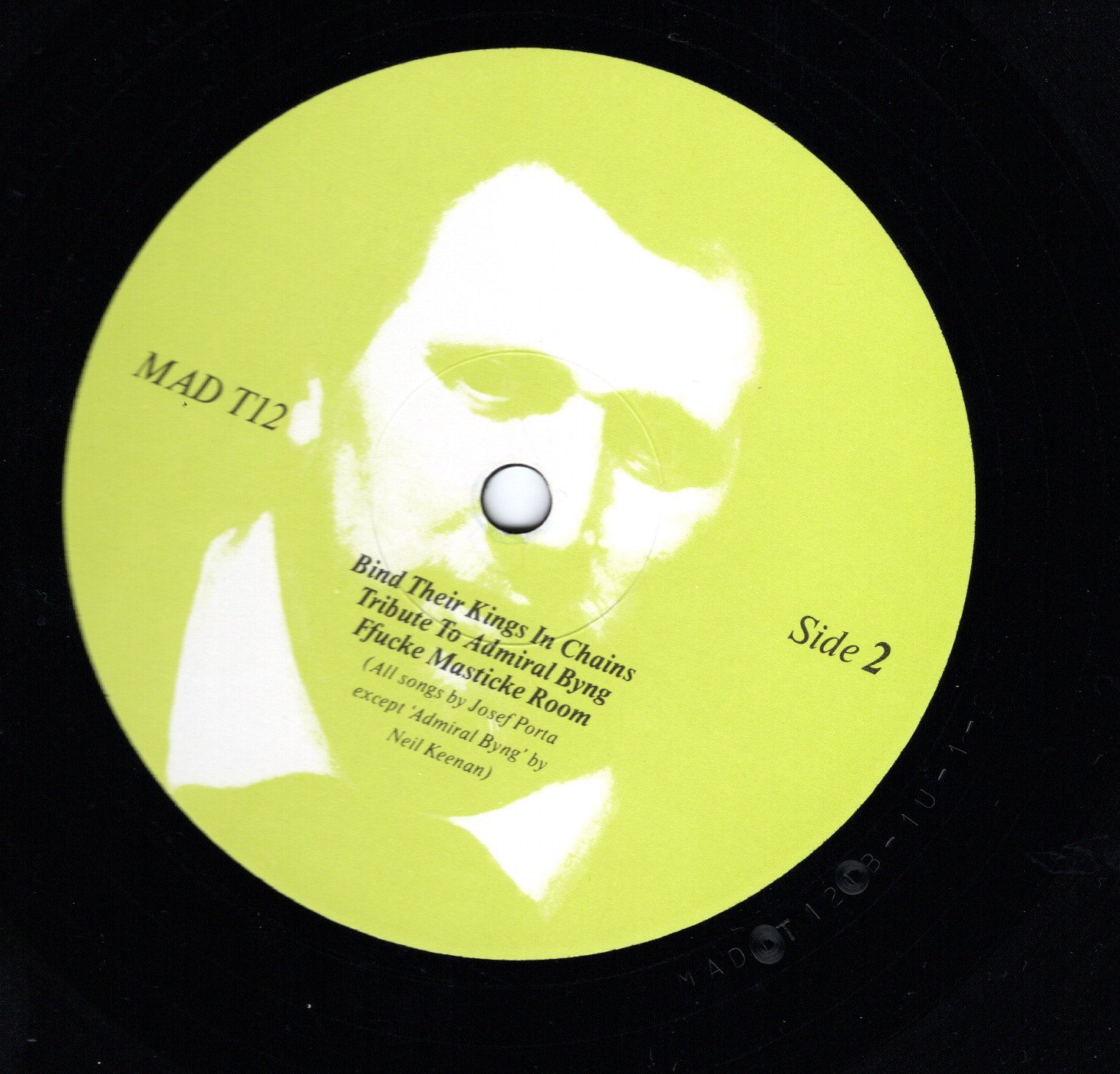
As mentioned Junction Signal was recorded in 1986 and released on All the Madmen and it is a recording that relevantly stand for what BP's early incarnation was about in terms of intents. Three of the four songs were recorded in Cold Storage studio in Brixton, a bigger studio, which, along with the presence of Grant Showbiz as the producer (he worked with bands like The Fall, Alternative TV or Androids of MU) account for the very clean sound of the 12''. I suppose you could argue that Junction Signal is slightly overproduced and you would not be entirely wrong as the songs would have benefited from a more direct, more organic sound (like on the song "Sordid tales" or the fist Ep that were recorded in Street Level Studio), however I don't think the production betrays the songs' nature. BP remain a highly difficult band to describe. Medieval anarcho pop punk? Anarcho folk rock? They certainly built on the catchiness of '77-inspired punk bands like Chron Gen or Naked, the moody poppiness of Zounds (Joseph also drummed for them) or Rubella Ballet, the strangeness of unidentified acts like The Fall or ATV and folk music. I have been told that Joseph's vocals were not unlike marmite, you either loved or hated them and I can see why as he has a very peculiar, dramatic accentuation and tone that makes him sound like a naughty minstrel or a medieval trickster. Whatever you think about his vocal style, it is at the core of BP's identity and completely unique as I cannot name another punk singer sounding even remotely like him. Another key element to BP is their almost excessive use of vocal harmonies and upbeat, infectious melodies that are but impossible not to sing along to. Some find the music too joyful, if not cheesy, and I can see why, as it is very accessible because of the intrinsically pop aspect of the music - even my mum could enjoy the music. Junction Signal is still a punk record though on the whole. The eponymous song is a Homeric mid-paced punk anthem full of harmonies with an epic singalong chorus that goes la-la-la and is just impossible to resist; "Bind their kings in chain" sounds akin to a medieval punky pub-rock tune with another brilliant melodic achievement for the chorus; "A tribute to admiral Byng" is an instrumental song demonstrating that you can be very tuneful without a singer; finally, the faster "Sordid tales from the ffucke masticke room" (it will be wisely renamed "Strawberries" later on) is an even more upbeat, sweet, bouncy and danceable number that makes me want to wear tights and jump around for some reason (but then, do I really need a reason to do that?). The lyrics (that you can read here) are unconventional for a punk band, closer to traditional folk music or even to poetry than snotty punk-rock. References to Thomas Hardy, Cromwell, the trial of Charles the First, adventure novels, mechanisation, pastoral tales, serve metaphors for social justice, liberation, submission, the need and desire to live a free life, the weight of history, but also loss and longing ("Who locked the door who holds the key who speaks the charms / Who gives His orders through the Junction Signal's arms"). I feel the imagerial words enrich the music and change its mood, confering a underlying sense of melancholy to the tunes that somehow balances the overall buoyancy, not unlike a bittersweet effect.

Junction Signal remains quite easy to find for cheap and another version of the Ep - in a 7'' format - also exists but with a blue cover and only two songs.  


Monday, 10 February 2020

Last Week's Trend is Now Passé (part 1): Political Asylum "Winter" Ep, 1985

It is hard to believe that it has been more than two months since my last proper review. To be honest, after Sonatas in D-Major, I felt drained, vapid, both uninspired and uninspiring. Of course, like any modern individual who believes in the performative power of virtual validation (the whole "like and be liked" paradigm) and actively seeks it, I was greatly confused by these feelings of self-doubt and insignificance. Why do I bother raving over proudly unoriginal d-beat bands or rough cavemen crust punk that actual cavemen would be likely to find a tad excessive? Does this existential scepticism and fear of irrelevance merely point to a coming mid-life crisis? If it is widely accepted that the average Joe, as he starts to get seriously bald, predictably buys a new flashy car to impress younger potential mates, then would getting some obscenely expensive Japanese punk records the equivalent for Western male punx who are reaching that same critical stage in life and thus have to wave goodbye to full on charged hair? I'm no sociologist but there could be some truth in this theory (it also works with obscure heavy metal and cheesy cold wave from the 80's obviously). 

Anyway, faced with the meaninglessness of life itself (oh yes, make no mistake, that is what has always been at stake), I decided to get back to basics for this first series of the year, and explore and revisit a couple of records and bands that, I feel, are underappreciated and you could say that this self-righteous, quixotic quest to promote and offer a critical insight about bands that our current superficial epoch unfairly ignores is at the core of Terminal Sound Nuisance, in that it makes feel somewhat useful and on the just side of History, a bit like a jedi but with a proper punk jacket instead of their hippie robe, although sucking hard at fighting and being shit scared of heights are rather unjedilike. 

So, basically, what I mean is that we should have a series about 80's anarchopunk from the British Isles, with a selection of 10 records that were all released between 1985 and 1989, a period that saw the decline of the anarchopunk movement and the rise of hardcore and crust in the UK. With the current renewed interest in the classic anarchopunk sound (although you could argue that the diversity of the movement renders such a concept irrelevant), the focus and attention have often been on the first half of the decade, and while I wholeheartedly enjoy seeing people get into classic '81/'84 bands, there is a relative indifference towards ulterior recordings, sometimes at the cost of overlooking genuine anarchopunk classics like Political Asylum's Winter.


It would be untrue to claim that Political Asylum were an obscure band back then and the mere fact that they were included on so many - usually homemade - compilation tapes in the 80's shows that they were a well-liked and rather popular band at the time, one that managed to sell 6000 copies (!) of their first demo tape, Fresh Hate. If Winter was PA's first proper record, they had recorded two demos before that, the aforementioned Fresh Hate in 1982 and the rather fantastic Valium for the Masses in 1984. It may look quite odd for a band to wait that long before releasing their first vinyl, especially at a time when anarchopunk was lively and at its top, and far lesser bands than PA got to have records under their belt. But then, if you manage to get your tapes around efficiently, tour a lot and get your message across, why bother doing a vinyl if you don't really need to (and I guess being young Scottish lads didn't exactly help either)? In our present day when more and more bands can release a full album before having even played ten gigs, the idea of taking one's time to put out a vinyl almost sounds blasphemous, but I suppose that many youthful anarcho bands of the time were just not as materialistic. Shame on them.

Despite the anarcho/UK82 trend that swept through the last decade and saw relatively confidential bands like Vex or The Mad Are Sane retrospectively gain a virtual cult status, PA, although one of the most important Scottish anarchopunk bands along with Oi Polloi and Alternative, are rarely discussed and, I suppose, seldom listened to (Valium for the Masses is not even on youtube, for that matter). At a time when self-proclaimed cool kids are prone to wear shirts from even the most obscure 80's anarcho bands, I have yet to see a PA shirt, a clear sign of a slight contemporary indifference toward the band. If they are a genuine classic anarchopunk band, PA never sounded like what we modernly reconstructed as "the classic anarcho sound". In fact, PA, with their overuse of vocal harmonies, their endless guitar solos, genuine prog rock moments and a folk influence, sounded like no other band and that's precisely what I loved about them. I remember being really confused the first time I heard them. I had ordered a cdr online and did not know what to expect as I was only aware that they were an anarchopunk band from the 80's and that was why I wanted to give them a go. I shall not palter with the truth and readily admit that the out of control technical solos almost killed me and in other circumstances would have had me burning the cd and calling for an exorcist, but there was a sense of melody, an incredible tunefulness and an intensity to the songs that compelled me to keep listening. Of course, they also had punkier songs that were easier to relate to (like "Disarm or die" of course), but the ones that really stuck were the moodier, darker ones. And I couldn't believe they just shamelessly ripped of a Black Flag line. I suppose it is the band's uniqueness that both made them quite popular at the time and rather unpopular nowadays as we always crave for comprehensible styles that can be pigeonholed, and while it makes sense to do so with the d-beat genre for instance, you cannot really do that with PA and with large fractions of the 80's anarchopunk world.    


I am not going to write about the band's history as they are well documented (their chapter in The Day the Country Died as well as the booklets to their cd reissues come highly recommended and showcase Ramsey's witty sense of humour). Suffice to say that Winter is one of my favourite anarchopunk Ep's of the 80's. It just has everything I look for in an anarcho record, it is angry and yet melodic, melancholy and yet strangely uplifting, the lyrics are political and sensible, the harmonies are perfect to sing along to it in the shower and I have even grown to like the epic solos. Winter may not really be classified as a punk-rock record nor is it a postpunk one, and I guess it effortlessly transcends genres without ever sounding artsy or even intentional. The song "Winter of our discontent", an obvious reference to the Winter of Discontent of the late 1970's, is a poignant antiwar ballad (I guess the term is somehow fitting) with plenty of harmonies and solos (the PA trademark) and an instantly recognizable opening. An absolute anthem that is authentically emotional. Ace. The next song, "Do they care", is a bouncy punk-rock number with a great vocals, a simple but highly catchy chorus and an eerie atmospheric moment toward the end. "System of war" is another beautiful, moving punk ballad that even the excessive use of solos cannot spoil. The folk element in the music can definitely be felt in the songwriting and in the ways PA conceptualized their two slower songs and there is an acoustic version of "Winter of our discontent" on 1992's How the West was Won 10'' which makes a lot of sense. The two issues I have with this Ep is the use of a drum machine (the cymbals were laid down afterwards) that sometimes sound a little unnatural and too mechanical and don't fit perfectly with the very organic and warm vibe of the songs, but I concede that it might make the Ep even more unique and different. My second issue is that Winter will always be the name of an Amebix record for me.   

Winter was recorded in early 1985 and released on Bristol-based Children of the Revolution Records, of which it was the fifth record (right between AOA's Who are they Trying to Con? and Potential Threat's Brainwashed). If you have never heard PA, today is your lucky day. Just imagine a fusion of Zounds, Chron Gen and Lack if Knowledge with a folk music vibe and a prog rock guitar player. Or maybe just listen to Winter and feel the unstoppable power of the harmonies. And sing along my friend, just siiiiiiiiiiiing.


Tuesday, 7 June 2016

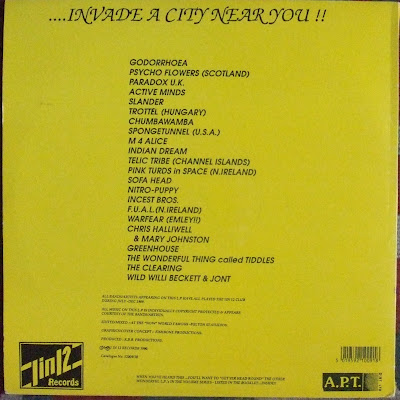
"Wild & Crazy "Noise Merchants"...Invade a City Near You!!: Worst of the 1in12 Club Vol.9/10" 2xLp, 1990


I always have a really good time whenever I go to the 1in12 Club. I haven't been there in a few years now to be honest (the last time was to see Antisect, Cress and Hellkrusher in 2012), but each time I went was a memorable one and the 1in12 remains one of my favourite punk venues (though it is by no means only a punk venue) and I particularly like that, as a venue and as a collective, it actually means something to support the 1in12.


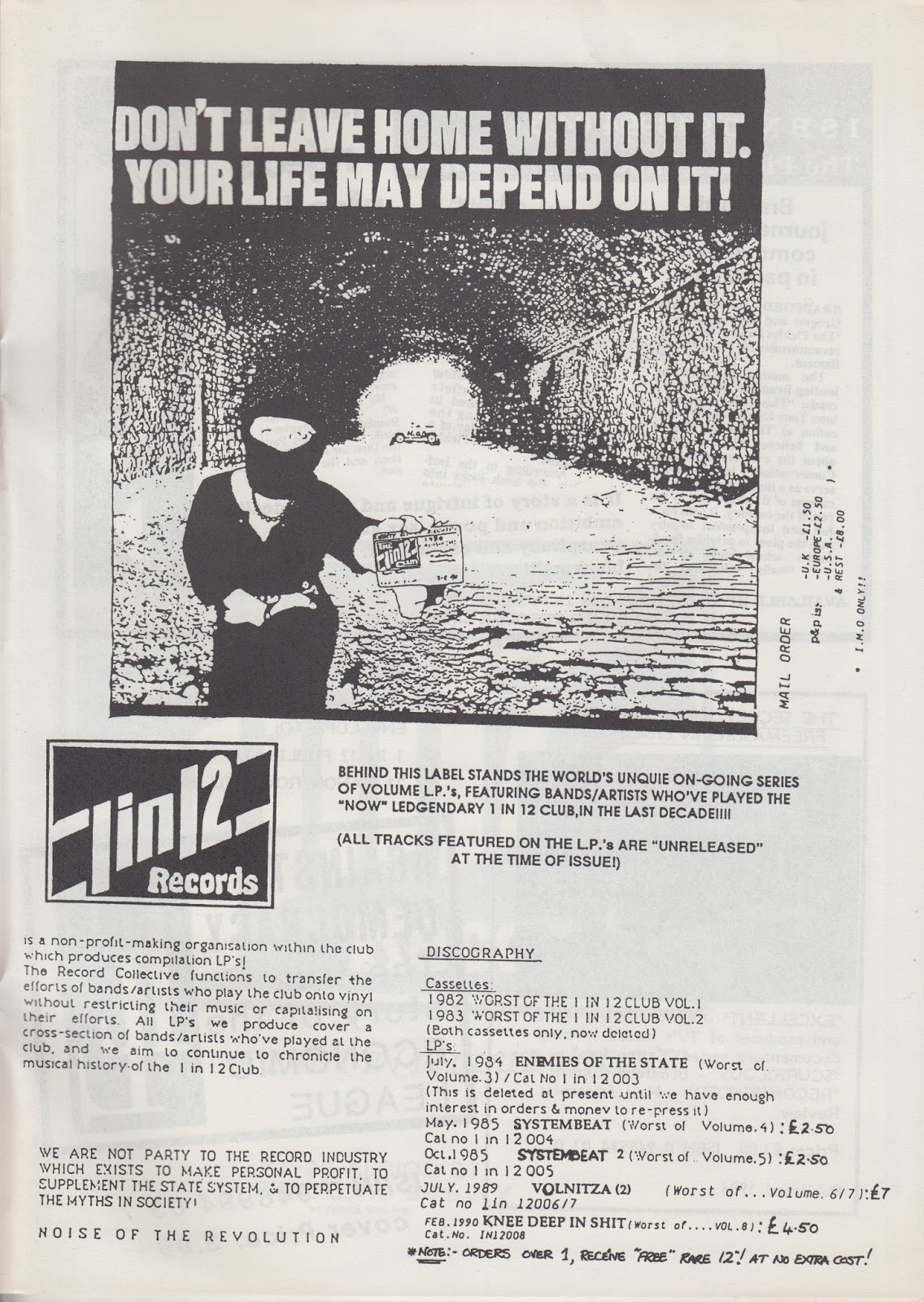
I am not going to dumbly rewrite the Club's wikipedia page nor its website but the idea behind the collective that started in 1981 as an extension of the Bradford's Claimants Union was to promote and work along the principles of self-management, mutual aid and solidarity and the opening of the actual building in Bradford in 1988 was a continuation of the collective's politics. Of course, because of the particular context which saw the birth of the 1in12 (meaning, Yorkshire during the 80's), the values of the collective's members meant that they quickly became connected with the anarchopunk movement (Leeds' Chumbawamba played for them countless times). Judging from the early flyers of gigs they put on, they certainly did not restrict themselves to punk however and worked with musicians that shared similar politics, were involved in activism or wanted to support a worthy cause. I am in no way qualified enough to identify with accuracy all the bands that played for the 1in12 in the early 80's but it doesn't take long to understand that the musical spectrum was wide, from folk music, indie-rock, goth to postpunk. Like New Model Army for instance, possibly the most famous rock band to ever emerge from Bradford...


Although very much rooted in local struggles, foreign bands also played for the 1in12 Collective in the early 80's like The Ex and other Dutch anarcho bands. Judging from the list of the gigs they organized on their website, the collective slowly began to book foreign hardcore bands from the mid-80's on (bands like Lärm, Die Kreuzen or BGK) but kept having non-punk acts playing for them. "Wild & Crazy Noise Merchants" was actually the sixth 1in12 Records compilation and the second one to be released after the club opened in 1988 (the first one was another double Lp compilation, "Volnitza"). Contrary to "Decade of Dissidence" that I reviewed here a couple of years ago, the line-up on this compilation is diverse and goes beyond the confines of punk-rock. Is it going to be a challenge? What do you think! Of course it makes perfect sense since the point of "Wild & Crazy Noise Merchants" was to include bands that played the 1in12 Club between July and December, 1989, and it didn't matter if they were a gruff grindcore band or a soft indie act. On a broader level, this compilation is also interesting because it captured the mood in the very last months of the 80's, this glorious and glorified decade. For the record, the last ever 80's gigs put on by the 1in12 saw Doom, Mushroom Attack, Warfear, Psycho Flowers, Pleasant Valley Children and FUAL play. Not bad, right? But let's get to it.


- Godorrhoea: incidentally, I consider the three opening songs as the real nuggets of the compilation. Godorrhoea were an obscure and short-lived Yorkshire band that was brought back to light a few years ago with the Ep "Zeitgeist" that was released on Looney Tunes and included all the band's recordings (not many of them). For a reason that I cannot quite comprehend, the Ep did not garner the band much interest. And yet, it is, by far, the best Rudimentary Peni-worshipping band I have ever heard. Peni belongs to that category of bands that are almost impossible to accurately emulate well and I cannot think of many bands that managed to pull it (Ciril did a good job but there were other things going on in their music). But Godorrhoea did it wonderfully, focusing on the savage and demented Peni sound of the first Ep's, they penned short and fast bursts of insanity-driven, asylum punk-rock. The three songs are heavily bass-driven and the lines sound like they could have been lifted from an unknown Peni practice. The most impressive achievement lies in the tense, almost uncomfortable atmosphere they recreated. It is a vision of a macabre Dantean circus produced by a madman's mind. Absolutely brilliant stuff. The lyrics are superficially non-sensical as the band played with syntax and word sonorities in order to confer meaning to their sound, not unlike in poetry: "Charlatan churlish chaplain churns out chapters of babble".


- Psycho Flowers: a Scottish anarchopunk band with a heavy, slightly metallic sound and gruff vocals that I already tackled when reviewing the "They ain't seen nothing yet" compilation Ep. Although not really spectacular, PF was a band that definitely heralded the typical UK hardcore punk sound of the 90's. "Who's the scum" was actually a rather angry diatribe about Napalm Death selling out and attested to the slow but unavoidable dislocation of the UKHC scene in the late 80's. 


- Paradox UK: beefy old-school punk-rock fronted by Spike, who sang for Blitzkrieg and ran Retch Records. I like Paradox UK. They had a heavy and groovy sound with a cool Motörhead influence and Spike had a raucous, rough-hewn voice that still sounded rather tuneful and I definitely recommend the "Disenchanted land" 12'' ep from 1990. The song "Abuse of power" was originally written by Blitzkrieg.  


- Active Minds: a tuneful number from Scarborough's finest anarchopunks. "Take it back" is about, well, taking control of our own lives and is reminiscent of Bad Religion, albeit with that typical raw sound that Active Minds have always had.


- Slander: one of the first bands that I reviewed for Terminal Sound Nuisance with their "Politicians cause it" 1992 demo. Slander were from Hull and epitomized perfectly the 90's UK hardcore-punk sound, updating the classic sound of GBH, The Varukers or One Way System with a more modern, heavier production (which didn't alway work, let's face it). Slander remind me an awful lot of a beefed-up Mau Maus, especially the vocals. "Freedom" is a good song with a cracking heavy bass sound that carries the whole thing. It is about the fall of the Berlin Wall and how capitalism was quick to invade the newly "freed" countries, thus replicating the same system of Western exploitation. Pretty dark and angry lyrics. I like it.


- Trottel: a classic anarcho band from Budapest that is relatively famous in France (we do love experimental punk-rock over here and they play quite often). Trottel have been playing since 1985 and truly developed a sound of their own throughout the years. I am not familiar with all their records but the song included here is great. Female-fronted anarchopunk with a psychedelic postpunk feel, not unlike The Ex jamming with Contropotere and Dog-Faced Hermans at the Post-Regiment's house or something. It is really good. 


- Chumbawamba: of course, they were going to be included on this. This is late 80's Chumba, very poppy, not unlike Madness I guess. This is music that would not scare off your granny. The lyrics are smart and subversive, as usual for them in the 80's, and were a tribute to Harry Goldthorpe, a sociologist from Bradford that worked on social classes and was an original "Bradford bad lad". 


- Spongetunnel: a band I know virtually nothing about... They were from Chicago and released a couple of pop-punk records in the late 80's. One of the blokes, Russ Forster, also ran Underdog Records. Musically, I cannot say that it is my cuppa tea as it is too rock'n'roll-sounding for me but I can imagine people getting into it.


- M4 Alice: now we are talking. Absolutely brilliant and inspired English gothpunk. M4 Alice is a band that sank into the punk netherworld and completely escaped me until I unearthed this compilation a few weeks ago. How I could forget about such a good band will remain one of Humanity's greatest unsolved mystery. There is little information floating around about M4 Alice. I think they were from London and released two records in 1985 and 1988, the latter being distributed by Plastic Head which makes it even more unexplainable that they remain so obscure. Granted, they played a genre which had probably become unfashionable by the time they were around, but there is quality in the songwriting and had it been released on a PDX label in 2012, people would be all over it. Of course, it is reminiscent of classic bands like Sisters of Mercy or Sex Gang Children, but I also hear a strong deathrock influence, some "Cacophony"-era Peni arrangement and some of the demented psychedelics of Smartpils as well. A definite highlight of the compilation. 


- Indian Dream: formidable anarchopunk from Scarborough. I already raved about Indian Dream in the article about the tuneful side of 88/92 anarchopunk but they are a band I cannot get enough of. Indian Dream had this fabulous classic UK 80's anarcho sound and aesthetics (without mentioning the cheesy, idealistic moniker), tuneful and melancholy, with strong female vocals, postpunk guitar leads and catchy choruses to die for. "Our land..." is a rather moody, poppy yet dark, song about racism and nationalism that is sadly even more relevant today than it was then. If you are looking for the perfect blend of Lost Cherrees, Omega Tribe, Karma Sutra and Skeletal Family then you are in for a proper treat. A winner.

- Telic Tribe: that is a really obscure one as Telic Tribe only recorded that one song and the internet remains silent about this lot. First, like Indian Dream (and in the spirit of City Indians, Flux of Pink Indians and Omega Tribe), a name like Telic Tribe suggestively indicates pacifist anarchopunk with tunes and second, the artwork and lyrics reminiscent of The Mob points in the same direction... Am I mistaken? What do you reckon? Telic Tribe played indeed dark, moody, if not mournful, mid-paced anarchopunk that is really quite impressive. They remind me a lot of The Next World's most melancholy songs (especially in the vocals) and of Kulturkampf. Telic Tribe were from the Channel Islands, Guernsey, which was very uncommon, and apparently had a demo that I am dying to hear. 


- Pink Turds In Space: I have always loved PTIS but their name probably rates as one of the worst ever, especially when you consider that they also had quite serious political lyrics... Oh well, that was the sense of humour of Belfast punks I guess. Fast and thrashy hardcore-punk with amazing, striking raucous female vocals. PTIS were made up of ex-members of anarchopunk bands like Toxic Waste and Asylum and after the band's demise, some of them formed Bleeding Rectum in the early 90's, an equally unfortunately-named band that is still very much worthy of attention. Of course, "Teenage kicks" is a manic, punk as fuck cover of The Undertones. 


- Sofa Head: yet another band that was tackled in the article about the 88/92 era of anarchopunk. Sofa Head was very much the continuation of the amazing Dan with a new singer and Lainey from HDQ and Leatherface on the drums. They played female-fronted tuneful hardcore-punk influenced as much by the UK scene as the US one. The guitar leads are crispy and melodic and I cannot help thinking that a band like Sofa Head must have been an important influence on bands like Harum-Scarum or Mankind? The song "Invitation" was recorded live and sounds much angrier than the studio version. 


- Nitro Puppy: a band totally unknown to me from Brighton. This is sadly not my thing at all. Grungy garage punk that still might appeal to some I presume.


- Incest Bros: aka Incest Brothers from Leeds, a fun-loving, silly hardcore band that always puts a smile on my face (after all they did headline the "Totally Crap Festival" with Skum Dribblurzzz in 1985 and had a demo entitled "Ugly but proud"). However, Incest Bros were much more tuneful than their name suggests and played fast and anthemic US-flavoured hardcore-punk with some great bass lines as the song on this compilation shows. 


- FUAL: probably one of the best punk bands ever to come out of the Belfast scene. FUAL was made up of people who had been involved in bands like Stalag 17, Toxic Waste or Crude and Snyde during the early days of the Ulster anarcho scene. This was a really innovative band that could play fast hardcore music, dark and moody punk-rock or upbeat poppy punk. The vocals of Louanne were incredibly powerful and strong, neither really sung nor shouted but still able to convey a whole range of conflicting emotions. It is difficult to find points of comparison when dealing with such a unique band but I guess that FUAL would have been comfortable sitting with Leatherface, Stalag 17 and Potential Threat. "20 years on" (here in a live version) was a song about the political situation in Northern Ireland and a criticism of the idealistic and dogmatic vision of Chumba about this issue that they expressed on their "Revolution" Ep. FUAL were compelling and possibly one of the very best anarchopunk bands of the late 80's. Top shelf.


- Warfear: of course, there had to be at least one song of utter aural savagery on a late 80's compilation from Northern England and Warfear proudly took this coveted spot. Most people who weren't there at the time (and even if they were, Warfear was pretty much a local band) must have discovered the band through the Crust War Lp reissue of their various demos from 2007 but Warfear actually did manage to appear once on a proper record in their lifetime: "Wild & Crazy Noise Merchants". Warfear was made up of Rich from Sore Throat on the guitar, Bri Doom on the drums, Chris (who would play in Health Hazard and Doom later on) on the bass and one James on vocals. As you can expect from such a line-up, Warfear played blown-out, fast and brutal crusty hardcore that, of course, brought bands like ENT or Chaos UK to mind, but was also very much influenced by noisy Japanese bands like Gai or Kuro. "Dig your own grave" is a raw, aggressive, groovy, pummeling number with undecipherable barking vocals. Just fantastic. 


- Chris Halliwell & Mary Johnston: oh boy... How am I supposed to review this? This is a folk song with a distinct Americana feel but I know nothing about this genre so I am not going to delve too much into it. I like the voice of Mary though. 


- Greenhouse: well, this is indie rock music with a punk vibe. I never thought I would have to write an indie band but here it is. Greenhouse appeared to have had some sort of success as you can find proper music videos of their songs on youtube and they released quite a few records. It is pretty catchy and uplifting and I must admit that it can work on sunny days.


- The Wonderful Thing Called Tiddles: what an albatross of a name... But it is actually much better than I remembered it to be. Dark cold-wave with a drum machine and winding guitar leads that is aptly depressing, sad, ethereal and urban. I wish I knew the genre better It must work very well on rainy days.


- The Clearing: this is... postpunk music with a strong poppy feel. Pretty catchy as well, this could definitely have achieved some kind of mainstream success. The mood of the song is rather light and uplifting but there is a dark undertone to it that makes it quite memorable and I can definitely imagine myself dancing to its great tunes at an after-party. Apparently The Clearing only appeared on this compilation. 


- Wild Willi Beckett & Jont: a local Bradford duo that played weird folky and dark experimental music with dark ominous music. I unexpectedly like it actually. Both Jont and Beckett also played in the Psycho Surgeons, an insanity-driven postpunk/goth-rock band that used theatrics and sounded like a mix of New Model Army, Sisters of Mercy and Southern Death Cult. Not a bad way at all to end the compilation actually.  


And I will leave you with the own words of 1in12 Records:

"We are not party to the record industry which exists to make personal profit, to supplement the state system & to perpetuate the myths in society! Noise of the revolution."