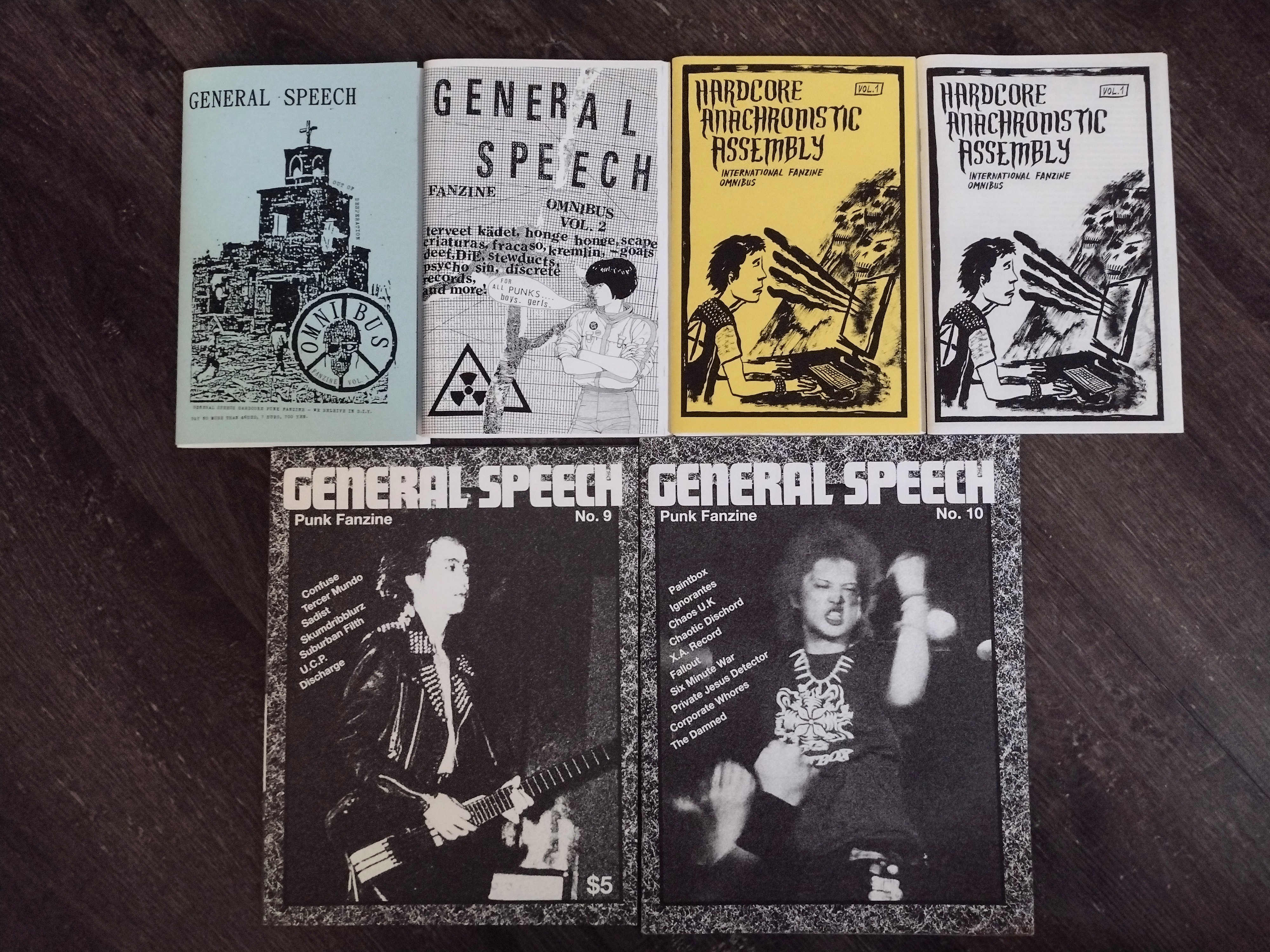
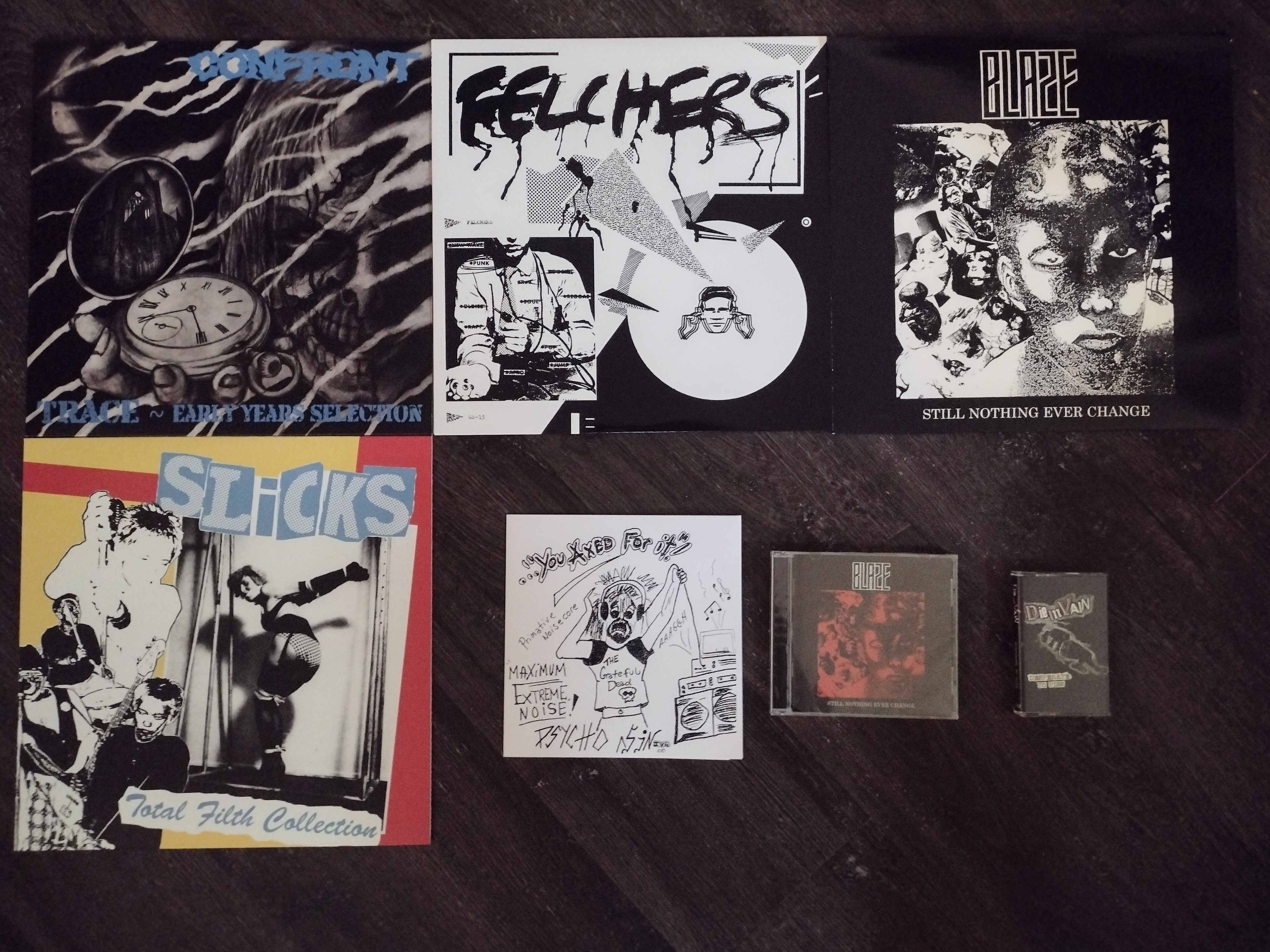
It is with much pride that I present to you the third interview conducted by yours truly for Terminal Sound Nuisance. This time I sat down on a comfy chair with Tom from General Speech. If you are not familiar with it, GS is a tentacular entity based in Lexington: fanzine, record label, distro and Discharge fashion outlet. Sheer brilliance. I have always enjoyed Tom's work because of the dedication and the passion pervading his writing but also because of the minute accuracy, the careful craftsmanship and the knowledgeability of his outputs. Even when he writes about bands I don't particularly care about, he manages to keep things interesting and engages the reader. You always learn something out of it. The man is so good that he can turn Asylum into Mozart. Genuine love and faith into punk-rock. But enough arse-kissing.
The interview is pretty massive and we went from rather light topics, like the future of global punk music impacted with the ever-changing listening practices, the relevance of physical forms in the face of technology, to much more serious issues like homemade Discharge badges. We went deep. Tom makes very valid and thought-provoking points so I strongly encourage you to read our verbal exchange, especially since it makes both of us look really smart and sharp. Of course, this is a conversation in process and punk being a collective entity, I strongly encourage everyone to bring new thoughts and arguments to the issues discussed.
Massive thanks go to Tom for taking the tie to answer the questions with the utmost seriousness but then I expected no less from him. Cheers mate. Up the punx and all that.
Terminal Sound Nuisance: Alright then, let’s start with some basic information. Would you please introduce yourself to readers who might not be aware of your work? No need to include your blood group.
General Speech: I'm Tom, and I live in the USA. I've been doing fanzines, and a distro since around 2007, but I didn't adopt the name General Speech until around 2011 when I started a new zine and the record label. Since most people think I'm old if they only talk to me online, or really young if they meet me in person, I'm 34 years old.
TSN: What is the band or the song that initially got you into punk-rock when you were a teen? Was that a specific moment or was it more like a process?
GS: It was definitely a process. I heard it in secret at night on the radio. Most times I had no idea what it was cause I was listening at a very low volume, and my recorded cassettes sounded really bad. Some bands like Suicidal Tendencies or Black Flag I didn't know what it was until 2-3 years after I heard it, and I didn't know it was called punk at first, I just knew I wanted to hear more. I think the bands that were most pivotal at various stages were Ramones, Bad Brains, and then Crass and Discharge. Each of these was just like opening a deeper door of interest I couldn't return from.
TSN: When and why did you start the General Speech fanzine? What was the main idea behind the project at first? Why did you want to do a paper fanzine at a time when they were, by and large, already becoming a thing of the past (or are they?)? How would you describe your fanzine to someone who does not know much about punk?
GS: I had been doing zines a few years already. I was doing around 400+ copies per issue near the end and I was spending less time on correspondence and letter writing which I loved, and more time printing and stapling zines and filling orders. I just sort of wanted to change. I think as people progress in their work, sometimes you just want a fresh start, or feel like you want to go in a different direction than what you originally started, and that was the case.
When I made the change to General Speech, I'd do around 150 copies per issue and it was sent out for free to people who were doing zines, bands, or close contacts and friends. It was a better way to refocus on the communication and network of friends aspect. I think that physical aspect of communication was also why I wanted to a paper zine instead a blog which was popular at the time. I later collected issues 1-4, and 5-8 into omnibus issues that sold in higher quantities.
Of course as time went on, the internet and social media made mail correspondence less necessary, and climbing postage costs made trading more difficult. Smart phones have allowed me to be more productive and work or write or email in the little moments where I have 3-4 minutes here and there. I'm doing this interview on breaks at work. It all adds up, and I can accomplish more now than I did then. Correspondence is easier, but also sadly less detailed a lot of the time. And I'm back to doing bigger print runs, since I can squeeze in more work here and there, than I used to, 1000 per issue, and about 200 per month of a smaller monthly zine called General Speech Supplement that's more along the lines of the earlier free half sized General Speech issues.
TSN: What are the contemporary and old fanzines that inspired and keep inspiring you?
GS: I have to give a huge thanks to MRR. I come from a small town without much or any punk stuff happening. My first zine review got 2 dozen letters in a matter of a couple weeks, and that alone was enough for me to keep going. I think R'yleh Rising and Warning were the first that inspired me on a level of "oh anyone can do this". As I started discovering older zines, I always held the deepest respect for the passion and obsessiveness I felt, almost like a camaraderie, from the 80s UK fanzines Final Curtain and Raising Hell. Both seemed like punk was the most absolutely exciting thing on the planet for them, and the enthusiasm just pours out in their writing, and layout and every aspect of the zines. To me, punk is still just that. The most exciting thing on the planet.
TSN: And what about the record label? Discogs tells me that your first release was 2012’s Confront Ep. Was that something that you wanted to do for a while and the opportunity just came about? Or was it supposed to be a one-off that turned into something bigger? Again, what were/are you trying to achieve with the label? What kind of bands do you want to support and promote through the label?
GS: I think the first release I wanted to do was the Decay 7". I had been chatting with Pablo, who is an absolute legend, wealth of knowledge, and for decades did his own bands and zines, and label, Strongly Opposed. When he told me that the Decay 7" was never pressed how they originally intended, since the cutting engineer thought it was too distorted, I thought I'd like give it a try to do it from the master tape and get it closer to what the band wanted.
Around the same time I had mentioned this my friend Zach who did the label and zine Not Very Nice, among others, and around the same time Confront had been looking to release a 7", and Zach and I were both fans, so we did it together, and I think Confront just got done first, but both were started around the same time.
I knew I wanted to do a label, and from the beginning that the focus was just going to be records I wanted to come out to have in my own collection that I thought may not come out otherwise. All of them are passion projects you could say. Luckily they've all done well so far.
Looking back, I think that Confront was the easiest release on the label. There was no social media, no Bandcamp, no real marketing other than just good old fashioned flyers and word of mouth, and emails. We sold out of two pressings quickly. Since then every release seems be harder and harder to keep people's interest, as people move further towards using Spotify or YouTube as their primary music source, and as social media becomes key to getting the world out about releases.
TSN: Finally GS is also a distro. How did it start? The selection of records is quite specific again. Could you tell us how you select your catalogue and the labels you strive to distribute?
GS: Like I mentioned earlier, I live in a place where there are not many people into punk. The record stores certainly don't have any current DIY punk releases, so I started mailordering a lot from an early age. At one time there were enough local people interested where I could buy 5-10 copies of a record I wanted and have a few to sell to other people. I think it was both a desire to share good music with people in a place where there wasn't much of it easily available, and also as a record collector a way to get new records without actually spending much of the money I was making at my job.
Eventually it got to where very few people locally were buying records so I eventually started a website and sold online. The focus of what I stock is things I usually want and am personally interested in. There's not a record on my website usually that I don't enjoy. I am one person, and doing this is obviously work, so it makes it easier to sell records you're enthusiastic about. Running a record shop is harder because often you have to cater to what customers want, even if you don't like it. I get the luxury of just sticking to what I enjoy. It makes reviewing easier, and my email newsletter easier when I can write honestly and positively about things.
I think people enjoy it as they begin to pick up on what my tastes are, which are pretty diverse, and know in a sense they can trust things I get in even if they haven't heard it. So while you may see some raw punk or 77 classics, you may also get a cool garage or psych rock, or extreme metal reissue in the mix that I usually don't stock unless it's got a unique appeal to punks, and I've had some people check them out and really enjoy things.
TSN: Seriously how many hours do you spend on GS as a whole, fanzine, label and distro included? Do you also have a dog called GS? A tattoo?
GS: It's hard to quantify it. I should probably keep track, but at the end of the day this is a labor of love, not a job. On the distro, between 2-20 hours a week. Some weeks I have 10 orders, some weeks 200. But it's rarely more than I can handle.
Each release varies as well. The Deef records which I'm working on now have been countless hours and first steps taken almost 10 years ago. But others just sort of come together fast and get done fast. Some releases just have more hurdles to get over than others.
The larger issues of General Speech I spend sometimes 100 hours on. The smaller monthly issues I've been doing sometimes I get done in 2-6 hours, and that includes going to the print shop and printing them. I intentionally try to do them fast cause otherwise they don't get done. In fact I'm very behind on them at the moment after a particularly busy month of travel and punk shows.
I surprisingly don't have any tattoos, and I no longer have any pets, but love cats and dogs and animals in general.
TSN: The interviews you conduct and the pieces you wrote for the fanzine are very detailed, knowledgeable and contextualized, much more so than the ones you can read in more mainstream and lazy music papers. What is the process behind a typical GS interview and article? How much time do you usually spend? Have you ever traveled to interview someone?
GS: I think when you are passionate about something it's easy. Or it becomes easy. I got a lot of positive feedback on the Damned article I wrote in the last issue. I think I wrote that at work on my phone in around an hour or two during breaks, and then edited it later. Just all from memory, and then went back and double checked details here and there on records. They are my favorite band, and the band I've spent the most time with, and own the most record by, so it felt easy.
Other times there's a conscious desire to do something that can't be found elsewhere. What's the point of regurgitating things about bands we all know and love that can be found online with a little digging. This is basically what modern music journalism feels like to me. It's boring, and if I'm going to compete as a paper zine people have to pay for, against online music journalism and various resources online that can all be read for free, I better be trying to make it interesting, so sometimes I spend a good amount of time on things, and on interviews.
I've never travelled to do an interview, but a couple times like with The Assassinators, and Terveet Kädet I saw them on tour, wasn't able to interview them at the show in person, so I gave my interview questions to them with an SASE to do in the van and mail back to me.
I was going to drive a couple times to do interviews that didn't end up happening though. At the end of the day, if it's something I want to do bad enough and is punk, I'll travel or do whatever to try and make it happen.
TSN: The interviewees often told stories about their works or the band’s history or anecdotes or very specific elements of context. How do you think such smaller pieces of bands’ history tie up and are woven into the global punk history and narrative?
GS: I'm a detail oriented person. I'm also the sort of person who thinks that trying to apply a narrative to punk as a whole is both impossible and foolish, as to do so, you have to emphasize one person, one band, one era, one scene, one country, etc. at the center of that narrative. When you do this, it erases the beauty of punk which was that it was global, and every participant was equally as important, and anyone could participate. Any underground subculture stands on the collective effort of its participants, not just the accomplishments of a few.
I think you can apply this to any history, but especially punk, and so I don't think one glaringly obvious detail is necessarily more important than the small ones, because they all make up the collective experience of punk, and sometimes the small details are what resonate with some people, and the obvious ones are what resonate with others.
For instance, a few years ago I found a great original press photo from a Swedish newspaper in the late 70s or early 80s of Ebba Grön. It still has the grease pencil markup around one the members indicating how to crop and size the photo for print in the newspaper article. I could easily remove these grease pencil lines, and the photo would look much nicer, but I left them on, as it was a great example of a journalist applying a narrative that likely missed the mark of what punk is about. They are focused only on one member of the band, while outside the frame of what what they marked on the photo is the audience, with a punk around the age of maybe 12, having the absolute best time of his life. He has a look on his face that all of us have felt while watching a truly amazing band, it's that feeling like punk is the greatest thing in the universe. To me, I bet that kids memory of that night is more interesting than what the band member would have to say about it. Without that kid and everyone else there, punk wouldn't be the same.
So I guess just as a general habit, I like to soak everything in, and consider it all potentially important, even if it may not be particularly important to me personally.
TSN: Some of the bands you deal with are very obscure, and/or sometimes, arguably, unlistenable. Aren’t you afraid to alienate a large part of punk readers who might not be as well-versed as you are? Or is GS intended to be a more nerd-oriented thing? Would a younger punk be able to get into it? Have you had feedback about that point?
GS: I can't say I've had feedback to that degree. I think part of it is that young people probably don't buy zines as much as the people from the generation they were ubiquitous to, so perhaps what you say is valid, and I just don't have any way to know for certain.
I'm not sure I really care though. I'd love for young people to get into zines and to read General Speech, but also young people should figure out punk on their own, and do their own thing, and they will. It's not a necessity for young people to grow up to love Plasmid and Confuse and Skumdribblurz. If they grow up loving Warthog or whatever bands are cool in the scene right now, and find a place with the same positive acceptance that I did, then punk is still alive and all is well. Young people probably don't really care about things exactly the same way as your and I's generation, and that's fine.
I think the one thing I do have going for General Speech is that even though sometimes the stuff is obscure, people tend to find it interesting, and it's coming from my personal perspective as a fan writing a fanzine, and a place of honesty that people tend to latch onto, and appreciate. So sometimes I do get feedback that's positive from younger people. Like in my monthly zine I've been covering some things that are so obscure I wouldn't even consider covering them in the bigger issues of General Speech, but I think at this point young people who missed the age of zines and blogspots find it fascinating that there is still so much absolutely crazy stuff that you just can't stumble across on YouTube or Spotify.
TSN: How do we get the younger generation into punk-rock these days? Is GS an attempt at converting the youth?
GS: I think by adapting to social media trends, and also supporting what young people are doing creatively. I think if you really wanted to reach the maximum number of young people with the sort of content I'm putting in General Speech, YouTube shows or podcasts are the way to go. The younger generation is dialed in a completely different way to what most of us slightly older punks are, and there's a huge gap in DIY content on these platforms, but I think there are plenty of people who want to consume that content if it existed
I have been asked multiple times if would ever consider doing a podcast, or videos, or put together Spotify playlists for people. Maybe it would be nice if that existed, but I think it becomes hard to align DIY values with a world increasingly ensnared in corporate technology and social media platforms, advertising, etc. I haven't quite made up my mind yet on the pros and cons of putting stuff out there that's putting more revenue into corporate pockets than I already am with PayPal, social media sites, and other companies that are just sort of ubiquitous if you are doing any sort of business online.
On a more local level, never forget the importance of all ages gigs, places to play, and congregate. I've seen my city go from a place where 15 years ago there were 50-200 people at most punk shows from 14 years old to 40 years old, to where there's not really anyone under the age of 28-30, primarily due to there being an entire decade where there was, and still is no place to see or play music if you are under 21. If you don't find punk as a place to belong by that point, you're probably going to have tried to find something else.
TSN: I am under the impression that the scope of GS in terms of style (see the great article about The Damned) and investigative accuracy is becoming larger. Am I right? And if so is that a conscious decision?
GS: Hmm, I almost said no, but I think it's a conscious decision. I hate that there are so many inaccurate pools of information on the internet. With user sourced websites like Discogs and Wikipedia, and video descriptions and comments on YouTube that are just so inaccurate , and then you even see a lot of this regurgitated elsewhere as if it was fact? It's concerning. I read about punk a lot, in books, in zines, on the internet. It's frustrating to see our history sort of getting smoothed out and details lost so quickly after it's happened when we have more tools available than any other generation to preserve it. But I think this is just the struggle with preserving any history.
Another peeve of mine is Instagram accounts that just repost photos they find online with no info, or poor or inaccurate information. They are seen by thousands and are sort of the bottom of the barrel when it comes to internet punk content. So I want General Speech to try and avoid the spread of misinformation. Sometimes it's even information that would be completely obvious with something as easy as just owning the record. So yeah I guess I want General Speech to feel sort of trustworthy and authoritative when possible.
As far as scope, I like a lot of stuff, but the scope will forever be what I want to write about. I love early punk, but there's a ton written about the classics. It's not as exciting to me to cover. I also feel like most people reading General Speech are a bit more knowledgeable, I don't need to cover basics. If I write about them it's going to be in a way that feels like G.S. It's going to have a bit of my flavor to it. If someone reads it, and it's over their head, there's no shortage of other things to read and get up to speed in that area.
TSN: You obviously are very much into Japanese hardcore punk bands, you did interviews about very precise aspects of Confuse or Paintbox, and released some unknown (to most) noisepunk or 90’s Japanese hardcore records. When and how did your passion for Japan start? And why? The scene has always been very popular and exerts a fascination and an attraction that has arguably no equivalent. Any theory as to why? What makes Japanese bands so unique according to you?
GS: I can pinpoint the interest to hearing GISM on the PEACE comp which I was lucky to find very young. Actually that comp sort of ignited my love for global hardcore in general, but GISM was the craziest thing I'd ever heard up until that point, and then I heard Confuse...
It's hard to say what draws the fascination to it, but I think it's because of my own sort of hardline stance on punk, and feeling a level of camaraderie. Punk is my life, for better or worse. I couldn't get rid of it if I tried. I think for some people who get into punk, and then get out of it after a few years, got into it maybe as an interesting social scene, or they may have just enjoyed the high energy music, and physical release of live shows.
For me, I've always felt a deep rebellion against oppression, complacency, etc. and an intrinsic alignment with DIY, self reliance and responsibility. The facets that make up punk outside of just the music part. The fact that the music and community are also something I feel strongly about has sort of built a connection I can't ever imagine giving up, and I take punk seriously because it's the thing I care about most.
Japan seems to have a more homogeneous society than we do, and to be punk, is a harder decision because you are basically opting to step out of society permanently by being different. It's not an easy choice cause you may not be able to go back as easy as you can here, and if you're punk there, you tend to take it seriously. This comes through in the music, the fashion, and the fact the scene tends to age and still remain active. I think it's something I just naturally bond with.
TSN: Now let’s talk about noize. You are obsessed with raw noisy hardcore punk, the messier the better as the Skumdribblurz interview can attest. Why? A lot of those 80’s UK bands (System Sikness, Sons of Bad Breath, Eat Shit…) are objectively unlistenable and quite terrible, as much as I personally enjoy them, but why do you feel they should still be documented? What is so enjoyable in such inept punk bands? Like The Decay for example?
GS: I think one of the most pure expressions of punk is people doing punk when it's the thing they want to do more than anything else in the world. The bands you mentioned couldn't play, yet their love for punk was so strong they tried by any means to overcome it and do it anyways. I'm a firm believer that there's a lot of unwritten, unspoken languages in music. Things science can't explain, and things I don't want to be able to be explained out of fear they could be artificially mimicked. But those bands tend to have an energy and emotion emanating from them that is warm, and comforting. It's the energy of enthusiasm and reckless abandon, and love for what you are doing. Sometimes it's so bad you just have to laugh, but the world is a fucked up place and sometimes we need fucked up music that still reminds us to have enthusiasm, reckless abandon, love, and sometimes just to laugh. Any band that makes someone feel like that is worth documenting.
TSN: Can you talk to us about the upcoming Nottingham Nightmare Lp? And what bout Hysteria Ward? How did that one come about as it is not really a « typical GS band »?
GS: Nottingham Nightmare will shine a light on 4 bands from that area, who never managed to release anything properly back in the day, yet despite not releasing anything, the bands from Nottingham had a sort of undeniably strong influence on the evolution of extreme music, especially Skumdribblurz. I've got a few things I want to do first, and obviously the audience for this release is small, but it's certainly a record I'd wish for in my own collection, so I'm going to do it. It came about after years of correspondence with Tim from Skumdribblurz, and inheriting what had remained of his cassette collection. There's a lot of stuff in there no one has heard like Skreechy Skroochers, dozens of Skumdribblurz tapes, Genocide Association, Nightmare of Noyze (ex-Skumdribblurz), System Sikness (Pre-Intense Degree), Utterly Bum, etc. It's intense and depraved music and needs documenting for the very small number of people who care.
As for Hysteria Ward, it may surprise people that my biggest love is actually 70s and 80s UK punk. I own twice as many UK records as I do American or Japanese records. I love the All The Madmen label, the Mob, Astronauts etc. and Hysteria Ward was like a hidden gem released right at the time the label fell apart, so there's very few copies and a lot of people hadn't heard it, but really it was good enough back then to have been a real album, but I just don't think they had the money. I felt like maybe it would be overlooked and no one would ever do it, but then around that time there was a wave of resurgence and interest in goth and post punk in the punk scene, so I decided it was a good time to try it.
It was easy to get in touch through some UK friends and the band was very easy to work with and I still keep in touch with Lou the vocalist. Of all the reissues I've done, I get the most email years after that release thanking me and saying what an amazing record it is. It resonates with people. I think the timing was good, and it helped that it was great and beautiful music.
TSN: Were there tears of joy on your face when the Asylum reissue came about?
GS: Absolutely. Well, I had the behind the scenes look too, as it was coming together. I talk with the guys who put that release together regularly, and knew it was going to be phenomenal, but when it was actually out it was just perfect. The perfect reissue. All the details I'm obsessed with, like a 70s UK Delga Press style pocket sleeve with the flaps on the outside and die cut pocket opening, that's stuff Clint and Paco and I talk about all the time, and things that probably like 5 people care about in the world, but it just makes for a very enjoyable feeling to hold it and think about the care that's gone into it.
TSN: The focus of your zine is quite international which I think is very important. In spite of the immense knowledge available about international bands, I am sometimes under the impression that we too often tend to focus only on renowned punk scenes (Japan, Sweden, Britain, Finland, the US) and discard bands coming from smaller countries and scenes that are not as fancy. Would you agree? Could you recommend five current bands from « smaller » and « not as fancy » scenes?
GS: Most definitely. I think there's two problems, one is that bands from smaller places don't have the exposure bands from bigger cities have. This isn't even on an international scale. For instance people can probably name more bands from Colombia than American states like Mississippi, Alabama, South Carolina, Maine, Wyoming, Montana, Idaho, Utah, North and South Dakota, New Mexico, etc. There's just not as many resources, and opportunities in smaller places that make it possible for bands to connect and get noticed by the global punk scene, even if you're digging pretty deep.
The second problem is smaller towns and small places it's more difficult to find people who all have a shared vision for a band, and often times relationships and creative differences between band members where there's not many people to play with, leads to more compromise to appease your band mates, and sometimes the music doesn't turn out as good when you can't come together on a shared vision or shared goal. There's also little in the way of bands that are your peers, so it's harder to hone your skills and have a bit of friendly competition and improvement against other bands. In a place like New York or Tokyo, there's hundreds of bands you are competing against. It's easier to see what people are doing well and not well, and use those lessons learned to improve your own band. In smaller places, you may be the only band, so there's not really the opportunity for younger bands to see other bands leading by example. I think because of this, sometimes music from smaller places just doesn't quite reach the level of quality as other places which makes it less desirable to seek out. Of course there are outliers, but I've seen it enough to think it's definitely a real problem. Most people who have the real drive to do something greater end up doing whatever they can to move to some place with more opportunities if they feel like they don't get them where they are from.
Some bands I'm loving right now from less mentioned scenes are Die In Vain from Istanbul Turkey. They play simple and catchy punk influenced by bands like The Partisans but with the slight rawness of bands like Chaos UK. I released a tape by them earlier this year. Morbo from Peru continue to release my absolute favorite record of the year when they do release something. Just perfect catchy punk rock that follows no trends. Balta from Hungary will be a name people will know soon as they have a 7" coming out on a bigger label. It's amazing, and will be a total modern masterpiece to people who love insane raw 80s hardcore. Ignorantes from Chile, even though they moved to New York, continue to be one of the best and most exciting bands live and on record. They stay underground cause they don't believe in social media, etc. Crispy Newspaper from Russia released 2 totally unique and wild USHC inspired LPs. They speak out against the war in Ukraine which has caused the singer some trouble and unfortunately some jail time. I've also been enjoying Peripherique Est, which may not actually be active any more, but they were a recent band from Belgium that I totally fell in love with. If you like 70s French and Belgian punk it's like a true time machine back to the glory days of 78-79 French language punk rock.
TSN: The rise of the internet, the great equalizer, has made almost the totality of punk music available online. What was once a utopia is real. We have access to obscure 80’s Italian hardcore, 90’s Burning Spirit hardcore, weird Soviet no wave or raw Greek dark punk everywhere, all the time and effortlessly. On the one hand, the sharing and availability of knowledge can be seen as a very positive and equalitarian process as many lesser known parts of punk history (like Yugo punk or Medellin noise) have reached the greater number, for free, and it is much easier to put your music out there when you are a young band with limited cash. On the other hand, I sometimes feel that we just fell into a complacent consumer culture and lost a real appreciation of many bands and their context now that you can just play them on your smart phone while taking a dump at work as one streaming link follows another. What’s your take on that? Is the magic gone?
GS: I think overall it's good, the more information is available the better. I do think that it is a bit of a shame that some people grow up now on 80s HC obscurities rather than knowing the sort of lineage of punk and some of the great early bands, but people can enjoy what they want to enjoy. I do find it strange when people talk to me about something like Mopo Mogo, but don't know Metal Urbain, or a particular experience was a band playing kinda simple early sounding punk with keyboards, wanting to trade me obscure KBD and 80s hardcore badges, but not knowing The Stranglers, who I was playing at the venue. How can you be a punk keyboardist and not know the Stranglers?!
I think another thing I miss, is that the internet and globalization have reduced the communication barrier down completely, which is good, but if you are willing to get on social media and YouTube and Spotify and Bandcamp, you can see what the world has going on in the blink of an eye, from trends in punk sound, artwork, fashion, everything. And it's caused things to be a bit more of a melting pot, and a lot of individual identities have been lost as access to information becomes easier. Like in the 80s and even 90s bands from Sweden, Finland, Spain, almost any country, or in bigger countries like the US, there was even local or regional sounds. That doesn't really exist today where you have South American bands trying to sound like Swedish hardcore and American bands trying to sound Japanese, or like they are from Finland with reverb on the vocals. It's not to say some of these bands aren't decent, but I miss the slower evolution of influences. Now an artist will blow up and they have done 7" and LP covers for 30 bands in a year and they all look the same, or trends come and go and bands from all over try to capitalize a bit off it. If you think about it some of these artists have done more album covers in a year than people like Pushead did in 5, and people float through 3-4 music trends in 5 years where some bands from the past spent 5 years honing songs in the live environment before making one new record. They may be fun for a while but I think sometimes aren't as memorable in the long run than something really unique or something that doesn't shy away from what the place they come from has historically done really well due to it's natural influences, natural sounds, etc.
TSN: So many new bands, « There’s a new band every week » as Zounds said, so as a music fan how do you keep in touch with new punk music? Do you sometimes feel overwhelmed?
GS: It's completely overwhelming. I used to be in very deep, I'd check out every new band I could, buy demos, and get hundreds sent to the zine, and there's even more bands now than back then. I don't have the time anymore. The distro keeps me up to date following new bands on labels I'm in touch with, and friends bands, but there's a lot that slips through the cracks. There's a whole world of popular YouTube channels of new punk I just have no idea about cause I'm at a computer all day for work, and when I get home, it's just not what I want to do, get on a computer and check out bands on YouTube or Bandcamp. I have a lot of good friends who keep me updated, and social media helps too, but I'd say the majority is slipping through the cracks these days as opposed to the minority, but I'm still checking out as much as I can. I'm of the opinion that while it may be rare there's still new bands that can impress me more than old ones, so it's worth it to keep an ear to the ground.
TSN: A mate of mine, in a rare moment of wisdom, said that nowadays we know many many more bands and music but we don’t know them as well as when we had less of them. Agree or disagree?
GS: It's hard to when there's so much to keep up with. We add thousands of bands and records to the annals of punk every year, so I can't blame people. Also not everyone is an obsessive like me, plenty of people don't have time to familiarize themselves with every release on Small Wonder Records, or sift through the Poko and Johanna records catalogs to see what's boring rock or raging punk, because they are out there making art, doing bands, participating in political actions, etc. Being knowledgeable is important, but knowing every morsel of information about bands and punk, rank pretty low in importance in the grand scheme of knowledge, and just in the grand scheme of everything in general. I would be equally happy if I was out there making punk music, and making art instead of learning all I can about punk, and just putting stuff out there for people to consume.
I think part of it also though boils down to what the last few generations find important. It's too early to say if where they are placing their priorities is good or bad, or somewhere in between.
I think part also has to do with social media. In the 80s, if you liked a band you would write to them to learn more, see what was going on in their town, etc. That info was published in zines, cause that was how info was shared so it's been preserved. Now if you like a band you can probably follow them on Instagram, or follow their members, and immediately see what the band is up to, flyers for the shows they are playing in their towns, pictures of their pets, friends, and their job and other details about their lives. There's less of a need to ask for the sort of details you used to have to in letters, and I think some people find it difficult to continue to pry for more about bands, when you can already glean a fair amount just from someone's social media presence without ever actually talking to them directly. That's sort of a shame. If punks are going to use social media, they should still keep up positive and actually meaningful conversations. Community is important.
TSN: What I love in GS is your drive to document punk history, like a scholar would actually. Since no proper academics is likely to rave about State Children or Wrong Boys, do you think we have a role in writing and remembering our own collective history because no one else will? Is it something that you think about though GS? Does punk still belong to the punks?
GS: Punk will always belong to the punks, because it's us who understand it the best. Scholars and academics will still try to write about it, usually if not always poorly, and I haven't made up my mind how I feel about that. I guess I'd like to remain open to thinking someone can do it properly, I have punk friends who are in the academic field, but they aren't usually writing about punk.
So sure, punks have a role in documenting, but punks don't always do the best job of it either, and many of us make the same mistakes or more mistakes than academics. The amount of poor information on the internet alone can attest to this. There's a lot of private collections out there that hold more punk history than any museum could, and I think this is one of the easier ways punks can preserve things, by holding onto them and taking care of them until it's time to let them go to live with the next generation of punks. But I mean we don't always do the best in terms of writing and publishing, and that's fine.
I also dont think any punk should feel responsible for playing a role in documenting our history. If punks want to document punk, I'm all for it, but if they just want to continue to smash it up, I'm here for that as well. So to answer the latter half of your question, no I don't really think of G.S. as trying to chronicle our history in any profound way, I think personally I do it cause I enjoy it, and I enjoy the music and the community around it, and the discussions that writing and putting that writing out in the world brings about.
TSN: I am sure you love records as much as I do but do we really need more physical records? In an age of environmental collapse and overproduction of cultural goods, is it still relevant to release physical records, vinyls especially? Most kids I talked to at punk gigs don’t own, and don’t intend to, a turntable - and I am not even going to mention tapes - so why bother? Is it a heroic quixotic, but ultimately irrelevant, act of nostalgia or the necessary protection and survival of punk culture? Does the future lie in immaterial formats?
GS: Records and physical formats are both a luxury product and environmentally irresponsible. They are absolutely not necessary. If people want to keep to physical formats, I'd like see things switch over to something like high quality CDr demos or CD releases with 5" or 7" packaging if people want to stick to that sort of DIY format we are used to. I am very guilty of almost never streaming music just cause I have a lot of music in physical format already, and lots that's not on streaming sites, but if bands just stopped releasing records all together I don't think I'd be sad or mad, if there was still a way to enjoy the music.
I also think our planet and society is totally and completely fucked, so if making or buying records or zines or doing drugs or whatever people want to say is destructive to the environment or human life is helping you get through this nightmare, I can't really critique anyone for it.
TSN: Alright let’s talk about lighter stuff. Do you remember the first time you heard Discharge? What did you think? Did you instantly get it or was it more like a process?
GS: Since I'm younger my first exposure was the CD which had Why plus the first singles. The one from around 2000 I think on Castle Music. It was absolutely incredible to me, and I remember thinking it was way more hardcore than Bad Brains who I thought were the best hardcore band I'd ever heard, which I think if you limited things to America, Bad Brains would still be the best ever, but I had already got into Crass, and was becoming more politically minded, and I think Discharge was just the band that filled a spot I was looking for, but didn't know that spot existed. They had the politics and the power. Antisect and Crucifix I heard soon after and they also meshed really well with what I was looking for at the time. Plus Discharge looked so cool. Fashion has always been something I love. They just seemed to check all the right boxes, and still do. To say it was life-changing may even be an understatement.
TSN: The Discharge badges set is one of the nerdiest thing I have bumped in the past couple of years. Do you do Discharge cosplay? When did you have this idea and how did you make it happen, it can’t have been easy to find all the original designs? Some of them are horrible let’s be honest although it did not keep me from getting a set, obviously.
GS: I don't do Discharge cosplay, or any cosplay, but I love fashion. I do own a jacket similar to the one Cal wears on the cover of Realities of War, but it's got no studs or paint on it. I own a lot of vintage leather jackets, and that one is a unique style you don't see often which is why I like it, and not necessarily cause Cal wore one similar. I still haven't figured out the exact make of his jacket on that cover though, if anyone knows.
As far as the Discharge badges, I wanted to do it, and I worked out a deal with their management to do officially licensed shirts and badges. I did several shirts and 3 sets of badges. 1 set in mystery packs, and 2 other packaged sets. About half of the designs are reproductions of old 80s badges, and half were original designs of my own done in the spirit of old 70s and early 80s punk badges. They were all designed and also printed without any use of computers as sort of an homage to the effort that went into designing graphics that small back in the day. If you compare them to a modern digitally printed badge, the quality is pretty different. Sometimes the easy way isn't always the best way.
I love old punk badges and collect them, and it's amazing how much time and energy some people put into the designs. Each one can be a work of art. It's not like today where people download a logo from Google and sell the badge in an Etsy store. It was a real point of pride to make a badge that looked great and unique. It's also something punks can be proud of for turning it into a DIY thing and part of our history, subculture and fashion. Badges could even be a secret code that only other punks knew. I love the 70s badges that don't actually say the band name, like Ian Dury's set of badges that said "Sex &", "Drugs &" and "Rock N Roll", or the Damned "I Smell a Rat", The Adverts "Bored Teenager", Buzzcocks "What Do I Get" or "Time's Up". You knew someone was cool even if they didn't look particularly punk, if they were wearing one of those. So that came through with some of the Discharge designs like the ones I made that just say "Q: And Children?", or "They Declare It", or "War Is A Black Hole To Avoid". To the uneducated, these are unassuming or even confusing, but we all know what it means.
I think people enjoyed the badges and the designs cause they were different and not like the same old things we've seen a million times. They were very popular and I quickly got tired of making them to fill the demand.
I still don't have all the designs I know of existing from the 80s though, even after years of collecting. At this point I think I have 20 or 30 Discharge badges from the 80s, but there's probably 20 or 30 more I don't have that are out there waiting to be found. Most interesting is there's really only like 3 or maybe 4 Discharge badges that were official merch back then. The rest were made by fans and bootleggers which explains some of the crazy, and like you said, sometimes bad looking designs that don't match their usual aesthetic. There's a certain charm to it. Also, get in touch if you wanna trade, or sell old punk badges!
TSN: Once taboo-era Discharge like Grave New World is now quite well-liked in some quarters. What do you honestly think about this album? Are Final Bombs brilliant, embarrassing or lovable against all odds?
GS: I think it's easier to think Grave New World is listenable if you separate it from Discharge. But I don't regularly listen to it, and to call it a classic, or anything beyond a bizarre piece of their legacy is kind of silly. I prefer Shooting Up The World CD to both Grave New World and Massacre Divine, but that even gets played about 1% of the time compared to the Bones era and even the Pooch era output.
Final Bombs deserves respect. Even though not all of their records are things I regularly listen to, they take pride in what they do, and make an effort to do it well. There's not a lot of bands that have been going near 40 years, so props to them.
TSN: Discharge is probably the only band in History to have created its own subgenre, one that has been going for almost four decades and has spread all around the punk world. Why do you think Discharge still fascinate? What made them so special?
GS: They were the complete package. A band that delivered in every category. Their music was amazing, and maybe more importantly, consistent. Until 1983 there's nothing you can really nitpick as being anything other than just completely raging. It was challenging what was currently happening in punk, their lyrics were simple but drove home the importance of awareness, individuality, and resisting war and nuclear weapons. It was something people of every class could understand and get behind if they agreed with it. And then never underestimate the importance of aesthetics, however vapid people may think it is, they looked cool, and their art and layouts were incredible. It tied up the whole thing into a package people could be proud to like and excited to emulate. Modern "D-Beat" fashion is pretty boring compared to Discharge, who brought the '77 style, and blended it in with something new that in a way that said, you can still love Crass, and dress in all black, but George Cox creepers, Vivienne Westwood and Seditionaries shoes and clothes, and looking PUNK, are still cool too. The fusion of DIY with traditional punk fashion I think is massively important to the evolution of punk fashion, even if things are a bit less creative these days.
TSN: Talking about d-beat bands: has punk-rock become conservative? Where has the originality and creativity gone? Could you name five punk/hardcore contemporary bands that you feel are original and bring something new to the table?
GS: I'm probably not the best to answer this question, as there's a lot out there I'm not familiar with, and my tastes tend to gravitate towards specific things that don't extend too far outside established punk criteria. Maybe Turtle Island is the most extreme example of something I like that is very original? Algara, Prision Postumo, Rigorous Institution, Ojo Por Ojo, Mock Execution, these bands may not be completely original, as they are all informed by punk from the past, but I feel like at least they don't have any real sonic equals in punk at the moment, and are sort of setting themselves outside trends. I also like all these bands quite a lot.
TSN: Punk-rock is a tale of missed opportunities and of record plans that were supposed to happen but never did (like Antisect’s second Lp for instance). What is according to you the best record that never actually happened?
GS: The best ones that came out eventually is the Protex LP and the Nerves second 7". It's mind blowing they weren't considered good enough or profitable enough to release at the time. The one that continues to haunt me is the Crück 7" from Japan. I love them deeply, but they never got to do their own record. No idea if it was ever recorded or not, but 2 labels advertised it. The Fallout LP from the UK, which was recorded, I think there's an unreleased Guilty Razors record which would be cool to hear, but somehow I doubt they could ever match the intensity of that first 7". There's some ads for stuff like ADK Omnibus 3 with QOP, Bradbury (G-Zet / Bitousha), and others, an LSD 12" was advertised. Those would have been cool. Nouten Rockers 7" 1983 Japan compilation of the early Sapporo Punk Scene featuring Deef. Akusho Virus is an obscure one, supposedly this was to be a 7" or Flexi in the mid 80s in Japan, but it never happened. The only copy of the recordings I've heard suffer from tape degradation, but you can tell the original master sounded amazing. Like The Execute meets G-Zet. There's dozens of bands that also just never had a chance to record anything at all, and just live tapes exist, some of which show they were obviously deserving of some studio time.
TSN: What does the future hold for GS in terms of writing and releasing? Where do you see yourself in 10 years?
GS: I think I'll probably call it quits after 2 more issues of the fanzine, and try to find a different output for writing, or a publication who wants my writing, that isn't corporate. If I do other issues they will be smaller and sporadic, or larger and themed. Maybe take a stab at books, I have 2 book ideas one of which I'm not ready to share yet, but the other is about punk postcards, so if you have and punk related postcards, or interesting punk postcard stories, please get in contact.
As far as the label I just reissued an LP for Slicks (OG Kyushu punk, which is near sold out from me), and then I have LPs, 7"s, and CDs lined up for Deef, Die Öwan, Frigora, Auntie Pus, and a few more.
The distro will keep going until I get bored with it.
I'd like to do more art and more directly creative things. I'd like to do more fashion oriented stuff outside of just shirts and badges. In 10 years? Maybe dead? or still just a punk doing punk things? Only time will tell.
TSN: Alright, time to have some proper fun.
- The five Japanese noisepunk records that you would recommend to a beginner in the genre:
Confuse - Contempt For The Authority and Take Off The Lie 7"
Gai - Extermination 7" Flexi
Swankys - The Very Best Of Hero LP
Gudon - Zannin Seija 7" Flexi (listing cause I hope they also listen to the latter Gudon records which are not noisy but even better)
Tranquilizer - 7" Flexi
- The five Japanese « Burning Spirit » hardcore records that you would recommend to a beginner:
I'm not a huge fan of this term as a genre classifier, but if we are talking traditional Japanese hardcore here's some:
'80s
Lip Cream - Self Titled LP
Gauze - Equalizing Distort LP
V.A. - Thrash Til Death LP
Death Side - Wasted Dream LP
V.A. - Get Back The Discharged Arrow LP
'90s
Bastard - Wind Of Pain LP
Nightmare - Give Notice Of Nightmare LP
Judgement - No Reason Why 7"
Tetsu Arei - Tetsu Arei LP
V.A. - Who's Chained Up To The Dogs Of Outrage LP
- Three bands that everybody seems to love but that you secretly hate:
I don't really hate any bands at this point in my life. General dislike are bands that just look lazy. It's ok to look cool whether that look is punk or not.
- Three bands that everybody seems to hate but that you secretly love:
I don't keep secrets about what I like, but The Smiths, Pink Floyd/Syd Barrett, Ska in general.
- Heresy or Ripcord? Heresy
- Diatribe or Iconoclast? Iconoclast
- Abraham Cross or Gloom? Gloom
- Flux of Pink Indians or The Mob? Hard one, side B of Strive to Survive and the Neu Smell 7" are the best, but the Mob's output was more consistent. Gonna go with The Mob as a whole package despite Flux's prime being better.
- Massacre Divine or Shooting’ Up the World? Shooting Up The World
- Bastard or Bastards? Bastard
- MELI or Massacre 68? MELI
- SDS or Misery? SDS
- MG15 or Subversion? MG15, easy
- Distress (Beograd) or UBR? UBR
- Private Jesus Detector or Hiatus? Private fucking Jesus Detector!!
- Bombanfall or Svart Parad? Bombanfall
- ’87 Doom or Discard? Fuck... Gotta go with Doom. Discard though....
- Gutrot or Plasmid? Plasmid!!!!!
- Disfear or Meanwhile? Meanwhile
- Eat Shit or Sons of Bad Breath? Let's go with Poison or Old Codger
- Macrofarge or Banish Arms? This one stings... but Macrofarge.
- Kaaos or Riistetyt? Kaaos
- Disarm or Avskum? Avskum
- Framtid or Disclose? Disclose
- Poison Girls or Crass? Crass by far
- Chumbawamba or Political Asylum? Passion Killers
- The Clash or Sex Pistols? The Damned
- The Astronauts or Blyth Power? Astronauts
- EU’s Arse or Underage? EU's Arse
- Black Fag or Gayrilla Biscuits? The Apostles
- The three best live performances of the past years? The Damned, No Fucker, Ignorantes