Monday, 28 April 2014

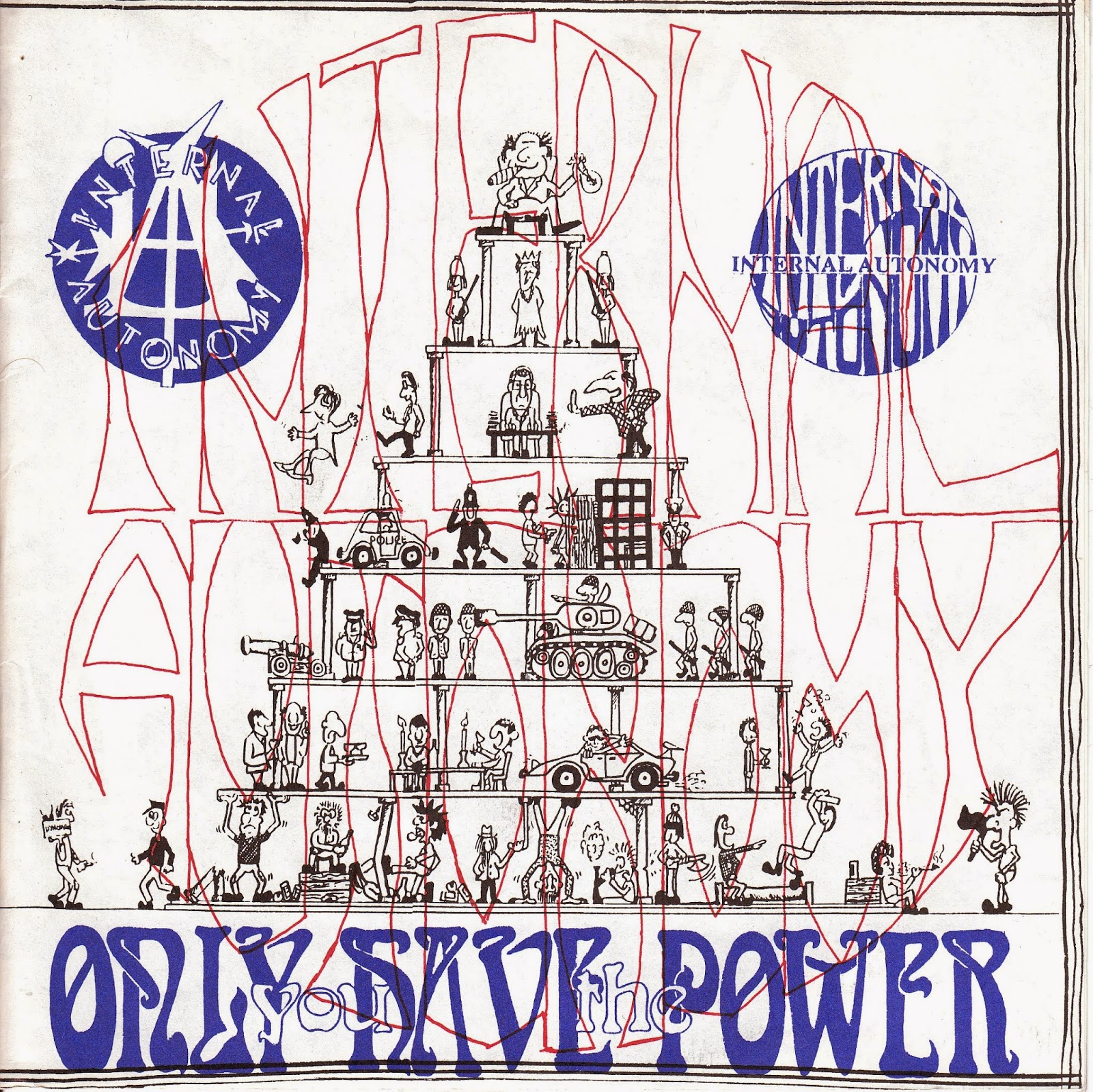
Internal Autonomy "Only you have the power" 2 x Ep 1993


Fuck me. It's been two weeks since I posted something here and I still don't really have the time to write a proper review (read "a lengthy ode to my own tastes"). Don't get me wrong I absolutely love Internal Autonomy, but since I already posted one of their records last year and ranted over it, I basically encourage you to check out the review of their "Love and life" Ep. I also strongly suggest you get their discography and their new album "Ferox".


In a time when everyone and their mums is desperately trying to play "dark punk" but often end up playing overproduced, self-indulgent and soulless gothic rock, it just feels good listening to what Internal Autonomy were up to 20 years ago. When I come to think about it, this band had a terrible timing: whereas they were penning wondefully dark and smart old-school anarchopunk tunes, by 1993 Hiatus and Doom were all the rage and the new American anarchopunk sound of Aus-Rotten, Mankind? and the likes was getting stronger. Even in Britain, this brand of punk-rock was almost extinct by then as most bands were getting faster and heavier, even when they remained tuneful like One By One, or they were trying to blend other musical genres with punk-rock, like PAIN with dub music or Witchknot with noise rock (or something). Thus Internal Autonomy remains, in my opinion, a really unique band which, unvoluntarily - almost in spite of them, as I don't think they were really aiming for a specific sound at all - were flying the 80's anarcho flag (in that light, only Indian Dream and to a lesser extent PUS come to mind). This recording doesn't have a female singer like "Love and life" did so it is the bloke singing and while I am a sucker for female-fronted anarchopunk, this offering is still fantastic, somewhere between Lack of Knowledge, Sanction, Flux of Pink Indians and Thatcher on Acid, this would have been a great fit on "All the Madmen" (I mean, there is a bloody saxophone on most of the songs!).


And then, there are the lyrics. Actual anarchist politics that are smart, down-to-earth and radical, stuff you can relate to, stuff that can actually inspire you. "What's is coming to?" is a song about the so-called freedom in modern democracies and how you are only really free to do what you are supposed to do; "Faith" is a song against all rulers, against political parties blinding us with illusions of a perfect world in order to gain power; "Storm" is a class war anthem that will get motivate you to create your own "Bash the rich" march in your local area and finally "Death to discipline" is about the school system and how it brainwashes kids and destroys their indiviudality. The great-looking booklet includes some political writings that delve deeper into the topics at hand. This is a quite odd format, a double Ep, that was released by Profane Existence in 1993. I know this has been posted elsewhere on other blogs but I am not sure the scans of the booklet could be found so here they are.


Monday, 14 April 2014

Desobediencia Civil "No hay libertad sin desobediencia" cd 2001


Most of the time, I focus on posting rare or obscure on Terminal Sound Nuisance. There are two reasons for this. First, I feel that the sharing of music and knowledge is what punk is all about. Although I alway try to give my own critical view of a band, a genre or a scene, I feel that it is our collective role to ensure that punk history doesn't get lost and that it is important to promote a sort of punk sensibility (for lack of a better term) through an accessible analysis of the punk-listening experience. Second, I am an opinionated bastard with an ego problem who likes to boast. But now is not the time for nerdy posturing, because today's post will be about one of the most crucial Latino anarchopunk bands ever: Desobediencia Civil.


In my (definitely not) humble opinion, DC is an unjustly underrated band that, had they not been from Mexico, would have its name on thousands of punk jackets across the world. I would even argue that they were easily one of the very best 90's anarcho bands worldwide. DC formed in Mexico City and started playing in 1993. From what I gathered, the people involved were all originally part of animal liberation and political collectives and felt the need to do something against the "chaos punk" apathy that prevailed then in the city. DC's discography is far from being massive as they only released one Ep and one album as well as a couple of live demos. I would venture that the band was more interested in getting their message across and touring than in recording twice a year and having coloured vinyls out. Although they weren't the first anarchist punk band in Mexico or indeed in Latin America, they may have been the first to call themselves anarchopunks (possibly along with Coprofilia, Empirismo and Regeneracion) and to merge the canonical anarchopunk sound and aesthetics with the aggression and the rabia of classical Mexican hardcore punk, thus creating a proper Mexican anarchopunk sound in the process. DC's first Ep, "Cuanto tiempo mas", though it already incorporated visual elements from the anarchopunk, still sounded very much like a traditional raw Mexican hardcore punk records and was closer to Massacre 68, MELI or Xenofobia (and my faithful readers already know that I love my Mexicore to death) than Antisect, Doom or Conflict. It is only with their Lp, "No hay libertad sin desobediencia" that the band managed to merge both worlds, seamlessly, effortlessly and with an honesty, a genuine anger that cannot be faked and that I wish I heard more often.


On this recording, DC kept the snotty, desperate anger and chaotic edge of late 80's Mexican hardcore but infused it with the classic UK anarchopunk sound of Antisect, Legion of Parasites or Potential Threat (especially with the addition of the female vocalist), with early Doom (whom they cover), Early Hiatus and early Extreme Noise Terror and finally, I would argue, with a bit of Swedish hardcore like Crude SS or No Security. The dual vocals work to perfection, the bloke having that raspy, raucous, threatening and just so bloody pissed off voice, while the girl shouts in a clearer, warmer tone, not unlike Potential Threat, Homomilitia or Antiproduct. The drumming is reminiscent of Stick (from Doom)'s early bands (Doom or more precisely Excrement of War come to mind): it beats the D but you still get some Disorder/Chaos UK changes and a couple of blast beats. The guitar sound is thick and crunchy, just what you need to get the crust in "crust-punk". The music is just incredibly energetic, catchy, angry AND catchy, as a lot of the chorus will stay with you. There is enough variety in terms of tunes and tempo hooks to make this album a fantastic listen from beginning to end and a real anarchopunk classic.      


To say that DC was a serious band would be an understatement and in that respect they really remind me of the best of the US anarcho scene of that decade, bands like Aus-Rotten, Antiproduct, Mankind? but they remind me more especially of Resist And Exist, a band that was outspokenly revolutionary like DC. Bands like Disaffect, Sanctus Iuda, Homomilitia or Paragraf 119 could also be relevant comparisons. Lyrically, you will find a whole lot of issues covered by the band, ranging from feminism, animal rights, the wage-slave system, class antagonism, social conformity, the corrupt political system to imperialism or being anarkopunks.


The influence of DC on the political punk scene both in Mexico and in the rest of Latin America cannot be underestimated and I see them in the same light as 90's bands like Abuso Sonoro or Execradores in Brazil or Apatia-No in Venezuela, that had relevant anarchist politics and merged the anarchopunk spirit with that South-American urgency and anger. DC split up quite soon after the release of that album, in 2002, because some of the members migrated to the U$ for economic reasons but I read that they reformed briefly in 2008 in order to play a couple of benefit shows in the States. I suppose you could say Mexican bands like Fallas del Sistema or Crimenes de Guerra are (or were?) the real legacy of DC in the 00's. "No hay libertad sin desobediencia" was released on the ever reliable Cryptas Records and I'm pretty sure it can still be found on decent distros everywhere.


Friday, 4 April 2014

Social Insecurity "S/t" Ep 2002


Today's post will be less epic than the previous one for two reasons: first, I'm fucking knackered and second, this record should really speak for itself, so you don't really need me ranting over and over again. Unless you want me to.


There are actually two bands - at least - called Social Insecurity, one from Edinburgh that was active in the early 2000's and one from California that was around in the early 90's and was part of the blooming anarchopunk scene then. But for today, the Scots will suffice. As you are all aware, I am a self-righteous wanker who likes dictating what good taste really is to the unwashed among you (and there are more than just a few). To those who sport a studded leather jacket, a mohican or two and a faded Varukers top, then let me tell you that you should have painted at the back of your jacket, instead of The Unseen, was Social Insecurity. Like many bands that are a bit late to the party, Social Insecurity played that rather typical mid-late 90's British hardcore-punk style, not unlike Poundaflesh, In The Shit or even Hellkrusher, but they may have started playing it a few years too late, so that they may have passed under the radar of "da punx" who may have been thinking they were merely derivative and under the crust radar as well for not being "crust" enough, not having Tragedy-like tunes or a Dis-name. Life does suck sometimes.


However, not only are Social Insecurity a top-of-the-shelf 90's flavoured British hardcore-punk band in its own right but they are also heavier, and I mean HEAVIER, than most neocrust that was starting to be all the rage back then. Social Insecurity is the perfect mix of mid-90's Varukers and Hellkrusher. I am pretty sure that all the members had played in bands prior to Social Insecurity but all I could find was a Beergut 100 connection (a typical, though enjoyable, mid-90's British punk band) through the guitar player. This is bass-driven dischargey hardcore punk that is openly pissed off and that you can pogo and drink cider to. I would have loved to see them live, at a punk picnic for instance, with, say, Disorder, Poundaflesh, Hellkrusher and Red Flag 77. Social Insecurity have this thick sound that is effortlessly groovy and heavy. The songs are mostly fast-paced but there are a couple of crushing metal breaks (in the crusty sense of the term) to keep things refreshing (in a guttural breath way).


Due to numerous tours, there seems to have been an important connection between Edinburgh punks and Czech Republic. Like Beergut 100 who had a split with Zemezluc, Social Insecurity's next record would be a split Lp with Czech metal-crust heroes, Dread 101, released on famous local label Insane Society records in 2003, also a highly recommendable work of art if you are into records that no one really remembers. This Ep was released in 2002 on Emergency records a label from... Czech Republic (!) responsible for records from Exekuce, Mardröm or Demarche. The lyrics are pretty serious, with an anarchist leaning. "Burn all flags" is about taking your dog to the park, breaking down the borders and flag-burning; you already know what "Police brutality" is about (but could it be a nod to old Scottish band Toxik Ephex?); "Rage inside" is about a bloke going mental because he's possessed by the devil (I warned you there were some metal breaks); "Suffer in silence" is about not taking any shit from the authorities and fighting back and "Systematic slaughter" is about the horror of war and brushing your teeth twice a day (and could it be a reference to Reprisal?). Does the cover look like that Anti-Cimex Ep? Yes, it does, and that's three additional punk points in my book.


Translations in the Czech language included.  

Monday, 24 March 2014

Ρήγμα "Ο Τελευταίος Αιώνας" Lp 1994


The division of punk into a myriad of different subgenres sometimes create funny situations or even small, but real, cultural misunderstandings. I was chatting with a good mate of mine once on a boozy night, basically drinking on the streets and talking shit, and for some reason the subject of Greek punk came up. I spontaneously said that I was a sucker for 90's synth-driven Greek crust and that I really couldn't get enough of the genre. He stared at me blankly and then laughed. The very notion of synth-driven Greek crust was ridiculous to him (but then he doesn't even enjoy Amebix, so what can you do?), absurd, surreaslitic even. But for the proper crust fanatic that I am, synth-driven Greek crust obviously means absolutely classic old-school crust, with an actual Amebix/Axegrinder feel. There IS such a thing as the Greek crust sound and it means real crust (or stenchcore, assuming that term might be more helpful), and judging from the prices some of these Greek records go for, I am definitely not the only believer. But what is classic stuff to me is not classic stuff to others, and it certainly was not to my aforementioned mate who may even have thought that I was taking the piss with such a preposterous phrase as "synth-driven Greek crust".


You are probably guessing where I am going with all that cheesy reminiscing. Today, we are going to talk about the Greek school of crust, a school that never disappoints and has steadily produced a handful of classic records in the past 25 years. There are some places where the crust genre has never really taken root (yes France, I am looking at your right now). On the contrary, the politicised Greek punks in the late 80's embraced the ideas, the aesthetics and the sound of British crust punk with an incredible ease. One would believe that it just made sense to them and they seamlessly adopted and further developped the crust philosophy. There are no similar instances in Europe that offer such a concentration of superb metallic punk bands combining gruffiness with a true sense of epics, rage with despair. "Why Greece?", one will ask. "I don't have a bloody clue," I will reply. "But let's try to figure it out". First, Greece already had had a solid tradition of quality punk-rock throughout the 80's, with bands like Stress, Ex-Humans, Genia Tou Xaos, Gulag or Adiexodo (and that's without mentioning the postpunk/new wave side of the spectrum) so the foundations were already there. Second, I would argue that, quite simply, Greek punks must have been into extreme metal music, early thrash and death metal, and therefore the dark, rough and gruffy metallic punk sound of Antisect, Deviated Instinct, Axegrinder or Hellbastard did not just appeal to them, it must have appeared like the next logical step. But contrary to a lot of bands worldwide that basically turned crossover overnight and tried to punkify Slayer and Metallica (with varying degrees of success), a significant number of Greek bands chose the "slow, dark and heavy metallic path that regularly wanders in pummeling d-beat territory" instead (although there must have been Slayer-wannabe bands there too). And some bands, not unlike Amebix and Axegrinder, really loved their synth (arguably a bit too much for their own good at times). Bands like Chaotic End, Panikos, Forgotten Prophecy, Naytia, Psychosi, Industrial Suicide, and later on in the 90's Nuclear Winter, Ashen Breath, Rising Terror, Hibernation. The Lp that is being posted today is, according to your favourite self-appointed expert, a relatively unsung classic of Greek crust: Rigma's sole album "Ο Τελευταίος Αιώνας".


From what my informer told me, after the demise of the band, members of Rigma and of Olethrio (another quality band with top female vocals) formed Olethrio Rigma, which originally followed a similar metal-punk way (the first album is highly recommendable) before falling in the "let's be a real metal band" trap. Apparently Oethrio Rigma enjoyed quite a bit of mainstream success in Greece which may have overshadowed prior works of both bands. And, in the case of Rigma, that is an unforgivable shame since "Ο Τελευταίος Αιώνας" may very well be the best Greek crust album of the period (that is a bold statement considering the awesomeness of Chaotic End's Lp but it will at least make people really listen to it).


The record starts off with a synth sound, just to let you know where you are heading toward. I wish I had the time to carefully describe each song but that would require an amount of leisurely time that I unfortunately don't have and beside, I am a lazy sod. The most striking thing about this Lp is the quality of the songwriting. Many think that crust music is generic and derivative, if not tedious. Well, this kind of work can undoubtedly prove them wrong. All the songs are memorable and, although the backbone is indeed metallic crust, inventive (not a term I use often on that blog). You will find all the elements that make Greek crust so great, the heaviness, the dark anger, the epic songwriting, the gruff yet not forceful vocals, the crushing mid-tempo numbers, the dirgy intros, so that you won't feel lost in a maze of musicianship pointlessly craving for originality (and we all know that trying too hard to be original never works). Rigma manages to enrich the crust formula with catchy guitar leads, witty tempo changes, but also with the addition of tasteful death-metal parts or "traditional" anarcho moments. Bands who try to mix too many elements from too many different genres often fail at doing properly, precisely because they consciously try. In Rigma's case, the disparate influences just seem to merge with ease and eventually end up making whole, coherent, cohesive songs. It sounds naturally heavy although the production is relatively raw; the riffs and the song-structures are not complex but they are always meaningful; the guitar sound is dirty, slimy and aggressive just as it should be; the drummer never overuses the double-bass and rather chooses to diversify his range of paces and his use of toms and cymbals, without ever getting technical (but then, I'm not sure he could!); the singer has a hoarse shouty voice but never overdoes it (aka, he doesn't want to be Bolt Thrower's frontman); the bass paves the way without being too up front and is used to great effect on some tempo changes and intros. The last song starts and ends up with the ominous sound of the wind blowing. The whole record reeks of spontaneity, like the original crust bands did, and it never tries to be crust. It just is. Rigma's "Ο Τελευταίος Αιώνας" is a triple threat match between mid-90's Panikos, early Hiatus and late Deviated Instinct.


The Lp looks great too, an antisectish gatefold with hand-written words and drawings to illustrate the band's message. All the lyrics are in Greek, which definitely adds to the uniqueness of Greek crust as the language fits perfectly with the apocalyptic gloom conveyed by such bands. Fortunately for the non-Greek speakers, you also have - broken - English translations which will show you that Rigma were indeed pretty serious. Songs about social alienation and control, about the sombre feelings and emotions, about the insanity born from our survival in a ruthless world, about the difficulty to express anger and despair. Dark words for dark times.      

For those interested, a demo also entitled "Ο Τελευταίος Αιώνας" was recorded by the band in 1993 and includes even crustier, rougher versions of the songs on the Lp. A glorious listen if you are in an epic neanderthal mood. Prior to this recording, Rigma also released a demo tape in 1992, called "Στα Μυαλά Των Ανθρώπων" but I have sadly never heard it... Sob, sob. Rigma's Lp was released on Wipe Out Records, a prolific Greek label responsible for records from bands like Chaotic End, Panx Romana, Stress, Anti or the brilliant Chaotic Dimension.


So now, do yourself a favour and get some Greek crust in your life.        


Monday, 17 March 2014

Skullkrusher / Article Nine "The machinegunlife sessions / The rebel girl" split Ep 2002

It often happens that I buy records I completely forget about. When I flip through my collection, I feel a bit sorry for these forgotten records because I hardly ever listen to them (but then, a lot of them are rather forgettable). This is one of the fallen soldiers and for once, this is going to be a short post because I don't have much to say about the bands, but honestly you are unlikely to meet someone who does (unless he or she was a member or a mate of the bands of course). As anecdotal as these bands might have been, it doesn't mean that they are worthless or even that they deserve this anonymity. We all know hundreds of bands who will always remain shrouded in a desperately indifferent obscurity. It is sometimes hard to explain, sometimes not so much. In the case of Skullkrusher and Article Nine, the reason is quite easy to find as both bands were quite generic and played a genre that was probably a little overdone in the late 90's/early 00's.


There is already a pretty good review of this Ep on the Aversion website (here) if you are interested in another opinion than mine (although I don't really see why you would to be honest). Let's start with Skullkrusher. They certainly picked a cool name but they certainly weren't the only ones either. There was a Brazilian metal band with that name and I think there's a band from Malaysia also playing the crusty d-beat thing working under that name. For the unwashed among you, Skullkrusher is obviously a reference to the mighty Onslaught song "Skullcrusher" and, I would argue, Hellkrusher. Fortunately to those allergic to lengthy guitar solos and lyrics about Satan, Skullkrusher are much closer to Hellkrusher than to Onslaught. What we have here are three songs shamelessly flying the d-beat flag and despite the utter unoriginality of this subgenre, I feel that it works very well here as the band didn't fall in some of the obvious Dis-traps. First, the sound is not too heavy and is metal-free. This is d-beat for the punx and that's how it should be. Second, the production is raw and spontaneous. I don't want too clean a sound when the D is beaten but I also personally tend to avoid overly blown-out, overdistorted rendering of the genre, not because I dislike it, but because few bands can actually pull it properly. Skullkrusher do it naturally, in an unpretentious fashion with the 90's feel that I enjoy. Early Disfer, Dischange, Hellkrusher, Decontrol, Besthöven, Holokaust are relevant points of comparison here. The presence of two types of vocals adds a bit of variety and aggression, the bass is adequately buzzing and upfront, the guitar riffs are simple and to the point (I even hear some Anti-Cimeish overtone here and there) and the drums, well, you already know what they do and they do it properly. Skullkrusher were from Chicago and released quite a few tapes between 1996 and 1999, so I am guessing they must have been pretty active at this time. These three songs were originally part of a tape called "The machinegun sessions" but I am not sure when it was actually recorded.


On the other side, we have Article Nine from Sweden and with them we enter the 90's Swedish crust realms. Two songs of fast, pummelling and heavy scandicrust with a couple of death-metal guitar leads, you know what to expect. This reminds me of Skitsystem though the vocals are nowhere near as harsh. Interestingly, the lyrics are not about war or destruction but clearly lean on the anarcho-syndicalist side of things with references to the red and black flag, antifascism and to the IWW. In fact, the song "The rebel girl" was written by Joe Hill, a Swedish-American itinerant worker, an anarchist labour activist and a member of the IWW who was framed and executed in 1915 for the murder of a local politician. The geezer wrote a lot of political songs and was a cartoonist for the IWW (the cover on the Article Nine's side is a reproduction of an ad for Joe Hill's song). From what wikipedia says, "The rebel girl" was written for a comrade of the IWW, Elizabeth Flynn, who was a strong feminist and advocat of women's rights. Clearly quite a refreshing cover for a crust band. This Ep was not Article Nine's only mischief, as they also did a split with Human Bastard and a full Ep during the first half of the 00's. A member of the band also played in Vaning 5 and went on to play in Massmörd.


So come on, give them a chance!

The Rebel Girl      
       

Thursday, 6 March 2014

"Slave to convention: A tribute to Doom" compilation cd 2007


Bands like Doom are to punk-rock what beer is to drinking.

Some people merely enjoy having a cold beer on warm days, others drink vast quantity of beer but are not bothered with the quality, and then you have the beer experts who can actually describe the tastes of many different ales and lagers, finally you have people who don't like beer but at least respect it as a worthy beveradge. The same could be said about Doom: the first category hardly listen to Doom but can enjoy a couple of songs at a gig or when really drunk at a mate's; the second category listen to a lot of Doom-type bands but can't really be arsed about the actual quality or even the identity of the bands; the third category include people who know all the records, the recording dates, the line-up changes, they are able to look at Doom and their works critically and are undeniably elite Doom-lovers with a PhD in crust-punk; people in the last category don't give a damn about Doom but at least recognize that it is a quality band, respectable and honourable, just not to their liking. If you don't fall in any of these categories, there are two possibilities: you either have never heard about Doom and I am about to change your life or you clearly are reading the wrong blog and I encourage you to get a life. Seriously, get ouf of my blog.


I generally have mixed feelings about tribute records for several reasons. Bands are often content with merely covering the song without bringing anything new to the table thus making the record a bit tedious to listen to and basically a poorer version of the original songs. In addition, I have seen tribute records with absolutely no information about the bands included or even with hardly any mention about the band that is being paid tribute to (I am thinking about the "Discharged" cd here). But do not despair as there are also really good tribute records, like the two recent (well, relatively) Amebix tributes (the Japanese one and the Balkan one) or the Conflict tribute "Barricades and broken dreams" which exemplify how it should be done. Granted, all the songs were not that great but they aptly reflected the passion that the covered band inspired to the participants and you had some comments from actual members of Amebix and Conflict which made the record more relevant and interesting. Fortunately for you, "Slave to convention" falls in the "good punk tribute" category.


Don't expect too much originality in terms of music on this record. Although there have undeniably been several different periods in the life of Doom with variations in song-writing, sound, musicianship or production, the power of Doom relies on a formula. I would argue that the repetitiveness of Doom - especially early Doom - is one of its strong points. It is a force hammering you again and again with unabated sincerity. Doom took the relentless power of Discharge, Discard (certainly the strongest influence of the band in its infancy), Totalitär or Asocial, added the crusty gruffness (probably more a matter of context than of intent) and the anarchopunk anger and aesthetics. As I mentioned, the Doom sound evolved throughout the years but still, and as the latest brilliant Lp shows, they nevertheless always sticked to the Doom formula, so that for all the different records, and if I may use a witty tautology, Doom will alway be Doom. And thanks fuck for that. Really.


There are 29 bands included on the compilation and I suppose that it would be a boring read if I were to describe each of the songs individually. The bands that took part in this project all belong to the crust/d-beat/scandicore subgenres so don't expect ska versions of "Police bastard". Unsurprisingly, mosy of the covered songs are from Doom's Peaceville days, although some bands also picked songs from "The greatest invention" (my favourite Doom records because of its tension), or from the splits with Hiatus, Selfish and Extinction of Mankind, so it's not 29 covers of "Police bastard" or "Exploitation" either. The strong point of this compilation lies in its international spectrum as you will find bands from the U$A, the UK, Germany, Peru, Japan, Sweden, Poland, Spain, Chile, Canada, Cyprus (yes, Cyprus!), Mexico, Brazil and Italy. In addition to being an ode to world-wide punk-rock, "Slave to convention" includes bands rather "famous" bands like Phobia, Besthöven or Cluster Bomb Unit, but also obscure ones whose contribution to the compilation is actually their sole appearance on a proper record like Aposynthesis, Hollow Scorn or The Indecents. Apart from the Desobediencia Civil song that was recorded in 1998, all the bands recorded their cover especially for this compilation sometime between 2006 and 2007. Not only this but all the bands provided some artwork specifically for "Slave to convention" as well with band and recording information. Funnily enough, three bands did a spoof of the Doom logo, well let's call it an aesthetical tribute, with their own moniker: Ruin, Filth of Mankind and Warvictims. Now that's a labour of love, isn't it?


My personnal highlights include the old-school crust rendering of the mighty Alehammer and the criminally underrated Filth of Mankind, the dual-vocals crustcore attack of the great Accion Mutante, the vintage d-beat punk of Cluster Bomb Unit (with Julia on vocals), Besthöven and Ruin (who have never sounded more like Cracked Cop Skulls than on this recording) and the angry crusty anarcho sound of Autonomia and Desobediencia Civil, a band I specially deal with sometime in the future. Despite unequal production between the songs (some of them must have been taken from rehearsal or live recordings which accounts for some sloppiness), it is on the whole a very pleasant listen and a great way to get familiar with previously unknown bands. In my case, I was really quite impressed with Aposynthesis from Cyprus and wish they had done something else (they get extra Doom points for their Doom/Aposynthesis studded jacket done especially for their piece of artwork).


The booklet is good too and provides an exhaustive Doom biography as well as some words from Stick. It also shows a lot of original Doom artwork, some old flyers as well as some pictures but I hope you have a good eyesight because it's all printed extra small. "Slave to convention" was released on Helvetet Records, a Peruvian label responsible for records from Los Rezios (I am pretty sure the bloke doing the label also plays in Los Rezios), a Warcollapse discography and re-issues of old 80's hardcore bands from Peru like the fantastic Autopsia or Kaos. Basically a label worthy of your interest.


Are you ready for almost one hour of Doom worship? You'd better be.

Slave to doomvention