Thursday, 3 November 2016

Japanese Crust vs The World (part 4): Battle of Disarm / Brainstorm "反戦-反動物実験 / Join no army, police and politician" split Lp, 1993

Let's get back to business with the next installment of the Japanese crust series, which is proving to be so far one of the most glorious adventures the internet has ever seen. And I am not even being funny (possibly slightly delirious though) as I was offered to become the head of the Department of Crust Studies in a pretty posh university. Of course, because I am a loyal fucker, I politely but firmly declined the invite. I mean, do I really want to see essays entitled "Crust and Intersectionality: symbolically deconstructed identities as embodied in the shift from regular black thread to dental floss in the noughties" being written? And do they even allow special brew on campus? Exactly, THEY DON'T. So instead of wasting money on a pair of thick-framed glasses for that job (I was told it was compulsory for teachers), I decided to write about one of the most famous Japanese crust bands: Battle of Disarm.


Battle of Disarm (whom I will refer to as BoD from now on, although I realize it does not look so great) was the first crust band from Japan that I listened to. And honestly, it was not illogical at the time: their patches were (and still are) everywhere. No wonder the name caught my then innocent glare. You just could not avoid seeing BoD patches on the jackets worn by that part of the punk population inclined to sew cheap pieces of cloth on an otherwise good-looking garment (and yes, sometimes with bloody dental floss, ironically an item that was prohibited until 1993 in France). The omnipresence of the band was not illogical, nor was it unwarranted. After all, the "Crust, Love and Peace" 10'' could still be found on distro tables at that time (not still for long though, to be fair). The band had toured in Europe only a few years back (in 1997) and the record, released in 1999 on Malarie Records (the label also organized the tour), was a live recording of a gig in Slovenia. I guess the label had made a shitload of patches and shirts for that special occasion and they literally flooded the crusty market at that time. Even now, BoD paraphernalia is easy to find on distros almost 20 years after the tour. And fair enough really, as the band used great visuals and crispy veganarcho-crust imagery. Doves, (A)//(E)//(V) signs, peace symbols, more doves, antiwar slogans, animal rights ones and yet more doves. The whole package. A genuinely great fashionable addition to any self-respecting crusty punk looking to boast some right on politics. Did we really listen to BoD though? Not really. I will be honest here, I did not even buy that 10'' at the time as I was not a fan of live records. I still wore the patch though, not only for the sake of obvious aesthetics, but also because I loved (and still definitely do) the name "Battle of Disarm" for its oxymoronic value.

My first Battle of Disarm tape...


A friend of mine had the "Crust, Love and Peace" 10'' so I did know what BoD sounded like but it was with the "Take Action" tape that I truly became acquainted with them. The tape was unofficial and compiled all the band's Ep's and I seem to remember getting it from Catchphraze Records in 2003. And I enjoyed it very much, undeniably, but that was not quite enough, to my ears, to really get me hooked on the band, and besides, there were too many fantastic new Japanese crust records at that time for me to really bother with and dig deeper into BoD. I eventually did though, years later, when I listened for the first time to the split Lp with Brainstorm and all of a sudden, BoD was no longer "that-band-we-all-like-but-don't-really-care-to-know-much-about". To say that I felt like a fool - yet again - for not paying careful attention to a crucial crust record, for reasons that were flimsy at best, would be an understatement.


BoD's side is entitled "反戦-反動物実験" (meaning "Anti-War Anti-Animal Experimentation", clearly the two main themes in the band's lyrics) and was recorded in February, 1993. This Lp was actually the first vinyl output of BoD, as the band had only recorded a demo tape before, "Not Lie", in 1992, which included studio and live tracks. Discogs tells me they were included on a cd compilation in 1991 entitled "War Compilation" and released on Tribal War Asia (it also had GJPB, Crocodile Sking and The Deepcore Fighter among other international bands). I have never heard that comp but I am sure that it cannot have been released as early as 1991 because of the presence of Warcollapse on the record (the Swedes formed in December 1991 but didn't record anything until 1993, so I am assuming the compilation must be from 1993 or 1994... so fuck you Discogs). There could be earlier BoD recordings since they formed in 1989 and it seems unlikely that they waited more than two years to release anything, but then that is only a usual wild guess of mine. They certainly made up for the lack of recording activity of their early days: between 1993 and 1996, no less than 13 BoD releases saw the light of day, mostly splits on vinyl or tapes. This Tokyo bunch were a staunchly DIY band and appeared to have been very active live in the mid-90's, which accounted for the important number of live recordings and also probably for the relatively small numbers of songs they have penned throughout their career. Not unlike Disclose perhaps, they firmly believed in the internationalist dimension of punk and have shared records or tapes with bands from Portugal, Brazil, Holland, Indonesia, Czech Republic or Finland throughout the years, be they famous like Doom or... huh... far less so like Satellite. This belief in DIY punk as an international network of friends was also reflected in the label of Ryuji, the aptly named DIY Records, that specialized in political hard-hitting punk music from all over and basically did things the way the name suggested.


But back to today's record. If the "Not Lie" demo from the previous year was a rather rough, if delightful, gruff scandi-infused hardcore affair (maybe not so far from Private Jesus Detector if you know what I mean), the eight songs of "反戦-反動物実験" are perfectly recorded, not in the sense that the production is spectacular per se, but because it fits the band's songwriting to a tee. I don't think songs like "Battle of disarm" or "Anti vivisection" ever sounded better than on this Lp. The guitar riffs are thick and thrashy, even slightly convoluted at times, and bring to mind Crude SS or Lobotomia more than Doom. They still sound straight-forward, almost deceptively so, but only because they are smart and seamless, not unlike what Hiatus managed to do with theirs. The drumming is really upfront, truly pummeling and gives the songs a vintage hardcore energy; the bass is omnipresent and does groove the songs but acts more as a support, a basis, than as an engine; finally, the vocals are growled in the purest cavemen crust tradition, never sounding forceful or constipated, just hoarse, filthy shouts brilliantly synced with the instruments to the point of becoming one of them. It will probably sound a little strange but BoD do not really sound like a Japanese crust band on this Lp. Not that Japanese crust must rigorously and necessarily include strict predefined parameters to fit the category, but still, we are much closer to early/mid-90's eurocrust here than to the national production of the time. Of course, there is a mastery, a tightness and an intensity that points to Japanese punk, but I do feel BoD made more sense sitting side by side with Hiatus, Warcollapse or Subcaos, than Gloom, SDS or Life. For the point of the argument, let's compare BoD to a contemporary Japanese band that can be said to fall in the same section in terms of subgenre, Abraham Cross. The two sound nothing like each other. Beyond the obvious fact that they both went, to an extent, for a neanderthal Doom sound, the textures, the vision, the purpose, the intent (and indeed the intentionality) were all dissimilar. I love both bands, but while Abraham Cross were clearly artistically contextualized in the buoyant Japanese crust sound, BoD were more akin to the global 90's crust wave, despite both band sharing, when bared to essentials, a rather similar songwriting.


Fascinating stuff, right? Well, all this to say that "反戦-反動物実験" (and indeed the 1994 Ep, "In the War", though it is not as cavemen-like) is a brilliant work, certainly the band's crustiest, and is up there with vintage Hiatus. Relentless gruff cavecrust with a groovy metal touch and a Scandi feel (I am pretty sure Masskontroll were heavily into that record). As mentioned above, the lyrics revolve around animal liberation, human destruction and anti-war protests and my only real issue with this record is that the insert looks pretty ugly.


On the other side of the Lp, entitled "Join no Army, Police and Politician", is Brainstorm. And I LOVE Brainstorm. I really do. Their 1989 demo and the 1990 Ep are clearly unsung early crust classics and are probably the closest incarnation of what a Peaceville-sponsored jam between Concrete Sox and Hiatus would have sounded like and, sad but true, had they been from Birmingham, Stockholm or New York, instead of Belgrade, they would probably be revered, their late 80's output (because it is always way cooler to rate the demo higher than what followed) hailed as classic, if not totally "cvlt". In fact, there will be a post about vintage Brainstorm at some point in the future so I am not going to tell too much about them now. Especially since I do not like their side of the Lp. I could get past the thin production but the US jumpy hardcore-crossover turn they took is too much for me to stomach, especially when compared to the tornado of relentless gruffness that characterized their earlier works. So I'd rather rave about them when dealing with one of their top recording.


A few words about the context though. The nine Brainstorm songs from that split were recorded in May, 1993, at a time when the war was certainly not over in Yugoslavia. The main interest of the Brainstorm side undeniably lies in the lyrical content, which, despite unfortunate losses in translation, still reflected the anger, the outrage and the urgency of that time and place. Written from an anti-state perspective, the songs read like cries against patriotism, conformity, blind faith, media and political manipulation, the brutality of war... No longer a mere punk trope used to denounce an imaginary endless war, calls for peace and disgust at the sheep mentality designated a very real situation. I cannot claim to be an expert, or even remotely knowledgeable, about the political situation in Yugoslavia at the time so I am pretty sure that I am missing a lot of references in the lyrics. Still, if only for the inherently punk nature of standing against oppression and violence literally knocking on your door (or tearing it apart really), I feel that the songs can be read as an important, urgent and crucial testimony of what it implied to be a political punk in that time and place.


This split Lp was released on No Time To Be Wasted Records, a Belgrade-based label run by the singer of Brainstorm (he also sang for a thoroughly enjoyable 80's hardcore band called Necrophilia) that was active throughout the 90's.  


Monday, 17 October 2016

Japanese Crust vs The World (part 3): Acid "Gray Earth" Lp, 1991

I have had second thoughts about including this record in a series dedicated to Japanese crust. I can almost hear the gasps of horror, the muffled cries of shock, see the bewilderment, the outrage, the genuine sense of justified disagreement on livid faces that even a poorly lit room cannot conceal. "OMG! BUT ACID WERE NOT CRUST! THEY WERE A HARDCORE BAND, MAN! ARE YOU OFF YOUR TITS?". And I get it, really I do, and I guess you are right. Had I been wiser, I probably would have put a "trigger warning: this post is just wrong" sign at the beginning. But then, there are worse things in life, like running out of coffee in the morning or realizing that Disorder are dreadful live nowadays. Right?


Acid was a band from Tokyo, apparently active from the late 80's to the early 90's, judging from the recording dates going from 1987 to 1991. They were part of the same punk scene that gave birth to bands like DONDON, Asbestos or indeed Macrofarge, whose obsession with Doom we tackled earlier in the series and whose drummer would later on form Liberate with Acid's singer Kuro ("So they must have been mates," says Captain Obvious). As I mentioned in the introduction, I have never claimed to be some kind of expert in Japanese punk, and especially not in the mirific hardcore scene that is so revered. While preparing for this odyssey into waters still unchartered on Terminal Sound Nuisance, I listened to all kinds of Japanese punk music in order to connect the dots and try to find my way in a maze that, for all its alluringness, still felt like quite foreign. Like when you find yourself at a punk gig in a town you have never been to, but that you have heard of quite a lot, and you end up at that afterparty where you don't really know anyone and things are familiar but you aren't comfortable enough to really engage with the whole thing. A friend of mine with indisputable Japanese hardcore credentials mentioned Acid's "Gray Earth" Lp as having a solid crust edge despite the band's obvious roots in hardcore. Until then, I only knew "Shock troop", Acid's first album from 1989, that - and you can vilify me for this confession - I honestly was not that much of a sucker for, but then I had only listened to it distractedly maybe twice and I had real troubles getting over the fact that the band had had the nerve to call their album almost the same as Cock Sparrer's first Lp (a work I have been known to sing along to rather loudly on numerous occasions when pissed...). But I just punked up and gave "Gray Earth" a shot. And thank fuck I did, because not only is this album an absolute scorcher, but it is also a fascinating case in point of a specific punk phenomenon called "the crustification of hardcore".    


I am pretty clueless what was up exactly with Tokyo punks in the late 80's, but something was definitely brewing. Applying the correlation between the rise of crust in Japan and the revival of the UK sound there to Acid is absorbing and complex, so it might be interesting to take a look at the band's discography while keeping this particular perspective in mind. Acid's first material appearance (according to Discogs, but for all I know there could have been earlier demos) was on the infamous, and awkwardly named, "Suck my dick" tape compilation released on Souzui Records (a label run by a DONDON bloke) in 1987, which incidentally was also the first SDS and Asbestos' release. It included two Acid songs which, in spite of a very rough sound (probably recorded live I reckon), illustrated rather aptly what the band was going for at the time: basically a high-energy union between Chaos UK and Japanese hardcore. The rather excellent 1988 demo confirmed that tendency but thanks to a better sound (still very raw but incredibly intense, it does not get much better than this sound-wise in terms of raw hardcore... just brilliant) brought additional dishes to the table, only this time you could actually read all the ingredients.

Of course, Acid was most definitely rooted in Japanese hardcore and a fair number of epic riffs and chorus arrangements screamed in that direction. However, most songs also nodded vigorously and interestingly toward Mower-era Chaos UK. After all, the Bristol punx had toured Japan in 1985 (which must have been quite an experience given the influence they have had on the Japanese scene in the 80's), and the studio side of the "Just mere slaves" 12'' (released on Selfish Records for the tour) must have been a huge influence on Acid. It was no longer the Riot City-era Chaos UK, by that time the band was faster, harder and more hardcore-oriented (I would almost argue proto-crust even, especially given the connections they had with the early UK crust bands). The priority was no longer given to the sloppy and the distorted (though it was still there of course) but to the intensity and aggression, a shift started with the "Short sharp shock" Lp from 1984. So Acid was a Bristol-influenced Japanese hardcore band focusing on post-84 Chaos UK and also the early Norwegian era of Disorder (the "noisecore" tag on the "Shock troop" insert acting as a fun reminder), as opposed to their glorious and noisy forefathers who had been traumatized by the pre-84 Bristol sound (for obvious chronological reasons). But Bristol was certainly not the sole point of reference in Acid's career up until the first Lp and other illustrious guests were invited: Crow of course, for the monomaniacal relentlessness and the aesthetics, Gauze, for the intensity of the delivery, but also early Antisect, as there are more than just a few riffs borrowed from them, possibly from the 1982 live tapes at that point in Acid's history. And, more importantly perhaps, I just cannot help hearing a heavy SoCal peacepunk vibe. It is in the vocals and some of the more dischargy moments, so much at times, that, had I not known that Acid were from Tokyo, I would have bet a tenner that some "Shock troop" songs were taken from an unreleased Apocalypse or Holocaust punky session. And that last element is actually crucial in my reading of Acid and especially of their later period (granted, I pretty much lived on Final Conflict and Crucifix in my late teens, so maybe I am just hearing things, or maybe the way we are educated to love punk music preconditions our later perception of it...).


Something happened to Acid in 1989. If "Shock troop" sounded like a logical progression from the 88' demo (the former being perhaps a little too polished and lacking in raw aggression for it to work completely for me), the five songs that Acid contributed to the "Get back the discharged arrow" compilation Lp, although released the same year as the first album, revealed a slight, but significant shift in terms of intent and sound. With a heavier, more metallic production and an emphasis on the drums, harsher vocals (even some gruff backing vocals) and a couple of obvious UK crust riffs, the songs hinted at the future Lp. The Chaos UK and Japanese hardcore tones were certainly not gone (the song "Free speech" was here to remind you of the God-like status of Bristol) but the presence of a very metallic number, "Democratic society?", can be seen as pointing in the direction of "Gray Earth". Perhaps no Acid song demonstrates this evolution as well as "Suck blood", a rather classic song that is present in every Acid recordings, from "Suck my dick" to "Gray Earth", and that emphasizes the changes in textures and mood that the band undertook throughout the years. Same song, different intent. A prime example of what is meant with the concept of "crust as tension and vibe".

"Gray Earth", despite having a couple of songs in common with earlier Acid works, is a different beast and the instrumental number introducing the Lp was there to make it very clear. It is a heavy, ominous, crustier than a squatter's socks, epic antisectish metal intro that just burst into an all-out fast crusty hardcore attack with gratuitous screams. The songs remain mostly fast and relentless but have a harsher edge (with the exception of the song "Free speech", again, being yet another reference to the band's roots in noisepunk), the riffs are heavier, thicker, darker and more insistent (not unlike Antisect's in fact), the vocals reminiscent of snotty metallic punk acts like Final Conflict and especially Apocalypse with some extra gruff crust vocals provided by the guitar player (who sounds a lot like Hiatus' first singer) and the bass is just thunderous, groovy and filthy. There is an undeniable protocrust vibe on "Gray Earth", like Crow teaming up with Final Conflict in Ipswich in 1986 or something, it is certainly not as all-over UK crust as Macrofarge since the backbone is still very much of the hardcore punk variety but the intent is undeniably here. Should I call it "Rags core", like the band proudly and noisily inferred? Yeah? Rags core it is then.


This Lp is almost mysterious when you think about it. Recorded in 1991, at a time when the early crust wave was actually folding, the songwriting reminds me of what preceded that wave by just a few yars. But then, there is the sound which turns what could almost be construed as a "five years too late" work into an incredibly modern album that must have been so influential for all the 90's Japanese crust bands. The production on "Gray Earth" is fantastic, very clear, almost unsettlingly so given the genre. You can hear that the band was at the top of its game and they knew exactly what they wanted in terms of textures, which was not the case of most of the bands having a go at that genre. I am reminded of SDS' bleak force at times but with the distinctive dark insistent power of Antisect as well (especially in the upfront sound of the drums) and the relentless flowing energy of ENT on the split with Filthkick and the deceptively chaotic mania of mid-80's Chaos UK, and yet it is also undeniably Japanese for all the intensity and the conviction. What an incredible album... The legacy of "Gray Earth" (and of Acid as a whole) escaped me for a long time but listening to this repeatedly showed that later crust bands like Gloom, Antiauthorize or Iconoclast borrowed more than a few songwriting and sound ideas from them (Gloom actually paid tribute to Acid by re-using the "Rags core" tag and turning it into "Rags speed noisecore", because, you know, Japanese punks just love to make up new cheesy subgenre names and so do I).


The cover of "Gray Earth" is pretty stark and definitely not as punky as their earlier works', if I did not know better, I would have thought they were a depressive cold-wave band from Switzerland or something. I really love the peace logo completed with two doves, as much referring to UK anarcho aesthetics than to antiwar Japanese hardcore punk. Really proper, especially with rather good, angry lyrics about Japan's warcrimes, greed, nuclear experiment or social conformity. Like "Shock troop" and "Get back the discharged arrow", "Gray Earth" was released on Selfish Record, a prominent Japanese hardcore label with a cult status due to its responsibility in putting out classics records from The Execute, Lip Cream, Death Side or SOB (among others) that, if you ever think of buying them all, would require you to contract a twenty-year loan.

Was Acid a Japanese hardcore band? Absolutely. Was "Gray Earth" a Japanese hardcore record? Maybe, but in a nasty crusty mood.


Wednesday, 12 October 2016

Japanese Crust vs The World (part 2): Crazy Fucked Up Daily Life "Atrocity exhibition" 12'' Ep, 2002 (1990)

As a theme, love is often shunned by da punx. And sometimes, it is fair enough. No one wants to be compared to a dreadful high-school emo band singing about being miserably single at 16. It does not exactly fit with the "rebels of the state" pose and we just love acting all tough and unaffected by affairs of the heart ("cuz, you know, like, there are more important issues to discuss, like, you know, wars and stuff, yeah?"), which does not keep anyone from listening to The Buzzcocks or The Undertones in secret (or to Joy Division and The Smiths if the culprit feels that playing non-punk bands somehow makes it alright). And this is pretty odd if you ask me, especially since most people's (including, gasp, da punx') daily lives, judging from all the usual drama, strike me as being more akin to Bonnie Tyler's tirades than to Conflict's rants. If love as subject can't be said to be one of punk's strongpoints, I would argue that the feeling is necessary in order to write good punk-rock. Love punk if you want to do it right. Take Disclose for instance. Kawakami's exclusive love for Discharge was of fanatical, unconditional, unshakable proportions, a source of limitless inspiration if one cares to listen past the strictness of the beat. There was more love involved in Disclose than in most love songs ever written. They were a romantic band, for real.


Whenever I listen to CFDL, love is the first thing I notice about them. These boys just LOVED punk music. Passion for punk permeates their songs, even (or especially?) the very sloppy ones. CFDL had this unequivocal, youthful enthusiasm for things punk that almost tended toward the existential. The band's tunes, DIY ethics and aesthetics are here to remind you, in much the same way a raving young lover is here to remind you of the new subject of his or her affection, that they love punk, noisily and staunchly. But whereas the aforementioned friend's infatuation can quickly come as rather monotonous, CFDL's always sounds fun. Punk and CFDL are a genuinely happy couple and you can hear that their relationship is a source of constantly renewed energy and the feeling is contagious. They really found each other these two and having CFDL in your life is not unlike stuffing yourself with ice-cream while rewatching that one good Hugh Grant movie when you feel low. Love punk and it will love you back.

But let's leave the cheesiness and the tired allegory for a moment. Love has never been enough artistically speaking, otherwise any happy lover would be able to write good poetry and we all know this has never been the case (and thanks fuck poetry editors often have higher quality standards than punk labels). Like love, punk-rock requires a mutual, even if tumultuous, understanding if you want things to work. And CFDL really got the essence of the punk spirit, its exultant exuberance, its bare-bones energy, its obnoxious and yet empathic anger. And of course its relevance as a culture echoing itself in a process of rejuvenation. Some would argue that there were more powerful, more intense, more radical bands than CFDL in Japan at the time, and they may be right. But was there a band more genuinely, goofily and unpretentiously in love with punk than them? I don't think so.


The band originally started as Atrocity Exhibition (yep, that is from the Joy Division song although one would definitely struggle to find common musical ground between the two bands) around 1989. They didn't record much under that name, only two songs, "You" and "Arsehole!", that appeared on the game-changer "Must get to the power of the defense for" flexi in 1989 along with SDS and Naüsea (one of the first Japanese grindcore bands, from Nagoya as well, who formed in 1987 and shared the same drummer as AE, Hisahiro, and whose singer, Takaho would late form the legendary Unholy Grave). The two AE tracks are sloppy as fuck, and I do mean that. Recorded without a bass and with just Takeshi on vocals, they stand as joyful, fast and rough hardcore songs. The AE live demo is probably more interesting (albeit definitely as rough and testing for the faint-hearted) if one craves to understand what CFDL would get at one year after. Entitled "Never mind the atrocity exhibition here is crazy fucked up daily life", it featured the dual vocal attacks CFDL was famous for at the beginning of their journey and is a clear (well... figuratively speaking) indication of the band's direction. This handmade DIY tape is ripe with references to the late 80's UK crust scene, especially Extreme Noise Terror (there are covers of "Deceived" and "Bullshit propaganda"), but also Antisect, Napalm Death and Electro Hippies (a couple of spottable riffs here and there), Disorder (with the song "I love DISORDER") and Sore Throat (like them, AE covered Shitlickers' "Warsystem"). It is precisely in this 87/89 "fast and crusty" Peaceville interstice that the band would nest when they changed their name to CFDL (another Disorder reference as it is a line from the song "Daily life") and lay a spectacular egg with the "Atrocity exhibition" Ep (they did seem to have second thoughts about leaving the AE moniker methinks).


Quite obviously, Disorder-influenced Japanese bands were nothing new by 1990. However, as we have seen, but for So What, the Bristol trend, though by no means completely extinguished (and it never will over there judging from the number of bands still flying the chaotic cider flag), was not at its best. But CFDL incorporated this element very differently from their noize forefathers. The music is both extremely direct and accessible and yet stems from an incredibly dense and even complex background, a literal maze of influences interacting with each other. It would be tempting to say that CFDL's "Atrocity exhibition" was just a brilliant take on ENT (especially the first Peel session) moulded with Japanese clay and spiced with UK hardcore, but it would not cover half of the record's essence. Just like bands like Atavistic or Electro Hippies was the result of a collusion of many international hardcore influences, CFDL's music feels like a synthesis of almost all the brands of fast and raw 80's hardcore punk written by a Japanese student majoring in the UK sound (the dissertation topic could be "The Disorder sound and its ramifications in the post-"Holocaust in your head" era"). If you care to listen, you can hear so many things going on in "Atrocity exhibition". From Mob 47-type riffs, a Shitlicker cover, G-Anx's upbeat tempo, Negazione's fury, Chaos UK-drumming (the opening beat of "Make my day" is the as "Victimized"'s), MELI's crude anger, Dirge's Bristolian dual vocal approach, Siege's "take no prisoner" stance, Gauze and SOB's frantic hardcore whirlwind, Kuolema, Lärm and Rapt's "noise not music" ethos and I could go on and on. And that is why it really is so good. While "Atrocity exhibition" makes sense as a post-ENT dual vocals crusty hardcore band (like Amen, Disrupt or Embittered), it is also a friendly, loving, passionate reminder of what makes international hardcore punk (or just PUNK in fact) so crucial and fun.


The sound on this 1990 Ep is insanely good. It is raw but it has a thickness and an energy that are impressive. The guitar 's texture is hard to define, you can almost feel it but it still sounds like it's flowing, like a current of energy through the sewer or something. It is not completely blown out either, it sounds more like Ake Mob 47 is playing on Gauze's guitar amp. The bass is definitely more reminiscent of the Chaos UK school but I am also reminded of NYC Nausea for some reason. It is omnipresent on the songs, with a round, groovy sound that gives the whole that mandatory crust edge. The drummer relies heavily on the crash cymbal and is in total "all out bollocks raw hardcore mode". He plays fast and tight, despite the rather thin production on the drums, and yet completely frantically, relentlessly, a bit like the 80's Swedes really but with more craft. CFDL were the first band (to my immodest knowledge anyway) to use the time-approved, specifically British, dual vocal attack in Japan and I particularly love its arrangement that brings to mind ENT at their most ferocious. Rabid and insanity-driven high-pitched barks answer to more traditional raucous and slightly gruff shouts not unlike very early Doom. On the whole, the songs are rather simple but they work perfectly, nothing sounds out of place or distasteful, and the untiring raw energy is truly incredible.

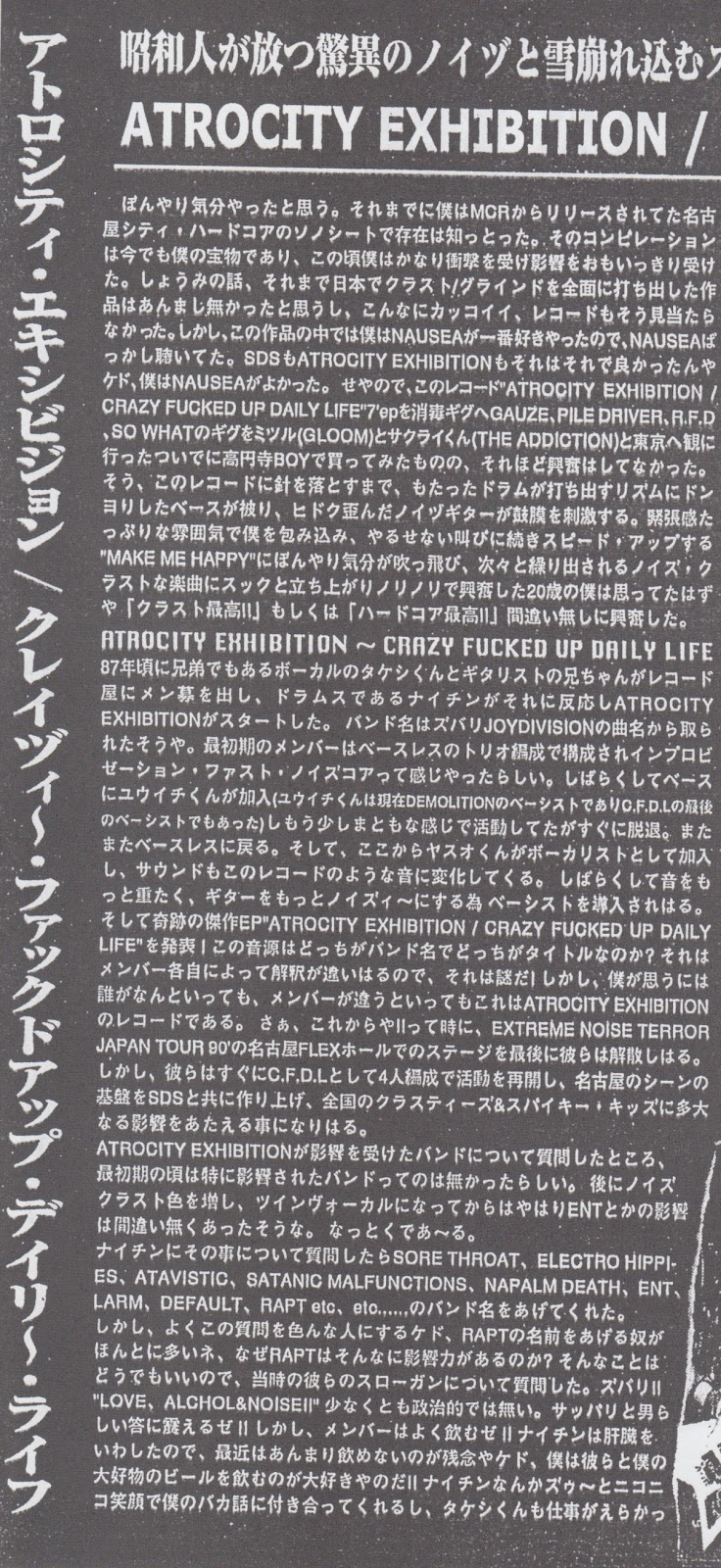
This version of "Atrocity exhibition" is actually a reissue from 2002. The original release was done by Yappy Core (CFDL's own label) and Standard of Rebellion in 1990, but this 2002 repress includes three extra songs from the same recording session, as well as liner notes from Takeshi and a history of the band written by Jhonio Crust War (yes, it is in Japanese). It was released on Scruffy Records and Answer Records (a Nagoya label that also put out records from Disclaim, Reality Crisis or Demolition). The cover is gloriously typical of the early crust days with an illustration of the proverbial "crusty and a dog" (a nod to Sox's "Sewerside"?). The real visual nugget is the very cheesy punk as fuck, crust as hell drawing of CFDL playing live on the insert. This good-humoured, snotty cartoon sums up what the band is about more relevantly than 1000 words (which kinda makes this post rather useless... oh well). Following "Atrocity exhibition", CFDL went on to be rather prolific, significantly not as crusty but still as energetic and wild. The 1991 demo and the "Thrashpunk '91" from 1996 are highly recommended. But man, what an unsung masterpiece "Atrocity exhibition" is... And how influential, of course.


It really was all about love.

<3    


Thursday, 6 October 2016

Japanese Crust vs The World (part 1): Macrofarge / Euthanasia "Reality Crisis" split flexi 7'', 1989

In this day and age when the medium matters as much - if not more so - as the content, it appears rather difficult to see a flexi for what it once was. The habits related to listening and indeed consuming music have changed drastically and have literalised the medium. A record is now just that, a record. As if the object needed to become irrelevant for it to actually find its real essence back as an object. Bluntly put, people who buy records don't necessarily love music, they often just love records that they will not listen to, as the music will usually be enjoyed in mp3's through computers or other devices. Ironically, the more the object becomes unnecessary and useless the more it becomes collectable and fetishized, no longer a means to an end (the music), but the end itself. In that light, a flexi from the 80's, maybe even more than a tape, is a strong reminder of what used to be the medium's role before: a vessel.

I don't really like flexis. They freak me out. I have heard so many scare stories about flexis getting unlistenable, proverbially "beyond fucked", with time that I usually think long and hard before buying one. According to old-timers, the original idea and the major advantage of a flexi was that it was very cheap to do and that, despite its fragility, its very low weight implied lower shipping costs as well, which made it easier to send around, especially abroad. From this perspective, the flexi can be seen as the ultimate DIY punk record in accordance with the idea of the legendary "Network of friends". But still, I have largely remained unconvinced, probably because the relevance of the flexi went extinct well before my time (if memory serves, only Active Minds flexis were still readily available when I started looming ominously around distro tables) and the ones that were still coming out were usually "tribute flexis" that referred to a flexi golden age without caring much for the original usefulness of the particular medium. And almost always, they were Japanese punk-styled records, so that, to this day, whenever I hear "flexi", I just know it is going to be the Battle of the Nerds if I want to get a copy. And if the flexi is a 6" or a 8'', blood will be shed and death threats uttered. And if it is a one-sided 8'' flexi... then God help us all.


Flexis are indissociable from the 80's Japanese punk scene. The amount of flexis released in that decade is truly breath-taking, probably for reasons of reducing costs and of convenience I mentioned above that made sense given the geographical position of the country, or even perhaps because of domestic shipping costs as well. The staggering number of Japanese flexis is reflected in MCR Company's discography. Even just a quick look reveals that, out of the first 30 releases of the label, 14 were flexis (and a good portion of them were single-sided... we really had it coming). Unsurprisingly, the compilation I mentioned in the introduction to this series, "Must Get to the Power of the Defence For...", to me the first genuine Japanese crust record, was a flexi. And today's record, released six months afterwards, in December, 1989, was also a flexi: the split between Macrofarge and Euthanasia. It proved to be MCR's 24th record, right between a compilation VHS (!) that included bands from the Nagoya-area (of course, the three bands from "Must Get to the Power", namely SDS, Atrocity Exhibition and Naüsea, are on it) and the first Fuck Geez Lp.

I would be lying if I said I knew a lot about Macrofarge. In fact, they are a little bit of a mystery to me and the internet doesn't seem to be that well acquainted with this Tokyo band either... Yes, you are perfectly right in assuming we are going to have a wild guess session here. Macrofarge were a late 80's/early 90's band, probably active between 1988 and 1991. Apart from this split with Euthanasia, the band appeared on two MCR compilation Lp's, 1990's "革命 Best Run Fast" (with Asbestos, DONDON and Juntess among others) and 1991's brilliant "I will take no orders from anyone!!" (with SDS, DONDON, Mess and Assfort, who were actually the first Japanese hardcore band I ever heard when I was about 18... you can imagine how baffled I was). Before these, Macrofarge appeared on a Souzui Records tape, compiled by Yoshikawa - from DONDON - in 1989, entitled "Kiss my ass". Yes, it was the follow-up to "Suck my dick" and included most of the aforementioned usual suspects from Tokyo. The first Macrofarge recording however might be a 1988 demo tape called "Stop your nonsense", about which I found close to no information so I'd rather be cautious here (especially since the song titles don't fit with any of the subsequent ones). Finally, the band self-released three live tapes in 1991, that I have sadly never heard.


On the face of these bits of intelligence, Macrofarge should be seen as just one of so many Japanese hardcore bands active in Tokyo at the time, a mere side note in the grand book of Japanese punk-rock. But there is this thing that makes them crucially relevant in the frame of this series: they were the first "Peaceville sound" band in Japan. While it doesn't really show much on the "Stop your nonsense" 1988 demo (although the groovy bass lines gave away what was to come), which was still by and large strongly rooted in Japanese hardcore, Macrofarge's following recordings are obvious and spectacular early examples of Doom-worship. Keeping in mind that the three songs from the split were recorded in July, 1989, it was a very early instance of Doom-type scandicrust that predated even Hiatus. The three tracks are perfect takes on "Bury the debt", with over-the-top gruff vocals, classic Discharge-by-way-of-Sweden heavy crusty guitar riff, a roaring bass sound and a simple, but highly effective, drumming that is perhaps an ideal blueprint for the genre. Doom's is undeniably a popular, beloved sound in the Japanese crust scene and, as bands like Abraham Cross, Warcry or Scene Death Terror (to give a current example) can attest, I am prone to think that Japanese crusties probably got Doom differently than the rest, more essentially perhaps. I don't know how Macrofarge are regarded today over there, but from an outsider's perspective, they clearly pioneered the gruff sound of Doom and Sore Throat (of course, both bands' Japanese legacies are closely tied and the opening riff of "Reality crisis" could have been lifted from "Unhindered by talent") that would be so influential in Osaka a few years later, whereas SDS were significantly working on Antisect's proto-crust sound. Fascinating band. Obviously, Macrofarge still had a Japanese hardcore background that shone through at times in some of the chorus and in the overall frantic energy (more so on the "I will no orders from anyone!!" songs), but for the time, they were amazingly close to what they wanted to achieve. The production on these three songs is fantastic as well, heavy and punishing yet highlighting the relentless simplicity and aggression of the songwriting. They were recorded at Our House Studio in Tokyo, where classic records from Bastard and Death Side were also captured, so you know it is bound to be really good sound-wise.


Visually, Macrofarge also borrowed from the classic antiwar imagery that permeated 80's anarcho bands and the cover referred to the Tiananmen massacres that took place just one month before the recording. The singers grunts in English but the lyrics are only translated in Japanese on the cover so I am only guessing (thanks to the cheesy little drawings) that the topics covered are war, the media and nuclear weapons. Direct references (apart from the riffs) don't abound but are still solid. "The dream come true" hints at Doom's "A dream to come true" while the mention of "The dark side of society..." may be a nod toward Hellbastard's "Dark side". And there has been at least one band that openly referred and paid tribute to Macrofarge ten years after: Reality Crisis (though I have only just made the connection really...). Following the split of the band, I know that the drummer Chara joined force with Kuro from Acid and Kawaguchi from Sicilian Blood to form Liberate, but that's about it. And Discogs tells me that Chara also did some backing vocals on a Juntess Ep, so that may indicate that Macrofarge were somehow close to bands like Juntess, Acid or indeed DONDON (with the Souzui Rec connection). Wild guesses, I told you. The only thing I have absolutely not even started to figure out about the band is the rather intriguing name... Macrofarge? I really am clueless...


On the flip side are Euthanasia, a Finnish hardcore band from the mid/late 80's that I am not familiar with. I must say they are quite enjoyable, very much on the punkier side of the Finnish hardcore spectrum, like Bastards meet Asta Kask or something (the second song form the split has that kind of singalong quality to it). The real gem on their side is the first song however, "Martat Pois Bingoista", a genuine vintage ripper reminiscent of the best bands of the suomipunk genre. The production is fitting as well, very angry and energetic with that chaotic bass sound, and like with most Finnish bands, there is always a rough-yet-catchy tune that you can hum. Euthanasia did an Ep before the flexi, "Ölöriefot Putkosessa Kemoryölöt Kabinessa" in 1987, and also a tape the following year, "Ämpäri Päässä Pyöränkumia Pumppaa". A double-cd discography of the band was released in 2009 as well.    


Wednesday, 5 October 2016

Japanese Crust vs The World: an introduction...

Japan. If you love punk-rock and you are being nerdy about it, it is this enigmatic country of definitive perdition and parallelly of unrestrained, undeterred passion. Can you have one without the other? Maybe not, but I am not here to answer this kind of questions and will leave the meditation to someone who has been reading far too much Romantic poetry.

For a long time, Japanese punk was this objectively awesome thing that I hated to love and loved to dismiss. It was the realms of nerds and record collectors, dirty words that the internet age has somewhat rehabilitated. Although I was completely aware that Japanese bands were not responsible for the goofiness that their production appeared to induce abroad, I instinctively knew that if I started to delve into the enticing, seductive world of Japanese punk, I might not make it out in one piece and my sanity would be jeopardized. Did it keep me from getting heavily into SDS or Crust War Records? Obviously not, and I remember having a Class War sticker on my bass guitar that I had changed into "No war but the crust war" (I am still not sure if it is really lame or sheer genius), but still, I tried looking at the whole thing from a safe distance. The era of file-sharing definitely changed the game and allowed average punks, like yours truly, to get a basic grip on the characteristics of classic Japanese punk and hardcore without having to sell a kidney in the process but sadly, through the vicious equalizing quality of the internet, sometimes losing sight of context as well. Until rather recently, I was fairly happy about my relationship with Japanese punk. We kinda knew each other, enough to share a few intimate things with one another, but we both felt that things could get really out of hand if we started dating properly. And then life happened (and not just the band) and I figured that I needed a daring challenge, something intellectually stimulating, not only for the blog, but also in terms of sound and texture. And to make life unbearable for my indie-rock loving neighbours. So I decided to punk up and properly engage with what Japanese punks had been doing with that favourite punk genre of mine: crust.

This Japanese crust series will be made up of twelve records, because I really had a hard time choosing and because it reminded of me the twelve temples of the Gold Saints in Saint Seiya, my favourite anime (I'm not apologizing for that). Of course, since I am not planning to write about this topic forever, there will be classic crust bands missing and probably some that may not be seen as genuinely "crust" but are interesting to tackle through that prism.

Just like for last year's 90's crust series, I suppose it is relevant to think about the very notion of "crust music" that I will be working with throughout the series. Rather than a strict set of narrowly defined elements, I like to think of crust as a particular, but fluid, atmosphere. It is a tension, a mood, a worldview as represented and stylized in a particular record using aggressive, heavy, dirty, groovy sounds inherited from hardcore and metal. And although there is such a thing as "crust aesthetics", I like to think that they can be adapted and built upon cleverly in order to create or re-create. Basically, I stand for an encompassing conception of what is "crust" instead of the few boring templates that seem to be the norm today, i.e. uninspired Wolfbrigade-mimicry or badly played takes on Bolt Thrower.

Now, since we are all obsessed with pioneers, originators and anteriority, let's have a few words about the birth of crust in Japan. It is expectedly unclear. Pretty much like everywhere else, the very term "crust" was not really used before the early 90's, notably through the rise of the Osaka scene, so any use of it applied to a band prior to 1993 (roughly) must be read retroactively. After discussing the issue with an old-timer from the mid-late 80's Japanese punk scene, I realized that, given the irrelevance of the notion of "crust" in the late 80's, it appears to be much more interesting to think in terms of outside influence, in this case the UK. So rather than a local take on what can be characterized as "the Peaceville sound", the rise of crust in Japan can be understood as an intentional rebirth of "the UK sound" in that particular geographical and chronological context. By the late 80's, the Bristol noisy sound and aesthetics of Chaos UK and Disorder, that had heavily inspired and led bands like Confuse, Gai or Kuro to yet unknown levels of distorted punk insanity, had fallen out of fashion. Similarly, the roaring sound of Discharge (probably the undeniable UK sound) was not quite all the rage either and bands openly referring to them (let's keep in mind that referentiality has always played an important role in Japanese punk) were relatively few. It is always tricky and slippery to generalize, especially when dealing with such a prolific scene, and there were, of course, exceptions that can be seen as, if not as precursors, at least as signs of things to come.

In Shizuoka, a band like So What (usually forgotten in our beloved "underrated bands list") kept the spiky sound of Bristol alive and well between 1985 and 1990. In terms of Discharge-love, it would be criminal not to mention Crow (I mean, they even mentioned "Special thanks to: Discharge" on the backcover of the "Last Chaos" Lp from 1987), arguably the first Discharge-worshipping Japanese band and possibly the local band that was the most influential in the making of crust with their radical antiwar lyrics and the relentless intensity of their sound (a common trait in Japanese punk, it has to be said). In Tokyo, the really thrash-influenced Asbestos certainly took inspiration in the dischargy sound (though probably more in Discharge-loving band than in Discharge itself) and were not unlike a blend of Concrete Sox and GISM by the late 80's, while the amazing Acid were uniquely blending the traditional Japanese hardcore sound with the thick Discharge one, and both bands also relied on the 80's Dis-aesthetics of war, famine and spiky band logo. At that time, international hardcore was getting faster and faster, and even though the UK sound was probably not a major influence on local speed pioneers like SOB, Gauze or Mad Conflux around 1987 (in terms of purpose, they could be seen in the same light as US-inspired British bands like Heresy, Electro Hippies or indeed Napalm Death I suppose), the increased velocity reflected a desire for music extremity that does echo that of the early crust bands worldwide at that time and was illustrated in the connection between SOB and Napalm Death, the former even doing a Peel session when they toured the UK in 1989 and both sharing a split Ep the same year, or in Gauze's UK tour with Chaos UK that same year. The ties between the late 80's UK crust/hardcore scene and Japan are possibly more intricate than one could think, after all Dean Jones cites GISM as a great influence on ENT in terms of vocals (the radical, gruff vocals of a lot of 80's Japanese punk bands certainly made the country really hospitable to the crust genre), Doom covered Crow's "Give up all hope" and Rich Militia's Warfear was openly into Gai-worshipping . Initiated by Chaos UK's Japanese tour in 1985 (a band that, through its musical evolution and involvement, played a crucial role in the development of the British crust scene in the mid 80's), some of the bigger names of the Britcore scene (I abhor the term but I don't think I had ever used before in these pages, so here it is...) like Doom, Napalm Death, Extreme Noise Terror and Concrete Sox toured Japan in the early 90's.


Significantly, on one of ENT's 1990 tour dates, besides SOB and Lip Cream, the Ipswich punx also shared the stage with two bands that can be construed as the real instigators of the UK sound revival, and eventually as the genuine crust originators in the country: Crazy Fucked Up Daily Life and SDS. Since both bands will be discussed at length (again, since SDS have already made a couple of epic appearances on Terminal Sound Nuisance and deserve their own parking spot), I won't delve too much into the subject right now. Interestingly, the first release SDS was ever included on was a tape compilation entitled, rather unfortunately, "Suck my dick" in 1987, which was released on Tokyo-based Nouzui Records, a label run by a bloke from DONDON, and also had Discharge-loving bands like Absestos, Crow or Acid. But SDS took the UK influence much further than the aforementioned bands as they expertly and spectacularly intensified the bond between 82' Discharge and 86' Antisect in their music, which was completely unique for the time (NYC's Nausea were still a couple of year away from that sound). Formerly named Atrocity Exhibition after a Joy Division song (until 1989), CFDL (a Disorder song this time and probably more fitting) started as an all-out fast and noisy chaotic hardcore that borrowed equally from UK bands like Disorder UK, Napalm Death and especially Electro Hippies, than European hardcore acts like Negazione or Lärm or mid-80's Japanese noisepunk. CFDL were from Nagoya, while SDS lived in a nearby but much smaller town called Gifu.

United by the common goal of reviving the UK sound and renewing it in the process, the two bands (it was still Atrocity Exhibition then) appeared on the excellent, but albatross-named, compilation flexi "Must get to the power of the defence for..." alongside a third Nagoya band called Naüsea that played brilliant Napalm Death/Terrorizer crusty grindcore. The flexi was released in May, 1989 on Kyoto-based MCR Company, a label whose importance in Japanese punk's history cannot be overstated. From my point of view, "Must get to the power" is basically the first actual Japanese crust record, from the music, the mood, the production to the artwork and overall feel. One may object that Naüsea was more a grindcore band and Atrocity Exhibition more of a... huh... cider-fueled superfast chaotic spiky hardcore band, but I reason in terms of tension, intent and connections and not so much in terms of discrete elements that must be assembled in a very specific way in order to work (this works for the D-Beat genre, but not much else) and I just stand my case. Later on, after they truly established their sound, SDS and CFDL started working more together and, with that UK sound in mind went on to organize the Punk & Destroy gigs (the name refers to a Japan-only Discharge record compiling the first five Ep's released in 1984... obviously) in the early 90's, in a Nagoya venue called Huckfinn. These gigs would welcome such openly crust bands like Life, Abraham Cross or Battle of Disarm. The infamous Final Noise Attack gigs taking place in Osaka (usually at the Guild if I understand correctly) and put on in the mid-90's by a new generation of local crusty battalions would be inspired by the Punk & Destroy gigs. But that's definitely another story...

Ok then, let's ave it.


Thursday, 15 September 2016

The PDX-Files: Deathcharge "S/t" Ep, 2005


Deathcharge almost made it to the "Chronicles of Dis" series I did a few months ago and to be honest, if I had physical copies of their first two Ep's, they would have. Sadly, when I had the chance to get them years ago for a normal price (aka "a decent price" since Discogs took over), I didn't take it and opted for records with covers depicting orcs wielding axes and causing havoc instead. C'est la vie... But the inclusion of Deathcharge in the PDX series is just as relevant and hopefully I will manage to get a copy of the "Plastic smiles" Ep in time for a possible sequel to the aforementioned Dis-series (I'm still working on a name and taking suggestions).

For a long time, Deathcharge was just a band that did what their name suggested: Discharge-worship. And they were good at it too. I distinctly remember them being praised for trying "just like Disaster" to sound "just like Discharge". Deathcharge were a "just like" band and I feel there is a quixotish beauty to it. No one has ever actually sounded just like Discharge and no one ever will, but many will keep trying, against all odds, aware of the illusoriness of the task, making the fight a romantically doomed one, but re-affirming not only the uniqueness of Discharge but also the relevance of this traditional punk discipline. Silly Discharge-worship may be a shibboleth to some, but it is one I am unashamedly proud of. And so were Deathcharge when they formed. The name is pretty self-explanatory (I love the fact that, when pronounced quickly, "Deathcharge" almost sounds JUST LIKE "Discharge"! Top meta stuff, right?) and as you would expect, their first Ep, the cheekily named "A look at their sorrow" from 1997, was a solid D-beat offering, packed with specific Discharge references (in the song titles with "A look at their sorrow", "The price of violence" and "Fear their power", and also in the actual songs, the chorus to "Fear their power" is the exact same as "Drunk with power" with just a few changes in the words). In terms of sound, this Ep sat comfortably between Totalitär and early Hellkrusher and it remains a solid specimen of 90's D-beat.


At that time, the line-up was made up of Adam on vocals and Roger on drums (both of them formerly in Masskontroll and the only members who have been in Deathcharge all along), Matt (Religious War, Blood Spit Nights, Dog Soldier...) on the bass, and Gabe and Colin on guitars. By 2001, Matt had left and Adam also played the bass for single-sided Ep "Plastic smiles". Now, this is indeed a record that sounds almost "just like Discharge" actually. But there is a very smart twist as the three songs included are all classic early Discharge mid-tempo songs, therefore not technically D-beat songs. It does raise the question of Discharge likeness when taken from the angle of track order and how it also creates meaning. If the three Deathcharge songs on "Plastic smiles" certainly rate as some of the best mid-paced Dis songs I have heard, the fact that they use a systematization of a mid-paced beat that Discharge used precisely as a means to balance and also emphasize their faster, proper D-beat songs is a shift from the global structure of Discharge writing. I still really like the Ep though and I actually love the concept but arguably, the inclusion of a couple of classic fast Discharge tracks would have brought Death closer to Dis in terms of the Discharge matrix of meaning creation. It could have hit the Dis-nail on the head in a spectacular fashion.

But enough disgressions already, especially since the eponymous 2005 Ep is not a D-beat record. In fact, despite an obvious Discharge influence, it doesn't really even try to be a dis-record - which is kinda weird from a band called Deathcharge, I'll give you that. Prior to this Ep, the band had recorded a demo in 2004 with their new line-up that saw the arrival of Chris (from Defiance, Religious War and even Poison Idea at the time) on guitar and Joe (from Assassinate) on bass. This tape demo (that is apparently pretty hard to find now) is probably my favourite Deathcharge recording. It already had what would make the subsequent Ep so good and unique but also kept a genuinely great hardcore punk basis. In my opinion, it is one of the strongest PDX punk recordings of the 00's and I cannot believe it has not been reissued yet. The mood of the demo is much darker than before, which definitely hinted at what the band was up to in terms of songwriting, and the five songs feel very cohesive, both individually and collectively. It includes three fast dischargy songs that would make any "raw punk" fan drool for their actual rawness and urgency, the perfectly timed vocals and the sound textures. They bring to mind the sound early Sacrilege, 83/84 era Varukers or early Hellkrusher, with a distinct Californian peace-punk vibe in the songwriting. Clearly top shelf. The remaining two songs are more metallic and moody, but not in a crust or metal punk way, rather they evoke post "Hear nothing", thrashy Discharge, but without the cheap glam touch, and late Antisect, dark and heavy, but not crushing or brutal. These two tracks are the foundations of the 2005 Ep.


The record contains two songs, "The hangman" and "New dark age", and I remember that, upon hearing it for the first time, I thought that I had never really listened to anything like it. Although there were enough familiar elements for me to relate wholly to it, I was still at a loss to describe the Ep. It is a genuinely dark record. Now, I realize the term "dark punk" has been overused and misused lately but I can't really think of a more relevant term. But it is 80's dark, clearly, as the Ep has a very peculiar 80's vibe (let's say 1986) in the songwriting and the overall mood. While the vocals remained very hardcore-sounding on the demo, here they have an almost goth quality but keep a very raucous tone that gives a dark incantatory aura to the songs that is not unlike Zygote or Bad Influence. There is mid-paced, heavy and groovy metallic riffing here, and mid-80's Discharge (for a long time one of punk's most tragic taboos) and late Antisect are relevant comparisons, but the purpose of Deathcharge is different. The songs are atmosphere-oriented, they sound like raw "danses macabres", they have that strange occult feel, lusting for death, and, dare I say it, are ultimately pretty glamourous and even sexy (if you are into morbid stuff but still like a bit of sophistication and velvet). As well as Discharge and Antisect, Smartpils and post-Amebix bands like Zygote and Muckspreader could be interesting postulates here, and I guess there were some Coitus songs that had a somewhat similar vibe, especially on the first demo, and even late Anti-System or English Dogs can be invited to the party too. But Deathcharge really created something with this Ep, something that certainly appealed to the Antisect fanboy in me and showed me that the way you tell a story is as important as the diegesis and that the meaningfulness of the output is completely conditioned by the narrator. And man, the two stories from this record, even though they are objectively heavy 'n' groovy metallic goth-punk numbers, utterly echo with the label's name: whispers in darkness indeed.

Like with any self-respecting PDX punk band, this Deathcharge Ep is highly referential, from the glam-punk picture of the boys on the cover, the "Grave new world" font they used, the riff from "The more I see" they nicked, to the Antisect nod in the title "New dark age". But despite all these familiar things, no one sounded like Deathcharge then and even the Ep itself looked like no other at the time (Discharge-loving goths with charged hair and studs?). Although the so-called postpunk/dark punk revival certainly borrowed from this unpretentious record and sometimes explored the same paths, I cannot think of many recent bands that wrote songs that were as inspired and inspiring. Following the Ep, Deathcharge released an album, "Love was born to an early death" in 2011, with Dusty from Hellshock on guitar and Frank from Lebenden Toten on the bass, that unfortunately did not live up to the Ep in terms of songwriting. Not a bad record by any means, but probably one that I was expecting too much from, hence a possible lack of judgement here.  


Tuesday, 13 September 2016

The PDX-Files: Ausgebombt "Hellbomber" cd, 2003


Ausgebombt make me think of Survivor Series, possibly my favourite wrestling competition. In it, you traditionally have four-on-four survivor matches that see four wrestlers teaming up to take on another four-man team. While it can be pretty messy but nonetheless glorious, sometimes you do have teams that work great together with the four dudes displaying proper collective skills and charisma and you wished that you could see them do another match together but you know you won't, because you've got different teams every year. It breaks my heart really. Ausgebombt is really not unlike the Randy Savage/Razor Ramon/1-2-3 Kid/Marty Jannetty team from Survivor Series 1993 as they showed solid wrestling kills, a great sense of timing and storytelling and delivered a quality match that, if rather classic in its construction, completely lived up to a wrestling connoisseur's expectation. But never did the four blokes wrestle together again, it was a one-hit wonder. And man, I have always been a sucker for Razor Ramon.

If you have followed this witty wrestling metaphor proving, once again, the distinction and sophistication inherent in Terminal Sound Nuisance, and assuming you have ever seen a wrestling match, you will know exactly what I mean about Ausgebombt. If not, don't worry, I will be more literal in the following lines. Ausgebombt (meaning "bombed" in German) only recorded once and released this record "Hellbomber", whereas they objectively worked really well together and I remember being pretty gutted at the time when I realized that they no longer existed. Now that I am infinitely wiser, I can get over the pain and revisit a record that I have loved dearly and regularly listened to, just like I can finally rewatch that Survivor Series match again after all these years.


In the Hellshock's post, I mentioned that PDX was a city of many bands, some of them quite successful and others really just short-lived sideprojects - which does not mean that the latter were bad at what they did. I would venture that Ausgebombt, from the inception, were more of a sideproject between long-time friends looking to play rocking music together, rather than a stable band built to tour Japan every year. I could be totally wrong of course, but I like to see the band in this light: four experienced punks getting together for a brief time but long enough to record a very enjoyable work. "Hellbomber" was certainly not the first endeavour of the members in a studio. Let's take a look at the resumes then. Ausgebombt's line-up (they all used cheesy nicknames for that one) included Jackal (singer of Defiance and The Unamused, and bass player for Blood Spit Nights) on vocals, Ratgunner (Religious War and Hellshock's guitarist) on guitar, Pigripper (bass player of Religious War and formerly of Deathcharge and guitar player of BSN) on bass and Hatchet Face (drummer of Axiom and Atrocious Madness and singer of Hellshock) on drums. Two things immediately spring to mind. First, my wrestling metaphor was utterly relevant since the name combination of Jackal/Ratgunner/Pigripper/Hatchet Face would make an awesome wrestling team. Second, Ausgebombt probably saw the light of day when Religious War stopped playing and, henceforth, promptly formed since having just one band in PDX was just impossible (or even prohibited). More seriously, although Ausgebombt were firmly rooted in the metal punk sound, I do see their essence as being not dissimilar to Religious War and BSN's. The respective musical intents certainly differ but the bands wrote solid, triumphant and well informed studded, bullet-belted punk rock. And by the way,  if a friend ever claims that Religious War sounds like Subhumans and Blood Spit Nights like Gai, please tell him that the Punk Taste Police requires him, in the shortest delay, to leave his scene membership card on his desk before more drastic measure must be taken.


As expected from a bunch of PDX punk rockers, Ausgebombt's visual and musical production is permeated with references. The very band's name derives from a famous Sodom song, there is a Broken Bones cover, the title of the cd (it came out as a mini Lp on vinyl) has the "Hell" prefix, you've got nuns in leather wearing gas masks (smelling Terveet Kädet here), a reaper riding bombs and a pretty neat PDX HC skull-embroidered axe logo. Ausgebombt quite obviously indulged in old-school metal punk with a distinct UK flavour that is naturally to my liking. I am reminded of a less technical, rawer Dis-take on classic bands like Broken Bones, Debauchery, Anihilated and English Dogs, or a punky, dischargy version of actual metal bands like Sodom, Warfare and Virus, or even of a PDX remodeling (aka the full studded jacket hardcore remix) of 90's UK metal punk band like early Hellkrusher or Aftermath. But there is one band that is incredibly close to Ausgebombt's music: Metal Duck on their 1987 "Quackcore" demo. Try to go beyond the unavoidable differences in terms of sound and production between a mid 80's young English band's first demo and a mid 00's Smegma studio record from thirty-something PDX punx for a second and focus on the music. Yep, amazingly close, especially in the triumphant, fist-raising, sensible riffs, the offbeat vocal flows and even in the peculiar energy. I have no idea if Ausgebombt knew about Metal Duck's demo, but it is not unlikely (they certainly did not keep the duck gimmick or the silly sense of humour though).


"Hellbomber" was recorded and released in 2003 on Hardcore Holocaust Records. I used to be a very regular customer at HH distro as I really liked the tasteful record selection (the distro carried Whisper in Darkness stuff as well) and I would buy pretty much everything the label put out. This particular record is by no means "a classic" but it is an ideal one if you are looking for simple, hard-hitting, epic, crunchy metal punk with a D-beat vibe and victoriously heavy intros and thrashy breaks. The guitar sound has that crunchy Nausea-meets-Sacrilege vibe, the bass is super buzzing, thick and groovy, and I love how the vocals are arranged, shouted but understandable and following the mighty "Rhythm of Cal". On a personal level, I would much rather listen to Ausgebombt all day rather than all the lame "crust'n'roll", "motörcrust" or "metal punk death squad" bands that seemed to pop up in the late 00's/early 2010's. They may just have been a side-project, an anecdote in the grand story of Punk, but sometimes, a short story written from the right perspective is really what you need. A good retelling can still make a good story. And if you do need to know the rest of this particular one, just listen to Dog Soldier, the band that Jackal and Pigripper, backed in their PDX HC quest by Matt from Defiance and Greg from BSN, formed after the end of Ausgebombt. Japanese hardcore-infused PDX metal punk. And the movie is great too.