Sunday, 14 March 2021
How Crust Survived the Millennium Bug (part 9): After the Bombs "Relentless Onslaught" Lp, 2008
Monday, 8 March 2021
How Crust Survived the Millennium Bug (part 8): Nuclear Death Terror "S/t" Lp, 2006
To an outsider, a non-member of the coterie, crust - as a genre - can look quite cryptic. Think about it for a second. Crust has always been a very confidential affair and you could very well argue that its believers even thrive on this sense of secrecy, on the conviction that crust's cultic nature set them apart, make them special and grant them the superpower to withstand the whole Zyanose discography in one sitting (the exact number of casualties after such a spectacular and testing, even if willful, torment remains sadly unknown). That crust appears to be an enigma is logical. After all, no crust band has ever achieved proper mainstream success, even if Extreme Noise Terror and Doom (the highly successful Napalm Death moved too quickly from crust to really qualify) can be said to be well-respected acts in the extreme metal community, although one should probably point out that their respective careers leading them to such honorable recognition have been quite different indeed. And let's face it, the metal world is the only place where ambitious crust bands can even hope to approach, not to mention attain, some semblance of respectability, not to mention commercial success, probably thanks to similarities and connections with the above-named Napalm Death and Bolt Thrower rather than a genuine appreciative knowledge of the genre. But then, does any current crust band even want to achieve what the doxa sanctions as success, even in the only relatively important extreme metal sandpit? Flogging the 500 copies of their latest record to the patched flock must already be enough, innit?
Like any punk subgenre (or punk subsubgenre), in order to properly understand and interpret a crust artifact (like any split Ep from 1995, a pair of crust pants or a rusty Amebix badge), one has to be familiar with the rules and conventions governing the music, with the ideas displayed and even the shower-free lifestyle. Like many artistic entities, crust and its subcategories have their own fantasies of themselves and always engage in self-representation. Crust basically "does crust" in an act of referentiality and performativity. Of course, the split Lp between Zygome and Kaltbruching Acideath can be enjoyed on a sensory level by anyone (well, maybe not anyone, some predispositions toward the appreciation of gratuitous sonic brutality and human imitations of wild boars fighting are generally required). However, important elements such as the band's intent, their context of production, their position in the grand crust narrative, the meaningful abundance - or, on the contrary, the purposeful scarcity - of referential visual and sonic clues will be lost. To decipher and unravel the inner workings and contextual dimension of a crust curio can be a captivating task casting light and knowledge on a specific human experience. But it can also sound like a tedious ordeal and unnecessary convolutedness. As your average punter might say, as long as it gets the feet tapping, why bother with futile verbiage.
I suppose you know where I stand on the issue and today's piece must be read with crust's self-reflectivity in mind, and possibly a few cans of cider, as Nuclear Death Terror's self-titled album is a prime example of such a process, beside standing as one of the best crust Lp's that the noughties had to offer. The puzzling nature of the very name of the band has oft been verified and it might cause some deep concern among your eldest relatives if you happen to wear a NDT shirt at a funeral, even if black. And, well, if you read it literally it obviously means the extreme fear of a nuclear-related death like being reduced to ashes by the bomb blast, being burnt alive, vomiting to death because of radiation sickness in the aftermath and other Discharge lyrics. Why, why, why indeed. However, if you are already even remotely familiar with the codes of crust, you will instantly know that the three terms making up the moniker can be described as genuine clichés, but not only that, you will also make the assumption that the members were well aware of the trite derivativeness of the association and that, precisely, in act of conscious self-awareness, choosing such a name is a knowing and knowledgeable wink to the initiated, a purposefully cheesy and loaded name meant to indicate that the band understood the codes of the genre and decided to play with them in a tongue-in-cheek fashion. It is like a pact between listener and listenee. We know how crust is redundant, you know we know and we know you know we know. NDT implied a certain knowledge on the audience's part in order to be understood on a diachronic level, not unlike "just like" d-beat bands perhaps. Of course, NDT were also a very good band with a serious political message and commitment to DIY ethics that could be enjoyed, influence and inspire one on a synchronic level without one having ever heard of Extreme Noise Terror, Mortal Terror, Societic Death Slaughter, Final Warning, Final Massakre and crust's obsession with war - often of the imaginary nuclear variety - and eternal synonymy.
I first heard of NDT through two punks from K-town - meaning both Copenhagen and the yearly DIY punk festival that took place there and still does - who were traveling through Europe and had brought demo tapes of the band with them (a useful talisman to protect oneself against both dodgy wankers and hygiene). The tale behind NDT's conception was just as good as the band itself, if not better. Apparently, the members had written all the crust-compatible clichéd substantives and qualifiers they could think of on distinct pieces of paper and they then drew three of them at random and the winners eventually were "nuclear", "death" and "terror". I suppose they could just as well have ended up calling themselves Final Doom Massacre, Slaughter Grave of Mankind or Napalm Hell Fear (Extreme Napalm Terror was already taken), but Nuclear Death Terror can be rightly considered as a very fine and lucky pick. I am not sure that the story is true but its veracity does not really matter. First, it makes for a great story to tell and second, and more interestingly, it illustrates crust's traditional self-reflexivity, the conscious decision to "play crust", to "do the crust", to "perform crust" and to establish this pact based on a shared subcultural context with the audience that partly implies some sort of suspension of disbelief. But isn't such a pact part and parcel of a relation with any artistic creation? All this blathering notwithstanding, the phrase "nuclear death terror" sounds too good to be true, fraudulent and I think they cheated and the game was rigged.
In any case, following the band's enthralling origin story and the very high praises of the crust-loving Danes, I ended up with a copy of NDT's 2005 demo tape. I hadn't played the fucker for a long time (almost forgot I even owned it to be fair) before this post and had forgotten how deliciously raw and angry it sounded and how extreme and gruff the vocals were (although they are sometimes quite difficult to distinguish, which is my only real reservation about this recording). If you need a relevant description, let's say it sounds like raw metallic cavemen scandicrust with dual vocals (State of Fear and 3-Way Cum battling with Hellshock in a squat to keep it brief). The recording really has the direct feel of a demo tape to it which feels a little dumb and tautological to point out (this demo really sounds like a demo) but the quality of recording and production has so dramatically improved during the past decade, even for demos, that to formulate such an impression is not so irrelevant today. NDT's first effort is a demo-sounding demo tape in the best way possible. It was released in June, 2005, on local label Plague Bearer (that also put out the excellent first Skitkids' recording on vinyl, Martyrdöd's debut and the magnificent album of Uro, Requiem) who made 600 copies of the tape, a large number indeed by today's standards for a demo.
The album that followed was a massive improvement sound-wise and can be rightly considered as an 00's crust classics. If the demo's rawness can be thought to link somewhat the first recording to the 90's crust wave (and to some wild animals fighting in a crate), its successor was firmly rooted in the 00's. Recorded in nearby Malmö by Rodrigo (from Putrid Filth Conspiracy) at The Bombshelter studio, it was again released on Plague Bearer and, without losing its menacing sense of aggression and its spitting directness, the album offered a more intense, not to mention tighter, lesson in emphatic, insistent crustcore with a dark metallic vibe. This said, it should be pointed out that NDT did not sound like a metal band on this Lp for the sound and the production were definitely on the punk side of crust. Some songs certainly contained their fair share of proudly epic mid-paced metallic moments and there are enough shredding guitar leads borrowing lovingly to the metal tradition not to be mistaken on the goods delivered here, but the dominant gene of the album is savage crustcore for the punx. This skull-laden work delivers tastefully pounding crustcore with hoarse dual vocals that sounds just as angry, tornadic and brutally relentless as scandicrust masters 3-Way Cum and State of Fear (there is a fair amount of Swedish riffing in NDT) but with a heavier stenchcore influence reminiscent of Hellshock's first opus that clearly roots the band in the mid-noughties old-school crust revival. As a bonus to the crust as fuck bollocking, there is a hidden song on the vinyl with an ace cover of "just like Discharge" d-beat pioneers Disaster's "Inferno" that, considering that, considering that the Lp was recorded in early 2006 before War Cry's cd reissue, indicacte that NDT knew their shit indeed.
The visual aesthetics of Copenhagen's crust heroes strongly reinforce the referential web already woven through the moniker and their Disrupt-meets-Sacrilege-in-a-haunted-Swedish-forest music. Like Hellshock and Stormcrow, NDT assigned Mid, original crust artist extraordinaire, to "draw crust" or rather to include as many elements of the templates of crust imagery as possible in one single drawing. Rows of cracked skulls, dead babies, ruins of an alienating metropolis, deathly fumes, massgrave, gas mask wearing survivors carrying corpses, desolate-looking frame, almost all the boxes are ticked and act like a massive sign saying "crust ahead" (you might want to hang the poster on your wall to precisely achieve such effect). The crust for crust's sake stance is further reasserted on the backcover with a drawing done by Stiv of War that covers the few boxes that were not checked yet: a peace sign made of scythes, a zombified punk and a torn war banner. For some reason, the album appears to be devoid of any nuclear explosion but then I suppose there just was not enough room. Rather unsurprisingly given the metallic progression of the band, NDT's following ep, Ceaseless Desolation, recorded and released in 2008 on Plague Bearer again, was an even heavier and tighter effort emphasizing the band's mutation into a more openly Frost-metal crust act. Objectively a better record than the Lp, I still think that it wasn't as fun and "crust and proud" as the album, which is the reason why I selected the latter. Afterwards, I remember there were rumours of a four-way split Lp between NDT, Guided Cradle, Instinct of Survival and Visions of War (bound to become an absolute classic) but it never came to fruition. The three songs NDT recorded for this project belonged to the same session as the precedent Ep and were subsequently released as a new Ep in 2009, called Total Annihilation. Guitar player, singer and lyricist Cormy, originally from Dublin, relocated in Melbourne and formed a new version of NDT with a lineup made up of members of Schifosi, Pisschrist or ABC Weapons. They recorded the Chaos Reigns cd for Southern Lord in 2012 but, to be honest, it did not particularly grab my attention. Cormy later on played in the very convincing noizy hardcore machines Krömosom and Geld.
Enjoy this slice of CRUST.
Friday, 26 February 2021
How Crust Survived the Millennium Bug (part 7): Guided Cradle / Instinct of Survival "S/t" split Ep, 2006
When it comes to Terminal Sound Nuisance, I always look for inspiration, wisdom and enlightenment in order to offer the deepest insight to the millions of readers spread over the world (according to the estimates of my rather competent Public Relations manager). While the mundanity of everyday life can be efficiently dealt with without involving too much of the - by nature limited - attention span and brain availability, writing for the blog requires the greatest intellectual commitment and the non-negotiable and total involvement of my resourceful knowledge. To achieve such a secondary state of utmost intellectual presence, Revelation must be attained through intense sessions of fasting and meditation (I recommend waterfall as meditation spots as they look great on Instagram and can highlight your abs) and then, and only then, is my mind ready to focus on punk music and the forced conversion of the unsuspecting masses. If you want to know more about my refined and beauty-enhancing meditation techniques, look out for my new book Essential Chakra Meditation: Awaking your Crust Power with Meditation, Visualization and Cider.
One of the numerous visions that I experienced after two days straight of standing motionless under that waterfall and freezing my arse off in the process is that, once upon a time, I often waited ardently for records to come out and my expectant chatter could be heard at punk venues and even, according to flatmates, in my sleep. Excitement barely contained, eyes sparkling with anticipation, watching our for the record's release with bated breath. If this incomparable feeling of suspension has not completely disappeared when it comes to my record buying habits, the years combined with our new gargantuan and yet blasé consumption of cultural goods online, their seemingly unstoppable commodification as well as the constant flow of new bands and new trends somehow tempered my once insatiable enthusiasm and eagerness for new punk records. Perhaps it has to do with growing older and with the steady accumulation of records that the loyal support for the bands, for the labels and for materialism necessarily entails. With the improvement of one's knowledge, the probability to be genuinely, not to mention pleasantly, surprised decreases. I sharply remember with a tinge of nostalgia the seemingly endless wait for the split between Hellshock and Effigy to come out, or the one between Stormcrow and Sanctum, or the After the Bombs Lp, and that's just sticking to the old-school crust sandpit (admittedly my genre of affinity). That's not to say that my proverbial ebullience dried up after the mid-00's as my expectations for more recent records like the split between Fatum and Cancer Spreading, the one between Extinction of Mankind and Apocalypse or the one between Zygome and Kaltbruching Acideath were quite high indeed. However, the stenchcore revival of the noughties undoubtedly marked the peak of my anticipative years and the split Ep between Guided Cradle and Instinct of Survival was one record that I waited for feverishly.
I already wrote about my intense relationship with Instinct of Survival - one of the few current crust bands that has proved to be able, time and time again, to surprise me - so for the sake of literary brevity I shall not tell the story of my first encounter with the band again but if you are interested in this classic moving tale of initiatory journey, I encourage you to read the review of Lapsed into Absurdity, their one-sided flexi from 2013. I obtained this very fine split Ep at a Guided Cradle gig in Paris in 2006 during their European tour. I first heard about GD, that band from Czech with two American punks in it, from a mate of mine who had already seen them live and, although he was not especially a sucker for this style of hardcore punk, was very complimentary about the band's performance which he described as "stadium crust". Now, that is a tag that makes one wonder, doesn't it? While a quick survey revealed that GD did not actually play crust music, I could understand where the "stadium" qualifier came from after ordering the first 2005 Lp and why it sorta made sense. GC were epic. And I don't mean epic like a neocrust band, far from it, they were epic like an over-the-top metal-punk band, one potentially able to entrance the audience and have them collectively fist-pump and cheer as one to their brand of bulldozing Swedish-inspired metallic hardcore punk. I witnessed GC for a second time at the Play Fast or Don't festival (in 2009 I think) playing to a large crowd and, if it could not be realistically called a stadium-sized audience (unless we're talking about of a mid-table November game at the Salford City stadium), the band definitely packed a severe punch and worked particularly well on a big stage supported by a massive sound which brought their crushing power to the fore. A live hardcore tornado that unfortunately had not materialized at their Paris gig.
It was bad luck really. GC were playing a squat on the outskirts of Paris (in fact it was a squatted inn), an infamous venue that hosted many gigs for a couple of years (Leadershit, Makiladoras or I Object played there) and was renowned for being inhabited by more dogs than people which could make for strange atmospheres when bewildered touring bands sometimes literally played at 2am to ten scruffy dogs barking and chasing one another and three dog owners too pissed to stand properly. On occasions though, when the place was packed, the atmosphere was crazy and electric and anything could happen. Great memories. Sadly, a massive party at a nearby squat was taking place on the very same days as GD's gig so that it was poorly attended and, well, a bit depressing. I was of course among the few excited people present in the room and the band played well enough, with the intensity you were entitled to expect after regularly blasting their debut album, until some annoying lad who was as high as a kite started to jump on one of the guitar player's pedal board (not once but twice) which brought the gig to a quick stop. Understandably, GC looked miserable enough after what must have been a major low on their tour. This sorry state of affair did not keep me from asking the band if they had the split with Instinct of Survival to sell, which they had, and I left the venue in a merry, light-hearted mood with a precious crust artifact whose coming I had anxiously awaited for what seemed like centuries but must have been less than a year.
On the other side the resplendent IOS offered their first two stenchcore songs on vinyl which, in retrospect and keeping in mind what they have achieved since 2006, is a bit of a historical event in the grand narrative of crust. As my wikipedia page and my previous post about the Hamburg crust elite indicate, the first contact with IOS was akin to an epiphany. Some people get to see the face of Jesus on a dog's arsehole, I get to be possessed by the new wave of crust at a festival somewhere in Germany. To each their own. I still have vivid memories of that IOS gig at the 2005 Yellow Dog festival but I am not sure how real they actually are and how much of an idealization of an initiatory arc of my quest for crust they might possibly stand for. Somewhere in the middle I suppose. In any case, my first live experience of IOS corresponds to a large extent to the two songs they committed to vinyl for this split Ep. You do not really need me to recount the tale of the band but since we are all gathered around the bonfire tonight I might as well have a go.
The band started out as Sperrzone in 1995 and played primitive and fast deutschpunk with studs, spikes and quite certainly acne. They then morphed into Instinct of Survival in 1998, the nod to Napalm Death a sufficient clue to know in what direction they were now heading: raw old-school grindcore. Most of the band's newer audience seem to ignore - intentionally or not - the pre-stenchcore period of the band which is, I believe, an error of judgement. Although personally partial to Warsore or Rot, I cannot be said to be much of a grindcore fan, however even a casual listening to their split Lp with Wojczech, recorded in late 01 and early 02, reveals that IOS had been toying with heavy old-school metallic music with gruff vocals before the mid-00's. The heavy and crunchy guitar sound enhanced with those typical slimy bends, the texture of the nasty hoarse-versus-screeching dual vocals and the overall filthy vibe are not dissimilar to the band's take on vintage Peaceville-styled crust that emerged in the mid-00's. And if you are so inclined as to look at the band's evolution from a meta crust prism, you could very well argue that, if the version of "Instinct of survival" on Scum belongs to the glorious early years of grindcore, the first version of the song on Hatred Surge had all the characteristics of the early UK crust sound of Deviated Instinct, Hellbastard and the likes. So even if IOS took it the other way around, it still makes sense. The band took the first step toward orthodox crustness around 2004 as a tape bucolically titled In Conspiracy with Crust, the Stenchcore Sessions seems to indicate. It might have been originally a rehearsal tape meant to capture the new unequivocal direction of stenchcore revivalism and it includes early versions of songs that would eventually end up on IOS records later on.
But back to this Ep. The production is, again, a bit thin and raw but, given IOS' style, I would say that it doesn't affect their songs as much as GD's and you could even claim that it gives them an even more organic old-school vibe (if you ask me, I wouldn't change a thing). I have listened to those songs so much that it is a little difficult to provide a critical perspective on them, but then if you are clueless about the band's music then your blithe inattention is really your fault and yours only. "Axis of stupidity" is a classic mid-paced number that starts with a dark and heavy Deviated-Instinct-in-'87 introduction and then bursts into a brilliant Napalm-Deathed riff that is guaranteed to have you headbang sensually and you also get a slower early-Axegrinding moment as a break and treat. "Human" is a faster one, it opens with a kind of primitive early-Bolt-Thrower-on-speed beat before unleashing ace Sacrilege-worshiping metal riffs highlighted by a groovy mid-tempo. The vocals are top notch, Kalle goes for the bear-like disgruntled low-pitched shouts while Padde opts for high-pitched and insane-sounding screeches and I love how the two work together. Absolute classic record of 00's stenchcore that made the listener - by which I mean me 15 years ago - crave for more. And, thanks fuck, more quality old-school crust records would come out of the IOS bag in the 00's, two Ep's with the wonderful Winter in my Mind at the end of the same year and Screams of Suffering in 2009 and an outstanding Lp in 2008, North of Nowhere, probably their most famous records. Without a doubt, IOS were at that time the strongest and most consistent European answer to US bands like Hellshock and Stormcrow, they influenced many bands to take up arms and do the crust and they are still a reliable and relevant crust force at the time of writing so that they more than deserve the "classic band" tag.The cover alone could be the object of a whole essay. It was drawn by Steve from Visions of War who can be described as both a talented artist in his own right and a talented crust artist. Not unlike Mid's art before, Steve's progressively went on to define new visual aesthetics for crust so that his drawings - or fartworks as he calls them - became closely associated with the crust/stenchcore genre in the 00's and 10's. If you are even only remotely interested in crust punk, you must have seen one of his pieces. In the case of this split Ep, Steve used a theme for the cover that was quite common in the 00's, namely orcs and skeletons in armours. I suppose the success of the Lord of the Rings movies is no stranger to recurring representations of savage axe-wielding warring orcs and heads on pikes in the crust universe (GD's first song even starts with a sample from a Lord of the Rings movie) and we have here a fine example of this trend that has not quite died out. As I said, it has also become a legitimate part of the genre's visual canon. The Ep was released on Yellow Dog Records, a now defunct Berlin-based label with a long discography that discogs will lead you through.
Friday, 19 February 2021
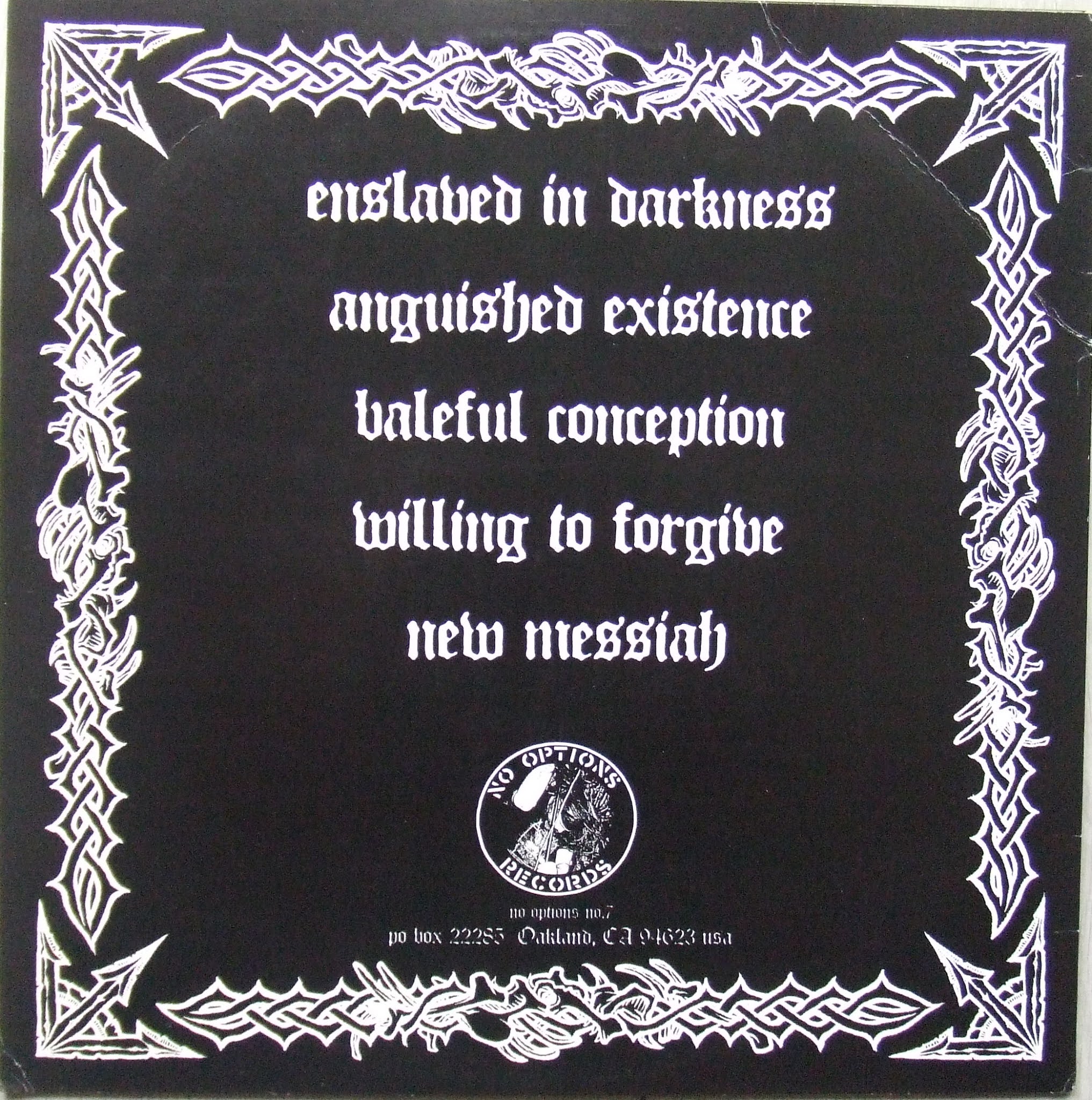
How Crust Survived the Millennium Bug (part 6): Stormcrow "Enslaved into Darkness" Lp, 2005
We are now deep into the middle of How Crust Survived the Millennium Bug, an as per usual tortuous retrospective series aimed at showing how crust music survived in the noughties after it gloriously peaked during the previous decade. The first five entries dealt with bands whose conception predated the so-called "stenchcore revival" - although Effigy often get associated with the trend, out of their split with Hellshock and of their open intertextuality - arguably the most spectacular crust-centered boom of the 00's and what that decade would be significantly remembered for afterwards. In truth, some would claim that the much more massive, not mention popular, "neocrust" wave is what really characterized the noughties crust sound and, as far as sheer proportions go, this claim cannot be said to be wrong. Still, do we really need terms like "epicrust" or "tragicrust" to be emblazoned forever on the forehead of 00's crust? Do we even want such terms to go down in punk History and be remembered at all? Exactly, we don't. And if someone must volunteer to undertake a radical revisionism of 00's punk and attempt to erase neocrust from History books and the comrades' collective memories and deny that cheap-looking xeroxed fanzines promoting brooding epic crust bands with melodies and, at least, four words in their name ever existed, then, for the sake of future generations, I'll be willing to take on that ungrateful role, even though the truth might resurface one day and, in a Planet of the Apes moment, a young hardcore kid will find an Ekkaia Lp half buried in the sand and thus uncover the conspiracy. It was all for your own good, Comrade.
So the 00's stenchcore revival it is then. Undeniably, the most iconic representatives and initiators of this trend were Portland's Hellshock, a well-known and respected band that I have already laurelled in the past and whose magnum opus Only the Dead Know the End of the War could be rightfully considered as one of the true great old-school crust classics of all time and all places, quite a feat when one keeps in mind that Hellshock was originally pretty much a humble side-project between mates who were keen on nicking Sacrilege and Bolt Thrower riffs, but the music ended being too good to be just that (which must feel lovely as it is generally the other way round). Accurately, if unwillingly, Hellshock also set up a new protocol for knowledgeably building on the original crusty stenchcore bands' sound and aesthetics while still rocking like a much more focused and self-conscious band of the early 00's (a different context of creation and a will to "play crust" that sometimes hindered creativity). Beside the evident sonic reliance on the canonical crust gospels, Hellshock deftly invited Mid from Deviated Instinct to draw the cover art for their first two Lp's and exert his not inconsiderable skills in (re)creating a typical crust visual, one utilizing saturated crust signifiers. The presence of an artist who originally defined the aesthetics of crust and the request from him to "draw crust" of course points to a referential stance and a message clearly delivered, that it's '87 in '03 - although it has to be said that Hellshock's experienced musicianship was undeniably superior to that of the original crust bands (without mentioning that Mid's craftsman ship and techniques vastly improved during this lapse of 15 years). Interestingly, the second bigger name of the stenchcore revival - which was at first distinctly located in North America - also asked talented stenchcore-architect Mid to "draw crust" for the cover art of their debut album, Enslaved into Darkness, and with the band's being name directly taken from a Deviated Instinct anthem - probably my favourite DI number at the time - I guess it would have been impossible to answer in the negative to Stormcrow.
I discovered Stormcrow through their connection with No Options Records, a label run by Will from Born/Dead that had released two records I owned and enjoyed (Endrophobia and Phalanx, the latter of which I still actually play) and whose moves I was monitoring closely. I must have hyperventilated upon reading the Deviated Instinct-inspired name Stormcrow on some message board, as any sane person normally would in the mid-00's, and then proceed the hunt the fucker which I eventually did... on Interpunk. Now be merciful with me and know that my using this provider is the source of no little embarrassment today but, to be fair, at that time, it distributed Prank, Hardcore Holocaust, Havoc, Tribal War and many other DIY hardcore labels. I bought my first Nausea and Antischism records from that website. Out of curiosity, I peeked at Interpunk a few hours ago - I was not even sure it was still standing - and even the most furtive look could not protect my innocence against the abominations proudly displayed on the website's front page, hellish visions capable of leaving your average crusty scarred for life. I'm sure they sell shoegaze over there. But anyway, shortly after its release in late 2005, I ordered the cd version of Enslaved into Darkness (I only upgraded to the vinyl version when I finally transitioned into adulthood in my early 30's), played it, was left astounded and in awe at the ferocity of their filthy metallic crust power, played it again, cavorted and headbang hard about my room for a bit, played it for the third time, swiftly ordered the shirt and prepared to boast about it to my mates the next weekend.
Stormcrow formed in Oakland in 2003 and was made up of members of local hardcore acts In the Wake of the Plague (that also had Will No Option) and Exit-Wound, PDX grindcore band Bent Over Backwards and sludgecore monsters Brainoil, beside which guitar player Nathan had also played in Destroy! and Code 13 while in Minneapolis. Of course, I was completely unaware of such resumes at the time but remember reading that Stormcrow was made up of people who had been playing in bands for a long time, known faces so to speak, though not by me. The band's association and ties with older Oakland crust outfits should not be left unexamined. Enslaved into Darkness was recorded and produced by Salvador Raya, who played in doom-metal band Asunder alongside former members of the mighty Skaven (with whom Stormcrow would eventually share an outstanding split Ep). Alongside Greg from Brainoil, aforementioned Raya is a sound engineer at Earhammer studios, where Stormcrow's debut, and many other Oakland punk records since, was recorded. Stormcrow were also mates with the people from Dystopia and, if it would be far-fetched and questionable to claim that both bands sound alike (who can even claim to sound like Dystopia anyway?), I like to think that their sound and creative intent arose from older metallic crust acts like Dystopia, Confrontation, Carcinogen and of course the oft overlooked Skaven as well as the heavier sludgy doom-influenced bands that followed. All bands must bloom out of some preexisting context, there is always an initial spark lit by predecessors and, from such perspective, Stormcrow can be seen as both a prominent band of the 00's metal crust revival and heirs to the Oakland crust tradition of the 90's.
The length of the songs - more than seven minutes for two of them - really helps the band install a specific atmosphere, one that reeks of pain and despair, rather than the sadness one associates with doom metal, but also of threat as Stormcrow sound like they are ready to bite back and spread rabies if need be, as punks playing metal healthily should, and the lyrics typically deal in allegories about destructive capitalism, alienation and state terror. The joys of our modern age. Like captain Obvious indicated at the beginning of this wordy sojourn, the cover art was drawn by Mid and represents - in his lovingly recognizable apocalyptic, morbid, organic style that came to define the classic crust aesthetics (though I would like to point out that the man is certainly not a one-trick crust poney) - mother Earth emerging angrily from a plague-ridden soil because of humankind's selfishness and greed. As much as I love Mid's art, I still have to admit that the focal point of this artwork, and as a result of my Stormcrow shirt, is the rather large pair of tits of Mother Nature. And I guess it makes sense that she would be big-breasted, what with her feeding the world and everything and, although seldom represented in crust art, there is nothing intrinsically ludicrous in having breasts on the cover of a crust record, it all depends on the artistic intent. Nonetheless, I still struggle to perambulate up and down the streets basically boasting monstrous tits right in the middle of my chest which certainly attracted more than a few frowns of puzzled consternation throughout the years. It's not as bad as my Genital Deformities artifact but still not a piece of garment I chose to wear at my great-aunt's birthday bash. However as a crust record cover, it works much better and I cannot really blame my lack of vestimentary insight on anyone but and I should probably have picked the other design. Oh well.
Hours spent overplaying Enslaved into Darkness converted me into a staunchly devout Stormcrow fanboy so that when I learnt that a split Lp with Sanctum - another stenchcore revival band I was really into - was planned, I exhilaratingly started to hassle everyone I knew about it - including the Sanctum lads when they played in France - and scouted the internet for any piece of intelligence about the Lp. This search came to an end in late 2006 thanks to No Options Records again and it proved to be an excellent effort and certainly one of the best crust split records of the decade with a cracking artwork, done by Dino from Dystopia, that is something to see if you are into Warhammer or Lord of the Rings-inspired fantasy battles (a recurring visual trope of the often very orc-oriented 00's crust scene). Stormcrow loved split records - and so do I to be honest - and 2008 saw the release of an absolutely classic split Ep with Skaven and a split Lp with Canada's prime grinding cavecrust unit on the always solid Agipunk from Italy with Stormcrow starting to display an even sludgier and doomier sound. The band's last two split Lp's (again!) with Laudanum in 2009 and Coffins in 2010 confirmed the band's development, which unfortunately was not my predilect cuppa tea, and my progressive loss of interest.
After the demise of the band in 2010, Brian and Tony formed Femacoffin, an excellent metallic crust act in the vein of Stormcrow's early years the review of which you can read here. I have to admit I quite miss the apocalyptic doomy stenchcore power of Stormcrow, which I actually got to see live in Tucson in 2009 (don't ask) and the guitars were so loud that they almost buried the drums and vocals. Well class.
Sunday, 14 February 2021
How Crust Survived the Millennium Bug (part 5): Flyblown "The Fear and the Fury" Lp, 2005
With an album opening on a slow and heavy sludge-like song and a political speech, the fact that Flyblown carried an urgent political message and were keen on spreading it with much force - like Scalplock did really - is little surprising. No insipid metaphors here. The Fear and the Fury can be likened to a scream of despair in the dark night of ignorance, a scream at our disillusions, our self-inflicted political powerlessness, at the manipulations of people's fears and at our war-mongering politicians and the Antisect comparison also applies to a lot of the lyrics. "Innocence is the first casualty of war". Recorded in 2005, this album has to be put in the context of the (second) Iraqi war started by Bush Jr. I remember the US president being absolutely hated by punks and progressives and his wars were extremely unpopular, notably in England who took part in the latest American crusade without thinking twice about it. Vehement anti-Bush songs bloomed in every punk band's set lists. That thick president was easy to hate and I would argue he probably prompted the formation of more than a few punk bands at the time (I doubt Behind Enemy Lines would have sounded quite as good without Bush). He was the new Reagan to some extent and Flyblown's poster representing a scarecrow-like Bush being crucified is a typical artifact of the period (and probably what I like the least about the album). Unfortunately, the insert of the album is very simplistic and with such a powerful collection of songs and lyrics, one could have rightfully expected something more elaborate as it looks a little rushed and there are not even any credits.
This album can also be used to punish unruly no(i)sy neighbours. Satisfied or refunded.
Friday, 5 February 2021
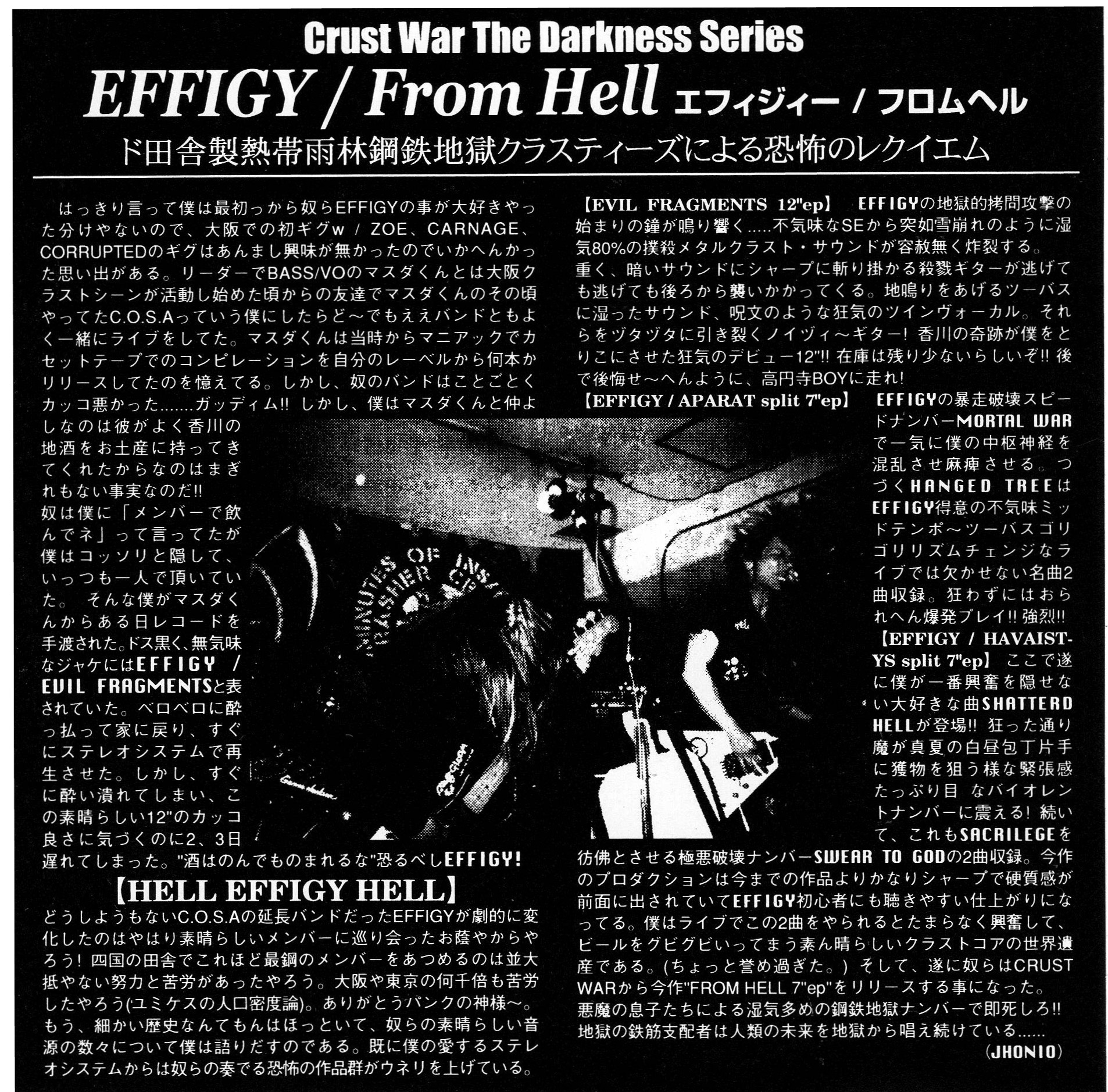
How Crust Survived the Millennium Bug (part 4): Effigy "From Hell" Ep, 2003
I know, I know, how predictable. Bloody Effigy. Again!
For those who have been unblessed enough to avoid reading my delusional ramblings, I have already written, loquaciously, about Effigy, on the Christmas Eve of 2015. Sometimes I fell like I am the internet equivalent of the bus station loonie - every bus station has one, it is common knowledge - who constantly harasses innocent and unwilling travelers about politics, the economy or the state of public services, except I would rave about Antisect worship instead of dodgy conspiracies. Be warned though that, if you ever witness someone standing on a box on your street corner and yelling feverishly about the apocalypse, it might just be me offering my expert insights into the band Apocalypse as part of a world tour of Terminal Sound Nuisance IRL.
Rereading the piece I did on Effigy's 1999 Evil Fragments 12'' Ep, I spotted unusual imprecision and a couple of blatant inaccuracies that could have me revoked from the crust society so I encourage the more discerning readers to gently disregard some parts of it. My core theory then was that Effigy, as a band and unit, bridged the gap between the second generation of Japanese crust and the third one. In an uncharacteristically pedagogical attempt, I will summarily resign myself to some defining.
The overarching hypothesis was that Effigy's works between 1999 and 2002 acted as a metaphorical tie between the second and the third crust wave. To put it succinctly, the second wave took place in the first part of the 90's with Osaka's Final Noise Attack scene, better embodied and violently kindled by the illustrious Gloom, generating bands like Defiance, War Cry or Condemned and the Tokyo crusties' club that included Battle of Disarm, Collapse Society, Abraham Cross or Crocodileskink; the third wave of crust took the early 00's by storm through the impetus of Acrostix, Zoe (two of the Darkest 4), Contrast Attitude, Deceiving Society or Defector (though some of these bands may have been as old as Effigy is not the point). Of course, Japanese crust is very much a fluid continuum and an analytical frame focusing only on discrete time periods or decades may not always be relevant or enlightening, although it can prove helpful to some extent. From such a perspective it makes sense to see Effigy in the same light as AGE, as a band carrying the sonic torch and perpetuating the metal crust tradition in the late 90's and early 00's. What I did not realize however was that Effigy's roots - not unlike AGE's with Hakuchi - were actually older as singer and bass player Masuda played in the metallic thrash-punk band COSA (cryptically standing for Cache Of Strategic Arms) between 1989 and 1995. It has to be pointed out that COSA had very different sonic intents to Effigy's (COSA sounded more like traditional 90's metallic Japanese hardcore) so that the conflation of the two bands is only partly pertinent in so far as it indicates that Effigy's songwriter - Masuda, I presume - was already experienced although not in the crust department.
Does all of this matter?
From a diachronic perspective, the coming and going of crust waves is always revealing, in spite of the inevitable instability of their stylistic and chronological boundaries and the inherent uncertainty of the notion of "wave" itself. I like to think that, because of their transitional place, Effigy can be seen as a - at least symbolical - link between the 90's and 00's, bringing not only bagfuls of the old-school metallic crust sound into the new decade, but also the high degree of sonic referentiality and visual intertextuality of SDS with them (without mentioning some new crust fanatics). From a synchronic position, you could very well make the sensible argument that From Hell is the best crust Ep of the first half of the noughties. Records like Hellshock's 2003 S/t Ep, Defector's Punk System Destroy or After the Bombs' Terminal Filth Stench Bastard would be definite contenders but From Hell remains the safest horse to bet on (but you know, what with taste being subjective and everything). But then, even trying hard not to fall into the trap of retroactive imposition here, the notion that Effigy's earlier records may have had an influence in kick-starting the 00's stenchcore revival is not completely preposterous.
Their split Ep's with Äpärät in 2001 and Häväistys in 2002 (I am not going to revisit Evil Fragments) openly and reverently built on the classic crust sound and visuals and nods to the crust canons were distributed prodigally. The former was a brilliantly crunchy and filthy, not to mention heavy as fuck, example of late-Antisect/vintage-Sacrilege infuenced metallic crust with a touch of cavemen doom/death-metal, while the latter, unfortunately a bit thinly produced, relied significantly on the rocking Japanese crust savagery of SDS, Carnage and Anti-Authorize (the locally-sourced original reworking of the Antisect sound if you will), with a spoonful of Hellbastard for added tastefulness. Could such potent records have prompted some PDX punks to also play referential old-school metallic crust, or stenchcore? After all, the split with Häväistys was released on Portland's Whisper in Darkness and there is little doubt that the members of Hellshock were suckers for the old-school crusty Peaceville sound to start with so would it be that far-fetched to venture that the early Effigy records and their creative intents, namely the unabated open tribute to the visual and sonic aesthetics of the crust canon, could have encouraged and facilitated the sonic formation of Hellshock? Or was a stenchcore revival just floating in the air at the time? After all, the idea behind Atrocious Madness was largely to emulate Gloom's revolutionary stance and Tragedy have always been notably influenced by the triumphant sound of 90's Burning Spirits hardcore, so that the artistic connections between Japan and Portland was certainly nothing new by the early 00's. It is also worth wondering whether the early Effigy records portended the band's tour de force, From Hell. In retrospect, it is far too easy to reply smugly in the affirmative. The first three records signaled potential but I have no idea how well-received they were upon their release and how high were the subsequent expectations.
From Hell was my first encounter with Effigy. I got the Ep when it came out in late 2003, at a time when I was obsessively and deeply immersed in the industrious exploration of crust music. Effigy's From Hell might have been the first Japanese crust record I really connected and closely listened to and I can distinctly remember the excitement and anticipation when I first looked at the cover which, it seemed to me, looked like a grandiose masterpiece, and, although in 2021 it may not look as impressive, the cover remains the iconic visual that Effigy would be known for until the end of time. I played this Ep a lot, with an almost religious fervour that comforted the prospective crusty in my heart, and along with Hellshock's Only the Dead Know the End of the War cd (which sounds exactly how it looks like), those immensely gratifying records gave me the belief that something was up, that a storm was coming. Out of sheer luck, the prediction proved to be true and "stenchcore" would be revived indeed but it proved to be the last time I was right about a punk trend ever (I remember betting in the early 10's that "postpunk" would be gone in a matter of months and look where we are now).
So what about the Ep then? It was released on Osaka's Crust War Records, run by Jackie Framtid, in 2003 and it was the label's twenty-first record, right between Defector's パンクシステムデストロイ and Gloom's 撲殺精神破綻者, which was not a bad spot. From Hell was made up of two long songs - "Stark moon" was 4:40 long and "From Hell (summer devil)" 5:11 - which already pointed to the template of epic old-school metallic crust territory. "Stark moon" opens on an eerie and dark guitar introduction that unsurprisingly bursts into an epic slow-paced metallic moment, all strongly reminiscent of Axegrinder, before going for a tortured and fast-paced Antisect/Carnage-like beat with rough possessed-sounding dual vocals, then a crusty thrashing Out From the Void-break, and back to the speedy darkness for the conclusion. "From Hell" starts with a bass line that is yet another nod to the axegrinding philosophy before unleashing a savage, primitive SDS-fueled metallic crust riff morphing into mid-paced thrashing crust inferno in the manner of late Antisect. For some reason, it was this very song, "From Hell (summer devil)", and particularly the riff, that made me realize - I was always the unperceptive one - that I was definitely not insensitive to the metallic variety of the crust genre.
The songwriting is certainly meticulous and the two numbers are perfect in their classical conception and purposefully stripped-down, approach. The production has a dark and raw, almost atavistic, quality that makes From Hell stand out, even for an Effigy record. Although the guitar sounds carefully primitive, gloomy and threatening, it is never lacking in the heaviness department, and I also especially enjoy the texture of the vocals, really hoarse and sepulchral but crushing nonetheless. There is an almost evil, lugubrious, tranced atmosphere running through the record, not unlike early black metal stuff, and I can easily imagine it being quite compatible with pagan bonfires (which I tend to avoid because of mosquitoes and bugs in general). Effigy sound like an evil thrashing crust band from the Palaeolithic and I suppose the mastering from Jhonio and Habi contributed to the uchronic impression. The artwork is aptly dismal and highly referential as Effigy respectfully borrowed Axegrinder's font and parts of one of their logos (and fair enough, they have some of the best of both) and Antisect-ish interlace - an intertextual artistic take that they most certainly inherited from the earlier Japanese crust school. Actually, and here comes another of my wild guesses, I would argue that the record's subtitle, namely Grinding Metal Massacre, is itself a reference. Of course, Effigy not being a grindcore band at all, the choice of the "grinding" qualifyer might seem odd at first, however I posit that it would be a mistake to connect it with the grindcore genre. Rather, I hypothesize that "grinding" refers to the descriptive vocabulary and terminology used, in late-80's and early-90's fanzines for instance, to define the sound of early crust bands. In those cases, before the sedimentation of subgenres and their attached lexicon, the term "grinding", in its literal sense, was not unusual.
From Hell proved to be, rather sadly, Effigy's climax and defining moment. A little after the release of the Ep, I read that a split record with Hellshock was in the works, an annoucement that had me compulsively check distros and labels' websites and send anxious emails all around. On paper, a collaboration between Hellshock and Effigy should have produced the ultimate crust record of the decade but, if Hellshock rather did the job, Effigy's side was disappointing, a little uninspired, and paled in comparison to From Hell. Still, the band managed to create a genuine crust classic so there is little point in inconsiderate judgements now. After the split of Effigy, Kakuda and Masuda formed Axewield in the late 00's along with Ujita and then Masuda and Ujita started Ulcer in the mid-10's, both bands sharing significant artistic similarities with Effigy although I don't think any of those bands could ever touch the crust magic of From Hell.