Friday, 19 February 2016

"They ain't seen nothing yet!!!" compilation Ep, 1991


"They ain't seen nothing yet" is a prime example of a world-wide anarchopunk tradition: the benefit compilation. It works like a benefit gig, but instead of drinking too much and raving about Discharge with your mates, you get an Ep you can take home (these are not mutually exclusive obviously). 


The Poll Tax riots, along with the Falklands War and the Miner Strikes, were a defining moment in British political life and one of the most important class movements of the 20th century in the country. This tax, implemented in 1989 by Margaret Thatcher, everyone's favourite enemy, was a direct attack on the working-class and an overt present to the privileged few. I am not exactly an expert in Law but the booklet provided with the Ep offers a clear description of it. The Poll Tax was a new local taxation system on housing that dictated that what you pay was not proportional to the value of the property that you own or rent. Basically, a poor bastard living in a shithole in Burnley would pay the same amount as a Lord living in a posh mansion. The resistance was overwhelming. There were huge demonstrations that often ended in chaos and destruction of property, famously the Trafalgar Square riots, and many people just refused to pay the tax. The Poll Tax was cancelled in 1991 but not before Thatcher had to resign. On a punk level, these events certainly helped rekindle a political flame and was arguably influential on the making of a lot of early 90's bands. Even The Exploited had an anti-Poll Tax song, which says a lot about the unpopularity of the measure. 


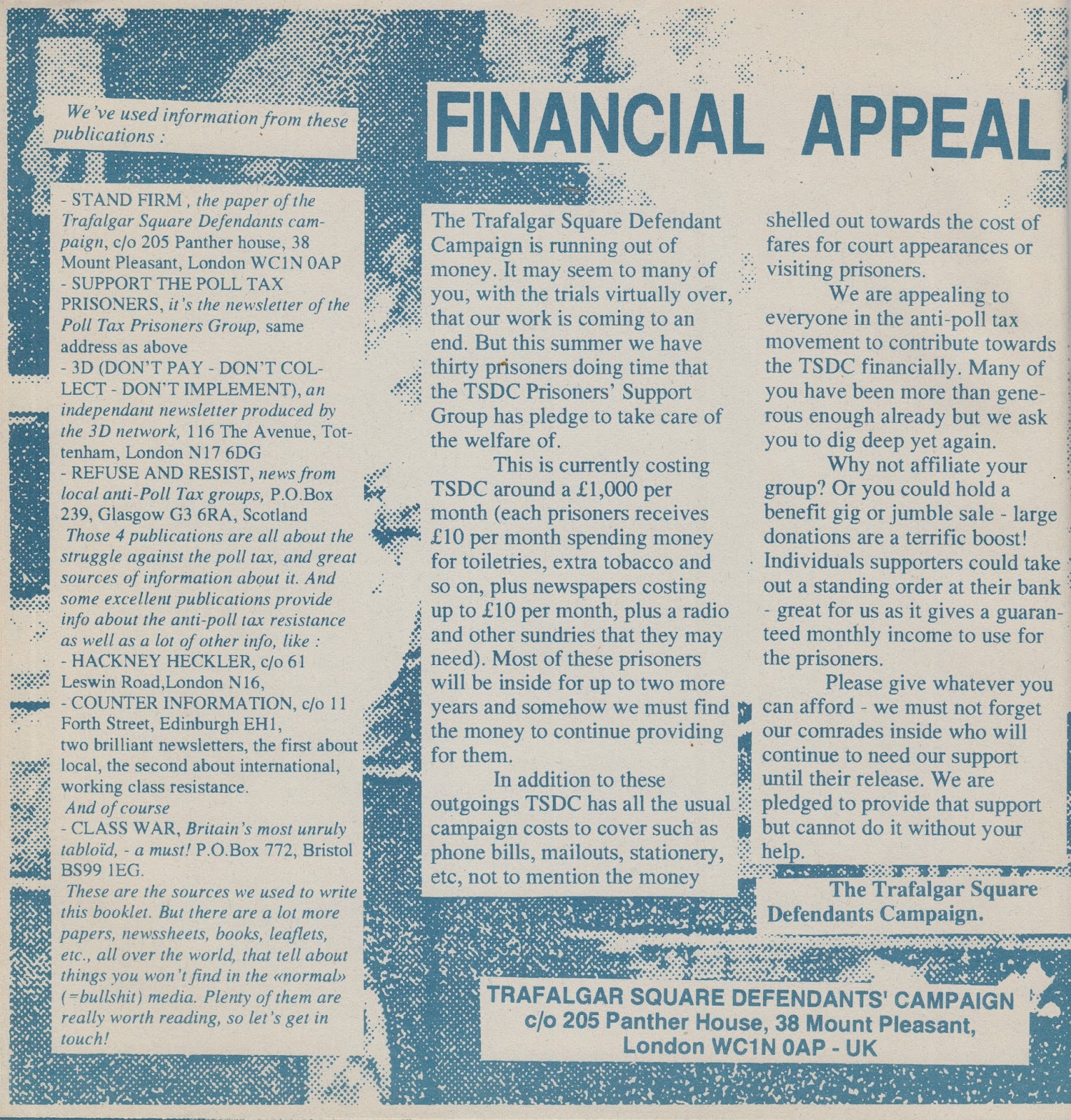
But let's talk about the actual record. It was a benefit for the Trafalgar Square Defendant Campaign, a prisonner-support group that helped those who had been arrested and were doing time following the Trafalgar Square riots. The Ep contains a lot of information about the riots, the TSDC, the Poll Tax and class solidarity from an anticapitalistic perspective. French translations are provided, which makes sense since it was released on Nabate, an anarchopunk label from Belgium that put out marvelous records from Revulsion, One By One, Disaffect and of course the mighty Hiatus who were close to the label. Nabate did an impressive job with that Ep as it looks superb, there is plenty to read and think about and all the bands provided some neat-looking artwork. This is exactly how a politics-oriented compilation Ep should look like and I strongly recommend you take a look at the "Exclusion" compilation Lp, which was Nabate's first Lp release in 1989, as it is even more spectacular.


The first band of "TASNY" is Mushroom Attack from Groningen, a band that is mostly remembered today as being "pre-Fleas and Lice". Although this is obviously true, as three members of MA would form FAL afterwards and there are indeed similarities between both bands (just listen closely to the crunchy, energetic guitar riffing and its profusion of chords), MA definitely deserve to be seen on their own merits. The band recorded two split Lp's, with Forgotten Prophecy in 1990 and Disorder in 1992 (the gloriously-named "Masters of the glueniverse"!), that stood out the test of time. MA played fast anarchopunk with a hardcore punk influence and great male/female vocals, not unlike a more tuneful Disaffect, a crust-free Fleas And Lice or a hardcore version of Toxic Waste. I love the fact that they played intense music but still kept a sense of melody, not unlike One By One really, and the intro of their song "Fuck nazis" that is included on the Ep even reminds me of Chumbawamba in its harmonies. While the production is certainly indicative of the early 90's, bands like MA could still be regarded as being ahead of their time, as their take on tuneful and yet fast, hard-hitting anarchopunk can be heard in many late 90's/early 00's anarcho bands. A genuinely good band with a genuinely strange name. Has anyone ever been attacked by mushrooms?


Psycho Flowers are next and I unfortunately don't know much about them. From what I can see, they were from Scotland and were around in the late 80's/early 90's but I haven't been able to link any of the members with other bands so far. Judging from their two appearances on vinyl, Psycho Flowers walked on the anarcho side of things. Beside their contribution to "YASNY", they also appeared on a great 1in12 Club compilation ("Wild and crazy "Noise merchants"") in 1990 with an anti-Napalm Death song (them selling out was one of the topics of the day I suppose). The song on the Ep is "Disease of mankind" and is yet another anti-nazi number. Musically, PF are not far from the early 90's Northern England sound and bands like Slander, Hellkrusher or Armed Relapse, just solid, slightly metallic and crusty, pissed hardcore punk.


Next are the mighty Hiatus, one of my favourite crust bands ever. I have already raved like a lunatic about them in the past so I will do my best to be brief. This was the early incarnation of Hiatus and the last recording with the first singer Raf who also growls on the "I don't scare easily" Ep. The song on "YASNY" is "The show must go on" and it is an absolute ripper, gloriously over-the-top and utterly unself-conscious. It starts with a slow and filthy metal beat, slimy guitars and gruff vocals in true UK crust fashion, and then bursts into vintage neanderthal eurocrust with a chorus you can sing along to. Hiatus has always been an uplifting band if anything.


On the flip side, Private Jesus Detector from Belgium are opening with "Paralyze power". And before I delve deeper into the subtleties of PJD, let's have a quick word about genres. Contrary to popular beliefs, PJD were not a crust band and in fact, they rejected the term back then. They were around between 1989 and 1993 when the genre was spreading like wildfire, but contrary to all the other early crust acts, PJD never had any metal influence, which makes it problematic to characterize them as "crust" (unless you consider than anything with a D-beat and dreadlocks is "crust"). So while some lazily categorize them as "crust" because they looked "crusty" (or whatever) or just because the vocals are really rough, well, I am not one of them. PJD intended to bring back the metal-free, raw hardcore punk sound of bands like Anti-System, Subversion, Shitlickers or even early ENT. And raw it is. I am not sure if it comes from my own copy but the sound is rough like the proverbial badger's arse. Heavy, distorted raw punk with a Scandi feel and an anarcho touch (I just love the the spoken part on this one). This is absolutely brilliant and exactly what I listen to when I crave for genuinely raw, 80's-inspired hardcore. The lyrics deal with systemic manipulation and social paralysis and are far above average as well and rather long for the genre, more akin to Antisect or Anti-System than Discharge. A few years ago (well, in 2003), a highly recommendable discography Lp of PJD's recordings was released.  


The last band on the compilation is Dreadful, a grinding hardcore band whose demo I reviewed a few years ago on TSN. Dreadful were from Glasgow and played rough, sloppy but very fast hardcore with vocals more akin to cavemen grindcore than bandana-worshipping music. Very intense stuff. The song "Wind of the storm" was their sole vinyl appearance and it is a pretty clever number about uprising in the face of poverty and frustration, in a "you reap what you sow" gesture. There is actually a rather long dub interlude in the middle of the aural savagery (I know, how unlikely is that) which works surprisingly well. Who would have thought? 


Tuesday, 16 February 2016

"S.I. One" compilation Ep, 1991


This compilation Ep is a rather obscure one that is perhaps more interesting for its historical relevance and for its significant snapshot of a particular time and place than for its musical content. I am not saying that the bands are bad, just that "S.I. One" is a really wonderful artifact of the second generation of OC anarchopunk despite being the only release of S.I. records.


Although rigid definitions of "punk waves" in strict terms of years are usually bound to misguide, I suppose you could say that there were two waves of Southern California anarchopunk, two generations of bands that interconnected but didn't coexist. I would situate the first one between 1983 and 1987 and the second one between 1988 and 1992. I am aware that some bands overlapped and that others kept playing well beyond 1992, but for the sake of analyzing and identifying this record, I feel that conceptualizing two different waves is useful. The first wave is certainly more famous and probably punkier-sounding and corresponds to such bands as Crucifix, Body Count, Iconoclast, Diatribe, A State of Mind, Trial, Treason, Bitter End, Another Destructive System, Atrocity or Final Conflict, while the second one saw the prominent local rise of crust with bands like A//Solution, Apocalypse, Mindrot, Confrontation or Glycine Max, but also Media Children, Resist and Exist, Total Chaos (I know), Holocaust, Armistice or Autonomy. Although you could easily situate some important differences between both waves, the feeling of continuity and fluidity between them, in terms of music and aesthetics, is overwhelming and definitely validates the existence of an "OC anarcho sound" (or SoCal anarcho sound if you want to avoid geographical arguments): British anarchopunk basis infused with US hardcore and varying levels of (usually thrash) metal. This second wave can be also linked on a national level with many other places like the Squat or Rot scene in New York (Nausea, Jesus Chrust, Insurgence, Apostates...), the Minneapolis anarcho scene (Profane Existence, Destroy!, Misery...), the Portland anarcho scene (Resist, Starved and Delirious, Deprived...) and many others. Overall, it was a transitional moment, the watering of the 90's anarchocrust wave's seeds (the actual planting was done during the first SoCal wave I presume).


The first band on the compilation is Media Children, one of the most active local bands of the era. They epitomized the radical anarchopunk politics of the time, like Resist and Exist with whom they toured a lot and even shared a member then. The song "Forever scarred" is about rape, rape culture, gender violence and women's self-defense and the band did not take the subject lightly. They provided a lot of information about sexual abuse (data, statistics, advice...) which I feel is important when one tackles such a difficult, sensitive topic. Media Children were this kind of band that offered more reading than listening on their records and I am pretty sure that it was also true during their live performances. The sound on this pretty direct punk song is rough but it works fine for the genre (and for me anyway). They remind me of Symbol of Freedom jamming with Ad'Nauseam in Chaos UK's local. The high-pitched vocals of Tammy will probably be a Marmite deal: love them or hate them. I think they work well when the music kicks in as they are really expressive but not so much on the spoken parts where they tend to sound too strident and shrieking. If you have never heard Media Children, I would suggest starting with the very solid 1991 Ep "But still they ignore..." that has a better sound, dynamic male/female vocals and, of course, a lot to read. Three members of Media Children went on to form Litmus Green in the early 90's who proved to be a prolific band and one that was influential musically (if not intentionally) for the so-called "streetpunk wave" of the mid/late 90's.


The next song is "The ultimate end" from Holocaust and to be honest, they were the reason why I bought this compilation Ep in the first place. I got to listen to their brilliant 1989 demo "Our anger has turned to rage" a few years ago through the great Crucified For Your Sins blog and needless to say that I was suitably impressed. The demo was an energetic and snotty blend of Final Conflict/Crucifix hardcore punk and UK bands like Instant Agony or Death Sentence. Pretty glorious stuff. "The ultimate end" was unfortunately Holocaust's sole vinyl appearance. The song was not recorded during the same session as the demo since the composition has a different feel. There is a definite metal influence in Holocaust's song that is strongly reminiscent of local metal crust heroes Apocalypse, Glycine Max and A//Solution and also of the thrashy hardcore sound of Bitter End and Final Conflict (who were possibly the biggest influence on the band). "The ultimate end" is just glorious: crunchy, metallic, crusty punk that the second wave of SoCal anarchopunk was renowned for. I have no idea if this song was part of a longer recording session, it seems likely but it may be wishful thinking too. Apparently, after the demise of Holocaust, some members went on to play in a band called Arise (I got this information from the booklet of Resist and Exist's "Ad liberty") and I have got a feeling (also triggered by the Amebix reference, truth be told) that they played something very similar to late Holocaust. Could "The ultimate end" also be an Arise song after all? This song has huge similarities with the 1989 demo but it is also quite different in terms of intent... Who knows? And I mean this literally: WHO KNOWS?


Social Insecurity are next (not the 00's heavy hardcore punk band from Scotland obviously). Information about them is scarce and I have sadly never heard their 1992 Ep, although I know it came with a great-looking newsprint lyric sheet and cracking anarcho artwork. I know just one other song from SI, that is not dissimilar to Media Children actually, that appeared on the "No lip service" compilation Ep that was released on Mass Media records in the early 90's (1993?). MM was possibly the label that was the most connected with the second wave of SoCal anarchopunk during the first half of the 90's (it was responsible for records from Media Children, Autonomy, Firing Squad and even Dan) and after a long period of silence, it looks like it has been back in business since 2010 or so, with a more postpunk/new-wave approach, and has released some convincing records from Moral Hex, Vivid Sekt or Cemetery. But back to Social Insecurity. The song "Fuck all powers" is about, well, resisting the powers that be. It is a sloppy and fast punk-rock number with a very rough and ready production and an early Disorder influence. A full Lp of it would make for a long listen but it does just fine on a compilation Ep. Social Insecurity records (aka S.I. records) was the band's label and I suppose it was created for the release of this compilation.


The final song is "Constant struggle" from Unauthorized, a band from Pasadena that also recorded a full Ep, 1991's "Cheated". While I like the sentiments behind the lyrics ("Constant struggle" is a positive song about anarchy), I guess it sounds a bit too much like a "proper" US hardcore band for me, especially the vocals, but the fast-paced music makes up for it and after all, it gives more variety to the compilation.


The object itself looks stunning: a huge fold-out poster sleeve with plenty of lyrics, arts and political writings in the grand anarchopunk tradition. I must admit that I have some troubles folding it out and up but then I am not the handiest man. More than a genuinely great record, "S.I. One" is a loveable testament to a particular scene and that is what makes it relevant and worth examining. And of course, it has that terrific Holocaust song...  


  SI One

Thursday, 11 February 2016

"More songs about plants and trees" compilation Ep, 1991

Today's post feels a little peculiar. On the one hand, I will be raving about classic bands that I have loved for years (which is pretty much what Terminal Sound Nuisance is all about I suppose), and on the other, I will be talking about classic bands that I am not familiar with at all, thus finding myself out of my comfort zone. But we all need a bit of a challenge sometimes, right?


"More songs about plants and trees" is objectively a good compilation. It gathered bands located at very different points on the punk spectrum around a common, worthy political cause. I love the idea because it illustrates the diversity in punk-rock but also the shared values, and in a time when we all cling to petty subgenres and artificial sub-scenes, it seems important to remember it. Besides, and even if it applies more to Lp's than Ep's, I like a little variety in my compilations. I often see them like punk festivals. I personally don't really enjoy monolithic festivals that only have one or two genres represented. As much as I love crust music, it quickly gets a bit tedious, if not boring, when the fifth Doom-like band starts playing. I much prefer festivals that display some variety in their programmes. It makes for a more diverse crowd and plenty of different punk expressions are celebrated. Granted, I may not watch the whole set of the Youth Crew band but at least it conveys the idea that, despite our aesthetic differences, we are on the same boat. Obviously, there also has to be a common political ground, otherwise any relevance is lost.


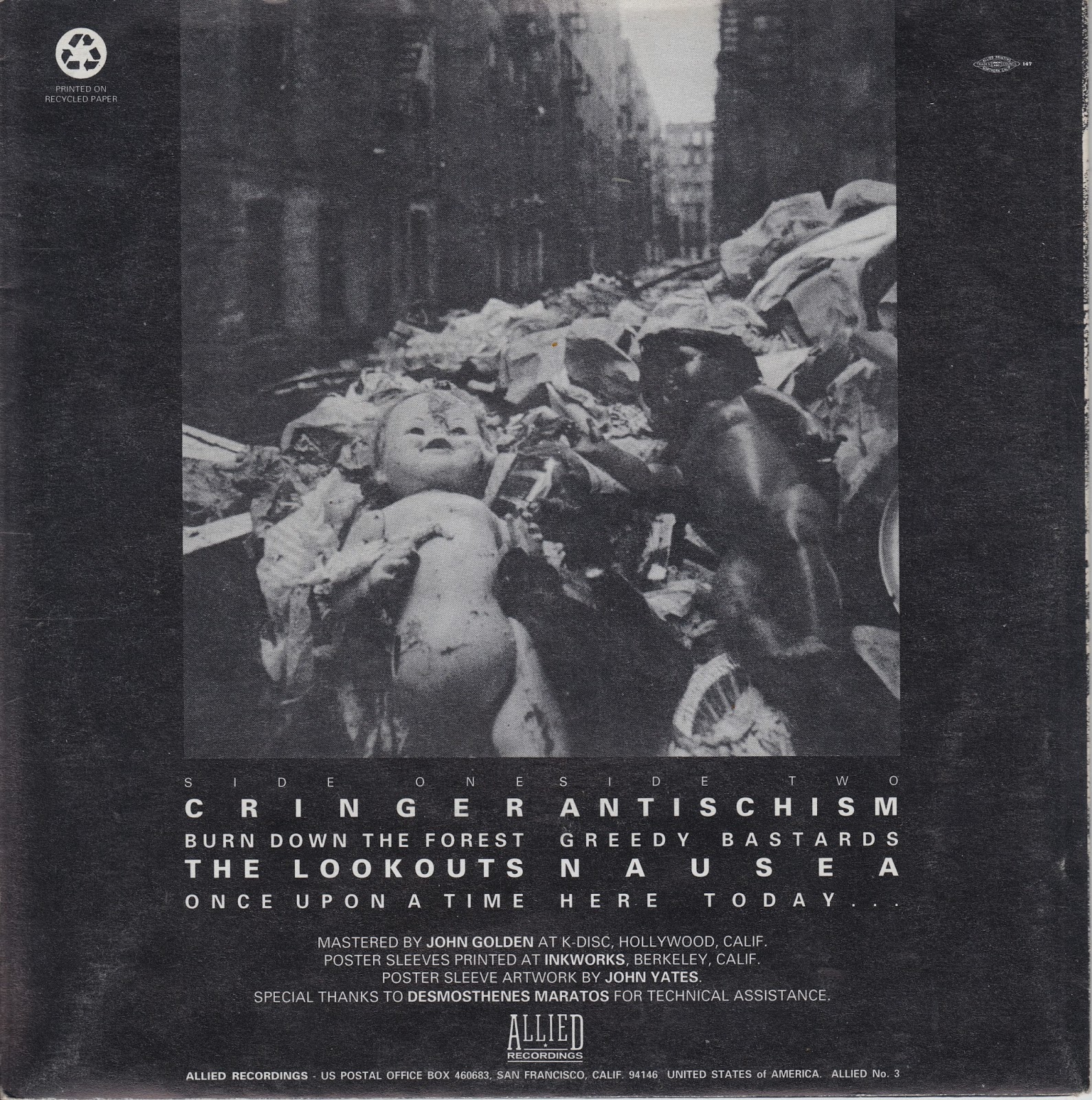
But back to this Ep that highlights diversity. It was the third release on Allied Recordings, John Yates' label. Although I am not a fan of everything he put out, one has to be impressed with the sheer variety of AR's discography (from Neurosis to J-Church, Political Asylum, Nausea, Wat Tyler, Buzzoven or Noam Chomsky!) and by his work as a visual artist throughout the years (a lot of Alternative Tentacles-related work of course but the full list of his contributions is truly stunning). You could say that the political meaning of punk has always driven John Yates' artistic choices and this early Allied Recordings Ep attests to that. The central theme of the compilation is the ongoing destruction of the rainforest for capitalistic gain and the the songs of the four bands included on the Ep deal with ecology.


Let's start with the challenging bit: the "melodic side". Now, I am a sucker for tuneful, anthemic punk-rock but let's say that I usually stick to the UK, Europe or even Latin America when I am craving for some, and hardly ever look to North America. Maybe the whole Californian punk-rock explosion of the mid-90's has left me wary of and prejudiced about the notion of "US melodic punk-rock". So let's try to give an honest look at the two bands of side A: Cringer and The Lookouts. I remember having a little argument (a misunderstanding really) with an American friend on a message board about the term "pop-punk" a few years ago. It was quite uneventful and amicable really, but we had very different notions of what "pop-punk" was meant to sound like. To me, it refers to Buzzcocks-influenced punk-rock, to the traditional Ulster punk sound or even to some of the 80's mod revival, basically bands that built on the pop tunefulness of 77 punk. I never really saw what was so poppy about Californian punk-rock, though it is melodic, but then, I never really dug deep into it.


From what I understand Cringer was a pre-J-Church band that was around in the second half of the 80's and formed in Hawaii before relocating to Los Angeles. Being a total stranger to both bands, I can't judge if "Burn down the forest" is a good Cringer song, especially since they have a consistent discography. What I hear is a tuneful and bouncy punk-rock song that is a little sloppily played but still works as a whole. It reminds me of Eastfield for the very upbeat tone and the vocals that are neither really sung nor spoken and borrow from American hardcore on that level.


I had vaguely heard of The Lookouts before listening to their song as this band that was related to Lookout Records and therefore to Green Day (yes, that Green Day). In fact, I realized that GD's drummer also played in The Lookouts, that The Lookouts' guitar player actually ran Lookout Records and that the song "Once upon a time" included on this Ep had a "special guest appearance by Billie Joe Armstrong". I never thought I would be talking about Green Day on Terminal Sound Nuisance but the punk world is a small interconnected one. I don't dislike Green Day to be honest, I have always thought that they had some brilliant tunes and proved to be smart songwriters, but that overall it wasn't bass-driven enough for me. The Lookouts' song is a mid-paced number, almost a punk ballad actually, that is not unpleasant, I like some of the ideas, but I feel the singing doesn't quite fit with the music. My own soundscape tells me that it is not unlike late Instigators, but I am sure there are more relevant points of comparison.


On the flip side are two of my all-time favourite US bands: Antischism and Nausea. "More songs about plans and trees" is a bit of a "Two rooms, two atmospheres" kind of pub. The fact that they are such classic bands don't make them any easier to describe, quite the contrary. As a matter of fact, I got my first Antischism and Nausea cd's (the Prank collection and the "Punk terrorist anthology vol 1" respectively) on the very same day, in 2003 (Discogs says 2004 for Nausea but they are wrong). I don't remember whom I ordered them from but I can still feel the excitement when I unwrap them. I knew next to nothing about both bands other than they were supposed to be "cult bands" that were often mentioned in the review sections of fanzines I was reading at the time. The only thing I actually knew from Nausea was the first minute of "Here today" that you could listen somewhere on the internet (it was the cd's first song and, ironically, also the one that appeared on our present compilation). I must have listened to this mere minute of music at least a dozen times in a row. Pure, unbeatable magic. As for Antischism, apart from the "classic band" tag, I picked them because the name really appealed to me since it was basically synonymous with "Antisect", a metaphor of unity and harmony. Cheesy, I know. I don't know if "antischism" was meant to be a reference to "antisect" but the meaning behind the monikers remains the same.


Antischism's song is "Greedy bastards" and it was recorded in september 1990 (another version of the song with Lyz singing appeared on the Lp). Recording dates are a bit blurry (there is no indication on the original records) but I would say that this song was recorded shortly after the "End of time" Ep. Antischism was a unique-sounding anarchopunk band with a very specific songwriting. The peculiar sound of the guitar and bass creates a fierce sonic landscape that blends surprisingly well with their brand of high-energy hardcore. The crucial factors of their music are urgency and intensity. The fast, manic drumming style combined with the breathless, desperate vocals gives the impression that the band's life was literally at stake (and even more impressive is the fact that the male vocals and the drumming were both done by Scott). There is an honesty, a genuine anger permeating the band's work that cannot be faked. Antischism remain difficult to aptly describe. I can hear some of Rudimentary Peni's demented sense of composition, the furious desperation of Italian hardcore like Negazione, possibly an influence from the Californian anarcho scene and bands like Crucifix or Final Conflict, and from a diachronic perspective, there is a definite hint of the rise of the super fast hardcore thrash of Hellnation and Dropdead. Truly breath-taking.


The final song of the compilation is "Here today" by the mighty Nausea. Much has been written about them and I suppose that most punks are at least partially familiar with the band's work. Again, I cannot be totally sure about the exact date the song was recorded, but my best bet is october 1990, probably during the same session as the "Cybergod" Ep. It was Nausea at their finest and I would not change a single thing to "Here today". The guitar is thick, powerful but keeps that filthy, rocking vibe; the distorted bass is groovier than a 70's disco party; the drumming is energetic, omnipresent but never distracting; and the vocals, foaming with rage, work perfectly together. Nausea at that time felt like a cohesive, unbreakable unit. "Here today" is a rocking anthem that takes the best of Discharge's bass lines, adds the smart riffing of late Antisect, Sacrilege and Hellbastard and tops it with genre-defining, dual male/female vocals. Genuinely, crushingly heavy but absolutely energetic and triumphant as well. I sometimes feel like the line "once fertile land now barren crust" can be read in a different way...


What an exhaustingly great side B this is...

Tuesday, 9 February 2016

"You are not alone" compilation Ep, 1986

A preventive message before anyone feels the need to make bad jokes about this record: this is NOT a Michael Jackson punk tribute. Now that this is settled, you would be surprised to know how many versions of MJ's "You are not alone' there actually are. I am not sure the world really needed all these.


"You are not alone" was the very first release of Words of Warning records. Based in Bristol, WoW became a pretty successful label through the releases of albums from Blaggers ITA and King Prawn, bands that enjoyed some mainstream recognition. The beginnings of WoW were perhaps not as spectacular, but the label's early years still produced DIY punk records of the highest quality with records such as Oi Polloi's "Outrage" Ep (maybe their best work), the Shrapnel/Toxik Ephex split Ep, the One By One Lp or the first two Terminus albums. It is pretty obvious that WoW started out as an anarchopunk label and founder Karl definitely had an ear for interesting, innovative punk-rock and it was no coincidence if WoW supported the so-called dub-punk sound that developed in the first half of the 90's. The idea behind "You are not alone" was to release a compilation that included four bands from the four different parts of the United Kingdom, thus promoting the idea of togetherness, solidarity and, dare I say it, community. Therefore, you had Hex from England, Stalag 17 from Northern Ireland, Oi Polloi from Scotland and Symbol of Freedom from Wales, which is retrospectively a pretty cracking line-up although I doubt the label realized it at the time.


The first band on "YANA" is Hex, a band that has been criminally forgotten and overlooked to the point that it almost literally pisses me off. Hopefully, the recent Boss Tuneage reissue of most of the band's studio recordings (but for the first excellent demo, "Not the promised land") will provide Hex with all the retroactive love they deserve.


Possibly named after Poison Girls' first Lp, Hex were from Sunderland and were active between 1984 and 1988. They belonged to that generation of Geordie punks that was heavily involved with the Bunker in Gateshead, a venue that played a huge part in the development of the Northern anarchopunk scene and fostered the idea of a punk community. If we ignore for a minute the brilliance of Hex's music, the band is probably remembered mostly because two of its members, Dickie Hammond and Lainey (who was actually a founding member of Hex), went on to play in the hugely successful Leatherface. The band also had close connections with another local band that would prove to be hardcore pioneers in England: HDQ (Golly played in both bands at the same time). You don't even have to listen that closely to spot similarities in terms of tones and composition between the three bands and the last two Hex's demos somewhat gave clues about what Leatherface would write later (in terms of intent more than sound but that's my theory). The song on "YANA" was "Is this to be?", recorded in 1986 and originally part of the band's second demo "Poison in the system". This is clearly an instant anarchopunk hit that displays the band's incredible songwriting skills and rather ambitious composition. This is a moody, diverse song in itself, made up of three parts that would have been good enough to make a proper song each. It starts with an eerie introduction with a postpunk feel but a punk-rock energy, then goes on with a cracking mid-paced anarcho part with great tunes and finally ends with an intensely angry, faster beat. Clearly the band had thought this through, it is like Vex, The System and Icons of Filth writing a song together. The presence of two singers with different vocal tones certainly plays an essential role and helps reinforce the mood change in the song as well. The production is perfect for the genre, earthy and thick but with a fitting unrefined quality. Fantastic song. By the end of their career, Hex's sound would evolve into an incredible blend of sensitive, tuneful, dual vocal anarchopunk and melodic hardcore with plenty of harmonies, which makes me think about the high potential the band had. Get the Boss Tuneage cd, by any means.


Next on "YANA" is Stalag 17, from Belfast, who were probably the best Ulster anarchopunk band of their time (I know, I know, Toxic Waste were brilliant too, but I feel Stalag 17 had something more). Although they were not necessarily spectacular musically in the strictest terms, there was an intensity, a passion, a genuine frustration that pervaded their songs and lyrics and it is really difficult to top that. Even after repeated listens, some of their songs still give me goosebumps. Stalag 17 existed under one shape or another since 1980 but the band only started to record in 1985. It coincided on a wider level with the creation of the Warzone Collective and Giros which played a pivotal role in the making of the Belfast DIY punk scene and, on a band level, with Petesy taking charge of the vocals. The song "Harmless fun" was recorded in late 1985 between the split 12'' with Toxic Waste and the "We will be free" Lp that Stalag 17 shared with Toxic Waste again and Asylum. As a matter of fact, it was even recorded as a two-piece with Petesy playing everything but the bass although I wouldn't say it sounds that different from the other Stalag 17 recordings (it is perhaps just a little less polished to be fair). "Harmless fun" is an intense but tuneful piece with fast sung vocals and some great guitar bits, somewhere between Subhumans and early Conflict. Petesy's singing was quite distinctive and judging from the length of the lyrics, the band had a lot to say in just three minutes. The song is about social conditioning and blindness, about letting oneself go with the flow and about the insensitive tolerance for violence and injustice. It is a dense text that refers to the daily routine of working-class people in Belfast as much as it does to the segregated political situation at the time.

"Brought to a standstill but what does it gain, the people in need are the ones who feel the pain, a blind population accepts this blind fate and don't look for answers to this cycle of hate. So the poor will kill and die while their leaders run away, retreat to their fortress to retrun another day. So while you sharpen your knives there's no cause for alarm, cos it's for the politicians who never done no harm."

Clever, passionate stuff.


The third track on "YANA" is Oi Polloi's "Nuclear waste". Now, Oi Polloi are a tricky band to talk about because they are very well-known in the punk galaxy and because they have always been really prolific, if inconstant at times. Today, they are sometimes seen as a "gimmicky" band that people enjoy seeing live but that few actually care to know very well. For reasons that are beyond reason (and no, the 30-year old "Oi Records" connection is not an excuse), Oi Polloi are still seen as some kind of "oi-punk" band with funny political lyrics, but then, it could just be a lame French interpretation of the band (it wouldn't be the first of its kind). In 1986, Oi Polloi was "just" a fantastic anarchopunk band. The brilliant "Resist the atomic menace" Ep and split Lp with AOA had just been released (though the latter was recorded the year before), on Endangered Musik and Children of the Revolution respectively, and showed that, like AOA, Oi Polloi was having a go at the heavy, hard-hitting anarchopunk sound of bands like Antisect, Anti-System and especially Icons of Filth, which were a huge influence on the band musically and, I would argue, in terms of intensity. The late 80's proved to be the band's highest point quality-wise with the release of the "Outrage" Ep in  1988, a genuine old-school crust classic that is not often regarded as such, and the "In defence of our Earth" Lp in 1990, which remains a great, diverse record of heavy, crusty anarchopunk.

Now that the way is cleared, let's give the song a proper listen. "Nuclear waste" was recorded in 1985 as it also appeared on the aforementioned split Lp with AOA and is one of the band's most famous songs, even today, and for good reason. It is a remarkably heavy, energetic and groovy mid-tempo anthem reminiscent of Icons of Filth and even One Way System with the distinctively gritty vocals we all know. Oi Polloi certainly had an ear for catchy singalong chorus and I guess that is why people still like them so much.


Finally, the last song on the compilation is "Suffering persists" from Symbol of Freedom, a rather obscure band with a brilliant name from South Wales that Ian Glasper had the great idea to include in "The day the country died". The band sadly did not record much during their lifetime between 1981 and 1987: one rough demo in 1984, an excellent split Ep with Shrapnel in 1986 and this song in-between. Symbol of Freedom and Shrapnel were really close, with Mark from Shrapnel joining SOF in 1985 (for that particular recording) and Steve from SOF joining Shrapnel in 1986. Who said incestuous? SOF played fast and snotty anarchopunk, at times reminding me of a speedier version of the classic UK82 sound with a Conflict and Riot/Clone feel. The sound on "Suffering persists", a song about animal exploitation, is raw and a bit sloppy but the very direct, urgent vocals from Steve really make the song stand out. The addition of a female singer when SOF recorded their tracks for the split Ep with Shrapnel - a better-produced, more mature effort by all accounts - made the band sound even more ferocious, with male/female vocals that were not unlike what US anarcho bands like Antiproduct, Mankind? or Thulsa Doom would do almost 10 years later... I doubt many American bands had hear of Symbol of Freedom (though I could be wrong) but the two songs on the Shrapnel split make them sound weirdly ahead of their time...


All in all a truly fantastic Ep.


Thursday, 4 February 2016

War/System / Grind the Enemy "Conform!!!" split cd, 2011


And while we are at it, let's take a look at Grind the Enemy's sole other record, the split cd with War/System from Worcester. This was released in 2011, like the GTE/Discarded tape, on Winston Records and Angry Scenes Records from Brum, a label run by a member of Contempt. I got this cd totally by chance a few years ago while browsing through a crust as fuck distro from Belgium. Thanks fuck I don't judge a book by its cover, because the cd cover is not exactly indicative of its content... I was not even aware that GTE had released anything then to be honest and if it were not for the cheesy drawing of a bobby on the cover, I would have probably passed it. When I realized it was actually a GTE record, I was speechless. Glad of course, because I love the feeling of aimlessly searching through a distro and unexpectedly finding a gem, but also a little surprised since I didn't really imagine that it would look like this. Oh well. Punk-rock.


I already knew War/System from their 2007 cdr demo and I think I saw them play in England at some point. Pat from Terrorain used to sing in W/S (he now sings for the rather good Endless Grinning Skulls along with ex-members of Heresy and Hard To Swallow) but on this recording the vocals are managed by the guitar player, Dave. W/S is a band that I have respect for, because I like what they stand for and I can relate to their lyrics and their staunch DIY punk attitude, but I cannot say I really enjoy the music. W/S played modern metallic hardcore, a genre I am unfortunately not familiar with, with political lyrics. They remind me a little of a more metal-sounding Rectify probably, but the sound is too clean and not groovy enough to my liking.


As we saw in the previous post, London's GTE played old-school filthy metallic crust. The "Conform!!!" cd contains four new songs from them (including an Axegrinder cover... you'll never guess which song they picked) and three interludes, one of which being the smart opening track called "Bukowski". The sound is better and heavier than on the demo tape although the songs were recorded at the same place, the Deathdrop squat, not long after their first session (there is no recording date provided but I am guessing in late 2010). The better production gives GTE a more modern feel: there are different layers of guitar and several samples (probably too many in fact) but the songwriting is sufficiently anchored in vintage crust to keep me interested. I suppose it is a more accomplished work than the demo, but I miss the simplicity and tension of their earlier work a little. It doesn't mean that GTE's songs are overproduced by any means, we are still in the realms of crude stenchcore here, and the song "War of the poor" is clearly the highlight of the cd: a perfect blend of early Axegrinder, Hellbastard and Effigy with dark, groovy, thickly textured riffs. "Your war" on the other hand has more of an early Bolt Thrower feel, which works paradoxically fine here because it remains sloppy and punky enough, and "More beer for the punks" is exactly what you think it is: a drinking metal-punk anthem not unlike mid-90's Genital Deformities. The band's version of Axegrinder's "Grind the enemy" is also remarkable. GTE cleverly readapted the song, adding a second layer of guitar, reworking the bass and guitar riffs and infusing it with new leads. It emphasized the band's resourcefulness and almost turned "Grind the enemy" into a song that could have appeared on "Rise of the serpent men". This is smart crust songwriting.


Apparently GTE toured in Italy before the release of this cd, which makes sense the whole line-up is originally from there, but they must have split shortly after, although I am at a loss to confirm it for sure.      


Wednesday, 3 February 2016

Grind the Enemy / Discarded "S/t" split tape, 2011


It does not take a genius to guess - at least superficially - the main respective influence of Grind the Enemy and Discarded: Axegrinder and Discard. But merely pointing out the obvious would make for a pretty shitty review, wouldn't it? And would it make the bands appealing to someone who has never heard of them, which, I assume is the vast majority of world's population? If anything it would be a disservice to both bands.

GTE and Discarded were local London bands, active in the late 00's and early 10's. These were the years of the Scum Fest collective, great squats and brilliant gigs. London is probably one of the most cosmopolitan towns in Europe, along with Barcelona and Berlin, home to dozens of punks from all over the world. These two bands are to be seen in that blooming internationalist context that is the London DIY punk scene. I got to see them both at the 2010 Scum Fest (I think). I had never heard of any of them prior to the festival but I remember getting a GTE shirt before I actually saw them. A band with an Axegrinder song for a name? You could count me in. To be honest, GTE's live performance was pretty sloppy as they played quite late and appeared to be as drunk as the audience, but that didn't make them any less enjoyable to me anyway. Discarded, on the other hand, had played a very energetic set earlier in the night. None of them had any demos to sell though so I made a mental note to my cider-fueled self (because that is what I do when in England): "I'll definitely get something from 'em at some point". And what could be possibly more relevant than a self-released GTE/Discarded split demo tape?


GTE was a band made up of four Italian punks living in London. Gianluca, from Nailbiter and Give Up All Hope, played the drum for them but I have been unable to confirm if the other members had been in bands previously. As you are entitled to expect, GTE played heavy metallic crust, or stenchcore if you will. By the time they recorded the tape ("in 2009/2010"), the so-called stenchcore revival of the mid/late 00's was breathless and the next generation of bands having a go at this subgenre was not quite there yet. I usually have troubles relating to the newest "stenchcore" bands as they tend to demonstrate too much cheap Bolt Thrower-worship or death/black metal leanings and essentially lack of the distinctive filthy groove and tension that characterize crust (or at least are meant to). Fortunately, GTE don't fall to the usual horrific shortcomings: no "blackened crust", no over-the-top Bolt Thrower wanking, just simple, sloppy but groovy, mid-tempo old-school crust, with the odd fast parts. They did not reinvent the wheel, the songs are a bit rough, but then they are much more enjoyable and genuinely crust-sounding than most today, and there are days when that is all I am asking for.

There are six songs on the GTE side, including a gloomy, typically crusty introduction. The songwriting is quite simple and effective as the emphasis is put on filthy grooviness and dark atmosphere rather than crushing power or musical extremity. In terms of influence, I am reminded of early Axegrinder, late Antisect, late Nausea, Coitus but also of Effigy or Revölt from Japan, and even Contagium's mid-paced moments (but sloppier). The guitar riffs are quite basic in their conception but are used very smartly, the way it should be done; the bass is distorted and gives a nice crunchy texture to the whole, not unlike Misery or Coitus; the drumming is a little all over the place but not in a distracting way (let's call it "added squat crustiness") and works well because you can tell that the drummer knows his shit despite apparent technical limitations; finally, the vocals are just what they should be, raucous, a little gruff but not overdone with some reverb (maybe a little too much) which gives an adequate old-school vibe. It would be hyperbolic to say that GTE were a great band, but their take on crust was accurate, you can tell that they really got it and, all in all, this is exactly the kind of bands I am craving for when I want to listen to recent, proper crust music.


The songs were recorded at the Deathdrop squat (the singer lived there apparently) and mixed at the Clifton Mansion squat, which accounts for the raw production (but to be fair, I'd rather have a raw DIY punk production than an overproduced all-out metal one). The artwork of the orc was done by Stiv of War (who else?) and while the lyrics aren't included, song titles such as "Don't laugh at work" or "Your power, my disgust" can give an idea of what the band was about. "Don't be fooled, don't be dragged along, don't be enslaved... Grind the enemy". Squat crust indeed.


On the b-side are Discarded, a Scandi-flavoured hardcore-punk band. The band also had Gianluca in its ranks, this time on the guitar (a spot where he truly shines), as well as Alex, who now sings for Agnosy, on the bass, the rest of the line-up being completed by two Brazilian punks. I am aware that there are hundreds of bands throughout the world doing the "Swedish Raw Punk" thing (or whatever it is called this week) and it is not a genre that I listen to that much at home or that I am especially familiar with. This said, Discarded did it pretty well, certainly better than most of the newer bands that I have come across in the past five years.


Since this is a demo recording, recorded in a squat no less, the production is probably not as refined as the new trend requires but I don't feel there was that much calculation on the band's part in terms of sound anyway. Although they were called "Discarded", the band was much closer to late 80's/early 90's Anti-Cimex with a slight Besthöven touch. Greatly helped by brilliant guitar leads (the Nailbiter connection makes a lot of sense here) and vocals shouted lovingly at the Swedes, the ten Discarded songs will delight everyone obsessed with Anti-Cimex (and I am guessing that's a lot of us).