Showing posts with label 1994. Show all posts

Wednesday, 26 August 2020

Ten Steps to Make Your Life CRUSTIER Starting Today (step 9): Extinction of Mankind / Warcollapse "Extinction of Mankind / Massgenocide" split Ep, 1994

As time passes and as the global ecological apocalypse looms ever closer, it seems that, not unlike most of the world's wild species, the average lifespan of punk bands has also grown shorter. According to the last estimate of the World Health Organization, a punk band formed in 2020 is now expected to live a total of 800 days, whereas a band playing a similar style in 1992 could live at least 2000 days. Of course, some factors external to the punk scene like global living conditions, economic hardships, dictatorial regimes or postpunk's growing instagrammability have to be taken into consideration when one tries to analyse the transience of modern hardcore bands. Still, the fact remains that many bands split up after just two years of existence (often involving one 20 minute long album, one Ep, one European tour and about ten different shirt designs), before members disperse in order to start new band with a slightly different approach, thus launching a new punk life cycle. The intrinsic shortness of hardcore punk bands' lives is a subject that has been on my mind for a while now and, in spite of my infinite wisdom and invaluable experience, I don't have much to offer to enlighten this process other than the global acceleration and increase of our consumption of cultural goods and the decrease of our attention span, both as audience and musicians. If internet has affected the way we listen and relate to music, it must have changed how we write and play music and form bands. In any case, it is always heart-warming to see bands formed in the early 90's that are still active, still hold the same values and still deliver the same sonic assault, thus showing that crust music can be a potent - without mentioning largely organic - preservative indeed.                 


Today, Terminal Sound Nuisance will be hosting two familiar ugly faces, gathered on the same split record, an Ep released in 1994: Manchester's Extinction of Mankind and Sweden's Warcollapse, the latter being the only non-British band of this crust lifestyle series. The inclusion of this split Ep made sense on several levels. First, it is a way to connect the past - in this case the early 90's, a crucial time in crust development - to the present, since both bands are still playing in 2020 and although WC have not been anywhere near as active and prolific as EOM in the past decade, the latest Desert of Ash 12'' was released in 2019 and is worthy of your attention. Second, in the timeframe that interests us, from the late 80's to the early 90's, the split Ep format grew to become a proper DIY punk staple. The format was emblematic of the period itself as it symbolised the idea of cooperation and was also a lesser financial risk with the involvement of two bands. Just consider the number of split Ep's released in the 90's and 00's that unquestionably belong in the upper level of the crust punk canon and it is utterly clear that, not only did the Ten Steps series dearly needed such a format as a matter of diachronic relevance, but that you should also have a list of your ten favourite crust split Ep's ready in case you are being challenged to a crust joust by your arch nemesis one day (lets get real, it's bound to happen). And finally, you did not get much crustier than EOM and WC in 1993 when they recorded their respective side of the split. 


I have already written about EOM's Scars of Mankind Ep (here) and WC's Crap, Scrap and Unforgivable Slaughter Ep (here), so that I do not really need to tell you about their origins again and the fascinating stories about how and when I got to know them probably don't deserve another round. I often feel as if I am droning on about the same old bands and sanity, or something approaching, dictates that I should avoid literally repeating myself too often. The day I accidentally review a record I forgot I already dealt with will be the last day of the blog and the first of a gofundme page for my retirement party (possibly a massive Discharge karaoke night). But we're not quite there yet and we have a lovely split Ep to rave about so let's get to it. There are several connections between EOM and WC, the split Ep being only the most obvious, and many parallels can be drawn between both bands. As punk bands do, they toured together in Sweden in late 1994 (Counterblast were also invited) and in central Europe again in September, 1995, but far more strikingly, both bands each recorded a tribute Ep to UK punk bands - Ale to England and the aforementioned Crap, Scrap and Unforgivable Slaughter - that included the exact same three bands (Antisect, Discharge and Amebix). If the similar choice of classic bands undeniably reflected major influences, there remains an impression of crust bromance that I find particularly endearing and relatable since, as any faithful believer of crust knows, Antisect, Discharge and Amebix is the official trinity of our cult. The Extinction of Mankind / Massgenocide split Ep was the first proper record for both bands (although EOM had one song off their Without Remorse demo on Loony Tunes' compilation Lp A Scream From the Silence Volume 2) and it proves to be an apt representation of the bands' rawer past selves. 


Recorded in October, 1993, in Middlesborough, the EOM side is made up of three songs, admittedly thinly produced and rather direct in their approach, that nevertheless pack up a right punch. Although beers and fags have affected Ste's voice during his almost three decades behind the mike in EOM, you can still instantly recognise his vocal style and unmistakable flow, tone and intonations, shouted with a lot of power but never yelled or growled, and always very much understandable (if you are fluent in the language spoken "Up North"). You can hear that the band was still young and not totally comfortable and had not really found its own beat yet. The sonic ingredients that defined the early years of EOM are already present however and the Antisect influence is prevalent indeed as the band tries to offer a blend of In Darkness There is no Choice's relentless power and Out From the Void's rocking darkness, an ambitious initiative that EOM probably did not have the ability to realise at that point in time but that Scars of Mankind remarkably did eventually. There are also elements of Anti-System and Icons of Filth in those early EOM tracks, especially on the faster "Overruled" or on the groovy mid-paced moment of "Extinction of mankind", while "Suffer in silence", arguably the best song, reminds me of a cross between early Axegrinder and Hellkrusher. Lyrically, we are on standard grounds with "Overruled" (about systemic control) and "Extinction of mankind" (about humankind's fair treatment of nature, of course) while "Suffer in silence" is a visceral number about domestic violence. Although EOM would significantly improve throughout the 90's, the key elements and the referential nods, that they would build on, polish and grow to be famous for, already informed their early sound. One may also note that they were one of the few 90's UK bands to worship so openly at the altar of Antisect and Amebix and pay such a powerful tribute to the mid/late 80's both in terms of songwriting and visuals (the artworks have always been brilliantly macabre and the band's logo is the equivalent of a Crust 101 art class), and on that level it is relevant to see EOM as an attempt to continue and preserve the whole Antisect approach to punk and a love declaration to the crust greats. In the end, a rather romantic endeavour.   


There are two songs on WC's side, "Massgenocide" and "Scorned by bombfighters", recorded in February, 1993. These two tracks were part of a larger session as two other songs were also recorded on that occasion, "Misery and despair" (which would end up on Tribal War's compilation War Compilation) and "Warcollapse" (included, along with "Misery and despair", on Distortion Records' Distortion to Hell classic compilation of Swedish crusty hardcore). I think it was the first session under the WC name but the band's website infers that a demo entitled Misery and Despair was recorded when they were still grinding under the Earcollapse moniker (a cracking name indeed). Being a massive WC fan myself, I cannot recommend the band's early era enough as it gloriously epitomised the 90's cavemen crust sound, albeit with a distinct Swedish hardcore vibe, and for all their rawness, the early Ep's did not fail to deliver and let it be clear that the Crust as Fuck Existence minialbum from 1995 is a masterpiece of mid-paced metallic old-school crust. The two WC songs on the split are typical of what would become the band's style. The heavy, slow, stripped-down dark crust number, "Massgenocide", points to Doom's slower moments, Döm Dar or even Saw Throat with super gruff and hostile vocals and such slow-paced epic metal-crust numbers would become a WC trademark. The other song, "Scorned by bombfighters", sees WC unleash a fast and pummeling scandicrust tornado upon the listener, somewhere between Doom, early Sauna, Anti-Cimex and Bombanfall, with the deceptively soft introduction cleverly linking it to the previous number and a spoken words moment nodding to anarcho hardcore punk. A clearly fantastic debut from the masters of Swedish crustcore and a fascinating instance of how influences circulate inside the punk scene with a Swedish band influenced by Birmingham's Doom, who were themselves inspired by Discard and 80's käng, who could not have existed without Discharge's fury. Not that many Swedish bands displayed a strong crust vibe in the 90's - be it of the stenchcore or of the cavecore variety - and many (and there were tons of bands) aimed for a harder version of the Swedish hardcore classics. WC, on the other hand, offered a punishingly convincing cocktail of old-school UK crust and vintage scandicore, and their sound, to me, defines what the term "Swedish crust" really entails.   

Both EOM and WC would go on to become genuine references in the world of crust throughout the 90's and 00's. In spite of important lineup changes (the departure of Mass and the arrival of Scoot on the guitar must have been a massive sonic shift), EOM have progressively become that rather unique and distinctive UK crust band with a sound that is both identifiably linked to the old-school crust wave and yet totally their own and there is something that I find inherently respectable, if not heroic and quixotic, in keeping a band alive throughout all these years, especially when they play such an underground peculiar genre as crust punk, surviving all the shallow trends and the endless punk drama in the process. As for WC just play Desert of Ash if you need to be persuaded that they are still up for it and may the crusties of the world hold hands and pray together that it signifies the rebirth of the mighty WC. 

Released on the Swedish label ElderBerry Records (responsible for records by the likes of G-Anx, Tolshock or 3-Way Cum), this is retrospectively a classic split Ep in the sense that, to some extent, it prefigures the greater things that are to come for both bands, although taken on its own as a rather typical early/mid 90's record, it would be far-fetched to call it a crust masterpiece but reasonable to describe it as a solid and promising raw crust work. It is therefore in the light of future events and of the bands' parallel progression that the EOM/WC split Ep makes the most sense.

To be enjoyed with some ale.    


Thursday, 20 August 2020

Ten Steps to Make Your Life CRUSTIER Starting Today (step 8): Coitus "Darkness on Streets..." Ep, 1994

Although not as uncomfortable to wear as that Genital Deformities one, my Coitus shirt remains one of those punk garments that I avoid to sport during family reunions, at work or on Valentine's Day. Nothing wrong with the design itself (I mean, who doesn't crave for gasmask-wearing skulls?), but having "Coitus" and "Fucked in to oblivion" written on a shirt might somehow send the wrong message socially as heads are bound to be shaken in disbelief whilst eyebrows rise judgmentally and loud sighs of disapproval are openly breathed out. However, when one consider that the first incarnation of Coitus, in 1989, was called Eternal Diarrhoea (and apparently had Lippy from Antisect on the bass, the choice of instrument being almost as surprising as the band's moniker), one can be thankful indeed for the terminological change to Coitus as an Eternal Diarrhoea shirt could only have been worn safely at all-male events like goregrind gigs, which is pretty narrow. But let's skip the fashion talk already and switch to the band Coitus, a powerful raw hardcore unit that any self-respecting crusty punk should be, at the very least, familiar with.   

Battered copy because of too many moves (additional punk point)


As foreplays to Coitus, drummer Alien and guitar player Martin had played in the legendary Sons of Bad Breath in the mid-80's, a cult band made up of members of the so-called Hackney Hell Crew, basically a bunch of drunken punk squatters looking like Mad Max rejects making a bloody noizy racket that made Chaotic Dischord sound tame and bourgeois. This tight connection to the punk squatters' scene, especially in London but also abroad, was part and parcel of the identity of Coitus and, as their chapter in Ian Glasper's Armed With Anger can attest, they have unsurprisingly more than a few crazy squat-related stories to tell, in particular when it comes to the brutal tactics used by the police against squatters. at the time. The third member of the early Coitus was Skinny on the bass, an Irish punk who had previously served in Paranoid Visions which accounted for the band's frequent trips to Dublin to record and tour. Martin was quickly replaced with Pato in 1991 for the band's first tape, In Two Minutes You'll Be Smokin' in Hell, that comprised two recording sessions, the first one done in March, 1991, in North London, the second in May, 1991, in Dublin. Pato then left the band and Mik was recruited on the guitar and the classic Coitus lineup was in place.  


If Coitus can arguably be considered as one of the most striking UK punk bands of the 90's and certainly as one of the very best and unique in their field, like too many bands of that decade, they sadly do not really enjoy the cult status they deserve. While swarms of internet-crazed punks idolise any 80's band that barely lasted 18 months and recorded two and a half songs before turning new wave, crucial punk as fuck 90's bands, who kept the flame of DIY punk alive, recorded genuine classics and contributed in the making of networks of punk scenes that we still witness and rely on today, are neglected. Not cool, kids. The first time I read about Coitus was on the distro list of the Nottingham-based Missing the Point sometime in the early 00's. The Coitus' retrospective cd Necrocomical, released on Inflammable Material, was then described, and I am quite sure that those are the almost exact terms, as "Antisect-influenced punk aaarrrghhhhh". Since I was already well into Antisect at the time, almost unreasonably so actually, I promptly ordered the cd but must admit I was a little disappointed, or rather, taken aback by their rocking metallic sound which I did not relate to Antisect at the time (I had only heard In Darkness by then), and it took me to dive into Out from the Void and Peace is Better than a Place in History to understand and enjoy Coitus properly and be able to grasp the significance of their sound. So why - I rhetorically hear you ask - should you need Coitus to make your life crustier then? Well, it is well-established that a flawless and knowledgeable adhesion to the Antisect mystique is a required predicate for the healthy development of one's crust identity but, given the harsh competition in the field, it no longer suffices and it is therefore strongly advised that one also becomes highly proficient in those bands displaying a prominent Antisect influence, like SDS or, in this case, Coitus. And anyway, they were so good that you don't really need a reason, right?


Multinationals, politicians and the army literally raping the Earth in case you didn't get the subtle metaphor. 


Whereas SDS (especially in the early 90's) openly used precise sonic and visual references to Antisect in order to create their own aesthetics and situate their band in terms of relations to the influence of Antisect, Coitus' driving take was very different, much more organic and spontaneous, without referentiality. Coitus took the more rocking, groovy, sweaty side of Out from the Void-era Antisect and built on it with their trademark thundering bass sound, an emphasis on the crunchy dirty metal parts, an obsession with Celtic Frost and a two-fingered attitude. I like to think that if Antisect had kept going in the early 90's and played the same London squats Coitus did, they would have sounded really close indeed. The Darkness on Streets... Ep, released in 1994 on Tribal War Records (UK), was recorded in December, 1992, in Dublin with help from Deko Paranoid Visions, at the same time as their When we Depart... Let the Earth Tremble (tape only) Ep and, in my opinion, this recording sessions stands as the defining Coitus moment (the Submission/Domination tape is stellar too) and an absolute UK crust classic, although the band, to my knowledge did not claim the crust tag. The Ep opens with the anthemic "Darkness on streets", a claustrophobic number of brooding and heavy metallic punk, somewhere between late Antisect, Hellbastard and a squatter version of Motörhead, which is followed by "Total collapse" a beefy mid-paced scorcher that sounds like an old-school crust band covering Poison Idea and, finally, the ultimate Frost-worship song, "Mind right?", which manages to recreate the threatening glamorous groove and the rocking aggression of the Swiss while adequately soiling their sound because that's what punks would do. The production is absolutely perfect for the brand of dirty, rocking and powerful heavy metallic punk the band set out to achieve and I would not change a thing to it. You can almost smell the music on Darkness on Streets... and it is a rotting cocktail of sweat, anger and beer. The band was tight by then - and it really shows - and I especially enjoy how the different vocals - Alien's on side one and Skinny's on side two - blend with and enhance the powerful music but still manage to sound vindictive, desperate and strangely nihilistic and hedonistic at the same time (the long Bukowski quote makes much sense in that regard), like a mad punx choir or something. As Coitus' existence epitomised and as their dark tortured lyrics reflected, punk life was tough but it was both a fighting answer and a means of survival to the urban paranoid oppression and alienation-fueled madness, and few bands could convey this idea as brilliantly as Coitus. In our era of mass tastelessness and punk blandness, (re)listening to the band is strangely comforting.


Following Darkness on Streets..., Coitus recorded the Real Cold Fear Ep, produced by Lippy from Antisect and released in 1996 on Inflammable Material, it was another cracker with the desperate-sounding eponymous song easily breaking the catchiness detector. Skinny moved back to Ireland and was replaced with Keith from Dread Messiah as the two bands often played together, but the band eventually split as the heavy touring took its toll. Mik went on to form The Restarts, Skinny joined Cold War (he died tragically in 2009), while Alien played in Mush with Keith and in Dirty Love with Martin. In 2010, Dublin label Underground Movement released a double-cd discography, Fucked Into Oblivion, including everything the band recorded (apart from the early In Two Minutes tape) and it goes without saying that you should rush to get a copy as it is an essential piece of both UK punk history and crust evolution as well. The last incarnation of Coitus reformed in the 2010's and released two convincing records since, the Fed to Wolves cd in 2015 and a split Lp with the excellent Bulletridden from Bristol in 2018.  
  
Play fucking loud.


Friday, 27 September 2019

Sonatas in D Major (part 6): Disgust "Thrown Into Oblivion" cd, 1997

This entry might prove tricky to write since I am not much of a Disgust fan. Don't get me wrong, I do enjoy Throw Into Oblivion tremendously, but as a band in the specific context of the 90's, I cannot say Disgust, as an entity, are particularly inspiring. I cannot really imagine a poignant, tear-inducing biopic about them for instance. For what such a record is worth, they were the first to be advertised an "all-star" d-beat band in History, demonstrating that, even regarding a subgenre as pure and noble as the holy D, one must remain quite vigilant. I am not saying that they sullied the respectable and legitimate practice of being Discharge by proxy, but their career did not exactly contribute to its good name. 


Disgust's origin story started well though. Dave Ellesmere - he who played the drums on a record you may have heard about called Why - was so disappointed with his former band's latest offering, Massacre Divine, "we were horrified at what they were doing" he said, his voice heavy with sorrow, and who could blame him,  it is a horrifying record indeed, that he decided to form a band that would sound like Discharge should still have been sounding like, namely like their '81/'82 era, "pretty much a strict template that you don't want to mess with". In order to turn these noble aspirations into reality, Dave picked up his favourite guitar and proceeded to recruit Steve Beatty, then owner of Plastic Head Distribution and formerly the drummer for anarchopunk band Stone the Crowz in the mid 80's, on vocals, Lee Barrett (who worked with Steve at Plastic Head) on the bass and Andy Baker (ex Varukers/Warwound/Sacrilege) on the drums. Unfortunately, this lineup lasted only a couple of rehearsals and promotional leaflets proclaiming with grandiloquence the second coming of Discharge in the guise of Disgust, had to be reprinted with a new lineup, Steve switching to drums because Andy left and Barney from Napalm Death (yes, I know) taking on the singer position. Because metal bands always have, by law, at least two guitar players, Gary Sumner, whom Dave knew from their glory days together in The Insane and Blitzkrieg, joined as well. With such a long "ex members" list, it is little wonder that Earache, smelling blood and cash, signed Disgust before they even played live. But then, Barney left and Disgust, without having set foot on a live stage, experienced yet another lineup change, with the arrival of England's prime gargling growler, Dean from Extreme Noise Terror, behind the microphone. It was this lineup that recorded the Brutality of War Lp in 1993 for Earache Records.

The high five of the apocalypse


Your assessment of early Disgust will totally depend on how bilious you are feeling today and on your level of cynicism. Of course, you could see the whole operation as a quick and easy way for a bunch of no longer relevant ex punks (is someone yelling "sellouts" at the back?) to make a comeback in the hardcore and extreme metal scenes. As far as I am concerned, Disgust's backstory sounds like the corny genesis of a heavy metal band made up of lads who used to play in bands that were kinda famous at some point (but to honest, a lot of hardcore supergroup have been promoting themselves exactly in this fashion for years in the DIY scene). You could also debate the idea that they were an actual band at all, since, being all spread out across the country, they pretty much wrote the songs on the day in the recording studio and, by their own admission, did not rehearse much, if at all, and did not get along well with each other so they cannot have done many gigs. Not really the Network of Friends mentality if you ask me. So even though Brutality of War was released the same year as Dischange's Seeing Feeling Bleeding, Disclose's Once the War Started and Disfear's A Brutal Sight of War, it can hardly be said that they were comparable works, since the aforementioned trio of Dis were just young hardcore bands that were part of the DIY punk fabric and not a so-called superband supported by a big metal label. So even though the output can and should be compared, the bands as entities and the contexts of production cannot. As for the intention behind the music, I am not in a position to pass judgements or attribute punk points (I ran out of them a while ago). I would hazard the opinion that Disgust's stance looked more opportunistic than Disclose's romanticism, although I have no doubt that the members of the band all dearly loved Discharge. In the end, a fitting description could be that Disgust was the perfect introduction to d-beat's stern extravaganza for your average metalhead.    


This said, and as peevish as my vision of the band can be, I have absolutely no doubt that the lads truthfully understood and related deeply to vintage Discharge. As Dave confessed, Disgust was meant to be a Discharge tribute band and on that level there is no denying the sheer raw power of Brutality of War. It is a great d-beat album, germane to the proper codes inherent to the genre and it basically hits all the right buttons. Apart from a couple of odd-sounding arrangements with the guitars (the one reserve I would formulate about the Lp is the slightly sloppy coordination between the guitars at times, which is surprising given the resumes of the people involved), Brutality of War does not fall in the usual traps one would be bound to associate with the idea of a d-beat album released on Earache in 1993. First, it is not an overproduced metal disaster, which would have been the biggest and most predictable mistake (one the band would eventually make). Of course, the production is clear and well-balanced, and objectively much cleaner than, say, on the Dischange Lp's, but it sounds like a punk record and not like an extreme metal one: raw, energetic and aggressive and it manages to reproduce Discharge's relentless brutality well enough. You can tell that the guys were really focused on dischargian mimesis and they completely deserve their inclusion in the "just like" category. I mean, even Dean does not overdo his proverbial growls and tries his best to melt in the collective D; which is how it should be done since, if anything, d-beat is a mystical sonic experience that, when well executed, transmits an uplifting feeling of harmony and of togetherness with the impending self-destruction of humankind, a bit like with psychedelic rock but with speed and cider instead of lsd. Brutality of War sounds and looks like a classic d-beat album and Disgust is a brilliant dis-name, these facts of life have to be dealt with as much dignity as we can muster.


Thrown Into Oblivion a live recording, first released on vinyl as an Ep in 1995 and on cd in 1997, both formats on the notorious Lost and Found Records from Germany. It was recorded during a Disgust's performance in Berlin at the Festivals of Hate tour that saw them share the stage with Cannibal Corpse, Samael and Morbid Angel, a lineup that shows how involved in and committed to the punk scene Disgust were as a band. In spite of an awkward moment when Dean invites, very loudly, the Cannibal Corpse bloke to grunt on stage during a song (I hold nothing against Cannibal Corpse but am completely indifferent to them), displaying once again that kind of corny metal festival mentality, Thrown Into Oblivion is, and it pains me a little to say that, a thunderous d-beat record. If Brutality of War felt a tad long and redundant in places (the Lp could have done without a few songs to be fair), Thrown Into Oblivion is a short sharp shock of Discharge-loving hardcore punk. The sound is bloody huge, and of course it would be, it is a metal festival, but the brutality of the set , made up of the best songs of the album, is awe-inspiring. That's what the end of the world should sound like. Eight songs of crushing "just like" d-beat that abides by the inexpugnable laws laid by the Stoke-on-Trent apostles who saved punk-rock in 1980. I guess it would not be erroneous to point out that Dean is a bit loud in the mix but his presence has never been subtle on stage so that was to be expected. The band is otherwise really tight, in spite of the scarcity of their rehearsals, and if you are looking for the sonic equivalent of being powerslammed by the Hulk wearing a studded jacket with Discharge painted on his back in order to make your friday livelier, you have just found the correct artifact.

All sizes for men, women and children,


The cd itself comes in a cardboard sleeve and sadly looks like a promotional giveaway rather than the best example of a live d-beat album recorded in the 90's, which Throw Into Oblivion objectively is. And I hate when ads for band merch find their way onto the insert. I have just bought the bloody cd already, let me breathe. Disgust would record the mediocre A World of No Beauty for Nuclear Blast (a metal label once again) in 1997, an album that chiefly made all the mistakes that Brutality of War wisely managed to circumvent. It is the perfect example of what a d-beat album should not sound like, so I guess you can thank the band for providing a counterexample: an overproduced, comlacent, uninspired metallic d-beat mess that is gruelling to listen to. As for 2002's The Horror of it all..., seldom has an album worn its title as aptly as this one. With only one original member from what was not really a proper band to begin with, this last Disgust album is to be avoided at all cost and I feel a bit sad for Crimes Against Humanity Records to have been entangled with what was essentially a crime against d-beat.


Monday, 16 September 2019

Sonatas in D Major (part 5): Deadlock "Fear will Continue" Ep, 1994

By 1994, the d-beat wave was reaching its apex. The Swedes must have looked unbeatable then, not only could they rely on their glorious past of 80's Discharge-loving hardcore, but they were also very heavily armed in the present with units like Disfear, Dischange, Dispense, Driller Killer, Diskonto, Uncurbed and Warcollapse (mind you, Wolfpack and Skitsystem were not even around yet), each of them standing for a particular aspect of the D in all its lustrous glory (the "just like" school, the scandicore revival one, the crusty one, the metallic one, the rocking one and so on, it was a bit like the Spice Girls but with discharge-y music). I am pretty sure you could have reached as many as fifty shades of D at that time and I guess we can still feel the aftermath of that wave of Discharge porn that swept through punk-rock's barren wastelands at the time. It amazes me how in such a short period of time, so many bands started to go for rather similar and circumscribed forms of hardcore punk music. But then, that's how trends work I suppose: they contaminate even the most innocent punks. Tales of creative, challenging individuals (usually into Rorschach or Refused) turning into Discharge freaks after being unscrupulously and malevolently subjected to repeated listens of A Brutal Sight of War and Seeing Feeling Bleeding were whispered around campfires in order to warn children about the dangers of the D, and, if some were clearly gross exaggerations (a man was once rumoured to have changed its name from Michael to Dismichael, a hoax that was revealed by the local town hall), it is undeniable that many a fair-haired Christian child was lost to the insane beats of "Decontrol" during the decade of the 1990's.


But I am not here to talk about Sweden today but about a Japanese d-beat band you may not have heard of called Deadlock. Deadlock is an eloquent name for a punk band, one that conveys an uncertainty about the future, a feeling of hopelessness, conjuring up images of oppression and doom. From an early Gdansk punk-rock band, to a Greek hip-hop crew, an Australian power-metal act or a melodic death-metal fiasco from Germany, there have been many bands in the course of history who thought that Deadlock was a top moniker that was bound to make them look both profound and sullen. I have no idea whether the Japanese Deadlock we are dealing with, who originated from Kimitsu in the Chiba prefecture (on the other side of the Tokyo Bay), aspired to a profound and sullen look but there is no denying that the name is fully appropriate to the essence of d-beat and its aesthetics with its Cold War undertones. Information about Deadlock is scarce indeed and I readily confess that the band was completely unknown to me until quite recently. Deadlock were pointed out to me by a friendly old-timer who not only experienced the 90's d-wave (with much joy I'm sure) but also played in a band named after a Discharge song, so the source was, without the shadow of a doubt, very reliable. As difficult as it is to stomach, I suppose that I was not that familiar with the DIY Records catalogue after all. In my defense, Deadlock's Fear will Continue looks unoriginal, its cover being a particularly grisly war picture with what appeared to be corpses of children burnt to a crisp, and the (over)use of the Discharge font with the band's name written vertically on the bottom left corner. It is so generic that it can almost be said to be exceptional in its derivativeness. But after all, Sonatas in D Major is about the d-beat genre so that derivativeness, intertextuality and overt referentiality are part and parcel of it. The only way to combine proper d-beat orthodoxy and creativity - or even, dare I say it, originality - lies in the acuteness in the choice of references. In other words, d-beat originality implies that the object and/or the extent of your worship is tastefully unusual or somehow unique. And in Deadlock's case, creativity can be located in their open, comprehensive, inspirational Disaster influence.


Recent years have seen the growth of a massive interest in Disaster. While they were originally a humble d-beat band from the North of England active in the early 90's, one that was strictly known by official d-beat maniacs and people who were actually there at the time, one that was sometimes mocked for their assertive unoriginality, they are now something of a cult band and considered as the ultimate "just like" d-beat band, which is a fair assessment of Disaster's prowess. As we have already
explored in The Chronicles of Dis, Disaster wore their desire to sound "just like Discharge" on their studded jacket and while their contemporary soulmates, like Hellkrusher or Excrement of War, used the Discharge influence to do something a bit different, Disaster aimed at sounding "just like" Why, a romantic, if redundant, quest that meaningfully echoes with our current obsession with the recreation of a glorified past and could explain the renewed interest in the band (that and La Vida es un Mus' reissue obviously). And in came Deadlock in 1994, three years after the release of War Cry, with the bonhomous objective to sound just like Disaster. This incredible, hardly conceivable endeavour meant that Deadlock were trying to sound just like Disaster who were themselves trying to sound just like Discharge. Does it mean that Deadlock sound just like Discharge? Not really. The band sounded like Disaster first and foremost so I suppose it may have been the idea of sounding "just like Discharge" that motivated Deadlock more than the actual fact of sounding "just like Discharge". This a major controversial issue in d-beat philosophy and one that has been biliously discussed on numerous occasions. I can assure you that words have been exchanged.


Fear will Continue is therefore an open tribute to Disaster and a testimony to the validity of the "just like" school of d-beat. The aggressive, distorted, hypnotic sound of the guitar is close, the songwriting has the same relentless simplicity (especially the riffs), the structures and arrangements (the pauses, the drum rolls, the solos, the singalong chorus...) are remarkably similar and the singer really tries his best to replicate the Disaster singer's mannerisms (in the flow, the prosody, the intonation, the unmelodiousness and even in the occasional bad timing) though it is impossible to sound as ferocious, but one can always try, that's the essence of d-beat. The Ep cannot be said to be a monster of heaviness (like Disfear for instance) but it has an anguished repetitiveness reinforced by the circularity of the riffs and the very rhythmic tuneless shouts of the singer. If you are into Disaster or British Discharge-loving hardcore, Deadlock's Fear will Continue will occasion much joy and euphoria for a couple of days. The Ep is very thorough in its Discharge-via-Disaster-love but can also prove to be easier to listen to for people who are not crazy about the genre since the vocals are not too rough or harsh (in case you're wondering about the record's social potential and standing) and the production is well balanced, it sounds aggressive and mean but does not bury you tersely under a wall of noise, rather its mostly medium-paced beat wears you down until you feel the unbearable sense of impending doom andreach a trance-like state. It is definitely my kind of D although the lyrics are prime examples of broken English poetry. When the Ep came out, the d-beat modus operandi had already set foot in Japan and the always prolific Disclose had several Ep's under their belt (they recorded Tragedy one month after Fear will Continue). Of course, Disclose now have a legendary status but at the time, it must have been rather fascinating to see two bands, both of whom were equally obsessed with Discharge and Discharge-referentiality, develop very differently in terms of sound and textures while still paying tribute to the same endless well of inspiration. Just imagine what a split between those two would have been. 

Fear will Continue was released on DIY Records (the label of Ryuji from Battle of Disarm) in 1994 and it was the label's fourth Ep (after the Disclose/Selfish split Ep and before the Meaningful Consolidation 2xEp). They would appear on another Ep for DIY Records the following year, this time as a split with Noise Reduction from Belgium, and on the mammoth 3xLp compilation Chaos of Destruction from 1997 compiled by Kawakami that also includes ace bands like Anti Authorize, LIFE, Reality Crisis and of course Disclose. I am clueless as to the musical activities of Deadlock's members after the demise of the band and will welcome relevant information on the subject.


Monday, 21 May 2018

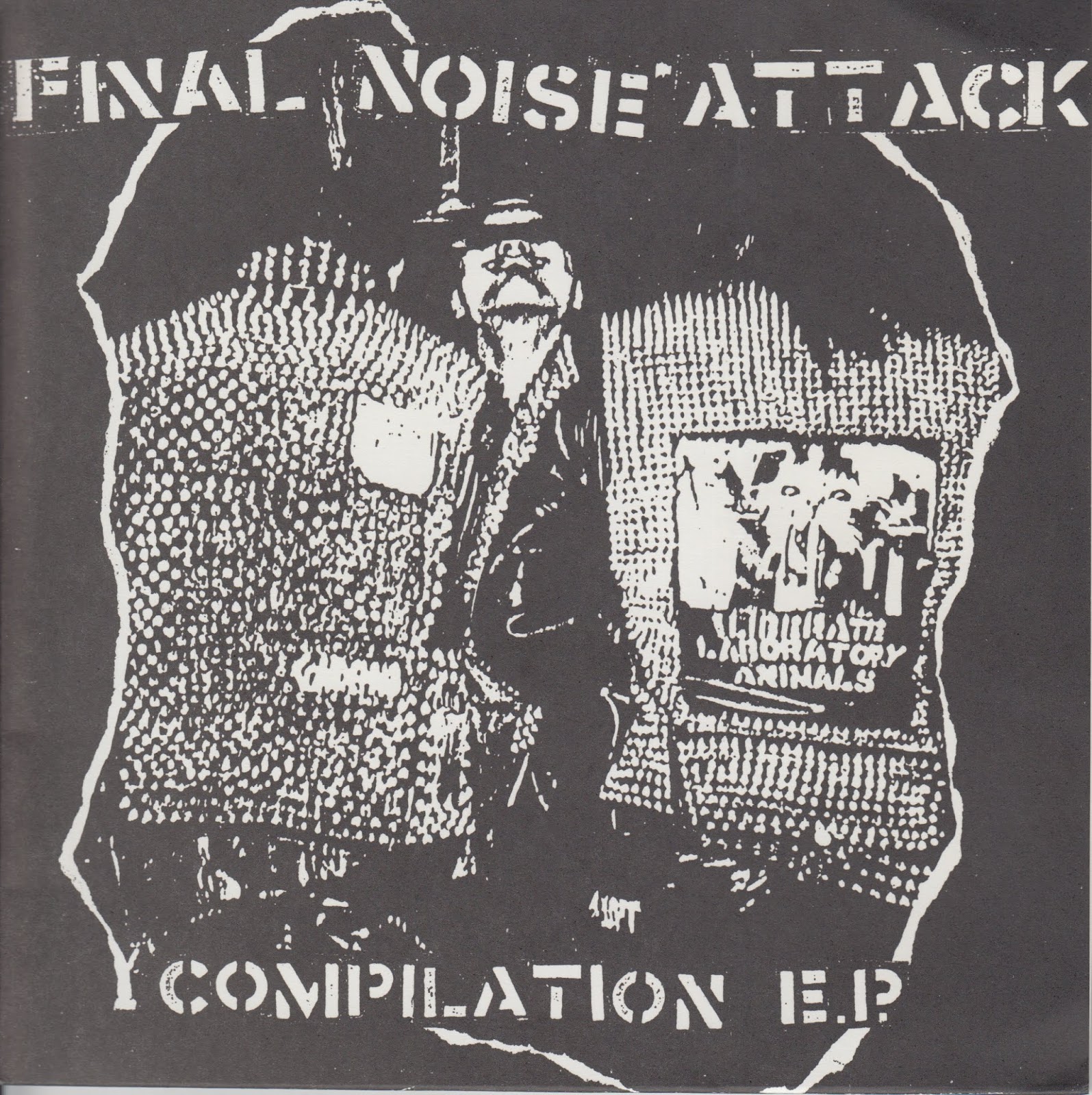
Noize Not Music is a Fine Art: "Final Noise Attack" compilation Ep, 1994

To ignore Final Noise Attack in a series revolving around the canonisation of the notion of "noize" would be criminal. Or dumb. Or even worse, a proof that you are not familiar with the record. And this discrepancy could mechanically have you eliminated from the contest for the - much coveted - Noiz Cruster of the Year award, assuming you did survive the Crust Pants of Hell battle royal of course. It is a tough game. 


But really, doesn't the very phrase "final noise attack" basically point to the next logical step, the sensible continuation of "noize not music"? Once you have settled that noize (and not conventional music, whatever it entails) is your project, then it makes sense to push the statement further and emphasize the agency inherent in the concept. The purpose of this music is to be hostile and relentless, to attack in a radical fashion that relies on noisiness and crudity. After all, radicality and extremity have always been punk's main selling points and attractiveness so you could argue that the call for a "final noise attack" can also be read as a healthy return to the basics, to the genuine foundations of hardcore, raw and noisy by essence, like the noize to end all noise...or something. Strictly speaking, the bands included on the Final Noise Attack Ep are not even that spectacularly noisy, though it depends what meaning one gives to this term and what is expected from it. But they are not particularly deafening or strident (especially by Japanese standards). They cannot be described as a wall of blown-out distorted d-beat noise, which would be the implication if the phrase was used today, since "noise" has come to be equated - I blame our epoch's compulsive need to classify everything for it - with the Disclose-style sound. At least within our little quarter of the hardcore punk scene, since to other people, "noise" will designate grindy noisecore bands or grungy dissonant bands or harsh noise electronic band or ambient stuff and so on, while Joe Public will probably be thinking that this is all bollocks and give him Phil Collins any day. We are all someone else's noise I suppose.


But my point is that this compilation is not so much "noizy" in a literal, sonic way (although it is also that), but above all for its focus on referenced influences and their almost systematic aestheticization, and for its unshakable belief in the value and relevance of hardcore punk as a raw, unpolished, noisy music belonging to a particular tradition, as opposes to the overproduced brand of hardcore that was blooming in the early/mid 90's. Noize becomes a way of looking at and creating punk music. On that level, it very much echoes with the almost bitter message on the back of Gloom's Recomendation of Perdition from 1997, dismissing crusty bands they deemed too melodic (which brings us to the real £100 question here: did neocrust kill Gloom?). But then of course, it makes sense since Final Noise Attack was, by essence, an Osaka record since it was compiled by members of Gloom themselves. As mentioned in the introduction to the Japanese Crust vs the World series (here), Final Noise Attack was originally the name given to the gigs organized by the then young and enthusiastic Osaka crusties in the early 90's. Not unlike the Punk & Destroy gigs that took place in Nagoya, Final Noise Attack gigs were numerous and certainly helped foster a new generation of raw punk and crust fanatics on a local level and consolidated crust as a powerful genre on a national one (just look at the posters and you will see that basically every single Japanese bands going for the crusty, d-beat, scandicore sound played at those events). I am not sure how many Final Noise Attack gigs were organized throughout the years (but judging from what I saw on da internet, quite a lot of them during a relatively short period, which says a lot about the dynamics and the momentum of the 90's Osaka scene) or when (or why) they stopped using that name, so I would be grateful is someone could shed some light here. What is pretty clear however, looking at the posters on the Ep's backcover, is that the visual aesthetics promoted by the gigs (a blend of Discharged-loving imagery, Bristol-by-way-of-Kyushu drawings, Crass-y anarchopunk symbols and so on) adequately reflected the music style of the bands playing (and the fashion of the people attending). Subcultural in the noblest sense of the term. And that is why I love this Ep. Of course I like the music and the looks of it, they are replete with visual cultural clues, nods, precise references, and it validates what I already know, like and know I like. But it also acts as a wonderfully accurate cultural artifact of a specific time and place. It has true meaning and meaningfulness as it concentrates what it was all about, and despite the many references to the glorious decade of the 80's, it completely conveys the energy and conviction of the next decade so that it does not feel nostalgic. But let's get to it.


The main surprise here is the absence of everyone's favourite 90's Osaka band: Gloom. I have no idea why since members of Gloom were the instigators of the Final Noise Attack gigs and I am sure they had a hand in the making of this Ep but there you go. They released Speed Noise Hardcore Rags the same year, in 1994, so maybe they did not have any songs ready for the compilation but that is just a wild guess. But if Gloom were technically absent from Final Noise Attack, it did not mean that all its members were. Indeed, the first band of the Ep, Defiance (the name is unlucky enough in retrospect), actually had Habi and Jhonio from Gloom in its ranks while Kaco and Okamoto respectively played in Warcry and Asphyxia. Noizy bands to say the least. I have already talked about Defiance on Terminal Sound Nuisance (here) since they were included on the magnificent Meaningful Consolidation 1994 2xEp and to which they contributed the brilliant metallic punk scorcher "Future is darkness". I could be wrong but I believe that the two Defiance songs on Final Noise Attack could be from the same recording session. Although they are nowhere near as metal-oriented, the production is similar and the thick and groovy bass sound that is genuinely appropriate for some thunderous Dis-oriented heavy scandi hardcore - with a mandatory dash of crust - is the same. I can hear obvious hints of Anti-Cimex, especially on the rather rocking "Violation of human rights", early Doom, Private Jesus Detector, Discard (the riffs on "Never be deceived") and even Anti-System (especially on the guitar texture). The songs are heavy, relentless and have this high energy, explosive quality that characterizes Swedish hardcore. The almost organic thickness of the bass and guitar certainly confers an edge to the otherwise classic 90's Discharge-flavoured songwriting and I really enjoy them. Classically-trained but very effective in a "Swedish hardcore crusties" way. The vocals are shouted but neither yelled nor gruff. This recording is from February, 1994, and Defiance also had a demo tape from 1993, the three songs of which subsequently landed on 1995's Truth compilation Lp, and had two tracks (with added crustness due to a dual vocal attack) on the What is Crust? cd from 1998 (though I guess they were recorded much earlier). I wish there was more from them...


Next are Reason Why. And... that is unfortunately all I can tell you about them! I have not been able to find any detail about the band so far (no trace of them on the internet) and it looks like the song "Contradiction" was their only vinyl appearance. The only thing I know about Reason Why is how their singer looked since there is a picture of the band in the book Inferno Punx. I know, it is pretty slim. As for the song itself, it sounds a lot like early Gloom (the 91-94 period). In fact, I even wondered at some point if it was not a Gloom cover or Gloom in disguise. Seriously. Perhaps Reason Why was a young band trying to emulate what was the most exciting punk band in town at the time? It certainly would not be the first time in punk history (more like a rule of thumb really). Anyway, judging from that one song, RW played a direct style of proto crasher crust with a very raw sound, distorted guitar and screams. A bit like listening to Chaos UK, CDFL and Confuse having an argument over a dove logo in the basement. How very Osaka.


Condemned follow on the other side with two songs, "Remember" and "Depends on bloody human". Like for Reason Why, information about this band is scarce (someone should write a book methinks) but it was not their sole recording. Condemned had two demo tapes out before Final Noise AttackDo you respective live? in 1993 and To all human error (possibly '94?), the latter being actually the very first Crust War release (catalogue number CW001 if you're wondering), and Jacky even played the guitar for Condemned toward the end of their existence (he formed Framtid after they split up). They were also included on Japankore's first omnibus tape compilation (that I have sadly never heard but also had Disclose, Battle of Disarm and the deliciously intriguing Ace of Shit) and contributed live recordings to the third volume of Bondage Maniac Record's tapes. If you are a devout Terminal Sound Nuisance believer, you will remember that I included the song "Depends on bloody human" on my cavemen crustmas compilation so that already gives you a hint at what Condemned were about. In Inferno Punx they are described as "PRIMITIVE BLAST CRUST CORE" which is pretty fucking accurate (I love the neological terminology used in the book). Condemned played fast, all-out primal crust with savage vocals reminiscent of early Disrupt, Embittered, Extreme Noise Terror (obviously) and the local Warcry (without the Sore Throat influence). There is a distinct early British feel to the band that is reinforced with the band's visuals being heavily "inspired" by the UK anarcho aesthetics (they use The Mob's dove and the logo of Dirge). The sound is raw and the songwriting direct and I so wish someone would reissue the band's demos on vinyl one day. Basic but glorious nonetheless.   


Finally, you have two songs from Despair, yet another rather obscure band that did not quite fulfill its potential. Despair had Gun from Asphyxia (he later on played in the tough guy hardcore act T.J. Maxx) on the bass but that is about all I know about their lineage. The band released three demo tapes in the early 90's, the last of which was called Victims of War, and were also included on the Outlast compilation tape (released around '95 or '96, I would say, and alongside a couple of brilliant Japanese hardcore bands like Toxic Noise, Scum Blast and GJPB) and the aforementioned Bondage Maniac tape (the Despair songs are taken from their third demo). In terms of sound, you will not be too astonished to learn that the band was into punishing the audience with fast and intense crusty hardcore with really gruff vocals. The production is pretty thin and is lacking in heaviness but the music is frantic, energetic and pissed enough to make up for this and I like the deep, hyperbolic crust vocals (they are forceful but not goofy-sounding and work well on a short format). Judging from the metallic opening of "The free world" and the crunchy guitar sound, Despair were clearly into early SDS, though I would describe the overall tone as a blend between early eurocrust and blazingly fast Japanese harcore (with a twist of Ripcord too). Two short sharp shocks that do not fuck about.


Final Noise Attack was released on MCR Records in June, 1994, and you could see this Ep as being part of the series of hardcore compilations focusing on specific Japanese towns that the label put out at the time. It should be pointed out that this Ep did not merely celebrate hardcore punk from Osaka but also the work and efforts from a bunch of young punks into raw punk and crust to create their own scene in their hometown through the Final Noise Attack gigs and bands. It highlights and validates specific dynamics. You could argue that this Ep (especially taking into consideration the reputation and distribution of MCR) pretty much put the Osaka crusty hardcore scene on the map, although the compilation itself, from a strictly musical point of view, with four quite short-lived local bands, is solid but not earth-shattering (and not as potent as Tokyo Crusties). Context might be more relevant than text here. At that time, all these Osaka bands (and by and large most of the growing second generation of Japanese crust) only had demo tapes so to be included on a proper Ep was probably a success for the whole Final Noise Attack scene. Also around that time, Crust War Records released the first Gloom Ep and the rest is crustory.


Friday, 11 May 2018

Noize Not Music is a Fine Art: "Mie City Hard Core" compilation Ep, 1994

From the inception of this series in my tiny mind, I instantly knew that this Ep had to be part of it but that it would represent a challenge. The main argument for selecting it could be summarized in one powerful word: CARNAGE. Given the templates of Noize not Music is a Fine Art and my endless obsessiveness with old-school crust music (one that Japanese punx have also been sharing for almost three decades, thanks fuck for that), picking a highly referential metallic crust band of a high standard, one that was not too obvious, appeared like a contractual obligation. If you really think about it (go on then, do it) Carnage were therefore the best solution, with only three songs recorded, a solid historical relevance and a cracking sound. It was to be a cruise on an ocean of excited blabbering over crust authenticity, yet another heroic and victorious march into dark uncharted stenchcore territories, one that would ensure yours truly a comfy spot on the Mount Olympcrust. Or so I thought...


I had originally bought Mie City Hard Core just for that one Carnage song and had not paid much attention to the other three bands on the compilation (I am not sure if it makes me a cooler punk or more of a poser...). Listening to the whole Ep again made me realize that, not only did I know nothing about these bands (and I do mean nothing), but that they played a genre I never felt completely at ease with: burning spirit hardcore. Now, I certainly do not mean to provoke the ire of honest, hard-working nerds with a crush for obi-wearing records by saying this and I hope I did not offend anyone. Please do not flog me with one-sided flexis as a punishment. Not being an expert in traditional (to be understood here as a genre signifier) Japanese hardcore, I cannot even really claim that Self, Zig-Zag and Blood Feast completely fall in the burning spirit category since they are not quite as over-the-top and epic as the 90's bands I tend to associate with the term (like Death Side, Slang, Warhead, Bastard or Tetsu Arrey), but I will leave the responsibility of clarifying such an issue for good to the ones in the know. However I feel like they each hold enough significant similarities with burning spirit to be widely described as such, if only for the sake of classification and clarity and because of the context of the time (there seems to have been many bands going for the style during the 90's in Japan). If you mention the phrase "90's Japanese hardcore" to me, I always hear flashy and epic guitar solos, ferocious speed metal leanings, a massive love for Discharge and Motörhead, some mosh parts, a direct and rough vocal flow, dynamic enormous gang chorus everywhere, weird lyrics about self-empowerment (you could easily make a few quids selling a book with burning spirit quotes these days) and even weirder band names. But perhaps the best definition I have heard for this style is that it makes you feel invincible and triumphant and for all the subjectivity of such a statement, I can see why someone would say that. 


But let's get to the record. Mie City Hard Core was released in May, 1994, on MCR Records and was part of a series of compilation Ep's focusing on the hardcore scenes of specific Japanese cities or areas. Before Mie, MCR had put out compilations highlighting bands from Kyoto, Nagoya, Sapporo, Yokosuka, Shizuoka, Niigata, Utsunomiya and Kochi-City (yes, Disclose). I personally love the concepts of local comps as they can meaningfully capture the essence of a particular era in a particular area. Of course, they are not all breath-taking and some bands never released anything else after but they are relevant cultural shots of a given context. Mie is not actually a city but a prefecture so this Ep includes bands from the same region but not necessarily the same town. 

The first candidate on the Ep are Self. Yes, Self. Now if that's not a name for a self-empowered, spiritually liberated hardcore kid, I don't know what is. Discogs tells me that the song "Clay guilty" (a song against war) is the sole appearance of the band on record and that is a shame. Self checked several important burning spirit boxes and played with a lot of raw energy (but then, that's a bit redundant to point it out given the genre) and that distinct Japanese hardcore fury. The Bastard-like riffs are excellent, very uplifting, the vocals are hoarse, the pummeling drums are super dynamic, there is a short but catchy solo, the singalong gang chorus are epic and contagious and you are even treated with Mad Max samples for good measure. Self were from Ise and I haven not been able to find any detail about them other than the fact the bloke who engineered the song also worked with bands like SOB, Warhead or Rise From the Dead and that the singer, Sakkon, produced an Ep for Dislike (you know, that late 90's noisepunk band, back when no one did the genre?). On an unrelated note, I am really into the band logo displaying a peacefully praying spiky punk inside a Star of David, also featuring two yin yang symbols, circled with an antiwar message written in the Crass font. Ace. 


Next up are Zig-Zag with the song "Act out!". From what I understand looking at the band's artwork, the name refers to the French brand of rolling papers since Zig-Zag (the band) used the same famous drawing of a zouave than Zig Zag (the brand). I am not sure what to think about it. They could have been heavy smokers or something got seriously lost in translation... Despite the rather raw sound, Zig-Zag pretty much epitomize burning spirit hardcore to my ears. The riffs are triumphant and catchy, the drumming is all over the place, the chorus are anthemic and will induce some intense sessions of fist-raising in your bedroom and I challenge you not to be taken by the sheer energy of the song. In terms of writing, you can tell that they really thought things through with a two-parts chorus that allows for the pressure to build up before exploding. I really like the snotty vocals on this one as they remind me of UK hardcore or vintage peacepunk at times and they add a genuine punky feel. Zig-Zag's drummer also played in Assfort (the first Japanese hardcore band I have ever heard) so it will give you a good picture of the waters in which the band liked to swim. Two years after Mie City Hard Core, they contributed four songs to a compilation cd entitled 2nd Round of the Game of Death (that could work as a title for a teenage horror movie as well). Much better recorded and even more aligned with the burning spirit school of crazy guitar solos and homeric hardcore songwriting, these songs will literally make you feel like a super saiyan. 


Blood Feast, from Tsu, are the next in line and contrary to Self, Zig-Zag and Carnage, they seem to have had a decent discography of their own (three Ep's) and can even pride themselves to have recorded some classic 90's Japanese hardcore. The band also appeared on a tape compilation (probably form the mid-90's as well), Outlast, along with bands like COSA, Slang or Guillotine Terror, but I am not too sure which was their first recording session. Judging solely on the quality of the sound production, I'd say that the split with Poison Cola contained their earliest stuff but I could be wrong. Anyway, from the three "Japanese hardcore" acts on Mie City Hard Core, BF are easily my favourites because they are the punkiest-sounding of the bunch. Super aggressive and direct thrashy hardcore punk with a punishing, hammering 1-2-1-2 beat and snarly desperate vocals. Mind you, I even enjoy the mid-tempo mosh parts with the crazy soloing. I can definitely hear that typical Chaos UK influence that pervaded a lot of Japanese punk although the arrangements and the riffing are undeniably local (Kuro and Death Side come to mind). The (moderate) distortion on the guitar - which they would subsequently pursue - is also an asset as it confers an additional edge to the song and they sang in both Japanese and English which I really enjoy since the flow of the language goes well with the steep relentlessness of the genre. Their '95 Ep on Discrete Records (that label responsible for some classic DSB records a few years later), War in a Babylon, was even better, with a distorted raw punk edge, a genuine antiwar message and one of the best Crucifix covers ever (in fact, BF even openly borrowed the Crucifix logo on this Ep!). Really solid band that is well worth (re)discovering and rates pretty high in terms of quality 90's Japanese hardcore.     


And finally, my precious, my beloved, my treasured Carnage. As you can imagine, a large amount of bands throughout the years decided to make a stand and call themselves Carnage, mostly of the metal variety, but by no means exclusively, and that is without even considering variations such as Total Carnage, Supreme Carnage, Mörbid Carnage or the classically misspelt Karnage. Still Carnage from the Mie Prefecture are, by far, my favourite Carnage, in spite of their very short discography. There must have been demos at the time but I have never heard them (or even heard of any) so that one song from Mice City Hard Core and the two others from the oddly named What is Crust? What is Melo-core? Be Different Hardcore? '98 compilation cd (that also has Disclose, Frigöra and Argue Damnation) will sadly have to do. 


As I mentioned, Carnage were pretty much the main reason why I picked that particular record for treatment. And let's face it, it was an obvious choice. Carnage excelled in crust referentiality and exemplified the notion that "noize not music is a fine art" and the aesthetic intent and artistic carefulness underlying such a statement. The point is not just to pay homage by playing with visual and sonic elements originally created by crucially influential bands, but to build on them. The motivation is twofold, as referentiality is a means to consolidate and validate one band's creation into a pre-existing tradition, but also to turn a band's sound into a legitimate style of its own, with its rules and codes as well as its songwriting potentiality. In Carnage's case, you could argue that they turned the sound and referential creativity of SDS into an actual subgenre, they conceptualized it. Very much like Anti Authorize at the same time (and closer to us, Disturd), they referred to SDS' sense of Antisect referentiality (as their piece of artwork and their hairy antisectish font can attest). Of course, the influence of SDS on the Japanese crust scene was prevalent by 1994 but Carnage was one of the first bands to openly work on the template of Antisect and UK sound as generated by SDS. 

The result is brilliant. The song "Desperate future", recorded in January, 1994, is basically a raw but powerful blend of Out From the Void and In To the Void with some groovy but filthy metallic riffing strongly reminiscent of SDS of course but also heralding bands like AGE and Disturd. In itself, the song is rather simple and effective, the vocals are gruff, almost Neurosis-like, the bass sound is thick, the riff is crusty and catchy and thus you've got the perfect mid-paced crust song. The short spoken words at the opening nod toward Flux of Pink Indians' "Neu smell" and Crass' "Mother Earth" and act as reminder of the anarcho roots of the genre. The two other Carnage songs on the cd, "Total destruction of nuclear weapons" and "Change", are faster and heavier and were recorded six months after, though they were released in 1998. These mere three songs showed that, at a pivotal time for Japanese crust punk, when bands like Abraham Cross, Disclose and Gloom were really coming to the fore with their own concepts, Carnage (along with Anti Authorize) paved the way for a different crusty path, carefully and specifically crafted with the SDS approach, that would be taken by more bands afterwards.  


Of course, it would be strange not to talk about the "crustier than Concrete Sox' socks" artwork, which can actually be rather misleading if you consider the lineup. It was done by Carnage's drummer Sucker and is yet another example of referential crust art with the adequate amount of broken instruments, crust pants and dreads. I personally have a soft spot for the drawing on the backcover because the geezer is drinking from a beer bottle sporting the infamous crossed out music note logo and because he sort of looks like me, I'm afraid to say. Noize not Music can also be a fine drink.   

Mie City Crust Core            

As a follow-up to this one, MCR released Mie City Hardcore 2 in 2002 with a much crustier lineup made up of Contrast Attitude, Deceiving Society and Alive.