This article has been in the work for some months now and is the result between a cooperation of epic proportions between Erik, of Negative Insight zine and website and Social Napalm records and distro (a busy fellow indeed), and yours truly. The initial idea was to cover a dozen (or so) anarchopunk bands form the UK that kept it tuneful in the late 80's/early 90's. I hope we did alright and we would like to thank all the old-timers that helped us in our near impossible punk mission.
Like all musical genres, punk has existed in waves of bands influenced by the previous wave as well as sounds and cultural influences contemporary to the time of each successive era. Anarcho punk, of course, is no different, as the originators of the movement including bands such as Crass, Poison Girls, and Zounds, represented the first wave and went on to influence legions of followers in their wake.
By the late 1980s, anarcho punk had shifted from the original sound, influences, and topics. The musical and cultural influences of Crass were markedly different than those of the anarcho bands that came 10 years later. And how could they not have been? The Miner's Strike had been bitterly lost, the Falklands War was over, and Thatcher's reign came to an end in 1990. With those changes among a litany of others spanning over the course of a decade, the enthusiasm and urgency of the first wave anarchist bands had largely dissipated. Beyond the external factors, internal bickering and holier-than-thou attitudes had also caused derision within the movement.
This period was a transitional time for political punk in the UK, as it splintered with the rise of crust, grindcore, and other forms of more extreme hardcore. In fact, these offshoot forms of political punk became the predominant and more popular styles during the time period covered here. While the crust and grind genres operated in cohesive scenes during these years, the bands in this article did not make up a singular scene per se, and the goal here is not to rewrite history by aligning them together in a way misrepresents their association with one another. These bands here are grouped together based on their sound and style; nothing more, nothing less.
That style can best be described as having a more restrained affect to their sound, influenced by poppier elements, softer and more melodic punk, and a more personal and introspective approach to politics. In contrast to the sloganeering protest bash bands of the early 1980s, the 1988-1992 anarcho bands were much more subdued and refined. Gone was the political outrage shout of Conflict, the abrasiveness of Antisect, and the moodiness of The Mob. Instead more mellow and tempered influences came from goth, traditional folk music, melodic punk, and even some dub influence as much as it did from the originators of the anarcho sound.
So without further adieu, here is what can (loosely) be defined as the anarcho punk bands from 1988-1992...
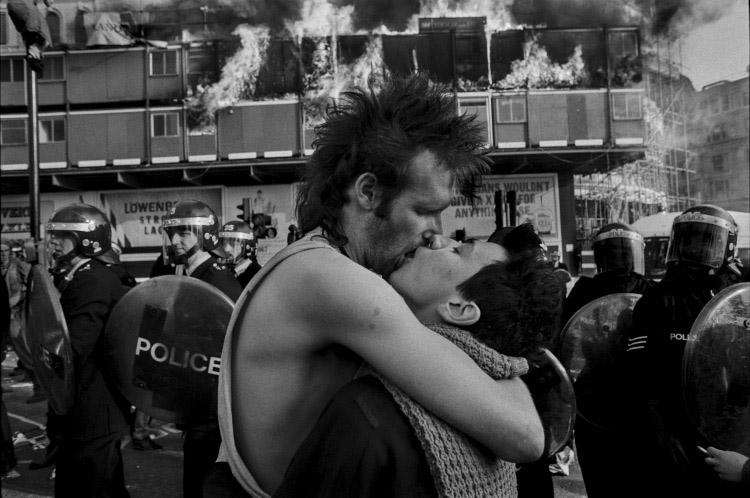
Love and riot, Britain, 1990.
Andy Martin was one of the strongest personalities to arise from the London anarchist punk movement in the early 1980s. His reputation for being outspoken and scathing in his criticism of the shortfalls of the punk scene yet altruistic made him a well known figure on the scene. As closely as he was linked to the anarcho scene, Andy was just as much a vocal opponent of it as well. Although best known for his time in the Apostles with long time collaborator Dave Fanning, Academy 23 sprang up a short time after the Apostles disbanded with their first tape coming out in 1991. Featuring both Andy Martin (vocals) and Dave Fanning (guitar) as well as Lawrence Burton (bass) and Pete Williams (drums), Academy 23 continued on in the direction where the Apostles had been headed.
While Academy 23 is still firmly rooted in punk, there's folk elements, some protest music, lots of minimalism, and the assorted eccentricities found in some Apostles material. If you're a fan of the Apostles, this really is the logical continuation in sound of where they were headed. Considered by Andy Martin to be "vastly superior" to his work in the Apostles, Academy 23 never garnered the relative popularity of the Apostles. They did manage to release an LP entitled "Relationships" in 1992 as well as several cassette only albums, a CD only album, and two 7"s ("Winning The Struggle" b/w "Double Standards" in 1992 and the "Cameo For Earth" 7" in 1993), along with multiple compilation appearances. If you're unable to find the original vinyl releases, there is a nice tape entitled "The Vinyl Documents" put out by AON Productions in Bulgaria that might be able to be tracked down as well.
While the Academy 23 material is quite strong and is similar in many ways to the Apostles, they remain obscure in comparison. On reflecting why the early '90s bands are regarded far less than the '80s forebears, Andy states "Perhaps the reason the 1990s is glossed over is because it was the decade where we all went bonkers - at least in Britain - replaced real instruments with computers, swapped our manuscript paper for cubase and blissed out on ecstacy. This may sound harsh but it's based on fact - I should know - because I was guilty of precisely this behaviour!"
Academy 23 would later morph into Andy Martin's current band, Unit, which is still going strong today and has many albums and CDs available.
Blyth Power
More often than not, us punks tend to put more value on the accuracy of the imitator more than the uniqueness of the creator. While there is nothing wrong with a properly done Discharge (or whichever punk legend you are into) tribute band, we struggle a bit with bands that are truly original. They challenge us. Blyth Power is one of those Marmite bands that you either goofily love or incredulously hate.
Blyth Power formed in 1983 in Somerset, with two former members of The Mob, Joseph (who also played in Zounds and, as the drummer/singer/songwriter/public relations manager, is the driving force behind the band) and Curtis. Now, it is always a bit tricky to start a band with the "ex-members of" brand. On the one hand, The Mob were one of the most popular and iconic anarcho bands from the early '80s, so a post-Mob band was bound to garner some attention. But on the other hand, it was difficult in the early years to get past this tag and to exist as a band in the shadow of The Mob. Fortunately for us, Joseph Porter is passionate and creative enough to truly create a band that is good enough to make one forget The Mob connection.
The years 1988-1992 were the time when Blyth Power really found their own identity artistically. The band's recordings between 1985 and 1986 (among which shone the amazing "Wicked Women" LP and the "Junction Signal" 12" for instance) were released on All the Madmen Records, a label closely connected to the early anarcho punk scene as it put out records from The Mob, The Astronauts, and Flowers in the Dustbin. But by 1988, and up until 1993, Blyth Power had a record deal with Midnight Music, a large independent label that specialized in post punk and experimental music. One can suppose that with the rather good reviews Blyth Power had gotten, perhaps along with the intent to go beyond the punk crowd, had made the band consider this deal in the first place. Although the relationship between the band and the label was not the friendliest, it is nonetheless on Midnight that Blyth Power released their best works (though it must be said that 1996's "Out From Under the King" and 2014's "Women and Horses, Power and War" are absolutely brilliant too).
Between 1988 and 1992, Blyth Power released three 12", "Up From the Country," "Goodbye to All That" and Better to Bat," as well as three albums "The Barman and Other Stories," "Alnwick and Tyne" and "The Guns of Castle Cary," and even one compilation LP that included most of their All the Madmen era recordings, "Pont Au-Dessus De La Brue." Of course, these four years saw the band at its most prolific and most inspired. Enhancing Joseph's inimitable writing skills, were Jamie Hince (who would later play in The Kills and marry bloody Kate Moss… I kid you not!) on guitar, Protag (who also played in Alternative TV at the time) on bass, Siân (formerly in Lost Cherrees) on harmony vocals for all the 1988 recordings and, after her departure, Julie (from Dan) up until 1991. Despite the semi-professional label they signed on, Blyth Power still played with fellow punk bands in those years, like Anrefhn, Sofa Head, Salad From Atlantis, Snuff and even The Levellers.

As I mentioned, Blyth Power was, and still is, a band that is difficult to categorize and describe properly. They borrow as much to the tradition of English jesters and minstrels as to punk rock and folk music. Deeply rooted in British history and storytelling, with songs about lords, battles, old countryside life but also about cricket (a recurring theme in the band's body of works), Blyth Power's music is highly theatrical, uplifting, dramatic, with a deluge of catchy, epic chorus, somewhere between the Monty Pythons, William Hogarth and the most sensitive and innovative brand of anarcho punk pioneered by All the Madmen. This is music to joust to.
Since 1993, Blyth Power have released their records on their own label, Downwarde Spiral and, apart from a few disappointing albums, they have kept the quality remarkably high and they remain one of the most unique bands in British punk history.
Cold Vietnam
This was an obscure band from the same area as Joyce McKinney Experience that only released one demo and appeared on a handful of compilations between 1988 and 1989: Cold Vietnam. Based in Redditch, the guitarist and singer, Andy Forward, had also played on Visions of Change's final LP, "My Mind's Eye" in 1989. Cold Vietnam formed in 1986 after the demise of several other local bands. They were apparently not too active for the first year but, in 1988, they managed to record a demo, "Blast Into Action" with "Hunt the Man," that should have taken them to much greater things. Despite a cover reminiscent of the cheapest crossover music, the demo tape is an incredible effort. Carried by the singer's powerful and tuneful voice, "Blast Into Action" is a unique collection of political punk hits (with a strong emphasis on animal rights) and displays a wide variety of genres, from moody anthemic post punk, to passionate melodic US hardcore, to mid-tempo anarcho punk, to melodic UK punk rock and even a punky reggae number. Perfectly produced, this demo is one of the most underrated recordings of this era. Two songs were lifted from it and landed on the brilliant "Spleurk" compilation LP in 1988. Released on Meantime Records, it saw Cold Vietnam rub shoulders with bands like Sofa Head, HDQ and Cowboy Killers. It was not however Cold Vietnam's first vinyl appearance. Indeed, earlier in 1988, their song "Rock Stars" was included on a compilation LP entitled "Vinyl Virgins" that was aimed at providing a first vinyl appearance to promising rock bands! It was released on Mighty Sheffield Records and Cold Vietnam even contributed another song on the label's second compilation LP, "Lemonade and Cyanide."

The band's last vinyl appearance was in 1989 with the inclusion of their song "New Patriot" on a compilation EP. It was the second issue of the "Panx Vinyl Zine" series. These were released by the French label Panx Productions and included lesser known international bands. This Cold Vietnam song however was not taken from the excellent demo but was recorded during a later session with, unfortunately, a weaker sound.
I bumped into an unofficial tape reissue of the demo last year from an Italian distro. It appears that the Kalashnikov Collective are big fans of Cold Vietnam!
Dan / Sofa Head
The band Dan was formed in Darlington (a small northeast town) by vocalist Andrew Bayles and bassist Ian Armstrong upon leaving school in 1983. That same year, they had their first gig in support of Conflict in Leeds.
Dan live. Courtesy of Andrew Bayles.
Although Andrew left Dan fairly early on ("for the bright lights of Leeds," as he says), he did manage to play on the debut Dan EP from 1986 called "Can You Dig It?," released by Meantime Records, as well as their debut LP "Where Have All The Children Gone?," released the following year also by Meantime Records. Andrew remained close with the band and his recollection on the history of it all is vivid and clear with a mind for the details.
He states "We went thru' various other singers including Helen and Jane, Dave S. and Joy and a couple of guitarists: Slob, Andrew Black. We also had a guy called Steely on drums and, after I’d left, they finally got their shit together with a guitarist called Wal and started taking the band more seriously."
Dan's Georgie and Jools selling records. Courtesy of Andrew Bayles.
"Female singers Jools and Georgie are singing on the albums and singles, although I think Jools was the longest serving and did the most gigs. Interestingly Jools (Julie Dalkin) went on to join Blyth Power and date their guitarist Jamie Hince who later formed Scarfo and his current band The Kills. Jamie's now married to supermodel Kate Moss... good grief!"
Regarding the musical influences of Dan, Andrew says "At the time when I was in the band we were listening to a lot of Crass type stuff, and Armstrong was a big fan of rockabilly punk like The Meteors and King Kurt. Obviously we'd all grown up with the classic punk bands like the Pistols and the Clash, but we def' all loved The Rezillos. Other influences included The Swell Maps (we did a cover of their 'Full Moon In My Pocket'), Blood Robots, Flux of Pink Indians, and Antisect."
Aside from the aforementioned records, Dan also went on to release the "Here's The Story Of The Further Adventures Of... Dan" cassette on BBP Tapes (1987), "An Attitude Hits" 12" on All The Madmen Records (1987), "Mother With Child And Bunny!" LP on Workers Playtime (1988), and "Kicking Ass At T.J.'s" LP with flexi on Meantime Records (1989). Who would have thought a band that couldn't settle on a line up in the beginning would end up so prolific!
The Meantime Records label was actually run by Dan bassist Ian Armstrong, and along with labels like C.O.R., Manic Ears, and In Your Face Records, became one of the most respected labels of the late '80s UK scene with releases by such bands as the Instigators, Hellbastard, Leatherface, and more.
Andrew Bayles writes "Later Dan morphed into Sofa Head with vocalist Claire [Sykes], Wal [Ian Wallis], Ian Armstrong and also recruited drummer Andrew Laing. I do recall getting back together with Sofa Head for a couple of gigs when they played with the Next World and they were using a drum machine, but I'm sure this was just an interim while they were looking for a drummer."
Sofa Head live. Courtesy of Andrew Bayles.
Continuing where Dan had left off Sofa Head played upbeat political punk with female vocals. The band quickly got their first vinyl exposure by being included on the 1988 benefit compilation LP "Spleurk!" put out by Meantime Records. Shortly after, a newly formed political punk label in the US wrote them in hopes of doing a Dan release. Upon finding out Dan had broken up, but that former members had started a new group under the name of Sofa Head, the "Pre Marital Yodelling (1127 Walnut Ave.)" LP became the first release on Profane Existence in 1989. A UK pressing on Meantime Records was also done.
The debut LP was quickly followed by the "What A Predicament" LP (Meantime Records, 1990) and "Invitation To Dinner" 7". Four versions of this 7" exist with one pressing by Meantime Records and Rugger Bugger Discs in England, a US pressing by Profane Existence, and two German pressings on Recordrom Records. Profane Existence described this release as "taking on a more dark and serious tone to their message on a thematic EP against rape and violence towards women."
The "Twat!" 12" EP came next (Workers Playtime, 1991) followed by "Acres Of Geeses" LP (SMR Records, 1992) and finally the "More Is Not A Word In Our Vocabulary" (Shazbat Records, 1992).
Sofa Head drummer Andrew Laing (also of H.D.Q.) would later go on to play for many years in Leatherface (appearing on all the early Leatherface material including the seminal "Mush" album). Laing and bassist Ian Armstrong would also reunite in the 1990s, forming the band Rugrat together. After releasing two 7"s under the Rugrat name, the Nickelodeon channel forced them to rename the band due to the likeness with their children's cartoon show Rugrats. A third 7" was released under the name Bulltaco.
Ian Armstrong now runs Hidden Talent booking agency, promoting gigs and bands such as The Stupids, Exploited, 7 Seconds, etc.
Decadent Few
Another band that was around between 1988 and 1992 and had deep connections with the early anarcho punk movement was Decadent Few, from London. Not unlike Blyth Power, they formed at the tail end of the original anarcho punk wave, in 1984, from the ashes of Youth In Asia, a band that had played with Poison Girls, Rubella Ballet and Omega Tribe in the early '80s but sadly never really released anything back then apart from a promising demo, "Sex Object" in 1982 and the one track on a "Bullshit Detector" compilation. Although Decadent Few were not as overly political as YIA – and indeed the band never really claimed to be "anarcho punk" – the songs they wrote still tackled political subjects like feminism ("Misogyny") or the events in Northern Ireland ("They Shoot Children"), along with more personal matters. Their first vinyl appearance was on a Mortarhate Records compilation in 1984, very early in the band's existence in fact, just after the demise of Youth In Asia, and one had to wait seven years (!) for another Decadent Few record.

This does not imply that the band were inactive for such a long period. Rather, the solid songs they had penned did not materialize into proper albums. In 1987, they recorded the auspicious "Kaputt" demo and the following year, a great full album that was meant to see the light of day on Real World Records, a Durham based label that had already released the excellent Heavy Discipline EP. Sadly, that was not to be, but Decadent Few eventually got an LP of their own in 1991, "Irrehuus," on Full Circle records, the label of Tez Turner from The Instigators and Xpozez. This was a remarkable album, an unsung classic of sort, blending seamlessly the moodiness of goth punk and the energy of the 1977 punk rock wave. In 1993, guitarist Mick released another Decadent Few record, the "They Shoot Children" EP, on his own Inflammable Material records that he had started a few years before with Jules from the mighty Substandard. It saw the band at its peak, with two memorable, emotional songs that stick effortlessly in the listener's psyche.
On the face of these pieces of information, Decadent Few could be seen as a rather anecdotal band that could have achieved more, an easy filler in our list. But then, there is Kay's voice. She has quite possibly the most powerful and intense voice in UK punk history. Hers is deep, warm, raucous at times, almost high pitched, but still always tuneful, it can convey the whole spectrum of human emotion and take simple, efficient punk songs to the next level. If you could blend the energy of X-Ray Spex, the catchiness of A-Heads, the moodiness of Siouxsie and spice it all up with the voice of the bear eating bastard child of Poly Styrene and Patti Smith, then you would be pretty close to the Decadent Few experience.
After Decadent Few, Kay briefly sang for Radical Dance Faction and Mick went on to release top notch records with his label. For those so inclined, you will be glad to hear that Decadent Few are playing again and that they have not lost an ounce of intensity with the years.
Indian Dream
From Scarborough, North Yorkshire, Indian Dream formed in the mid '80s. The sound of Indian Dream takes the gothy anarcho punk sound similar to bands such as Karma Sutra, Crow People, and others while still adding in the more melodic sounds common in the late '80s and early '90s.
Indian Dream received their first vinyl exposure on the Mortarhate Records compilation "We Won't Be Your Fucking Poor" in 1985. Two years later their debut EP "Well! Are You Happy Now!" was released on hometown contemporaries Active Minds' imprint Loony Tunes Records. The band returned to the studio to record their only LP, "Orca," self released on their own Xingu Records, in 1989.
Moving in an even more melodic pop direction, "Orca" was dedicated to the plight of the Orca whale. The album contains a sparse production and some parts that can only be described as "hippyish" sounding as well as some points that be likened as similar to later era Lost Cherrees.
According to Bobs of Loony Tunes. records, many copies of the Indian Dream LP ended up in a rubbish bin in Scarborough: "Indian Dream had split up, but they still had a lot of unsold LPs and some unreleased recordings which they'd originally planned to put out as an EP. I offered to try to sell the LPs and then to use the money raised to help finance the pressing of 500 copies of the unreleased EP. I sold a lot of the albums, but eventually got to the stage where they just weren't selling any more. None of the band members wanted them back, so at least 100 copies ended up being thrown away, believe it or not."
Too bad, as copies of the "Orca" LP now regularly sell for over $30.
The final Indian Dream release was the aforementioned self titled 1992 7" EP also released on Xingu Records. The EP was pressed in an edition of 500 and distributed by Loony Tunes Records. Bobs explains more on this release:
"We knew this couple (Roland and Corinna) who organised a couple of gigs for us in Germany and who we sometimes travelled around with, I think. They were wanting to start a label/distro (Asekk). At some point I must have mentioned the Indian Dream EP we were going to organise (although I can't recall how that topic of conversation had arisen) because they offered to pay for, and distribute, 200 of the 500 copies. They did, and we sent the copies to them.
It took us a while, but we eventually sold and traded away all the 300 copies we'd taken. Then years later (I reckon at least 10 years, but maybe even longer) I got this package through the post from Roland saying that these EPs had just been sat around and he thought I could probably do more with them than him so he just gave them to us. I reckon there was 150-170 copies in there which means he'd hardly sold any. I don't believe his label released anything else, and organising trades with other labels when you've only got one item to trade is pretty impossible, so I guess after a while he'd just given up and they'd sat in a cupboard in his house or something for years."
Thanks to this, copies of the final Indian Dream EP are easily found at very affordable prices. In addition, Boss Tuneage from England released a discography CD (omitting compilation tracks) in 2013 that is still available. Members of Indian Dream would later go on to play in the band Better Than Life.
The Instigators
Hailing from the West Yorkshire town of Dewsbury, the Instigators were holdovers from the earlier years of the anarcho punk movement. Having released their extremely well received "The Blood Is On Your Hands" 7" (Bluurg Records, 1984) and "Nobody Listens Anymore" LP (Bluurg Records in 1985), The Instigators were well established and highly respected. However, upheaval within the band led to line up changes and inevitably a change in sound.
Original guitarist Simon Mooney recruited former Xpozez vocalist Andy Turner (who had previously acted as a promoter for the Instigators) and pushed the band in a new, more melodic direction that can first be heard on the "Phoenix" LP (Bluurg Records, 1986). When asked about the change in sound, Simon states "There was no conscious decision to change sound from 'Nobody Listens Anymore' to 'Phoenix,' but three-quarters of the band left after the first record so the follow-up was always going to be different." The line up would continue to change throughout the tenure of the band, but Andy Turner and Simon Mooney remained constant and built the band into one of the most exciting live bands in Europe, regarded for energetic and powerful performances.
Instigators live in Huddersfield. Courtesy of Tez Turner.
In 1987, the Instigators released the "Full Circle" b/w "The Sleeper" 7" (Double A Records, 1987) which features one of their strongest melodic and rocking songs they recorded in "The Sleeper" and is highly recommended. In regards to their 1988 LP, Simon states "Personally, my favourite is 'Shockgun,' the third record, but I wish I'd stayed around for the mix as it's a bit thin…" As one old UK scene head describes it, "Shockgun" sounds like "Rush meets NWOBHM" adding that "in England in 1988, this was as good as it got."
Instigators live. Courtesy of Tez Turner.
The following year saw the band re-recording old songs as the "New Old Now" LP, ironically released on Peaceville Records which was run by original Instigators drummer, Hammy. The band carried on through the end of the decade and recorded a final two song EP in September of 1989, a collaboration with Japanese artist Toshiyuki Hiraoka, which was released by Deco Records in 1990.
Today, their material is largely still easy to find and at affordable prices as well. A large number of sealed dead stock copies of the Flipside Records US pressing of the "Shockgun" LP turned up in the early 2000s and can still be found for cheap money.
Internal Autonomy
Internal Autonomy formed in late 1986 in Surrey with Al (drums) and Nikki (vocals) as core-members. Despite having released several top notch records, it took the post punk revival of the past few years for the band to get rediscovered. Truth be told, neither the rather meaningless "post punk" tag nor the "anarcho punk" one really fit Internal Autonomy (although the band certainly emerged from the anarcho punk scene and ideals). If anything, they can be seen as a free punk band, not only because they were not scared to experiment with music but also because of their passion for questioning and introspective inquiry reflected in their strong lyrics. Internal Autonomy questioned the ills and the vanity of the anarcho punk scene, but also the concept of ideology.

Their first demo was recorded in 1987. Entitled "Song and Speech," the tape, despite a thin production (assuming you could it that), was a promising collection of songs (and speeches!), deeply reminiscent of Lost Cherrees, The Apostles, The Mob and Smartpils with haunting, powerful vocals, tribal drums and catchy guitar leads. Because the band recorded everything themselves (Al had his own DIY studio), the band got to record demos regularly: "Capitalism on Sulfate" and "Cause of Liberty" in 1988 and a fourth demo for Bluurg Tapes in 1989 (which made sense since Internal Autonomy's music suited well Dick Lucas' catalogue in the late '80s) that had a brilliant Poison Girls cover.

The year 1990 marked the beginning of the band's association with Recordrom Records from Germany, a label that, for some reason, seemed to specialize in British anarcho bands with releases from Dan, Potential Threat and Inside Out. The "Monumental Inquiry" LP was released that year and displayed an impressive blend of vintage female-fronted anarcho punk bringing Rubella Ballet or Crass to mind, psychedelic music that would not have sounded out of place at a Stonehenge festival and tasteful gothic punk. It also included a new version of "Awayday to Auschwitz" a song that had been originally written by Cyanide Scenario, Al's former band, that was supposed to release something for Mortarhate and for Napalm Death Justin Broadrick's label that was never to be. In 1991, Internal Autonomy recorded a new EP for Recordrom, arguably their best moment, called "Love." The artwork for this one was made by none other than Gee Vaucher from Crass. The same year they took part in yet another Recordrom project, the "Tired of Sleeping" compilation EP that included art pieces as well as a record.
A second LP, entitled "Here in Our Hearts" was meant to be released on one of the strongest British DIY punk labels at the time, Words of Warning Records, but it sadly did not materialize, although one of their songs did land up on a Words of Warning compilation, "Mind Pollution," in 1992. Fortunately, seven songs from the recording session of the second LP were included much later on a CD discography. That year, the song "You Wonder Why" also appeared on the "Screaming for a Better Future" compilation LP released on Campary Records alongside Mushroom Attack, Verdun and Earth Citizens. Finally, Internal Autonomy did a last record, a rather impressive double EP for Profane Existence Records, albeit with Nikki having been replaced by Hog on vocals, that demonstrated the band's political bite.

In the late 2000's, the band more or less got back together and recorded a few songs that would eventually appear on a massive double CD discography in 2010. Released on Front Cover Productions, it contains songs from all their old recordings as well as a booklet retracing the band's history and underlying motivations. Finally, they reformed for good in 2013 and released a new, terrific album entitled "Ferox" that added some dub and electro sounds to the classic Internal Autonomy blend. They are still going under the name Ferox (or Feroxide), have relocated to South Wales and release records regularly on their own Vanity Productions.
Joyce McKinney Experience
Joyce McKinney Experience were a breath of fresh, flowery air amid a fetid storm. Far from the slimy beats popular then, JME's colourful, upbeat music made them stand out and epitomized the diversity of the mid/late '80s UK punk scene. The band was part of the lively Leamington Spa punk scene that spawned bands like The Depraved/Visions of Change and Bad Beach (without mentioning the Varukers). At that time, the dynamism and enthusiasm of local punks had placed Leamington firmly on the punk map with a lot of gigs being organized at the Bath Place, a strong music collective that allowed bands to rehearse easily and many bands coming to play while on tour. The scene was close-knit, thriving and positive (Bolt Thrower being the obvious exception). It was in this particular context that JME were born.

The band started around 1986. At first, the idea behind it was to do an all-female hardcore punk band and although two males eventually joined, Gigs (drums) and Charlie (guitar) the original intent behind JME can explain why there were two female vocalists, a crucial element that made the band shine out. The first line-up was made up of Sharon and Yvonne on vocals, Robbie on bass, Gigs (who also drummed for Bad Beach and Visions of Change) and Charlie (who also happened to be Robbie's boyfriend). They recorded a demo in 1987 that appeared on a brilliant split LP entitled "Shall We Dance?" released the same year by Meantime Records. This wonderful record, also featuring Decadence Within, The Incest Brothers and Nox Mortis, showed the band's potential and 1988's "Joyce Offspring" LP spectacularly confirmed it. A collection of eleven songs of JME's spontaneous, dynamic and powerful music, this LP blends the energy and youthfulness of hardcore with the catchiest brand of tuneful British punk rock and positive anarcho politics that expressed themselves from a personal point of view. The upbeat dual female vocals bring to mind Lost Cherrees, Rubella Ballet, A-Heads, JME's contemporaries and label mates Dan and probably paved the way for several '90s anarcho punk acts like Harum-Scarum or Mankind?. The same year, JME recorded a solid session for John Peel.
The band released an equally strong Ep in 1989, "Boring Rock" and from that point on, slowly started to write softer, poppier songs. 1990's 12" "Cuddle This!" pointed to that more melodic direction but remained rooted in energetic punk rock (the kid on the cover was actually the son of Sharon and Ian from Visions of Change). Following the release of this record, Robbie left and was replaced with Spencer, Sharon's brother, who had just left Visions of Change. The pop direction that JME was taking allowed them to play even more and attract larger audiences as well. Unfortunately, the line-up was beginning to crumble with Gigs becoming increasingly busy with work and Spencer leaving the band (Malcolm from Identity took his place). 1992 saw JME record their final two works, a demo for EMI (probably attracted by the mainstream appeal the band could have with their new direction) and the "Braemar" demo. They caught the band at their most melodic, their initial gritty punk rock influence giving room for rather subtle harmonies that aligned them with catchy, heartfelt British pop-rock music.

The great double-CD discography that Boss Tuneage released in 2006 contains all JME's recorded works, lyrics, pictures and liner notes and is highly recommended.
The Next World
Drum machines. In the realms of music, few things scream '80s more than them. While many think they are quite inappropriate in a punk band, there are places like France where "drum machine punk rock" is actually a recognized genre in itself. And closer to our field of investigation, bands like Cress or Burnt Cross have certainly proved that you can create great songs with a drum machine. Or indeed, The Next World.
Originally from Kettering, close to Northampton, The Next World were a punk duo, formed around 1986. With their politics deeply rooted in anarchism, they were involved with the 1in12 Club collective in Bradford and would often play at their famous venue on Albion Street, which has played a crucial role in the development of the DIY punk scene in the North. If you look closely, you will notice that the contact address on all The Next World recordings is a P.O. Box in Bradford that was also used by Flat Earth Records.
The Next World's duo. Courtesy of Andrew Bayles.
In 1986, The Next World self-released two demo tapes, "Peace Is Not Just the Absence of War" and "Imagination Seizing Power," that included early versions of songs that would end up on the band's vinyl outputs. In 1988, The Next World released its first record, the "Branded" EP, which was in support of the Campaign Against the Public Order Act of 1986, a piece of legislation that gave even more power to the police in the face of social unrest. The EP contained a text detailing the implications of the act and how the new measures had already been implemented during the Miner's Strike a few years earlier. Musically, "Branded" is an astonishing record that has few, if any, equivalents in the anarcho punk scene in 1988. While the songs themselves sound like a healthy mix of Hex, Southern Death Cult and Smartpils, the drum machine gives the music a cold, almost industrial feel. The same year, they played a benefit gig for the Stonehenge Festival with Political Asylum in Glasgow that was recorded and released as a tape, and they got to tour Ireland with Generic.

In 1989, The Next World released a full LP entitled "Resurgence" and produced by Carl Stipetic, who has been responsible for the record production of bands like Doom, Health Hazard or Cress since. It showed the band at its best, alternating between danceable tuneful punk rock and moody, sensitive post punk. The cover showed their strong antifascist stance and if the lyrics demonstrated the band+'s rebellious politics, they also focused on the pain, despair and alienation that one feels. That year saw The Next World contributing one track to a 1in12 Club compilation, "Volnitza" and in 1990, they played at the legendary Vort 'n' Vis venue in Switzerland with Indian Dream. The Next World stopped playing in the early '90s, but a couple of years later the dynamic duo teamed up with Bri from Doom to form Virtual Reality (or VR), a Black Sabbath inspired band that would release one LP on Flat Earth Records in 1995.
Nox Mortis
With a name like this (it means "deadly night" in Latin), Nox Mortis were unlikely to be the most joyful band of the lot although there is no denying they had an incredible sense of tunefulness. With their potent, moody, vintage anarcho punk sound that brought to mind such greats as Omega Tribe, The Mob or Kulturkampf, Nox Mortis were quite literally five years too late. This unfortunate timing did not imply that they were not successful locally, quite the contrary in fact, as many people who were lucky enough to catch them live still rate them as one of the best punk bands ever to emerge from Southampton.

Nox Mortis formed in Southampton (aka Soton) in 1986 but the three members had previously played in a band called Suicide Pact (another cheerful moniker) that was around in 1984. The band recorded their first demo in 1987 which included five tracks of catchy and yet melancholy mid-tempo punk-rock with some memorable harmonies and great vocals. By 1987, the Southampton scene was burgeoning and the foundations of the infamous STE Collective, of which PJ from Nox Mortis was part, were laid. The STE Collective would go on putting on gigs until 2002 and a lot of its former members have remained committed to the Southampton scene to this day. NM's first demo would be centered around the recurring theme in the band’s work, in terms of visual aesthetics and content: WWI poems. The words of the songs "In Memoriam," "Arms and the Boy" and "Flanders Field" were actually poems written during WWI, respectively by Ewart Alan Mackintosh, Wilfred Owen and John McCrae, that were put to music to great effect ("In Memoriam" epitomizes the very notion of moody punk-rock) by the band. In fact, the very name "Nox Mortis" was itself a reference to another war poem by Paul Bewsher.

The war poems theme was used again for Nox Mortis's next recording, also in 1987. It comprised four songs, two of them being superior versions of songs that already appeared on the first demo and two new ones. “The sentry” was yet another adaptation of a WWI poem written by Wilfred Owen. Three songs from this session were included on the "Shall We Dance?" LP released on Meantime Records in 1987. It was a four-way split LP that saw Nox Mortis alongside Decadence Within, The Incest Brothers and Joyce McKinney Experience. NM's side was entitled "The War Poets 1914-1918." The remaining song from that recording session, a new version of the glorious "In Memoriam," was included on another Meantime Records compilation LP, "Spleurk" in 1988. However, by the time the LP hit the distros, Nox Mortis were no more following the tragic death of singer/bassist Simon Gregory, a hemophiliac who contracted AIDS from imported factor 8 blood product (his girlfriend Tracy also died shortly after). The aforementioned LP was dedicated in his memory. In the '90s, guitarist PJ would play in Portiswood along with Tony from the mighty Suspect Device fanzine and Mike who would from Pilger in the 2000s.


Political Asylum
Political Asylum is one of these Marmite bands: you either love or hate them. Though it must be said that a liking to – or at least a high level of tolerance for – guitar solos may be seen as a prerequisite to really get into the band. Political Asylum were one of the most unique bands of the British anarcho punk wave. Not only did they manage to keep the band going from 1982 to 1992 (albeit not without almost constant line up changes), but their sound, blending many different genres throughout the years, made them highly original and instantly recognizable.
Live in Dunfermline. Courtesy of Andrew Bayles.
Political Asylum were originally from Stirling, Scotland, and, before they relocated to the livelier Edinburgh in 1984, they released their first demo, "Fresh Hate," in 1982. This demo was a rather promising first effort and already showcased Ramsey's great singing ability as well as the band's acute sense of tune. "Fresh Hate: is also infamously known for its unashamedly juvenile Black Flag rip off on "Trust In Me" which made Political Asylum an example of a British act overtly influenced by US hardcore, a recurring dimension in the band's history. Another, technically much superior, demo was recorded in 1984, "Valium For The Masses," and a fantastic EP, "Winter," was released on Children of the Revolution Records the following year for what is the label's most melodic adventure (and no, the title was not a tribute to Amebix). The next demo, "Walls Have Ears," recorded in 1986, would only confirm the potential of Political Asylum and cement their identity as a band obsessed with good tunes.

Singer Ramsey. Courtesy of Andrew Bayles.
Equally influenced by the poppy and folky anarcho Zounds, the melodic hardcore songs of Hüsker Dü and Dag Nasty, the prog-rock guitar sound of Dire Straits or U2, the passionate traditional folk sound of Christy Moore, the catchiness of The Instigators or vintage hard rock, Political Asylum successfully managed to take elements from a wide array of genres and mold them into something distinctly of their own. Their 1987 mini-LP "Someday" has few – if any – equivalent in the punk world and Political Asylum even included a moving, epic ballad on it with "Standing Over Me." Political Asylum had always been a band that played a lot, all over Britain, which accounted for the amazing number of live songs that made their way to tape compilations during the '80s. After "Someday," the band started their first European tour where they met the band Pissed Boys from Lubeck, Germany, and which resulted in a split EP between both bands. They undertook a second European tour in 1988 and then a three week UK tour with Thatcher On Acid and Chumba's Danbert Nobacon. It was during that tour that the live side of the next LP was recorded. Entitled "Window on the World" and released in 1990 on Looney Tunes, the other side contained studio tracks that were basically cleaner, softer versions of the songs that appeared on "Someday." Prior to the LP's releases though, Political Asylum had the opportunity to do a small tour in the US with Dead Silence, from Colorado. That same year, Swiss label Off the Disk Records, released a live EP, "Solitary," that was a benefit for Rwandan mountain gorillas (Ramsey would later admit that the benefit was not the band's choice and that he'd rather have done a benefit to guerrillas…).

Although a life-changing event for all concerned, the US tour proved to be the beginning of the end for Political Asylum, with two members moving to Holland and Australia. This did not keep them releasing their last record in 1992, the 10" "How the West was Won," that again comprised a studio side with energetic melodic hardcore songs and a live one with top acoustic tracks that illustrated the band's protest folk sensibility.
Far more than most of the other anarcho punk bands of the period, Political Asylum were actually anarchists and had an articulate political message to offer that was more radical than most (not unlike The Apostles perhaps). Contrary to the often naïve liberal message of a lot of bands, Political Asylum's was rooted in class analysis and anarchist rhetoric. In 1994, Ramsey, the singer and lyricist of the band, left for the US and moved to Oakland. There, he turned the small mail order outlet distributing political pamphlets, that he had been running from his hometown Stirling since 1987, into a proper anarchist publisher. But he kept the same name: AK Press.

Political Asylum is band that has been fairly well-documented and several worthy reissues have seen the light of day. In 1997, Broken Rekids released a "best of" CD called "Rock, You Sucker." As well as a good look into Political Asylum's discography, it provides the listener with great anecdotes about the band written by the always witty Ramsey, where you will learn that NOFX and Napalm Death opened for them in the late '80s and that they financed some of their touring with Mars Bars wrappers. In 2004, Passing Bells, the Finnish label run by 1981's singer (the only band to have ever covered Political Asylum to my knowledge), released a CD entitled "Winter" that includes the first EP as well as the three demos. In recent years, Passing Bells and Boss Tuneage conjointly repressed the "Winter" CD and reissued "Someday" on CD, adding a great 1987 live show recorded in Lubeck as well.
Revulsion
Revulsion came from Norwich, and, like Blyth Power and Decadent few, existed prior to our chosen time frame, but they reached maturity in the late '80s and released what was probably their best work, albeit a slightly disconcerting one given the context, in 1991.
Initially formed in 1983, Revulsion were, up until 1985 or so, a quite typical, though undeniably furious and effective, anarcho punk band. Their early years were marked with a strong friendship with the Disrupters which resulted in the release of the :Ever Get the Feeling of Utter… Revulsion?" 12" and the inclusion of one of their songs on the "Words Worth Shouting" compilation LP (a benefit for the Norwich hunt sabs) on Radical Change records, Disrupters' own label. At that time, Revulsion combined the snottiness of UK82 bands such as Instant Agony or Mayhem with the politically charged sound of Riot/Clone or Anthrax.

The departure of their singer Adie also marked a shift in the band's sound. Although speed was not left off, the incorporation of catchy and intricate guitar leads (that never fell in the metal trap) and more melodious vocals revealed an influence from the more tuneful side of American hardcore that proved to blend perfectly with their Mortarhate-type sound. By 1987, they were playing regularly alongside local crust heroes Deviated Instinct and fast thrash merchants Rhetoric, who even had a song dedicated to Revulsion's singer Simon Cooper… This proximity between the three bands was to put to vinyl with the release of the "Consolidation" three-way split EP that showcased the band's evolution and their peculiar, unique brand of tuneful yet angry hardcore punk. In 1987, they also had a track included on the "A Vile Peace" compilation LP, a pivotal album that demonstrated the rise of the crust genre (though it should be pointed out that Chumba were on it too).

In 1990, the band started their collaboration with the Belgian label Nabate Records through the inclusion of the song "World Without Hate" on the "Exclusion" compilation LP, a monumental record about sexism and the feminist answer to this issue with a thick, thought provoking booklet. One year later, Nabate released its second record, Revulsion's "The Only Revolution" EP. On that single, Revulsion had pretty much given up on their aggressive sound and instead offered much moodier, introspective, bitter even, melodies that reflected their disillusion with the anarcho punk movement. Reminiscent of Leatherface or Hex, this EP is pretty unique in the UK anarcho canon and, with its sensitive tone and its distinct anarcho punk aesthetics, is certainly at odds with most of its contemporaries.
The band split up in 1991. Two former members formed the Kaotixx in recent years and Steve also plays in the reformed Disrupters. In 2013, the ever-reliable Boss Tuneage released a retrospective Revulsion CD that includes their best songs from 1987 to 1991 and it is exactly where you should start if you have passed on this wonderful band.
Terminus
If the 1988-1992 period is not exactly the most popular in terms of tuneful anarcho punk, it nevertheless saw a few bands reaching their apex and turning into unique entities that defy categorization. Like Blyth Power or Decadent Few, Terminus formed in the first half of the '80s (in 1983) but only played their first gig in 1985 and released their first EP in 1987. Nothing should be done in haste but gripping a flea. Between 1988 and 1992, however, the band released no less than two LPs and three EPs, which temporarily made them one of the most prolific UK punk bands.

Terminus were from Scunthorpe, in the Northwest. Throughout its existence and the many line-up changes (it sometimes feel like all the Scunthorpe punks played in Terminus at some point), the band remained the brainchild of the talented vocalist/guitarist, Mark Richardson. Terminus have been plagued with a peculiar curse. They sound almost familiar to any experienced punk listener but they have always had this specific, unique feel so that it is extremely difficult to find points of comparison. They have been said to sound like The Damned, The Stranglers, Motörhead, but also like The Mob, Leatherface, Anti-Nowhere League, Amebix or Bad Religion (this list is in no way exhaustive). For the sake of clarity, let's say that Terminus were a hearty, beefy, moving, punk-rock band with a soft heaviness, carried by top guitar leads and dark and deep vocals.

Terminus self-released their two first EP, "Star Born Thing" and "Dance With The Dead" in 1987 and 1989, respectively. These promising records paved the way for the band's collaboration with Words of Warning Records which materialized with their first LP, "Going Nowhere Fast." Because of various substance abuse and a shaky line up, the album did not exactly fulfill the band's expectations, although it showcased the folk sensibility with songs like "Going Nowhere Fast" and "Propaganda War" (in fact, Mark Richardson recorded some acoustic demos by himself in the late '80s). The following WoW Records release, the "What Kind of World?" 1991 EP and "Back Among the Blind" 1992 LP, sounded fortunately much better and are probably the best Terminus ever recorded. They also had one track, "We're Dreaming?," on the Mind Pollution 1991 compilation LP that was a reply to a Cowboy Killers song entitled "You're Dreaming," that had appeared on the "Spleurk" compilation LP. Although there was no rivalry of any kind between both bands, the Cowboy Killers song was a criticism of the perceived naivety of the anarcho punk scene to which Terminus felt the need to answer with a song about hope for a better future. Although Terminus' lyrics were not deprived of pessimism and a sense of hopelessness sometimes, they remained highly political and combative, rooted in anarchism.

In late 1992, Terminus released their third EP, Into the flames, on Campary Records, the label of the Schwazen Schaffe's singer, that would also put out their last EP, New from nowhere, in 1996. In the meantime, they contributed a track in 1995 to the massive 1in12 Club double LP international compilation "Endless Struggle" that included some of Britain's best bands at the time (One by One, Disaffect, Doom or Oi Polloi). Terminus stopped playing shortly after the release of their last EP although they have been threatening to reform, if only to record their third LP. In recent years, Boss Tuneage has reissued all the band's EPs on one CD, entitled "Graveyard of Dreams," as well as their two albums. Unique, heartfelt, potent anarcho punk that deserves to be (re)discovered.
Thatcher On Acid
Formed in Somerset in 1983, Thatcher On Acid already had two releases ("The Moondance" 12" and "Curdled" LP) out on the well known All The Madmen label by the time the years covered in this article rolled around. While not your typical 'humorless anarchists,' the band were still avowed Leftists, covering many of the typical antiestablishment punk themes. Founding member and vocalist/guitarist Ben Corrigan has said that many of the lyrics were written while he himself was tripping on LSD. Musically Thatcher On Acid was very and poppy compared to the protest and outrage bands of the earlier anarcho scene.

In 1988, the band released a live album entitled "Garlic" on Rugger Bugger Discs. The band embarked on a short European tour the same year as well, but it went disastrously with poor shows, homesick band members, and general dysfunction. The band persevered undeterred and doubled down their focus. They took aim at the hypocritical nature of the punk scene by releasing the three song 12" "The Illusion Of Being Together" on Meantime Records in 1990. Led by the A side track "Outwardly We're Lying, Inwardly We're Crying," the release called into question the punk scene's own integrity and false pretenses.
A new album was recorded and released in 1990 as well. "Frank" came out on Chumbawamba's own label Agit Prop in 1990. It also featured two Chumbas members playing on the record and showed the band continuing with their pop oriented melodic punk sound.
Several more singles were undertaken as well as a split LP with Wat Tyler on Allied Recordings in 1992. This was followed by one last tour of Scandinavia before the band dissolved due to outside commitments. A partial discography release on US label Desperate Attempt entitled "Pressing: 84-91" was released in 1995.
Some members of Thatcher On Acid would later form the '90s political punk band Schwartzeneggar as well as the greatest Oi! swindle band ever, Hard Skin.
Time To Think
Sharing members from the same family tree as Academy 23, Time To Think was the project of Academy 23 drummer, Pete Williams that was actually started prior to him joining Academy 23. Based in London and aiming for a more US hardcore sound influenced by 7 Seconds and Minor Threat ("Ian MacKaye's mob, whatever they were called" -Andy Martin), Pete Williams writes "The idea of the band came from the first meeting between myself and Andy in late 1990. We both wanted to play/record hardcore punk songs so we decided to get together ourselves and later in that year, with the first recording sessions, Time To Think was formed."

Pete goes on to explain "The songs were put together fairly spontaneously but despite this, the tracks on the first cassette, 'Be Yourself,' came out pretty well. We also decided to make the packaging a little more interesting than some I had seen in the past with a colour cover as well as lyric sheet. Using a list of distros scraped from various fanzines, we managed to sell quite a few copies, especially within continental Europe which was very pleasing for an unknown group playing, at times, very non-conventional music. From this cassette nine hardcore tracks were taken and put onto the first Time To Think E.P. entitled 'Where The Hell Is Andrew?' This was self financed, being released on Thinking Time Records. This was also received well and even got some airplay on Radio Bristol." Further recording sessions were undertaken resulting in an inclusion on the Rape Crisis Benefit compilation LP, "You've Heard It All Before" (Ruptured Ambitions, 1993), which was a double album of Crass cover tunes.

Time To Think was dealt a significant blow in 1994 when Hackney Council decided to reclaim the row house in which Time To Think practiced and recorded. Pete Williams states in regards to losing their band home "Not only was it home to Andy and Dave, but it was a great creative space (a couple of Academy 23 cassettes were also recorded there) and it seems like, in hindsight, losing the house was key point for when Time To Think lost its dynamic." The loss of a practice space coupled with the increasing time consumed by Academy 23 resulted in the project coming to an end. Three final songs were recorded but remain unreleased to this day ("Antinazi," "Violence Is Fun," and "More Violence").
For those interested, the original Time To Think and Thinking Time Records (Angelfire hosted!!) website is still up for viewing online, though it has not been updated since 11/11/2001. But for those interested in checking it out, here is the link: http://www.angelfire.com/tn/TTT/index.html
And for those interested in a small (but hopefully relevant) look at what all these top bands sounded like, I have made a compilation with 16 songs, one from each band we have reviewed, all on one track so that it keeps a mixtape feel. Here are the punk anthems you will drink cider to tonight:
1. Academy 23 "For Imogen Boorman", from "Relationships" Lp, 1992.
2. Blyth Power "Better to bat", from "Better to bat" 12'', 1989.
3. Cold Vietnam "Winds of change", from "Blast into action with hunt the man" tape, 1988.
4. Decadent Few "Heaven to Hell", from "They shoot children..." Ep, 1992.
5. Indian Dream "Discarded", from "Walk across America for Mother Earth" compilation Ep, 1992.
6. The Instigators "The blood is on your hand", from "New old now" Lp, 1989.
7. Internal Autonomy "Love", from "Love" Ep, 1991.
8. Joyce McKinney Experience "Faceless", from "Cuddle this" 12'', 1990.
9. The Next World "Branded", from "Branded" Ep, 1988.
10. Nox Mortis "In memoriam", from "Spleurk" compilation Lp, 1988.
11. Political Asylum "Fown amongst the olive groves", from "Window on the world" Lp, 1990.
12. Revulsion "Another bloody war", from "A vile peace" compilation Lp, 1987.
13. Sofa Head "It doesn't work", from "What a predicament" Lp, 1990.
14. Terminus "You're dreaming", from "Mind pollution: the first installment" compilation Lp, 1991.
15. Thatcher On Acid "Our gods are falling down", from "Frank" Lp, 1990.
16. Time To Think "Gay plague", from "Where the hell is Andrew?" Ep, 1992.