Tuesday, 9 February 2016

"You are not alone" compilation Ep, 1986

A preventive message before anyone feels the need to make bad jokes about this record: this is NOT a Michael Jackson punk tribute. Now that this is settled, you would be surprised to know how many versions of MJ's "You are not alone' there actually are. I am not sure the world really needed all these.


"You are not alone" was the very first release of Words of Warning records. Based in Bristol, WoW became a pretty successful label through the releases of albums from Blaggers ITA and King Prawn, bands that enjoyed some mainstream recognition. The beginnings of WoW were perhaps not as spectacular, but the label's early years still produced DIY punk records of the highest quality with records such as Oi Polloi's "Outrage" Ep (maybe their best work), the Shrapnel/Toxik Ephex split Ep, the One By One Lp or the first two Terminus albums. It is pretty obvious that WoW started out as an anarchopunk label and founder Karl definitely had an ear for interesting, innovative punk-rock and it was no coincidence if WoW supported the so-called dub-punk sound that developed in the first half of the 90's. The idea behind "You are not alone" was to release a compilation that included four bands from the four different parts of the United Kingdom, thus promoting the idea of togetherness, solidarity and, dare I say it, community. Therefore, you had Hex from England, Stalag 17 from Northern Ireland, Oi Polloi from Scotland and Symbol of Freedom from Wales, which is retrospectively a pretty cracking line-up although I doubt the label realized it at the time.


The first band on "YANA" is Hex, a band that has been criminally forgotten and overlooked to the point that it almost literally pisses me off. Hopefully, the recent Boss Tuneage reissue of most of the band's studio recordings (but for the first excellent demo, "Not the promised land") will provide Hex with all the retroactive love they deserve.


Possibly named after Poison Girls' first Lp, Hex were from Sunderland and were active between 1984 and 1988. They belonged to that generation of Geordie punks that was heavily involved with the Bunker in Gateshead, a venue that played a huge part in the development of the Northern anarchopunk scene and fostered the idea of a punk community. If we ignore for a minute the brilliance of Hex's music, the band is probably remembered mostly because two of its members, Dickie Hammond and Lainey (who was actually a founding member of Hex), went on to play in the hugely successful Leatherface. The band also had close connections with another local band that would prove to be hardcore pioneers in England: HDQ (Golly played in both bands at the same time). You don't even have to listen that closely to spot similarities in terms of tones and composition between the three bands and the last two Hex's demos somewhat gave clues about what Leatherface would write later (in terms of intent more than sound but that's my theory). The song on "YANA" was "Is this to be?", recorded in 1986 and originally part of the band's second demo "Poison in the system". This is clearly an instant anarchopunk hit that displays the band's incredible songwriting skills and rather ambitious composition. This is a moody, diverse song in itself, made up of three parts that would have been good enough to make a proper song each. It starts with an eerie introduction with a postpunk feel but a punk-rock energy, then goes on with a cracking mid-paced anarcho part with great tunes and finally ends with an intensely angry, faster beat. Clearly the band had thought this through, it is like Vex, The System and Icons of Filth writing a song together. The presence of two singers with different vocal tones certainly plays an essential role and helps reinforce the mood change in the song as well. The production is perfect for the genre, earthy and thick but with a fitting unrefined quality. Fantastic song. By the end of their career, Hex's sound would evolve into an incredible blend of sensitive, tuneful, dual vocal anarchopunk and melodic hardcore with plenty of harmonies, which makes me think about the high potential the band had. Get the Boss Tuneage cd, by any means.


Next on "YANA" is Stalag 17, from Belfast, who were probably the best Ulster anarchopunk band of their time (I know, I know, Toxic Waste were brilliant too, but I feel Stalag 17 had something more). Although they were not necessarily spectacular musically in the strictest terms, there was an intensity, a passion, a genuine frustration that pervaded their songs and lyrics and it is really difficult to top that. Even after repeated listens, some of their songs still give me goosebumps. Stalag 17 existed under one shape or another since 1980 but the band only started to record in 1985. It coincided on a wider level with the creation of the Warzone Collective and Giros which played a pivotal role in the making of the Belfast DIY punk scene and, on a band level, with Petesy taking charge of the vocals. The song "Harmless fun" was recorded in late 1985 between the split 12'' with Toxic Waste and the "We will be free" Lp that Stalag 17 shared with Toxic Waste again and Asylum. As a matter of fact, it was even recorded as a two-piece with Petesy playing everything but the bass although I wouldn't say it sounds that different from the other Stalag 17 recordings (it is perhaps just a little less polished to be fair). "Harmless fun" is an intense but tuneful piece with fast sung vocals and some great guitar bits, somewhere between Subhumans and early Conflict. Petesy's singing was quite distinctive and judging from the length of the lyrics, the band had a lot to say in just three minutes. The song is about social conditioning and blindness, about letting oneself go with the flow and about the insensitive tolerance for violence and injustice. It is a dense text that refers to the daily routine of working-class people in Belfast as much as it does to the segregated political situation at the time.

"Brought to a standstill but what does it gain, the people in need are the ones who feel the pain, a blind population accepts this blind fate and don't look for answers to this cycle of hate. So the poor will kill and die while their leaders run away, retreat to their fortress to retrun another day. So while you sharpen your knives there's no cause for alarm, cos it's for the politicians who never done no harm."

Clever, passionate stuff.


The third track on "YANA" is Oi Polloi's "Nuclear waste". Now, Oi Polloi are a tricky band to talk about because they are very well-known in the punk galaxy and because they have always been really prolific, if inconstant at times. Today, they are sometimes seen as a "gimmicky" band that people enjoy seeing live but that few actually care to know very well. For reasons that are beyond reason (and no, the 30-year old "Oi Records" connection is not an excuse), Oi Polloi are still seen as some kind of "oi-punk" band with funny political lyrics, but then, it could just be a lame French interpretation of the band (it wouldn't be the first of its kind). In 1986, Oi Polloi was "just" a fantastic anarchopunk band. The brilliant "Resist the atomic menace" Ep and split Lp with AOA had just been released (though the latter was recorded the year before), on Endangered Musik and Children of the Revolution respectively, and showed that, like AOA, Oi Polloi was having a go at the heavy, hard-hitting anarchopunk sound of bands like Antisect, Anti-System and especially Icons of Filth, which were a huge influence on the band musically and, I would argue, in terms of intensity. The late 80's proved to be the band's highest point quality-wise with the release of the "Outrage" Ep in  1988, a genuine old-school crust classic that is not often regarded as such, and the "In defence of our Earth" Lp in 1990, which remains a great, diverse record of heavy, crusty anarchopunk.

Now that the way is cleared, let's give the song a proper listen. "Nuclear waste" was recorded in 1985 as it also appeared on the aforementioned split Lp with AOA and is one of the band's most famous songs, even today, and for good reason. It is a remarkably heavy, energetic and groovy mid-tempo anthem reminiscent of Icons of Filth and even One Way System with the distinctively gritty vocals we all know. Oi Polloi certainly had an ear for catchy singalong chorus and I guess that is why people still like them so much.


Finally, the last song on the compilation is "Suffering persists" from Symbol of Freedom, a rather obscure band with a brilliant name from South Wales that Ian Glasper had the great idea to include in "The day the country died". The band sadly did not record much during their lifetime between 1981 and 1987: one rough demo in 1984, an excellent split Ep with Shrapnel in 1986 and this song in-between. Symbol of Freedom and Shrapnel were really close, with Mark from Shrapnel joining SOF in 1985 (for that particular recording) and Steve from SOF joining Shrapnel in 1986. Who said incestuous? SOF played fast and snotty anarchopunk, at times reminding me of a speedier version of the classic UK82 sound with a Conflict and Riot/Clone feel. The sound on "Suffering persists", a song about animal exploitation, is raw and a bit sloppy but the very direct, urgent vocals from Steve really make the song stand out. The addition of a female singer when SOF recorded their tracks for the split Ep with Shrapnel - a better-produced, more mature effort by all accounts - made the band sound even more ferocious, with male/female vocals that were not unlike what US anarcho bands like Antiproduct, Mankind? or Thulsa Doom would do almost 10 years later... I doubt many American bands had hear of Symbol of Freedom (though I could be wrong) but the two songs on the Shrapnel split make them sound weirdly ahead of their time...


All in all a truly fantastic Ep.


Thursday, 4 February 2016

War/System / Grind the Enemy "Conform!!!" split cd, 2011


And while we are at it, let's take a look at Grind the Enemy's sole other record, the split cd with War/System from Worcester. This was released in 2011, like the GTE/Discarded tape, on Winston Records and Angry Scenes Records from Brum, a label run by a member of Contempt. I got this cd totally by chance a few years ago while browsing through a crust as fuck distro from Belgium. Thanks fuck I don't judge a book by its cover, because the cd cover is not exactly indicative of its content... I was not even aware that GTE had released anything then to be honest and if it were not for the cheesy drawing of a bobby on the cover, I would have probably passed it. When I realized it was actually a GTE record, I was speechless. Glad of course, because I love the feeling of aimlessly searching through a distro and unexpectedly finding a gem, but also a little surprised since I didn't really imagine that it would look like this. Oh well. Punk-rock.


I already knew War/System from their 2007 cdr demo and I think I saw them play in England at some point. Pat from Terrorain used to sing in W/S (he now sings for the rather good Endless Grinning Skulls along with ex-members of Heresy and Hard To Swallow) but on this recording the vocals are managed by the guitar player, Dave. W/S is a band that I have respect for, because I like what they stand for and I can relate to their lyrics and their staunch DIY punk attitude, but I cannot say I really enjoy the music. W/S played modern metallic hardcore, a genre I am unfortunately not familiar with, with political lyrics. They remind me a little of a more metal-sounding Rectify probably, but the sound is too clean and not groovy enough to my liking.


As we saw in the previous post, London's GTE played old-school filthy metallic crust. The "Conform!!!" cd contains four new songs from them (including an Axegrinder cover... you'll never guess which song they picked) and three interludes, one of which being the smart opening track called "Bukowski". The sound is better and heavier than on the demo tape although the songs were recorded at the same place, the Deathdrop squat, not long after their first session (there is no recording date provided but I am guessing in late 2010). The better production gives GTE a more modern feel: there are different layers of guitar and several samples (probably too many in fact) but the songwriting is sufficiently anchored in vintage crust to keep me interested. I suppose it is a more accomplished work than the demo, but I miss the simplicity and tension of their earlier work a little. It doesn't mean that GTE's songs are overproduced by any means, we are still in the realms of crude stenchcore here, and the song "War of the poor" is clearly the highlight of the cd: a perfect blend of early Axegrinder, Hellbastard and Effigy with dark, groovy, thickly textured riffs. "Your war" on the other hand has more of an early Bolt Thrower feel, which works paradoxically fine here because it remains sloppy and punky enough, and "More beer for the punks" is exactly what you think it is: a drinking metal-punk anthem not unlike mid-90's Genital Deformities. The band's version of Axegrinder's "Grind the enemy" is also remarkable. GTE cleverly readapted the song, adding a second layer of guitar, reworking the bass and guitar riffs and infusing it with new leads. It emphasized the band's resourcefulness and almost turned "Grind the enemy" into a song that could have appeared on "Rise of the serpent men". This is smart crust songwriting.


Apparently GTE toured in Italy before the release of this cd, which makes sense the whole line-up is originally from there, but they must have split shortly after, although I am at a loss to confirm it for sure.      


Wednesday, 3 February 2016

Grind the Enemy / Discarded "S/t" split tape, 2011


It does not take a genius to guess - at least superficially - the main respective influence of Grind the Enemy and Discarded: Axegrinder and Discard. But merely pointing out the obvious would make for a pretty shitty review, wouldn't it? And would it make the bands appealing to someone who has never heard of them, which, I assume is the vast majority of world's population? If anything it would be a disservice to both bands.

GTE and Discarded were local London bands, active in the late 00's and early 10's. These were the years of the Scum Fest collective, great squats and brilliant gigs. London is probably one of the most cosmopolitan towns in Europe, along with Barcelona and Berlin, home to dozens of punks from all over the world. These two bands are to be seen in that blooming internationalist context that is the London DIY punk scene. I got to see them both at the 2010 Scum Fest (I think). I had never heard of any of them prior to the festival but I remember getting a GTE shirt before I actually saw them. A band with an Axegrinder song for a name? You could count me in. To be honest, GTE's live performance was pretty sloppy as they played quite late and appeared to be as drunk as the audience, but that didn't make them any less enjoyable to me anyway. Discarded, on the other hand, had played a very energetic set earlier in the night. None of them had any demos to sell though so I made a mental note to my cider-fueled self (because that is what I do when in England): "I'll definitely get something from 'em at some point". And what could be possibly more relevant than a self-released GTE/Discarded split demo tape?


GTE was a band made up of four Italian punks living in London. Gianluca, from Nailbiter and Give Up All Hope, played the drum for them but I have been unable to confirm if the other members had been in bands previously. As you are entitled to expect, GTE played heavy metallic crust, or stenchcore if you will. By the time they recorded the tape ("in 2009/2010"), the so-called stenchcore revival of the mid/late 00's was breathless and the next generation of bands having a go at this subgenre was not quite there yet. I usually have troubles relating to the newest "stenchcore" bands as they tend to demonstrate too much cheap Bolt Thrower-worship or death/black metal leanings and essentially lack of the distinctive filthy groove and tension that characterize crust (or at least are meant to). Fortunately, GTE don't fall to the usual horrific shortcomings: no "blackened crust", no over-the-top Bolt Thrower wanking, just simple, sloppy but groovy, mid-tempo old-school crust, with the odd fast parts. They did not reinvent the wheel, the songs are a bit rough, but then they are much more enjoyable and genuinely crust-sounding than most today, and there are days when that is all I am asking for.

There are six songs on the GTE side, including a gloomy, typically crusty introduction. The songwriting is quite simple and effective as the emphasis is put on filthy grooviness and dark atmosphere rather than crushing power or musical extremity. In terms of influence, I am reminded of early Axegrinder, late Antisect, late Nausea, Coitus but also of Effigy or Revölt from Japan, and even Contagium's mid-paced moments (but sloppier). The guitar riffs are quite basic in their conception but are used very smartly, the way it should be done; the bass is distorted and gives a nice crunchy texture to the whole, not unlike Misery or Coitus; the drumming is a little all over the place but not in a distracting way (let's call it "added squat crustiness") and works well because you can tell that the drummer knows his shit despite apparent technical limitations; finally, the vocals are just what they should be, raucous, a little gruff but not overdone with some reverb (maybe a little too much) which gives an adequate old-school vibe. It would be hyperbolic to say that GTE were a great band, but their take on crust was accurate, you can tell that they really got it and, all in all, this is exactly the kind of bands I am craving for when I want to listen to recent, proper crust music.


The songs were recorded at the Deathdrop squat (the singer lived there apparently) and mixed at the Clifton Mansion squat, which accounts for the raw production (but to be fair, I'd rather have a raw DIY punk production than an overproduced all-out metal one). The artwork of the orc was done by Stiv of War (who else?) and while the lyrics aren't included, song titles such as "Don't laugh at work" or "Your power, my disgust" can give an idea of what the band was about. "Don't be fooled, don't be dragged along, don't be enslaved... Grind the enemy". Squat crust indeed.


On the b-side are Discarded, a Scandi-flavoured hardcore-punk band. The band also had Gianluca in its ranks, this time on the guitar (a spot where he truly shines), as well as Alex, who now sings for Agnosy, on the bass, the rest of the line-up being completed by two Brazilian punks. I am aware that there are hundreds of bands throughout the world doing the "Swedish Raw Punk" thing (or whatever it is called this week) and it is not a genre that I listen to that much at home or that I am especially familiar with. This said, Discarded did it pretty well, certainly better than most of the newer bands that I have come across in the past five years.


Since this is a demo recording, recorded in a squat no less, the production is probably not as refined as the new trend requires but I don't feel there was that much calculation on the band's part in terms of sound anyway. Although they were called "Discarded", the band was much closer to late 80's/early 90's Anti-Cimex with a slight Besthöven touch. Greatly helped by brilliant guitar leads (the Nailbiter connection makes a lot of sense here) and vocals shouted lovingly at the Swedes, the ten Discarded songs will delight everyone obsessed with Anti-Cimex (and I am guessing that's a lot of us).


Thursday, 28 January 2016

Bellicose pessimism and the melancholy of Ελληνική πανκ (Part 5): Πανδημία "Mοντέρνα Πανούκλα" Lp, 2013


The last chapter of the Terminal Sound Nuisance Greek epics will deal with the the record that actually inspired it: Πανδημία's "Mοντέρνα Πανούκλα" Lp. It would be an understatement to say that it took everyone by surprise when it came out two years ago and that absolutely no one, apart from the local punks in Athens probably, saw it coming. In fact, no one even knew about the band until the album was released and, if it were not for its high quality, it would have been met with the same indifference that so many younger, "smaller" bands from lesser-known scenes experienced. In this day and age when so many records are released everywhere, we often tend to focus on familiar punk scenes that we feel deliver good, if predictable, punk-rock (say Portland, Malmö, Bristol or wherever you placed your trust) and dismiss the others. And a certain lack of curiosity doesn't explain everything, it is ironically also very hard and overwhelming to keep track of what is going on punk-wise. Despite means of communication that have never been so efficient, it sometimes feels like we are lost in an unreadable world of unfamiliar bands. Pandemia, like Arxi Tou Telou, were rightfully noticed because of the quality of their composition and certainly not because of any "ex-members" connection, unless you were really into Kalazaar or Räjähtää to begin with (again, things are different if you are local to Athens).


This work is very different from the previous four I posted and how could it not be? While Genia Tou Xaous, Gulag, Arnakia and Xaotiki Diastasi were essentially rooted in the early Greek punk scene (even though some of them reached their peak well into the 90's), Pandemia is decidedly a modern band, whose intent was not to rehash the classic Greek dark punk sound and go for all-out Ex-Humans or GTX worship. Given the context of the band's creation (they formed in 2008 but only recorded in 2013), I would argue that they were driven by the "postpunk" revival of the early 2010's, but not in the sense that they wanted to emulate sonically a trend that quickly, and sadly, became formulaic. Beside ripping off Skeletal Family, Vex and X-Mal Deutschland, the latest "postpunk" trend put an emphasis on moodiness and melancholy using bass-driven punk-rock and dark guitar leads, and although most of the recent postpunk bands didn't look to Greece for influence, Pandemia may have seen this as a chance to modernize and rebuild upon the old Greek dark punk sound by infusing it with a whole new bunch of influences. Or they just wanted to play dark punk music and went for it. The truth is probably somewhere between both.


The most striking difference with the classic Greek punk sound is the thickness. "Mοντέρνα Πανούκλα"'s sound is heavy, almost oppressive, but not in a sludgy way, it feels more like an explosion of restrained frustration than an attempt to crush the listener. The guitar is far more present than on earlier Greek punk records as well and its sound more upfront. Some more or less well-meaning friends of mine (who shall remain nameless) argued that the sound texture of the guitar melodies reminded them of neocrust, and while I sensed some dismissal in such comments, they are not irrelevant as there is definitely an Ekkaia vibe to the guitar (not a bad thing as they were excellent at writing gloomy melancholy guitar tunes). Even in terms of the overall production (and indeed of aesthetics), the comparison holds to some extent as there is a relentless intensity that is not dissimilar to the early/mid-00's crusty hardcore sound. However, the songwriting itself is firmly ensconced in anthemic mid-tempo punk-rock and, seen in that light, Pandemia's Lp is clearly a new fascinating chapter in the Greek dark punk sound.


The Lp is suffused with catchy bass lines that, albeit a tad overshadowed by the potent guitar leads, progressively make more sense listen after listen. The vocals are aggressive, almost threatening and raspy but they still convey a similar sense of fighting despair, of anger in the face of alienation. Like with all the others classic Greek punk records, the moods are pretty diverse on this Lp and the music is always a tool to express them (and not the other way around and that is a crucial point in the songwriting). From open doom and gloom, to frustration, melancholy, outrage, hope, foreboding, urgency... "Mοντέρνα Πανούκλα" aptly reflects them all while remaining a cohesive unit. Musically, I would argue that the production makes it sound angrier and more raging than the other records of the series (not unlike Adiexodo perhaps), but it would be relevant to point out that the particular political context in Greece at the time of the recording certainly incited the band to go for a more tense atmosphere. Modern sounds for modern times. All the elements that characterize the classic Greek dark sound can be found in Pandemia's Lp (the smart lines on the bass, the guitar leads, the variety of drum beats, the desperate yet beautiful vocals...) but they have been updated, so to speak, so that it really feels like the band was not paying a tribute to the older generations (strictly speaking, it is not a referential Lp at all) but rather, used the essence of the 80's sound, recreated its shapes and made it genuinely relevant again. This is a rich Lp that can appeal to many. It brings to mind old anarcho bands like The System, Stalag 17 or Virus, late Peni, acts like Part1 or Nerorgasmo, but also brooding, modern dark hardcore bands, and even No Hope for the Kids.


In true DIY fashion, "Mοντέρνα Πανούκλα" was the result of a collaboration between six record labels, the excellent Scarecrow records, Scull Crasher records, Eye5 records, Punk.gr and We don't fight it records from Greece, as well as Imminent Destruction records from the UK. Pandemia unfortunately split up but their follow-up, the split Lp with fellow dark punks Era of Fear, from Xanthi, is also worthwhile and probably closer to the classic Greek sound with a distinct emotionnal influence (I never thought I'd be writing this, but there you go).


Pandemia             

Monday, 25 January 2016

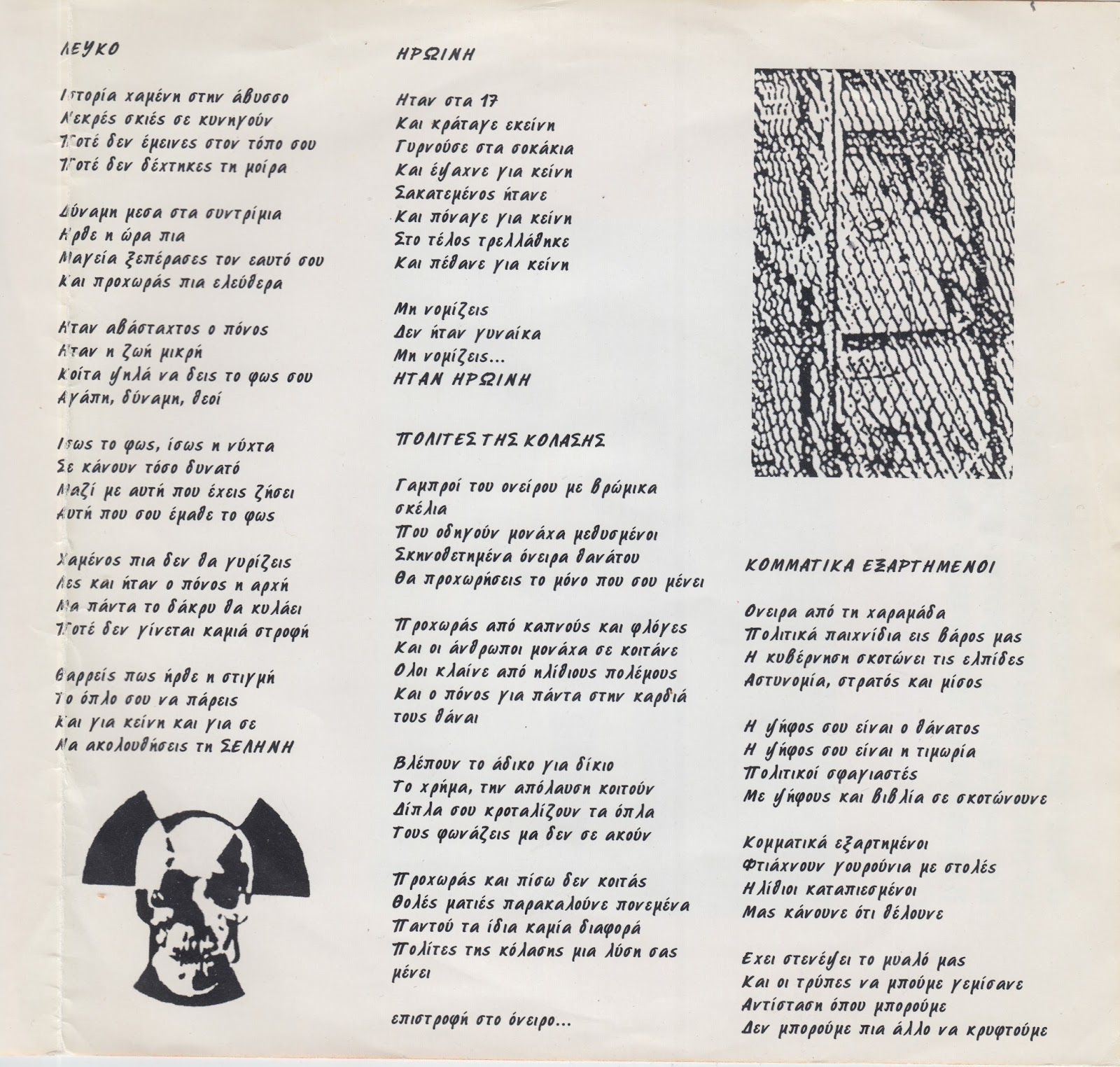
Bellicose pessimism and the melancholy of Ελληνική πανκ (part 4): Χαοτική Διάσταση "Πολίτες Της Κόλασης" Ep, 1993

This Ep is particularly significant to me for two reasons.


First, it reasserts the relevance of good music blogs. I first heard it through Music Not Noize, a blog that I really enjoy for its editorial choices (a bit of a solemn expression in the context of a punk blog, but you get the gist) and for the fact that it focuses on the tuneful side of punk songwriting, while countless other music blogs only, and lazily sometimes, deal in "crust to death" music. There is nothing wrong with that in itself, but I feel like we sometimes show ourselves as one-trick ponies, while punk has a lot more to offer. So thank you Music Not Noize.

Second, Χαοτική Διάσταση's "Πολίτες Της Κόλασης" completely floored me. I just couldn't believe how brilliant the songs were when I first listened to them. A truly epiphanic moment, a rare thing to be cherished, not unlike the first time I saw a wrestling match on telly as a kid. I instantly knew I wanted to become a wrestler. Of course, things didn't exactly go as planned and 25 years later, being a skinny chain-smoking bloke, I realize I might never become a wrestler at all. I am still thinking of embracing a career as a referee though.


Xaotiki Diastasi (meaning Chaotic Dimension) were from Patra, in northern Peloponnese, not a small town by any means, but one where the punk scene was certainly not as developed as in Athens or Thessaloniki. Xaotiki Diastasi's story is not so dissimilar to Arnakia's when you think about it. XD also formed in the 80's, in 1986, but knew an incredibly long period of silence, as they stopped playing between 1988 and 1992, when they reformed. Although they played a few gigs during their 80's life, in Athens notably, there is no recorded trace of it and they first entered a recording studio when the trio rose back from the dead in 1992 to create the "Χρόνια Σιωπής" (meaning "Years of silence") demo tape. Although thinly produced, XD's first endeavour into the studio highlighted the band's unmistakable songwriting skills and their almost organic sense of a good tune. Perhaps like Arnakia, the fact that they experienced first hand the mid/late 80's Greek punk scene, but didn't actually record until a good few years afterwards, influenced the way they composed their songs. They feel rather mature and thought through, as if XD had a clear idea of what they wanted to achieve, not so much the products of a young band but more the result of a reflexive process about their 80's influences (there is a great cover of Ex-Humans on the tape).


And it is not even a shaky conjecture to say that "Χρόνια Σιωπής" was well-received at the time. When Xaotiki Diastasi recorded their first Ep the following year in 1993, it was produced by none other than Dimitri from the iconic Panx Romana. The "Πολίτες Της Κόλασης" Ep ("Citizens of hell") had four songs, two of which already appeared on the demo, and was infinitely better-recorded than their previous work which really showed how genuinely good XD were. On this Ep the composition is not as melancholy as the previous records of the series as it has an almost somber uplifting quality that could be explained by the presence of the Panx Romana fellow behind the desk (he also produced their 1996 Lp but by that time, I think the band purposefully went for a darker martial sound texture). It is certainly not joyful though, but it has that early punk-rock feel that emphasizes the idea of moody, edgy frustration and disillusionment more than it portrays antagonistic despair. There is an accurate sense of urgency in Xaotiki Diastasi's Ep that reminds me of Genia Tou Xaous and Panx Romana's first Lp's (although the two contemporary bands picked very different aesthetic paths).


Musically, "Πολίτες Της Κόλασης" is a genuine accomplishment that summarizes everything that is great about Greek punk. Deceptively simple and incredibly catchy songs that demonstrate how punk-rock energy can blend seamlessly with new wave tunes. Of course, bands like Ex-Humans or Gulag come to mind, but it also summons up Chron Gen at their moody best, the beautiful bitterness of Polish punk-rock and the energy of 80's Yugoslavian bands. The four songs on the Ep exemplify the effectiveness of smart variations of mid-tempo punk music, from Crass-like beats, dry postpunk rhythm to 77-styled pattern, they are all integrated into the band's sound. As usual for the genre, the music is really bass-driven with catchy dark guitar leads dressing the whole and the vocal are mostly sung, with that sort of tuneful spontaneity that cannot fail to hook the listener.

I am aware that most people rate the "Δεν Περιμένω" ("I am waiting") Lp higher than this Ep and indeed, it can be seen as a stronger work with a better, heavier production stressing deeply the melancholy side of Xaotiki Diastasi. I personally enjoy both an awful lot and you cannot really beat the punk quality of the Ep, although it is arguably not as refined as the album. As I understand it, the lyrics are suitably angry and pessimistic, of a political nature, with a song about heroin (not an uncommon theme I am afraid for Greek punk bands at the time). Both Ep and Lp were released on the prominent Wipeout Records and hopefully, some kind soul will reissue them at some point.


My copy of the Ep has seen better days, truth be told, so there is one scratch on the first song and the side B has surface noise... Well, punk innit?

Xaotiki Diastasi        

Saturday, 23 January 2016

Bellicose pessimism and the melancholy of Ελληνική πανκ (part 3): Αρνάκια "Στο Στόμα Του Λύκου" Lp, 1993


Arnakia (meaning "Lambs") exemplifies perfectly the difficulty to assess the reach and influence of a band in its home country, when they remain completely obscure in your own. I only got to know about them six months ago, when I spent an entire afternoon exploring the discography of Wipeout Records. I must admit that the name "arnakia" made me smile at first because it sounds close to the French word "arnaque" which means "swindle"... Tell anyone about Arnakia over here and you are bound to hear an endless flow of terrible puns. I know, what a terrible sense of humour we have... But anyway, there was a band I had never heard of at all, that appeared to have been around in the late 80's and 90's, had enticing visuals and were supposed to play punk-rock. I was intrigued and gave it a go. And I was both upset and delighted after listening to just one song off that Lp. Upset, because the thought that I had failed to notice Arnakia for so long was frustrating, and delighted because the "Στο Στόμα Του Λύκου" Lp is easily one of the very best punk-rock albums from Greece.


So, how could such a brilliant band elude me for so long? I have never seen Arnakia mentioned in record reviews, articles or on music blogs. However, judging by the decent amount of information one can find about them, they were not in the least an unknown band in Greece. On the contrary, I have the impression that they appealed to a quite wide audience at home and that this Lp is recognized as a minor classic. Perhaps that this failing of mine can be explained by punk's collective obsession with the 80's, something I am also guilty of. "Στο Στόμα Του Λύκου" was recorded in 1993 and many of us, consciously or not, tend to draw a line when we think about "punk classics" and the determining factor is often the decade to which the band is supposed to belong. Had this Lp been released four years earlier, it might have been given a cult status, albeit a confidential one. A harsh, but not completely unfair statement, when one looks honestly at our judging scale.


The irony in all this is that Arnakia was actually an 80's band. They formed in 1984 in Athens and even had two songs included on the "Συνταγή Αντί Θανάτου" compilation Lp from 1986, alongside Anti... among others. But, from what I could gather, the band knew quite a few line-up troubles with members constantly leaving, sometimes to return later on, so that the band had to stop playing during rather long periods of time. The early years of the band were therefore a little chaotic and it may have postponed the full development of Arnakia's potential, which was already obvious when one considers the two tracks they contributed to the aforementioned compilation. Although thinly produced, these two songs already demonstrated the incredible quality of the band's songwriting, characterized by a distinct sense of tunes, fantastic postpunk guitar leads and beautiful vocals. With a tighter, stronger line-up and even better compositions, the band came back in the early 90's and delivered this incredible album that not only built upon the legacy of the Greek dark punk sound from the mid/late 80's, but also opened new possibilities for the genre that they would go on to explore for their second album.


"Στο Στόμα Του Λύκου" is a genuinely great Lp in the sense that everyone can get something meaningful from it. The very clear production makes it a rather accessible work and none of the subtle music arrangements is lost. On some level, it could almost be seen as a "pop-punk" Lp, not because it sounds like American melodic punk music (I never understood why it was called "pop-punk" actually, when I hear the term, I think about the Buzzcocks and Ulster punk, not about California), but because it has an undeniable pop sensibility for the refinement of the tunes. Don't get me wrong, it is definitely rooted in Greek punk territory but so much care has been given to the melodies that the pop tag is not irrelevant either. Everything on this Lp is close to perfection: the bass lines are omnipresent, wittily conceived and always smartly used to lead the songs; the sound of the guitar is clear, almost eerie, but the leads are dark and tense, which significantly conveys that sense of melancholy; the drum beats are accurate and the sung vocals are emotional, able to express a lot of different, sometimes conflicting emotions. The mature songwriting helps create a soundscape that is completely whole and yet very diverse, in terms of sound and mood, and if you really think about it, this is one of the defining factors of the Greek sound. "Στο Στόμα Του Λύκου" is tough to describe, some would qualify it as a postpunk record, and they wouldn't be wrong, but there is a crucial punk-rock energy too, and as I mentioned, it is not deprived of pop sensibility either. To my British-trained ears, there is something of A Touch of Hysteria or Null And Void, but with a Greek punk tension and a dark ethereal feel. The overall atmosphere is probably not as desperate as on the GTX's Lp and not as organic as on the Gulag's, since Arnakia's has more of a sense of vulnerability and beauty that is also dark and tense.

Does it sound like the two previous records I posted? Absolutely not, unless you are approaching utter deafness or are just too lazy to actually listen to them. But there is still this similar intent, although it is not aestheticized in the same way.


The second Arnakia album, released in 1999 also on Wipeout Records, saw the band in an even more indie-rock mode but still keeping the dark punk backbone. It will not be everyone's cuppa tea but it is a very interesting listen nevertheless.


Wednesday, 20 January 2016

Bellicose pessimism and the melancholy of Ελληνική πανκ (part 2): Γκούλαγκ "Στην Αυλή Των Θεαμάτων" Lp, 1990


The next instalment of the Greek punk-rock series is Γκούλαγκ (Gulag)'s first proper album, the "Στην Αυλή Των Θεαμάτων" Lp from 1990, which I will refer to as the "In the showyard" Lp from now on (who knew it would be such a pain to edit texts that include non-Latin alphabets...). This Lp is undeniably one of the great classics of the genre and one of the best Greek punk Lp's of all time. "In the showyard" is a unique work that saw Gulag at the top of their game and in fact, I would even argue that they could not have done a better Lp. I just can't think of any single things in terms of songwriting that I would like to change in this album (apart from the cover probably... but we'll come back to that later).

While a lot of the classic 80's punk bands were located in Athens, Gulag were from Thessaloniki, a place renowned for its student life and its radical left-wing leanings, and are probably the town's most famous, emblematic punk band. Contrary to Genia Tou Xaous, Gulag moved pretty quickly in their early days. They formed in late 1985 and released their first record but one year after, the "Είσοδος Κινδύνου 0° C" mini album. Interestingly, the band started just as the scene was really, albeit unknowingly, beginning to consolidate its dark punk sound. Significantly, it also implied that Gulag's early sound was probably influenced by the Ex-Humans or Genia Tou Xaous, and although they definitely brought other elements to the table, it is not unlikely that they also intended to build on what older bands from Athens were doing at the time. If Gulag were not, chronologically, a second-generation Greek punk band (after all GTX only released their first album in 1986), the fact that they borrowed key elements from the early Greek punk scene and reached their apex in the early 90's could make such a term relevant when dealing with them. But enough conjectures.


"Είσοδος Κινδύνου 0° C" was a highly promising collection of songs. Despite a rough, almost misty production, it already stressed the band's flair for great composition. While certainly reminiscent of the Ex-Humans' Lp, there was also an All the Madmen vibe to Gulag and I can't help thinking that bands like The Mob, Flowers in the Dustbin or Blyth Power may have had an influence at that stage. There are two reasons for this. First, on a very material level, Gulag contributed directly to the creation of the label that released the 12'', Thessaloniki's Lazy Dog Records, a label that not only went on to release Greek versions of The Mob or Astronauts' records, but also released a DIY compilation tape in 1987 entitled "No dogs fly here" (now, what a pun). Second, from a more analytical perspective, Gulag's sound has the same kind of warmth as the aforementioned UK bands. I have already heard people say that The Mob were "cold-sounding", something that I disagree with completely. Yes, they create a dark atmosphere, but there is an unmistakable human warmth permeating the work of the band, especially in the vocals. I am not saying that Gulag's singer sounded like Mark from The Mob, but that they both conveyed sadness, passion but also sympathy and warmth. That point is crucial when dealing with the Greek punk-rock sound: hopeless and dark it may be, but it is endowed with the warmth of alienated human suffering. And vice-versa. No, just kidding.


Following the release of the mini-album, Gulag toured Europe and played locally with bands as diverse as The Ex, Naftia and Chaos UK. In early 1989, they self-released a highly impressive demo entitled "Είμαστε Μικροί Μα Θα Μεγαλώσουμε" but I won't dwell on this one too much because it is basically a rough version of the album that would be recorded not even a year later, in december 1989. If "In the showyard" didn't exist, I would probably be raving like a madman about this tape because the songs are just fantastic, but since it does, let's just say that Gulag managed to polish and refine their songwriting between this tape release and the album's recording. An Ep, entitled "Big talk", was also released in 1989 but the sound is so rough and distracting, that I am wondering why the band still went for its release...


"In the showyard" has everything you can expect from a good Greek punk-rock record with solid, catchy bass lines, intelligent guitar riffs and leads and subtly dark tunes to die for. But it is actually much more than this. In a MRR review of this Lp from 2012, the writer, among other justified praises, said that it was never "predictable" and that is precisely where the strength of "In the showyard" lies. The range of mood and musical elements demonstrated in the Lp is just breathtaking. The band moves from sadness to optimism, from melancholy to rage, from compliant alienation to antagonistic resistance with ease, seamlessly, the Lp feels like a journey throughout various, but singularly-driven, human emotions. To manage this unpretentious tour de force, Gulag used different musical elements, there is hardcore-punk, punk-rock, postpunk and metal (with a bloody blast beat in one song that should not work but miraculously makes sense... Talent, perhaps?) that all work and blend together to create this Lp. "In the showyard" can appeal to anyone because of its variety and yet feels completely unique. The vocals are particularly impressive and are one of the Lp's strongest points. It is obvious that the singer can actually sing and is able to express different emotions with passion, vibrance and without ever overshadowing the wholeness of the songs.


In terms of influence, Genia Tou Xaous' first Lp is obvious because it also demonstrated varied and yet cohesive, passionate songwriting, but Gulag's sound is much rounder, indeed warmer, not as angular as GTX's. As I mentioned earlier, some All the Madmen bands and other UK anarcho bands could be points of comparison. But for some reason, and that is rather uncommon for me, Gulag's "In the showyard" also reminds me of early Social Distortion (especially in the composition) or even of The Misfits, and mentions of Californian bands like 45 Grave or Christian Death wouldn't be off-topic either. Do not expect some "deathrock", Gulag's sound is rooted in Greek punk, but there is still that dark American vibe floating around, readapted to fit the peculiarities of the context.


There are English translations of the lyrics, which is great to see, and you can tell (in spite of the usual risk of loss of meaning that such an exercise entails) that they fit the moodiness of the music perfectly. Gulag use metaphors and images to convey social hypocrisy, the inability to empathize, our self-created system of frustration and compensation, the fantasy to run away, literally or through drugs or death... There is definitely a lot to them and although the English is broken at times (but then, it never stopped anyone from loving Japanese punk-rock), they are well worth anyone's time and illustrate the band's intent to blend form and content in their work. As for the cover... well I am still struggling on this one to be honest... It depicts a pack of green cats waiting for food (I presume) in a bleak, grey room where two elderly persons seem to be living. It does give a sense of unease and gloom and the cats don't exactly look cute here... Would it have been my first pick for an Lp cover? Probably not.


Following "In the showyard", Gulag did an excellent Ep in 1994 called "Η Άλλη Πλευρά", again for Lazy Dog Records, that was every bit as potent as the first Lp. Unfortunately, their second album 1996's "Πάτα Γερά" told another story that illustrated the danger of being a punk band in the mid-90's. Gulag went "fusion". And I don't mean that they fused genres through great songwriting. No, they just became a "fusion band". I just can't talk about this album because it pains me too much. I hope you understand. The band pretty much split up after this although they still sporadically reform to play some local gigs.