Showing posts with label 1991. Show all posts

Saturday, 15 July 2023

Still Believing in ANOK: Kismet HC / Αρνητική Στάση "Love is our strongest weapon" split Lp 1991

My mate Paul often says that doubt is the origin of wisdom, which is pretty sensible. But he also argues that reptilians once raided his weed stash so I suppose it is safe to examine his philosophical stance in context. Can Love is our Strongest Weapon, beside sounding like an R&B song recorded for a charity against world hunger, be considered as an anarchopunk release as far as the 80's legacy goes? In terms of politics and aesthetics, the split Lp is without a doubt a relevant anarchopunk record but, in a series that focuses on those 90's works that specifically built on the foundational sound of the original anarcho waves, does it belong? What would Paul do (or smoke)?

I realize such intellectual hair-splitting considerations may look very trivial but, in my quest to be viewed as sophisticated, they have become the basis, if not the raison d'être, of Terminal Sound Nuisance. Reflecting on records or bands few people give a fuck about (I could be wrong about this one but I very much doubt it) and on how they fit or don't fit with certain pre-defined categories, how they challenge them or on the contrary embrace them and how such processes are intentional or unintentional. But yeah I offer lossless files and clean scans for printing shirts for your Etsy shop as well. Of course, aforementioned questions are meaningful in retrospect when it comes to 90's bands, a time when bands did not try to replicate specific schools or bands quite as much (the then novelty d-beat wave being a crucial exception musically but not conceptually). You had bands influenced by Wretched, but not bands who thrived to sound just like Wretched. Throughout the series, we saw that bands like Counter-Attack or Wlochaty certainly loved Conflict to death and a large part of their sound relied on their musical and structural influence but they did not sound "just like" Conflict. The question remains: how influenced by the original anarchopunk wave were Kismet HC and Αρνητική Στάση/Arniki Stasi? Alright, you can think about it for a couple of days before reading what's next.


Kismet HC, from Stoke-on-Trent (yes, just like...), is a band that I have known for a very long time. For some reason I cannot quite remember how I was able to get hold of a copy of their very strong cd-only 2001 album Our Message is of Anger... Our Voices are of Pain (I may have ordered it from Active Distribution). I have to admit that I absolutely loved (and I still do as a matter of fact) the title of the album although I seem to remember reading that it was not the original choice of the band and that one of the labels basically decided for them. Some animosity was involved. Perhaps one of the labels was run by a reptilian, who knows? In any case, that album is brilliant (if you have not heard it, imagine top notch female-fronted unhinged anarcho hardcore thrash with plenty of energy and versatility, quite original) and I really got into them and was even able to see them live in Manchester in 2004 (I think). While KH are often associated with the frantic, powerful vocals of Zanne, she only joined the band afterwards. In 1991 the vocals were shared between Fluff and Dave (I think? So many unanswered questions, so many...), providing the music with a vintage classic dual vocal hardcore attack. Their side of the split indicated to an extent what they would eventually become, 10 years after (why such a break between records? Yet another question...), but you could almost argue that 1991's KH and 2001's KH were two different bands and today we are going to focus, with determination, dexterously, perilously even (I may fall off my chair and injure meself like that one time I dozed off during math class), on the early period of the band and see how close they were to the traditional anarchopunk sound.


Well, their side does open with a poem entitled "Piggy overdose" about animal exploitation and the production of meat so that definitely sets the tone in terms of politics and of course these are issues that are inherent to classic anarchopunk and have even almost become synonymous with it. After all, having an animal rights number for an anarcho band was pretty much compulsory up until the mid/late noughties. Failure to provide a specimen could result in the members having their anarchopunk membership cards cancelled and, worse, being exposed as posers in public. We don't have such problems nowadays, fortunately. Just post a picture of yourself with a vegan cupcake on Insta with the proper trendy # and you're good to go. Why even bother mentioning animal rights in a song anymore now that we have Beyond Meat and get vegan food at the supermarket? Vegan sausages were the ultimate goal, right? 


Like the poem and some spoken parts, there are other softer, tuneful moments in the music reminiscent of the 80's school, like the Omega Tribe-ish opening of the brilliant "Honour Mother Earth" but on the whole KH was very much a high energy post-anarcho hardcore thrash band. They kept the politics and the fierce DIY non-profit of anarchopunk but were first and foremost a hardcore band musically (such a comment applies to most of the early crust bands). I see the first era of KH in the same light as other late 80's British fast anarcho hardcore like Generic, Electro Hippies and Active Minds in terms of creative intent to which you could add a healthy slice of late Anti-System and filthy spoonfuls of Mortal Terror. Raw and direct snotty hardcore. I really like the energy and the drive and unsurprisingly, what with me being a sucker for early Britcrust and UK hardcore, I think the music is bloody brilliant and makes the heart beat. Undeniably, it is more relevant to think of 1991's KH as a powerful illustration of the classic mid/late 80's UK hardcore sound rather than a draft of what they would be doing 10 years later. Very good and rather unappreciated. 


The other side of Love is our Strongest Weapon comes from Athens, Greece, with the band Αρνητική Στάση/Arniki Stasi. If you have already read my glorious prose on the blog, you will have noticed, quite certainly, that I dearly enjoy the specific brand of dark punk-rock that Greece has produced since the 80's. I even made an introductory compilation if you are interested (and you should be, knowledge of the classic Greek punk sound could help you triumph over your opponents on trivia nights). Like most people outside of Greece - beside initial followers of KH I presume - I first heard of Αρνητική Στάση through their connection to Profane Existence with whom they worked on the release of the Spectators of Decadence Ep in 1993. I distinctly remember getting the 15-year anniversary issue of Profane Existence in 2004 that included a retrospective compilation that had ΑΣ among many other bands that I was not familiar with at the time like One By One or State of Fear. The Greeks did not really sound like the other bands on the compilation (they kinda stuck out, almost as much as Karma Sutra) but their song was anthemic, dynamic and had a cracking chorus. And well, they were from Greece, that was very unusual for me at the time and the peculiar tonalities and flow of the language were challenging but also memorable and enticing. Different but good, I craved for more, the polar opposite of the time I first heard ethereal shoegaze and I ended up vomiting in the paper bin because there was already someone in the toilets. That the ΑΣ Ep is nowhere to be found on its own on youtube is ridiculous. 

As I progressively grew into a maniacal Greek crust fan (one of my favourite sub-sub-subgenres), my focus shifted toward ΑΣ's classic 1993 album Άγγελοι Του Ψεύδους, a work that blended the heavy metallic Greek crust sound with the classic dark punk sound, not unlike an orgy between Ολέθριο Ρήγμα/Olethrio Rigma, Ναυτία/Naytia and Γενιά Του Χάους/Genia Toy Xaoys. It is a great inventive album that does not totally fit into preconceived categories and it comes highly recommended if you are into 90's hardcore punk. This split Lp is totally crust-free on AE's side and their progression between 1990 and 1993 is impressive. At the start of the decade, ΑΣ epitomised what Greek dark punk is all about: melancholy but energetic, desperate but bellicose, suicidal but fighting to live, deceptively simple, always on the verge of crashing, catchy and tuneful but not really melodic, it just has a specific feel. On this side, they excel at using all the songwriting tricks popularized by Γενιά Του Χάους, Ex-Humans or Γκούλαγκ/Gulag with a simple clear sound and production, almost minimal at times but the intensity and sincerity emanating from the songs themselves are enough. ΑΣ jump from psychedelic rock, to moody mid-paced anarcho-tinged punk, fast hardcore punk or depressed, trippy yet raging dark punk and yet it never sounds like a random aggregate of songs, they really work and flow together in a very natural fashion and the overall trippy atmosphere and sonorities help the songs coalesce and echo with each other. ΑΣ are hypnotic on this record. A full discography of the band was released last year so you know what to do.


In terms of lyrics, ΑΣ was a political animal with words about fighting back against the police, resisting oppression and even an animal rights number. So they were clearly an anarchist dark punk band but assessing the influence of the early UK anarcho wave on their songwriting (or on Greek punk in general) is trickier. In addition the obvious local culprits, without context, you could definitely find parallels with British bands like The Mob, Conflict even, Karma Sutra, Two Fingered Approach or Null & Void. It could just be out of a common mood and similar desires and ways to express things rather than a conscious decision to use such influences to create your language. It could be neither or, maybe more likely, it could be both. The Greek style is not identical to its British counterpart, there are other influences going on and meeting and merging with one another, it easily stands on its own two feet, but to my ears the connections in terms of mood and content and atmosphere are obvious. They are like cousins if you like. That Bluurg Records released Ex-Humans' demo tape in 1984 cannot have been a coincidence.         


Love is our Strongest Weapon is classic because KH and ΑΣ both exemplified a specific time, place and genre and original because such a pairing was unique and the combination of a British anarcho hardcore thrash band with an angry hypnotic Greek dark punk makes a lot of sense. It is meaningful and it offers a wide array of emotions and vibes while the two bands share essential common beliefs. The cover is unusual. I'm being diplomatic here as the first thing you notice is that there is a mulleted hippie with his cock out right in the middle. It is not badly executed as the psychedelic shroomy aesthetics are not irrelevant considering the bands and you still have the reassuring figures of a nazi police officer and a crazy vivisector to indicate that it is indeed an anarchopunk record. In fact, I quite like it. But still: cock out. The Lp also comes with a poster depicting an angry-looking crucified Jesus... with his cock out! And there are two other crucified cocks, fully erect, in the background. The artist responsible for the poster is one Mike Diana who was apparently the first artist to receive a criminal conviction for obscenity in the U$ of A. Thanks for that Wikipedia. 

A delightful minor classic.


Punk is our strongest weapon


Wednesday, 27 October 2021

Booze, Life and MISERY: a Look at Three Ep's from One of Crust's Greatest

You all know Misery (and if you've ever been dumped during your secondary school years you've experienced misery too). If Prince was the prince of pop music then Misery are the princes of US crust music. Not that Minneapolis is an aristocratic hotspot but you get the idea. Although I am under the impression that they are semi-retired at the time of rambling - oh rage! oh despair! oh age, my enemy! - the band has been the real deal and delivered the crust for 25 years. By the early noughties, the majority of the 90's crust icons had but fallen with varying degrees of heroism on the battlefield of punk. Some, like Hiatus, died standing up still holding a half empty bottle of tripel (though they finally did come back from the grave recently), others like Warcollapse managed to soldier on but had to go on hiatuses on several occasions to survive. Disrupt and Destroy! did not get to live long enough to see 1995 and legendary Japanese pioneers SDS and Gloom barely made it to the next decade. The new millennia had arrived. Once healthy, flourishing sectors of the crust scene were engulfed in flames and overrun with epic emotional guitar leads, baseball hats and bands owning more pedals than own songs. The classic eurocrust style never really got up from this heavy blow, with still some exceptions, and the death certificate was on the table when it transpired that the new wave of 00's crust bands enjoyed wearing Vans and maintaining an acceptable level of cleanliness. Fucking posers. 


The metallic brand of apocalyptic crust did survive thanks, notably, to a major revival in the mid-00's and although there is no denying that the popularity of crust music has been declining steadily, dauntless groups of valiant crust survivors managed to carry the original old-school sound and spirit on their shoulders through more than two decades and no one has stood for this admirable resilience better than Minneapolis' finest, Misery. Misery is what can be called a "name band". If you have been into hardcore punk for a decent number of years, you've either at least heard of them at some point or used to have a dodgy roommate who wore a patch of them, often the same fellow who favoured records over rents. There is no exception. Misery is a prerequisite for any entry-level crusty (you can get extra crust points if you identify the reference in the article's title by the way). What is even more remarkable in their case is that they formed as early as 1987 which makes them a first generation US crust band, like Disrupt or their Minneapolis comrades Destroy!, and on the other side of the country Apocalypse, A//Solution and Glycine Max. New York City's Nausea are also often considered as one of the very first crust bands nationally because they were around since 1985 but they only really started to sound like crust - as commonly defined by the British Mermaid crust wave of Hellbastard, Deviated Instinct et al. - when Al, actually Misery's first singer, joined sometime in 1988. Interestingly, Misery would release two full Ep's in 1989 before Nausea got to release their own crust masterpiece Extinction in 1990. But let's stop arsing about, it's all good shit. Misery were among the first on the starting line, even though in 1987 they were probably just scruffy kids messing about in a studio getting pissed and making a lot of noise (in that order). Like any other tribe, the North-American Crusties, in order to thrive and eventually reproduce, need strong origin stories. These allow them to find their place and some balance in the sometimes ruthless wider punk world, one that have seen rival tribes prosper in later years. Tales of glorious late 80's crust bands reinforce a sense of belonging to a strong American tradition of soap-dodging Amebix-worshipping individuals and validate a tradition spawning over three decades so that it matters to underline Misery's place in the early crust pantheon. 

We are, as a social species, a bit odd and inhabited with rather morbid fascinations. People never like you more than when you are dead. Absence makes one great or, at least, greater, as if death somehow casts a glow of grandeur and produces a feeling of admiration and instant nostalgia. A statement that is as true for bands as it is for people. It sometimes looks like in order to become a "punk legend", you first have to die. Just think about the deificiation and hero worship of short-lived 80's bands while long-running bands are taken for granted and don't get the credit they deserve. I am personally always favourably impressed with bands who keep flying the flag undeterred, which does not mean I like all of them - some should objectively have been stopped a long time ago - but I like the quixotic romanticism and determination of playing in a punk band for decades. As a wise man might have said once - probably my role model Fat Bob but I could totally be making that up - "we're still bollocks but we're still here". Misery kept going through many trends, seemingly undisturbed, just being Misery. Of course, their sound changed a lot and the opposite would be almost worrying. Born, Fed... Slaughtered sounds very different to From the Seeds that we have Sown, but, in spite of the significant changes, the band's music has remained meaningfully recognizable because of the strong identity they managed to build throughout the years. You cannot really mistake Misery for any other crust band, an impressive feat considering the influence they have had on the global crust universe. One thing that characterizes the Misery sound is how punky it actually sounds and feels like. They have always been, first and foremost, a punk-rock band with several proper punk-rock-tinged songs in their repertoire (granted, these are much heavier than your ordinary punk-rock numbers) which, given the emphatic Bolt-Throwerization of the metallic crust sound from the 00's on, is quite remarkable and something that I, coming from a UK punk background and not a metal one, enjoy thoroughly. And of course, Misery's artwork and lyrics are punk-as-fuck, just taking a look at the drawings on Blindead - which includes drunk zombie punx with spiky hair, barely readable handwriting, a method for a beer bong game and a massive gratuitous "FUCK OFF" - has even the most unperceptive punk notice that the lads were listening to Disorder and charged punk just as much as Axegrinder, all in a boozy fashion.


But enough arse-licking, let's get to the core of the write-up. I chose to address three Misery records, all recorded in the crusty decade of the 1990's: Children of War because it unarguably stands as one of Misery's strongest records, Your Leaders were Lying because it showcases a live performance from a band that, according to reliable and sober enough witnesses, was brilliant on stage and the split with Assrash because it highlights the band's punkier worldview (a bit of an understatement in this case as we will see in due time). Let's start with the Children of War Ep, released in 1991 on Grind 'Til Total Perfection Records, an albatross of a name for what was a one-off sublabel of the then young Relapse Records (the record was also distributed as indicated by MCR Records from Kyoto). This was Misery's third Ep, after their deliciously raw debut Born Fed Slaughtered released in April, 1989 (a second version with a new mix and an additional song saw the light of the day the year after) and Blindead released in July, 1989 but recorded during the same session as the first Ep. Busy bees indeed since they also found the time to record a full Lp during the summer of 1990, Production Thru Destruction, released the following year on the French label (yes!) Intellectual Convulsion. They kept this rather incredible productivity (born out of destruction?) with their third Ep Children of War, recorded only five months after the Lp and eight months before their side of the split Lp with SDS a legendary 90's record and one of the most potent collisions in the memory of crustkind, possibly the best crust split record ever that can also be used as a spell to get your ex back and find the perfect job or as a talisman that can repel malevolent beings (like your neighbours, but play it really loud). 


But let's get back to Children of War. If you happen to have a friend who is unfamiliar with the work of Misery or if you just happen to have a friend at all, this Ep is an ideal introduction. The first two might be a little too raw and grinding for the uninitiated and a full Lp could be hard to stomach on a first date. My own initial introduction to Misery was through the Who's the Fool Lp, a recording which saw the band at its apex so that diving into it proved to be easy enough, although grasping properly what they were intending to create sonically can be said to be a more arduous task. Forget all the slandering and libeling about 90's crust punk and how all of it is supposedly generic, bland and redundant, Misery have always been the real deal, an innovative and creative band. Uneducated judgements such as these are always uttered by people wearing non-black shirts from trendy and "edgy" or "freaky" hardcore bands and secretly dreaming of drinking IPA on a Brooklyn rooftop instead of special brew in a rat-infested Leipzig Wagenplatz on a rainy October night. Beside, at least 10% of the 90's crust production was a bit original. At least. On Children of War, Misery's music was really falling into place and you could hear the different elements blending seamlessly together to shape the sound the band was known for in that decade. The Ep kicks off with the eponymous anthem "Children of war", one of their most famous and strongest early number. Mid- paced, anthemic and organically heavy Amebixian song with a strong '88-Axegrinder-meets-'87-Deviated-Instinct vibe. What made this song a proper "Misery song" was, first, the interaction between the two guitars, and, second, the bulldozing sound of the bass guitar. Not many, old-school metallic crust band played with two guitars as having two geezers rocking the same heavy apocalyptic riff all the time is a bit pointless. One of the guitars in Misery's music often concentrates on leads, eerie or epic tunes that help create a foreboding soundscape and draw the song to a particular mood that will define or herald what follows. The introduction of "Children of war" perfectly exemplifies this: miserable and atmospheric at first and then apocalyptic and seemingly unstoppable but interdependent. The bass sound also plays a crucial part in this shift. Misery were always very bass-driven, probably more so than any crust band of that era. During the introduction of the song, the bass is rather clear, very Monolith-like and then, when the guitars kick in, it turns into a lava-like, distorted monster with a terrific steamrolling groove. Undisputedly this bass sound is one of the band's clear trademarks which is unusual for a crust band.


The second song, "Thanksgiving day", illustrated another, punkier side of Misery. Typical old-school UK anarchopunk riffs played with the doomsday Misery vibe. Like a crustier version of '84 Antisect and Icons of Filth. On that level, the band has often reminded me of their London contemporaries Coitus who also added a dirty and groovy punky vibe to the classic heavy Antisect sound and one could advance that Misery did the same with the Amebix/Axegrinder sound. Does that make sense? The Minneapolis bunch love classic punk music and it shows, the last song of the Ep, the faster "Dragged off to war" is reminiscent of GBH and Broken Bones drinking malt liquor around a bonfire in a scrapyard. I always tend to associate Misery's vibe with an urban and desolate industrial atmosphere, atavistic anger or derelict factories while a band like Amebix evokes in me a bleak moor, a strong land connection and the potentiality of praying to pagan gods in the nude, probably not something you can do in Minneapolis, although I could be wrong. The third song of Children of War, "Morbid reality", is not dissimilar to "Children of war" in terms of songwriting, classic old-school metallic crust with death-metal-ish vocals, a shitload of mosh power and something of a Prophecy of Doom touch. The lads in Misery liberally shared vocal duties which brought some variety to their already diverse bag of crust tricks and offered different possibilities in terms of vocal textures. The singers complement each other perfectly and have recognizable voices and prosody - gruff, hoarse and pissed lower-pitched shouts answering to snottier, punker in-your-face vocals, not unlike GBH and Concrete Sox at times. This element, I think, has significantly contributed to the identity of the band throughout time and along with the distinctive guitar plays and massive bass sound. As for the cover, it is an iconic piece of crust history, a little confusing at first but I like the many details and the profusion. 


Misery is possibly the one crust band I wish I saw live but never did. Don't get me wrong, I wish I had been at the Mermaid in the mid/late 80's obviously, but Misery were still very much active when I first fell for them in the early 00's so the prospect of seeing them one day was not completely unreasonable and even plausible (I was blissfully unaware of the logistics of touring at the time so that, in my youthful mind, any active band was likely to play in Paris at some point. Little did I know that most bands actually avoided playing in my hometown but that is a whining session I shall develop another time). Of course, Misery never toured Europe in my punktime and  never will, something I have done my best to be as placid as possible about for a decade. So posting a live Ep sounded like the thing to do to exorcize some of the pain, especially since Misery, I have been told, were a live powerhouse. Not exactly surprising given the unique sound they managed to create in the studio but it is still comforting, and in this case also painful, to know that a favourite band of yours which you never got to sing along to while properly wankered in a live environment was a great live band. Your Leaders were Lying was recorded during a gig in New York City in 1993 and released the same year on Squat or Rot, a label close to the local squatters' movement run by Ralphie Boy from Jesus Chrust and Disassociate. 

There are three songs on this wonderful Ep, two classic Misery numbers on the first side, "Filth of mankind" and "Fear to change", that appear respectively on the 1992 split Lp with SDS and the 1994 Who's the Fool Lp. Brilliant songs epitomizing the sheer power of Misery. The band is tight, the sound is surprisingly good and balanced for a live recording. Heavy, rocking, dark polyphonic metallic crust and the perfect soundtrack to the apocalypse. At the time of this recording Misery were possibly the best band around doing this type of crust so that there is little point using points of comparison. Misery just sounded like Misery and sounding like oneself is quite an achievement (metaphysical shit for you). These two songs are energetic and rather fast ones with "Fear to change" showing that the band could pull the fast and furious brand of crust, with ease. The other side includes an Amebix cover, "Nobody's driving", which they pull brilliantly, with the skillful drummer even bringing some variations of his own. Needless to say that, Amebix being the band's primary influence, covering an anthem from Monolith must have been an easy enough decision to make. Misery seemed to have been a band that loved playing covers as, beside "Nobody's driving", they did Sacrilege's "Life line", Icons of Filth's "Fucked up state" (the best one of the lot according to me), New Model Army's "The hunt" and Amebix again with "ICBM". The band was apparently made up of cheeky bastards prone to terrorize innocent law-abiding citizens. There is a copy of a letter from angry neighbours living close to what I assume is "the Misery house" complaining about the noise, the raucous partying, the obscene behaviours and language although they claimed to have nothing against people "generally maintaining an appearance and lifestyle different from others". Punx will be punx. Misery was not insensitive to childish, puerile, scatological jokes either as the cover is basically a picture from the loos' venue while the backcover of the Ep shows a bare arse with the caption "Nobody's wiping". I did find it funny which says a lot I suppose.


The third Ep we are going to talk about today is the split with Assrash, another Minneapolis band with a common fondness for arse-related topics. This Ep was a picture disc, a format I have never cared for and I don't think I own more than ten records of this kind (I am similarly completely indifferent to coloured vinyl, my Discharge vision only seeing things in black and white). However, this one is pretty funny. This Ep might be one of the punkest-looking records I own - and I still have my old Casualties collection so that's saying something. A picture of the lads getting heavily pissed on one side, and one with them standing in line back to the camera with their hands against a brickwall as if about to being searched by the police. Typical punk posing I have to say but the so-called US streetpunk wave was emerging back then so perhaps the "pissed, punk and proud on the street" was in the air. In any case, while I would not listen to a band whose sole quality is their fashion statement, Misery waving the punker-than-you flag is fine with me. And well, in the light of the current alienating fashion worship and popularity contest on Instagram, the pictures on the split look almost tame in 2021. I am not sure when the songs were recorded exactly but the split was released in 1996 so I am guessing in 1995, perhaps during the same recording session as the Next Time Ep. "Bitter end" and "12 years of hell" see the band still in their unabated old-school crust mode, with maybe a less prevalent Amebix/Axegrinder influence. "Bitter end" has that classic guitar play and bass groove as usual and the songwriting reminds me of a crustier Celtic Frost, not unlike Coitus again (now that I think of it a Misery/Coitus split would have been magnificent and an endless source of top puns, just think about it) while "12 years of hell" is a quality fast and thrashing crust punk numbers. Both songs have that "90's Misery sound" but it was to be the last record to really display Misery at their crustiest. The following record, the split Lp with Extinction of Mankind from 2001, saw the band incorporating other, new influences into their crust recipe to great effect (their songs on this Lp are among the very best they ever wrote). On the other side of this 1996 split, Assrash delivered their typical brand of raucous, obnoxious, two fingers in the air punk-rock with singalongs, not unlike late 80's Chaos UK, The Restarts or Suicidal Supermarket Trolleys. Energetic and snotty, the three songs work pretty well on the Ep and should get you properly prepared for a pogo session or a night out on the piss. The Ep was released on Clean Plate Records, the label run by Will from Orchid, and it is without a doubt the punkest record he ever put out. 


That's enough Misery for today. This band deserve all the praises in the world for keeping the old-school crust sound alive and making it evolve for such a long time. Our shorter attention span, the availability of everything everywhere and our modern consumption of punk music makes us addicted to a constant flow of new bands and records often using marketing techniques and vocabulary to sell their product and turn a six-month old band into hardcore pioneers so that bands like Misery are less likely to keep running and flourish in our current context. Love and support your older crust bands.


 Booze Life and MISERY


Wednesday, 5 August 2020

Ten Steps To Make Your Life CRUSTIER Starting Today (step 6): Sarcasm "Your Funeral My Party" Ep, 1991


Yes, you guessed it. Once more, I am going to rave wildly and without any restraint, with an excitement similar to that of a teenage punk upon finding a rusty Blitz badge crushed on a sticky venue's floor, over a 90's band that embarrassingly few people seem to care about nowadays. And, mind you, it won't even be my first time since I already wrote about Sarcasm in 2012 (no less than eight years ago according to my calculator! o-m-g!!!) and yet, in spite of my very positive review of their Brave new World Ep, it saddens me to say that the band has not seen any spike in popularity for the past decade. I have to admit that this horrific realisation made me feel like a crust army general, standing upon a hill and about to charge headlong at the enemy (at, say, a legion of shoegazers), and taking one last look, before unleashing the fury, at his glorious orc-like troops lying in wait behind him and... seeing no one there at all since everybody fucked off because they suddenly all remembered at the same time that they were really into postpunk after all. However, being a resilient bastard basically unwilling to face the truth with a genetic predisposition for Alzheimer disease, I was bound to try again and spread the good word about Sarcasm.


Did you know there was a late 80's Slovenian speed metal band called Sarcasm? No, neither did I. Or a mid-80's crossover hardcore band from New York also called Sarcasm and even humbly referred to as "The Original Sarcasm" on youtube? Well, I did not know them either, and if the rather typical New York hardcore boasting does not come as a surprise, NYC Sarcasm may not have been the first Sarcasm around since the first incarnation of Leicester's Sarcasm had their first run in 1984. If you want more details about the band's story (and you should in fact crave for more details), as usual, a dive into Trapped in a Scene and a lovely cup of tea come highly recommended, but strictly out of crustian charity, I am required to provide at least some intel about the band. At the start, during their existence in the mid-80's, Sarcasm endeavoured to be as noizy as possible and were influenced by the likes of the legendary Skum Dribblurzzz (which they considered as their mentors and even covered) or the mighty Dirge and could therefore relevantly be seen as being part of the noisiest part of the squat-loving UK hardcore punk spectrum that also welcomed such hugely talented acts as Asylum (from Stoke), Eat Shit, No Brain Cells or System Sikness and religiously drank scrumpy at the altar of Bristol's punk gods Chaos UK and Disorder. Sadly, I have never had the privilege to enjoy the noizy chaotic punk sound of early Sarcasm but for some reason but I still know how it sounds: fast and fuzzy and fun and gloriously ear-damaging.


The second coming of Sarcasm took place in 1989 and their subsequent noisy career was well documented with three full Ep's, two split Ep's (with Sanctus Iuda and Wojczech), a split tape with CFDL as well as other demo and tape recordings. Today's post will focus on the band's first Ep, Your Funeral My Party, that was released in 1991 on Rotthenness Records from Sao Paolo, a label specialised in grindcore. The Ep was actually a reissue of Sarcasm's first demo that was originally distributed as a tape at gigs (no idea what it looked like as it is not on discogs) although judging from the crunchy, powerful sound, you would not guess that it was "just" a demo recording (done in only 8 hours!). By the time Sarcasm reformed, singer and songwriter Mark had played the guitar in Extreme Noise Terror (you can hear him on A Holocaust in Your Head and the second Peel Session) and guitar player Barney was formerly in Dirge so you can imagine without too much trouble what the revived Sarcasm sounded like in the early 90's: a noizy and crusty thrash attack.

If maximum crust cred is to be achieved, as we have seen, anything less than a substantial mastery of the stenchcore canon will not do and if you have to spend sleepless nights learning the early Peaceville catalog by heart, then so be it. However, filthy metallic crust punk cannot suffice if you aim to become a well rounded crust lord prone to display an impeccable piosity so that it is crucial that you develop a sensible expertise in the noizier branch of the crust philosophy, primarily influenced by the sophisticated works of the Bristol and Kyushu schools, and more generally 80's hardcore bands that believed in the curative powers of distortion, glue and really fast music. Sarcasm is a fun band to listen to - and I say this with the utmost respect - especially on this recording which truly conveys their intent to make a bloody racket and enjoying themselves in the process. Starting with the song "Suppression" which opens with a deliciously filthy stenchcore introduction, à la Deviated Instinct, before diving headfirst into cavemen crust oblivion, Your Funeral My Party is an intense listening experience and if you are looking for nine minutes of extravagant aural savagery, it will be your thing. While the aforementioned "Suppression" and "Crisis point" can be described as aggressively gruff and distorted cavecrust numbers reminiscent of Extreme Noise Terror, Doom or early Disrupt but with a Bristol vibe, the four remaining songs are shorter and faster, highlighting the band's talent for revisiting the mid-80's Disorder/Chaos UK hardcore sound, not unlike Plasmid, Dirge or Insurrection but with a heavier sound and a nod toward Gai and raw Japanese hardcore. I love the hyperbolic, insanity-driven crusty vocals and the classic "low growls reply to high-pitched barks" pattern. Primitive and gnarly noizy crusty UK hardcore thrash or something. Whatever you want to call it, this Ep is a proper delight if you like old-school ear-slaughtering hardcore punk that smells like cider and squats and, on some odd ontological level, Sarcasm sound like what their font look like. Right?


As you can imagine from the title of the Ep - which I personally adore - the lyrics are quite angry and direct indeed with songs against popstars (with the classic line "Don't give me one of their record, or I'll stick it up your ass"), the rich, politicians and the fucking system. The following Ep, The Lowest Form of Wit released in 1992 on Tribal War Records, might even be better and, well, even crustier. I strongly recommend the compilation of all their vinyl output, entitled Noise Bastards Vol. 1: a Collection of Ep's and Splits released in 2007 on Impulso Ruin from Peru.

This Ep kills posers.  


Sunday, 12 July 2020

Ten Steps to Make Your Life CRUSTIER Starting Today (step 4): Extreme Noise Terror "Are you that desperate?" Ep, 1995

This step is going to be a relatively small but still important one toward a well-balanced stenchcore diet and a harmonious relationship with the crustmos. So place your healing crustals on the table, light some sweat'n'cider-flavoured incense sticks and let's unclog those chakras.   

I guess everyone here is familiar with the cavemen crust pioneers Extreme Noise Terror so prattling at length about them - as I normally would - does seem a little pointless. Besides, the inclusion of this ENT Ep into the present series has a lot to do with the fact that it is a live recording and a rather rare occurrence of savage but listenable live crustery on vinyl. The marriage between the extreme sonic characteristics inherent to the style, the very limited means of recording in the 80's and a marked inclination to get plastered before playing, explains that there aren't that many good live recordings of the classic crust era, which is a shame since those bands usually played a lot. I certainly can think of a couple of great ones (of Antisect and their three live Lp's and Amebix of course, and even Axegrinder, that were done through the mixing deck), but often it was just an enthusiastic hardcore punk fan armed with a tape recorder in one hand (and a pint in the other) which logically accounted for the sound quality being very rough and the listener being barely able to make out all the instruments amidst all the drunken blabbering of the punters sometimes. All in all a pretty amusing experience and certainly one that makes the passionate punk feel like an archeologist exhuming scarce and precious artifacts of an ancient civilisation, which is probably not completely wrong when one considers that every gig is filmed by at least twenty persons in the audience nowadays.


Are you that Desperate? belongs to that rare category of "listenable live recordings of 80's crust" and let's face it you need to master at least one of those if you want to be a credible crust punk. Apart from the aforementioned forefathers of the genre Antisect and Amebix, Extreme Noise Terror have been the only vintage crust band to enjoy a proper live record of one of their late 80's performances - although the first pressing of the Ep was only released in 1991 - namely their gig at the Powerhaus in London on October, 5th, 1989, with Doctor and the Crippens. Of course, Doom would also have a couple of solid live Ep's later on, 1992's Live in Japan and 2001's Pissed Robbed and Twatted, but those were not recorded in the 80's. Of course, you could also argue that protocrust noize masters Chaos UK - with the B side of 1986's Just Mere Slaves 12'' recorded in Japan - and Disorder - with their full Lp 1985's Gi Faen I Nasjonalitenten Din recorded in Oslo - had official live recordings on vinyl prior to ENT, but since we, at Terminal Sound Nuisance, posit that "crust" is both continuation as well as change, and that, although the Bristol hardcore heroes played a major role, in terms of musical influence, aesthetics and logistics, in the making of crust, they were not, strictly speaking and in spite of similar lifestyles and hygiene, "crust bands". Know what I mean?


Along with Napalm Death, ENT were the most iconic band of the mid/late 80's hardcore crust wave in Britain and their early works remain unsurpassable cult releases like Scum or War Crimes. However, whereas Doom, who started a bit later as a band, always stuck both to the ethics of the DIY punk scene and to their cavemen adaptation of Discard, ENT decided to go for bigger things, signed to Earache Records in the 90's and tried to become a medium-sized metal bands, leaving their crust punk roots and anarcho lyrics in the process, which was seen by many as selling out and understandably left a stain on the ENT name to this day even though the band (which was always singer Dean's band) have gone back to their old-school cavemen crust style and to DIY punk label, a return that some have deemed more than a little questionable and hypocritical. However I am not here to pontify but to talk about the actual piece of wax and the band's legacy because, as much as one may be critical of ENT's past direction, there is no denying the sheer power and insane intensity characterising their 80's period and in 1989 they sounded bloody unstoppable.

Like many a snot-nosed punk of yore, ENT was the first crustcore band I ever knew through their split Lp with Chaos UK, a record that did not really convert me to the cause of noize at first as it all sounded a bit much and just plain silly to me, whereas I immediately connected to Doom at about the same time. I remember not being able to get my head around ENT's dual vocals. Were they for real or just arsing around in the studio? And what about that name? Sure, your band can reasonably be described as an extremely noisy terror but does that justify being so literal? It took a listening session of A Holocaust in your Head while inebriated for me to really grab the essence of ENT. Many years have passed and my appreciation of late 80's ENT is strong and pure and I still cannot help singing along to "Murder" whenever I hear it (with the appropriate level of discretion that the social situation requires of course). The widely accepted current consensus concerning the band's body of works is that the Peel Sessions (all three of them: 1987, 1988 and 1990) along with the In It For Life split Lp with Filthkick are the most ferocious ENT records (and their cover of the Rejects has to be one of the most inspired punk covers ever), but you cannot go wrong either with the raw pogo crust power of Radioactive, A Holocaust in Your Head's emphatic - if a bit sloppy - template for the traditional dual vocal crust attack formula and 1991's Phonophobia certainly heralded the new era of controlled and tighter crustcore brutality that would define the 90's and climax with Disrupt's Unrest.


Contrary to Doom, with whom the comparisons are unavoidable because of common members, who pretty much stuck to their initial career plan to sound like Discard/Crudity/Svart Parad, the spectrum of influences of ENT - who grew out of the ashes of mid-80's bands Raw Noise and Victims of War - was broader and included, beside the Bristol noise merchants Chaos UK and Disorder and anarcho bands like '82 Antisect (to whom they owed their famous trade-off vocal style) or Anti-System, classic foreign hardcore bands from Japan (GISM, Swankys or Kuro, Italy (Wretched or EU's Arse), Finland (Kaaos or Rattus) in addition to the usual Swedish suspects (Anti-Cimex and Shitlickers). Those rather varied but always savage hardcore influences were then blended together until you obtained a smooth enough texture meant to be played at full speed, with cider-fueled intensity and with completely over-the-top extreme dual vocals that still manage to sound punk as fuck. To get back to Are you that Desperate?, it includes six absolute classic ENT classics: "Deceived", "Another nail in the coffin", "Subliminal music", "Murder", "Raping the Earth" and "Punk - fact or faction?". The Ep appropriately starts with "Deceived", and its classic and so epic introduction that has certainly sent shivers down many a spine throughout the years and is just the perfect opener. The sound is pretty decent and the band quite tight so that you can easily understand what is going on. I would not recommend this Ep to someone not previously familiar with ENT as it sounds even more brutal than usual - because of the proximity created by the live recording - like an enraged mob of drunk cavemen banging on your door at 2am. A couple of speeches between the songs indicate that the band was not too happy with the macho dancing and "metal attitudes" they were witnessing at the gig which I suppose is fairly positive and showed that they still cared and, beside the lyrics, there is a text entitled Meat Food for Thought exposing the impact of Western carnivorous diets in terms of pollution, ecological destruction and social inequities in developing countries, that is - sadly - still very much relevant.


The live Ep was originally released in 1991 but this present version of Are you that Desperate? is the second pressing from 1995 with the black border cover. Both were released on Crust Records, a Providence-based label run by Dropdead's guitar player that was responsible for a couple of noizy classics from the likes of Disrupt, Diskonto, Totalitär and of course Drodpead. My only minor issue with the Ep is that the cover, depicting a Oliver Hardy lookalike in a uniform pouting at a burger, is not what it could have been. Indeed, the drawing on the backcover with its crustier than thou gnomish caveman making noise out of a helplessly broken guitar would have made for a legendary cover (but since it already appeared on the insert of The Peel Sessions 1987-1990 maybe they refrained from the idea of putting it on the cover, I dunno).

Probably not the most ideal listen for an ENT novice but an undeniable treat for your inner crusty.  


Wednesday, 14 February 2018

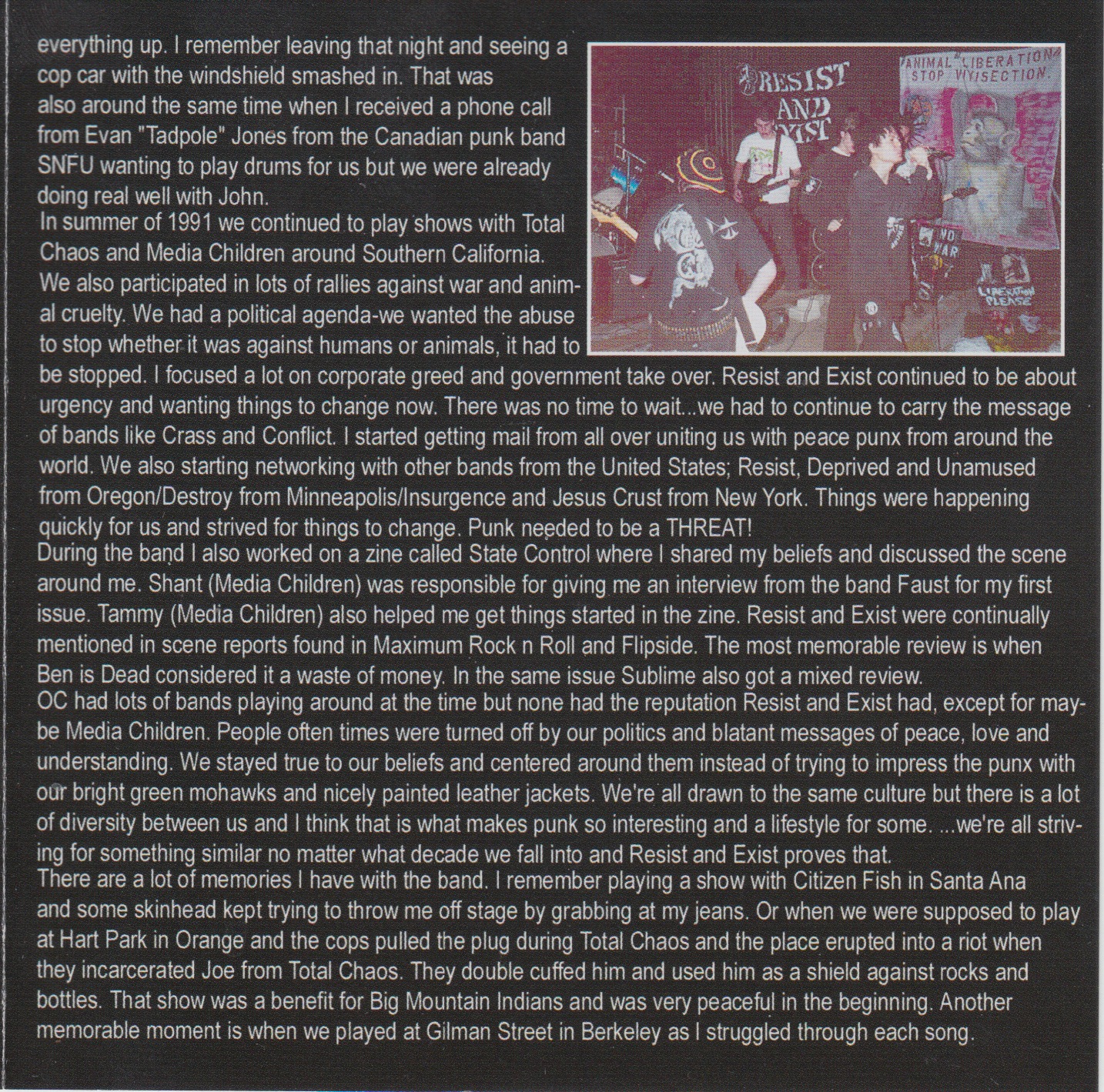
California Screamin' (part 5): Resist and Exist "Ad Liberty" cd, 2010

Jurassic Park left a lasting impression on me when I first watched it as a kid in 1993. The parents of my best mate actually took the both of us to the movies in Paris for the occasion. We were 10 and overexcited at the prospect of seeing proper dinosaurs on screen. Of course, like all boys our age we loved dinos and had been playing with colourful plastic versions of these long-gone reptiles for years so the movie felt a bit like a consecration for us. We were aware that the special effects were amazing and I can still us in the queue chatting noisily and obnoxiously about how awesome it was going to be. Of course, we had seen the trailer on telly and we knew how realistic the dinosaurs were going to look. Or rather we thought we did. Jurassic Park scared me shitless and I was absolutely petrified, grabbing my seat like a sloth on its branch. I even thought of leaving the premises during the infamous kitchen scene but I was literally too afraid to move (The Grudge had the same effect on me many years later, though this time the reason why I stayed was that I was too hungover from the night before... oh well...). To this day, I still feel a little uncomfortable and nostalgic whenever I watch Jurassic Park. 

The other thing I took from the movie then was how ace it was to be an archaeologist because you got to wear a hat, be on your own and look for old things in the ground. Though I have always been too shit at biology to become a proper one, I sometimes feel like Professor Grant when I do my research for Terminal Sound Nuisance, digging endlessly to find fossilized pieces of information about punk bands from past eras, dusting them, showcasing them in this digital museum. Only I do not really see the point of wearing a hat indoors. That'd just be silly, yeah? 

This one was a piece of work. Which may seem quite strange since Resist and Exist is not like an obscure dinosaur that no one, apart from the usual bitter nerds, has heard about. They are pretty well-known and respected in the punk world for their longevity and their unwavering political commitment. I would even argue that, along with Aus-Rotten and Resist, they are the most influential US anarchopunk band from the 90's. If their mid/late 90's vinyl releases are pretty much classics, little do punx know (or care to, but that's an other matter) that R&E have had two existences, related but distinct, during the decade. Their first incarnation was rather short-lived but meaningful and relevant in the history and development of OC peacepunk at a pivotal time, what we often and wrongly see as the end of the golden punk era: the transition between the 80's and the 90's.


I have already written about R&E before (about a '03 live recording here) but I will not try not to repeat myself, pretty much because I love being redundant and raving about bands I love dearly. Besides, this post will closely focus on the band's first run and origins and how they are tied to the peacepunk scene. 

The Ad Liberty cd contains 24 songs taken from five different recordings. There is an eight-song demo recording from 1991 (it might be the very first demo but it is unclear as the Music For Social Change demo was recorded the same year and I don't know the precise month), one song from their very first gig in '91, two songs from the aforementioned Music For Social Change demo, two songs off their '92 demo entitled The Oppressors and a live set from the same year.  If you want to be thorough about early R&E (and why wouldn't you?), I strongly suggest you get the Music For Social Change cd (released on Fight For Your Mind in 2005) which includes additional songs from the demo of the same name as well different versions (mastered differently I presume) of the two songs from The Oppressors. The booklet of Ad Liberty tells the story of the band from the point of view of Chris who was, along with Jang and Cyhndi, the original singer. R&E was formed in December, 1990, when Jang offered Chris to join the band. The former had been working along with Jayd (from Media Children) on a song called "The system remains the same" (which makes it the very first R&E song I presume) and I guess they were looking for like-minded punx to form a band.


Now before I go on, let's point out a crucial element in the genesis of R&E, one that is made up of two words: Media Children. I have already touched upon MC previously (when writing about the S.I. One compilation Ep here) but have come across significant intel since. I suppose that MC epitomized, during their lifetime between 1988 and 1992, the third peacepunk generation in California, after the second one (basically made up of bands like The Iconoclast, Another Destructive System, A State of Mind or Diatribe) folded. They were peacepunk's third wind if you like. However, if you take a close look at the first lineup of MC, as indicated on their first 1988 demo Slaughter of the Innocent, you will realize that along with singer Tammy (one of peacepunk's most recognizable voice), the band was made up of Jang on vocals, Jayd on guitar and bass, and finally John on drums, all of whom were part of the first R&E lineup. Therefore, it would not be irrelevant to see '88 MC as some kind of precursor or sketch of what R&E would do just a few years later (or perhaps equally as the first personal experience of mates making punk music together). The first MC demo is, on the whole, not completely similar to R&E's first demos as it was a more melodic and slow-paced effort, somewhere between Atrocity, A State of Mind, Icon AD and Alternative, but then R&E also had moody, tuneful punk songs in their setlist along with their fast dischargy peacepunk sound. MC would go on with another lineup and a faster, Bristol-meets-ASOM sound, but both bands remained very close partners in crime, touring together and even sharing songs (R&E's "Anti war" and "The women song" were originally MC songs).


But back to the early R&E entity. The band played its first gig with MC (obviously) and Arise (a band with former Holocaust members that I am honestly dying to hear) and did some touring with Total Chaos, back when they were part of the OC peacepunk scene and did Antisect covers (this historical fact is known to have given a few self-proclaimed streetpunx a heart attack). In 1992, Jang left the band to form Autonomy along with (I believe) some MC members (R&E singer Cyhndi would join the band later on... I think!). But there was no hard feeling since R&E played their last gig in April, '92, with Autonomy. Of course, Jang would resurrect R&E after the demise of the latter, bringing with him songs from their first incarnation and even an Autonomy number ("Korean protest song" is basically a reworking the song of "Autonomy").  

So, after all this background information, why choosing to talk about R&E in this peacepunk series? I mean, apart from the fact that their moniker was taken from an Antisect song? I am fully aware that the time gap between my last post, which explored the Naturecore's 12'' recorded in 1986, and these recordings from 1991 and 1992 can look suspicious. Did nothing happen in this five-year period? Of course not. OC crust happened. Essential bands like Apocalypse, A//Solution, This Bitter End, Mindrot, Glycine Max and, of course, Final Conflict emerged (though the latter were never technically a peacepunk band and inbetween scenes). But although they shared the values and the politics of peacepunk and can be seen as the logical sonic and aesthetic extension and continuation of it (just like in the UK really), they also reflected the birth of something new with a different artistic perspective and as such cannot be said to represent the "classic peacepunk sound". While R&E, at that time, were THE ultimate synthesis of the preceding decade.


If you were to be asked (say, during a fancy dinner party at the embassy or something) what 80's peacepunk is then look no further and play the early R&E demos. How ironic since they are actually 90's recordings but they concentrate what 80's peacepunk is all about musically, lyrically and aesthetically. The real strength of the band is how effortlessly they managed to synthesize the two schools of peacepunk while never losing sight of the structural British influence. You will find furious dischargy hardcore punk songs that nod lovingly toward The Iconoclast, Crucifix, Body Count, Against or Final Conflict, as well as moody and catchy anarcho numbers reminiscent of Atrocity, Trial, Naturecore or A State of Mind (yes, my evil peacepunk master plan was to write about four bands that the fifth one would perfectly summarize!), and all this with the intense versatility of Another Destructive System. I know I haven't really mentioned all the faster, more hardcore-sounding side of the scene in this series (because I already have before) but of course it played a major role in the shaping of the classic OC peace sound. As I said, the UK sound and inspiration are also very much present in R&E's songwriting and early Antisect, Anti-System, Liberty, Civilised Society?, The Sears or Potential Threat are obvious points of comparison. However, I would argue that they were a band heavily influenced and primarily motivated by the local historical peacepunk, in other terms a peacepunk-influenced peacepunk band (that's a lot of peace and a lot of punk, I know) which was important in and of itself.


As you can expect from demo recordings, the sound quality is not exactly crystal clear. It is raw punk with a sense of youthful urgency and spontaneity and that's precisely how it should sound. The presence of three singers gives the song a polyphonic vibe that conveys the collective identity of the band as well as a cracking vintage anarcho feel. The fast and furious hardcore numbers are brilliant and their ferocity is actually reinforced with the catchy and moodier, darker punk songs that Cyhndi's haunting voice make so poignant. Through these songs (as well as the inclusion of some poems), the band expressed a wider ranger of emotions, like melancholy on "Self destruct" or "When we meet again" or dignified outrage on "The oppressors" (perhaps one of the most uplifting anarchopunk songs of the period with fantastic male/female vocals and a terrific singalong chorus). The song "The system remains the same" (that the band would turn into "Movement" in the late 90's) may be my favourite with its tribal Crass-like beat and layered vocals and its deliciously melodic and poppy Chumbawamba conclusion. Genuine anarcho magics here. The live set (without Jang) is pretty rough but you can tell how receptive the audience is to the band's message and music and they cover BGK and Crass for good measure. The low point of the cd is the absence of lyrics (apart from the reggae-tinged "Ad liberty") which is a bit of a missed opportunity, especially with such a political band with a positive anarchist message. 

This was released on Mass Media Records, an OC-based record label with an ace dove logo that was close to the peacepunk scene of the early 90's (they shared the same address as Media Children actually) that released Ep's from Autonomy, Social Outcasts, Dan and of course Media Children before going on a hiatus for 15 years. Ad Liberty appeared to mark the return of MMR in 2010 (or is 2009?) since the label went on to release top shelf anarcho deathrock and postpunk in the following years with very convincing records from bands like Masses, Moral Hex or Silent Scream. By the way, this cd is still available, so you know what to do.


Since there were annoying gaps between tracks on the cd I did my best to blend songs when necessary (for the live set mostly as the gaps were too distracting). /And before wrapping it up, I strongly suggest you take a good look at Jang's youtube channel (here) if you want to learn more about these peacepunk years.


Thursday, 12 October 2017

Kids of the 90's (part 1): Dischange / Excrement of War split Ep, 1991

Still bollox but still here. 

I have not written anything for the past month because - in all honesty - I was clueless about what to do next. The anarchopunk series had left me drained. I was lost, cold, battered, little more than a pathetic, staggering version of myself, my good looks and proverbial biting wit all but gone. Remember when Austin Powers loses his mojo in one of the movies? Well that was me, only I have got much better clothes and hair (not too sure about the teeth but let's not focus on that). I still had many ideas for Terminal Sound Nuisance but suddenly none of them sounded fun. Sad emoji face indeed. So I took some time off and traveled to South-East Asia in order to find myself and take selfies in front of neat-looking temples. Well, not really actually, I just locally boozed my way through the month, waiting to be struck by inspiration. To no avail. 

Until one day, as I was coming home after a rather enjoyable gig, I just looked through my record collection without anything in mind, or rather, with a completely open one. I realized that a significant portion of it was made up of 90's records, most of which no longer seemed to trigger general punk enthusiasm nowadays (the average Discogs price is usually a good indicator, albeit a fairly depressing one) but were still lovable and even - in some cases - genuinely good, to me anyway. After a good hour of mumbling to myself "Who still gives a shit about this one? And about that one? And what about this little bugger, I don't even recall buying it..." I took a meditative break and tried to remember and reconnect with the core values of the blog (as stated in "The Terminal Sound Nuisance Constitution of 2012"), which can basically be summarized as lengthy talks about bands and records that deserve to be talked about but are only marginally so in our culture of cultural overconsumption, floundering attention span and neglect of punk as a critical discursive art form.  The solution became clear, obvious. Weren't the 90's supposed to be fashionable now? I remembered seeing a lot of lads with typical 90's boy bands haircut recently, which of course I took as a good omen and a sign. I had to respond quickly and accordingly. 

As a result ten loud 90's split records, mostly Ep's but not exclusively, that no one really cares about anymore were carefully selected in order to exemplify the decade's specificities. Expect sloppy, crusty hardcore from the most important common denominator: genuineness. 


And let's start with a dischargy split Ep from 1991 between Dischange and Excrement of War. If you are a consistent TSN reader (and why wouldn't you be? It's an ace blog!), you know that I have always been thoroughly obsessed with British crust and hardcore and punk in general and it would come as no surprise to read that I originally bought the Ep for EOW and not for Dischange. When I got it (in the mid 00's), I don't think I had ever listened to Dischange. I knew Meanwhile through compilation tracks but was unaware that it was the same band under a different name. At that time, with a few exceptions, I was suspicious of the D-beat genre and honestly did not rate it very high. I certainly did not see Discharge as "a D-beat band", that would have been irrelevant and anachronistic, since the genre's essence lies on the repetition and emulation of vintage Discharge (could 2017 Discharge qualify as a D-beat band, like a contextualized recreation of oneself?). I thought that Disclose were too noisy for their own good but at least had that going for them, that Disaster were lovingly goofy because they sounded just like Discharge and that Disfear sounded like a bloody steamroller, but that was that. The Dis is getting pathetic Ep from Active Minds (the first one I bought from them) certainly had a lot to do with my wariness of the D, which was quite ironic since the Ep was very much about the 90's D-beat wave, which I was too young too have known anyway. But still, I must admit that their anti-D-beat rant (which may actually have been written about Dischange if I remember well) did leave a mark on my young mind at the time and definitely made me unimpressively look at Dischange. 


Older and wiser (?) now, I must say that I really enjoy the Dischange songs from this Ep and the band's relevance to the genre cannot be underestimated. They formed in the late 80's (not sure exactly when but their first demo was recorded in 1989) with Jallo, then drummer for the mighty No Security, on the guitar and vocals, and can be considered to be the first proper D-beat band, with the drive to sound and look JUST LIKE Discharge it entails, along with contemporaries Disaster (if Discard did lay the template for the dimension of Discharge worship, they never aimed at sounding just like Discharge, neither did Disattack and they were far more obscure anyway). The three songs included on the split were Dischange's first vinyl appearance and can be thought to be perfectly representative, if not foundational, of what the Swedish D-beat orthodoxy would grow to be in the following decades, with that crushing, pummeling, precise relentlessness, the monstrous riffs and the harsh vocals. The songs "After-war scars" and "Dead end" clearly fall in the Hear nothing category but my favourite is "On knees" whose groovy bass line is gloriously reminiscent of Why (I like my D-beat with some groove). The production is just fine for the genre, powerful but not too heavy as I am one to believe that there has to be an element of urgency and rawness in the D for it to be appealing (I often find Swedish D-beat to be too tight but that's not the case here, probably because it is an early instance of this peculiar variety). Dischange also released a split Ep with CFDL the following year and a full Lp in 1993 that I find a bit hard to sit through to be honest. They then changed their name to Meanwhile (and if you care to look at the label on Dischange's side it actually reads "Dischange - Meanwhile" which could indicate that they intended to call their side of the split Meanwhile... or not, it is a wild guess) which was a good call. Not only did they arguably get better during their Meanwhile era, but if the idea to swap a letter in the word "discharge" in order to obtain a new Dis-name is kinda funny, its realization is more embarrassing. 


On the other side of the split are a band whose name always makes me very self-conscious when I am wearing the shirt (I actually got into a needlessly long and unpleasant discussion with an odoriferous man about the use of the word "excrement" printed on clothes on the metro once... believe me, you do not want to know, but it was a long ride): Excrement of War, from Dudley, not too far from Birmingham if you are asking yourself. This lot were possibly the most intentionally Swedish of all the English hardcore bands of the early 90's with references to Anti-Cimex and Shitlickers even in the participants' nicknames. However, little do people know (and I only do because I am a loyal Glasper reader) that EOW originally started in 1990 as a boisterous, inept-sounding but cider-loving Chaos UK/Disorder band, before Stick (from Doom) joined. EOW was formed by Tom (of Genital Deformities), Rat (ex Indecent Assault and the greatly-named Depth Charge) and one Wonka with the idea of playing noisy Bristol punk, and although it did not work out, they still recorded a demo with that sound, which I would be very curious to hear indeed. Anyway, the proper EOW, the one we all (?) remember really started when Stick joined on drums after Doom went on a hiatus and the band decided to play punchy, punk-as-fuck Swedish hardcore with gruff vocals. This Ep was their first vinyl appearance, although the four EOW songs were originally part of a demo that Stick sent to Finn Records (the recording also included a Doom cover entitled "Relief (part 3)" which did not make it on the Ep but at least answers the fateful question of "but who did the part 3 then?"). 


If Doom initially wanted to be Discard - a noble endeavour in and of itself - you might imagine that EOW wanted to be Protes Bengt, in the sense that in their early days the band shared the same over-the-top urgent enthusiasm, that effective hardcore punk simplicity and straight-forward impactive crudity (yes, you may lol). Basically, you can tell that the trio had fun recording the songs and I would argue that the chaotic vibe that permeates the four songs, one that is also not quite unlike mid-80's Chaos UK if you think about it, makes for a nice and crunchy contrast with Dischange's starkness. And when the two bands on a split complement each other well, which is the whole point of such a format, you know you've got a good one. It could be suggested that the band's great dynamics on this record be somehow linked with Doom's lack thereof at that time. As Stick explains in Armed with anger, by 1990 "it seemed we (Doom) had lost our direction, or directness anyway, so I wanted to re-achieve what I'd already had". Who said that the way of the D couldn't be therapeutical? Of course, Doom would become again a force to be reckoned with a new lineup (and Tom on vocals) from 1993 on, but I definitely hear a manic liberating element to EOW's early years. Although clearly Swedish hardcore-fueled, the vocals also have that delightfully excessive gruff crusty edge that characterized the late 80's UK scene of Extreme Noise Terror, Mortal Terror and Sore Throat. The band went on to record fine records of fast and direct Dis-inspired crusty hardcore, The waste and the greed Ep being a tighter and better-produced take on what was glimpsed on the split with Dischange, but never really found back the snotty vibe of these early recordings afterwards (this is not to say that I don't like Cathode ray coma or the split Deformed Conscience, but they were recorded with a different lineup and I don't approach them in the same way as I do early EOW's output).  

That must have been a cracking night out


This wonderful split Ep was released on Finn Records, a Swedish label - as the name doesn't suggest - that was active from 1989 to 1999 and put out brilliant Swedish hardcore records by the likes of Totalitär, Disfear or G-Anx. There was the label's distro list from November 1991 included with the split Ep which is bound to make you feel nostalgic if you were around at the time (I was not so it just makes me excited).  


The infamous Meanwhile reference